New articles

意識の深層

Sublimation of Negative Emotions in Creative Activities and Reality Reflection Mechanisms Based on the “Law of Mirrors”A Comprehensive Study on the Psychological Structure of Free Horror Game Creators

Introduction: Internal Inconsistency in Creators and Dissociation of Social RepresentationIn expressive activities, particularly in the medium of free horror games where expressions that shake the creator’s deep psychology, primal fears, and ethical boundaries are permitted, a dissociation that cannot be overlooked is often observed between the world presented in the work and the behavior that person displays in actual society. The existence of creators who produce works with inhumane or extremely cruel grotesque depictions while simultaneously expressing irritation at workplace interpersonal friction and candidly venting daily dissatisfactions on social networking services (SNS) is not a peculiar phenomenon in today’s digital creative environment.
意識の深層

The Active Role of Consciousness in Quantum Physics and Dynamic Considerations of Reality Selection The Academic Turning Point of 1998 and Scientific Validity of the “Dominant Frequency Projection Method”

The Quantum Mechanical Observer Problem and Physics of ConsciousnessSince the dawn of quantum physics, the influence of the observer on physical systems has reigned as one of the most profound and intractable paradoxes in science. Within the framework of traditional physics, particularly the Einsteinian objective worldview, physical reality is assumed to exist independently, regardless of the presence or absence of an observer. However, the standard interpretation of quantum mechanics—the Copenhagen interpretation—suggests that through the process of wave function collapse, the act of observation crystallizes a probabilistic “superposition” state into a single “reality.”
意識の深層

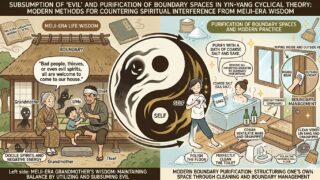
Construction of Cognitive-Environmental ‘Barriers’ in Modern Society: Mental Defense Theory and Practice for Non-Psychics

Introduction: Scientific Deconstruction and Modern Redefinition of Supernatural ConceptsConcepts such as “evil spirits” and “barriers” have historically been discussed in religious or occult contexts. These have been treated as supernatural phenomena that can only be manipulated by those with specific “psychic abilities,” and for ordinary citizens, they have been regarded as objects of passive fear or areas where one should wait for salvation by specialists. However, by mobilizing the knowledge of modern cognitive psychology, neuroscience, and environmental psychology, these phenomena can be rationally explained as “external factors that threaten an individual’s mental homeostasis” and “cognitive and environmental control to protect oneself from them.”
意識の深層

生成AIにおける対話の不協和と技術的限界:心理的受容性と構造的脆弱性の包括的分析

In contemporary information society, Large Language Models (LLMs) such as ChatGPT and Gemini have established themselves beyond mere search engine alternatives, positioning themselves as partners in human thought and confidants. However, as these technologies become increasingly sophisticated, a serious cognitive mismatch emerges between users’ expectations of “human-like dialogue” and the “statistical responses” generated by computational algorithms.Purpose of This Report: To comprehensively analyze the mechanisms of “prophetic insights” provided by AI, the merits and demerits of emotional idempotency in dialogue, and the structural vulnerabilities observed in specific models like Gemini, based on the latest findings in computational linguistics and Human-Computer Interaction (HCI).