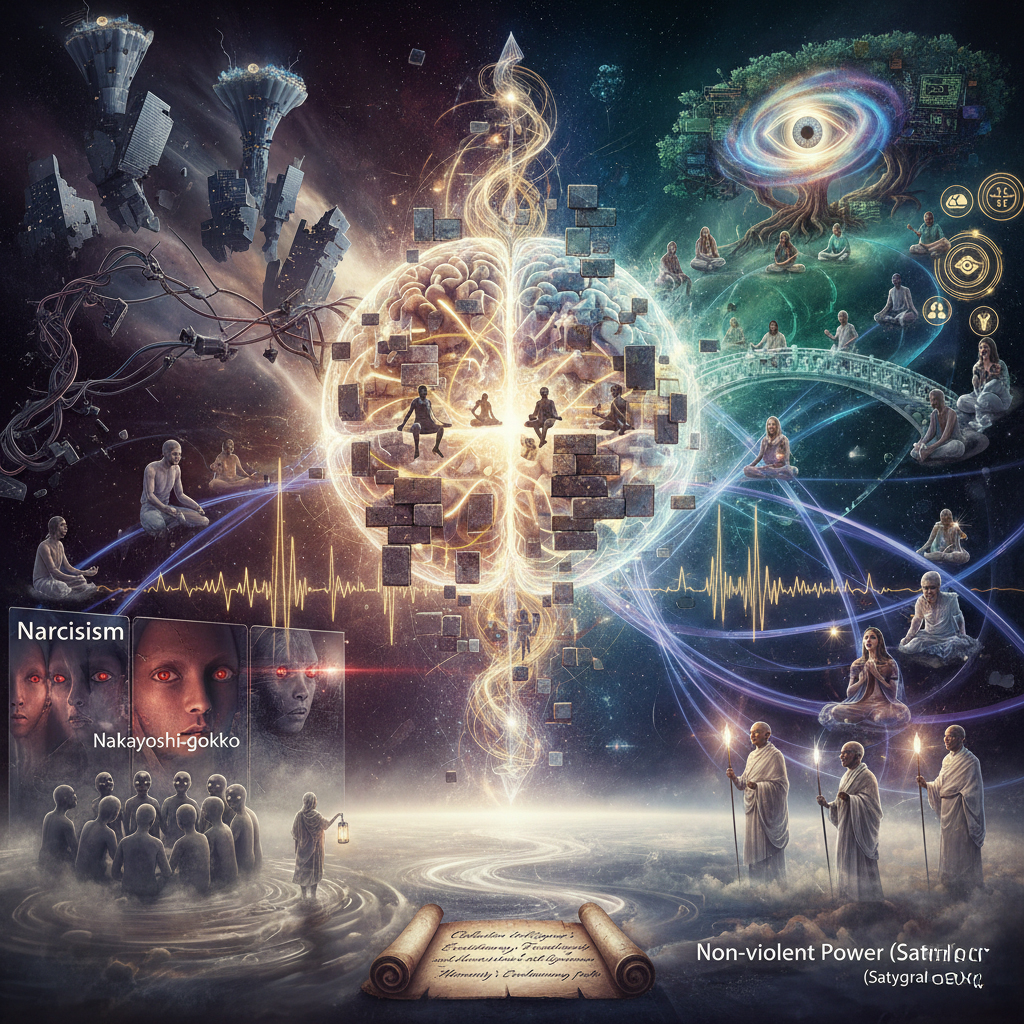
Psychological Dynamics and the 22 Emotional Stages in Religious Devotion
- Introduction: Historical Examination of the Divergence Between Institutional Religion’s Origins and Theological Construction
- Organizational Religious Structure: The Paradox of Power, Violence, and Dependency
- The Psychological Prison of Religious Second/Third Generations: Inheritance of Powerlessness and Guilt
- The 22 Emotional Stages: Abraham-Hicks’ Theoretical Framework
- Savior Complex and Psychological Analysis of “Feeling Like You’re Saving People”
- The Essence of God (Source): Cooperation, Freedom, and Autonomy
- Yakuza-like Domination Mechanisms in Institutional Religion
- Process to Awakening: Specific Methods to Climb the Emotional Ladder
- Conclusion: Toward Autonomous Souls and Cooperative Divinity
- Two Perspectives: The Necessity and Danger of Facilities
- The Positive Role Facilities Can Play
Introduction: Historical Examination of the Divergence Between Institutional Religion’s Origins and Theological Construction
Analyzing the emergence of religion in human history and its subsequent organizational processes reveals a decisive divergence between the original intentions of founders and the systems constructed by later followers. At the foundation of “why people get hooked on religion”—the subject of this report—lies the question of how individual inner spiritual exploration transforms into external power structures and dependency systems.
Tracing the footsteps of the historical figure Jesus of Nazareth, there is virtually no evidence that he himself established “Christianity” as a dogmatic organization in the modern sense. The essence of his teachings centered on criticizing the formalism of existing religious frameworks (Judaism of that time) and focusing on individuals building direct, cooperative relationships with “God (Source).”
However, after his death, in the process of absolutizing him as “God” and systematizing his teachings, many human political intentions, needs for social governance, and biases for organizational maintenance intervened. This process can be said to be the origin of “institutional religion” that suppresses individual freedom and creates dependency on specific facilities and leaders.
In such organizations, God is given a restrictive definition as “existing only within specific facilities” or “reachable only through specific doctrines.” This functions as a device to keep humans in the lowest frequency state on the “22 Emotional Stages” proposed by Abraham-Hicks.
This report analyzes in detail the psychological background of religious dependency, particularly through the dynamics of powerlessness faced by second and third generations, and the “savior complex” conducted under the guise of salvation. Furthermore, it systematically elucidates where these series of behaviors and psychological states correspond on Abraham’s emotional scale from an academic perspective.
Organizational Religious Structure: The Paradox of Power, Violence, and Dependency
One of the most powerful means religious organizations use to ensure their survival is fixing believers’ consciousness on “fear” and “dependency.” The points raised about “Soka Gakkai’s connection to politics” and “structures similar to yakuza” can be analyzed from a sociological perspective as domination under the guise of “protection.”
Exclusionary Doctrine and Vibrational Decline
Behind specific religions establishing taboos such as “you must not visit shrines” lies the intention to instill “separation” and “fear” in believers’ consciousness. According to Abraham-Hicks’ theory, alignment with Source is based on Stage 1 energy (joy, freedom, love) of “accepting everything and harmonizing.”
However, doctrines such as excluding other religions or prohibiting shrine visits bind believers’ consciousness to “disgust (Stage 19),” “insecurity (Stage 21),” or “fear of punishment (Stage 22).”
Organizations connect with political power and sometimes violent means because organizations that have lost spiritual authority attempt to control believers through physical coercion. Yakuza-like organizational management—that is, “connections behind the scenes” and “pressure”—is driven by energy from Stage 17 (anger) to Stage 19 (hatred/resentment) on the emotional scale. This is in complete misalignment with the outwardly stated “compassion” and “happiness.”
Confining “God” Within Facilities
“God exists within facilities”—this form of faith denies the omnipresence of God (Source) and aims to monopolize access rights through the organization. Originally, God does not demand dependency and should be an existence that supports individual autonomous creation, but organizations trap believers in a loop of “powerlessness (Stage 22)” by presenting salvation premised on “unhappiness.”
The following table compares how each aspect of organizational religion corresponds to what vibrational state on Abraham’s emotional scale.
| Organizational Component | Surface Claim (Ideal Stage) | Actual Psychological State (True Stage) | Vibrational Frequency |
|---|---|---|---|
| Exclusivism (shrine prohibition, etc.) | Belief, devotion (4) | Disgust, fear (19, 22) | Extremely low |
| Collusion with politics/violence | Peace, social contribution (3) | Revenge, desire for domination (18, 19) | Low |
| Facility-centered faith | Gratitude, reverence (1) | Dependency, inadequacy (22, 21) | Extremely low |
| Forced recruitment/conversion | Enthusiasm, salvation (3) | Blame, dissatisfaction (15) | Low |
| Generational chain (2nd/3rd gen) | Tradition, love (1) | Guilt, powerlessness (21, 22) | Lowest |
The Psychological Prison of Religious Second/Third Generations: Inheritance of Powerlessness and Guilt
The most serious aspect of religious dependency is the problem of “second and third generations” where faith systems are forced regardless of individual will. Education from early childhood—that is, “imprinting”—has tremendous impact on brain function and emotional set points.
Religious Dogma from a Neuropsychological Perspective
Recent research suggests that specific brain regions, particularly the ventromedial prefrontal cortex (vmPFC), are involved in belief evaluation and doubt processing. When the vmPFC is damaged or specifically adjusted, tendencies toward authoritarianism and religious fundamentalism strengthen, and a so-called “doubt deficit”—the inability to process information skeptically—occurs.
Second and third generations raised in religious environments are taught that the very process of “doubting” is sinful, so they are cognitively conditioned to skip “doubt (Stage 13)” and jump directly to “lack of self-worth (Stage 21)” or “fear (Stage 22).”
RSS (Religious and Spiritual Struggles) and the Emotional Scale
The difficulties faced by religious second and third generations are measured by the RSS (Religious and Spiritual Struggles) scale. This includes negative emotions toward God (feeling abandoned or punished by God), fear of demonic existence, interpersonal conflict within religious communities, and internal guilt.
These conflicts are positioned on Abraham’s emotional scale as follows:
The 22 Emotional Stages: Abraham-Hicks’ Theoretical Framework
To clarify “what stage people who get hooked on religion are at,” we need to deeply explore the definition of the 22 Emotional Stages (Emotional Guidance Scale) proposed by Abraham-Hicks. This scale arranges human emotions from highest vibrational frequency (positive states) to lowest (negative states).
List and Characteristics of the 22 Emotional Stages
The following table summarizes Abraham-Hicks’ definition of the 22 emotional stages.
| Stage | Emotional Content | Overview and Psychological Characteristics |
|---|---|---|
| 1 | Joy/Knowledge/Empowerment/Freedom/Love/Appreciation | Highest vibration. Completely aligned with universal Source. |
| 2 | Passion | Strong energy and conviction in one’s purpose. |
| 3 | Enthusiasm/Eagerness/Happiness | Driving force toward positive action. |
| 4 | Positive Expectation/Belief | Firm trust that good things will happen. |
| 5 | Optimism | Believing in possibilities and seeing the future brightly. |
| 6 | Hopefulness | Desire for improvement. Gateway to positive. |
| 7 | Contentment | Accepting current state, no resistance (entrance to upward spiral). |
| 8 | Boredom | Neutral state but stagnation from lack of change. |
| 9 | Pessimism | Stage of beginning to expect negative results. |
| 10 | Frustration/Irritation/Impatience | Dissatisfaction with situation. Energy becomes heated. |
| 11 | Overwhelment | Exhausted by demands exceeding processing capacity. |
| 12 | Disappointment | Expectations betrayed, beginning to lose vitality. |
| 13 | Doubt | Distrust of self, others, truth. Feeling heaviness. |
| 14 | Worry | Anxiety about the future. Circular thinking. |
| 15 | Blame | Act of blaming others or situations. Less power than anger. |
| 16 | Discouragement | Feeling that path to goals has been cut off. |
| 17 | Anger | Intense fury. More active power than powerlessness. |
| 18 | Revenge | Desire to harm the other party. |
| 19 | Hatred/Rage | Intense rejection and hostility. |
| 20 | Jealousy | Envying others’ success or possessions, lowering self-worth. |
| 21 | Insecurity/Guilt/Unworthiness | Fundamental doubt about self-existence. Extremely heavy vibration. |
| 22 | Fear/Grief/Despair/Powerlessness | Lowest vibration. Feeling unable to do anything—breeding ground for “dependency.” |
Nature of Vibration and “Emotional Navigation”
According to Abraham’s teachings, emotion is a “navigation system” that tells you whether your current thinking aligns with Source’s perspective. Good-feeling emotions (Stages 1-7) are aligned with Source and have strong power to attract desired reality. On the other hand, bad-feeling emotions (Stages 8-22) indicate divergence from Source—that is, “resistance.”
The true nature of the “enthusiasm” that people hooked on religion feel when attacking or refuting others using doctrine as a shield is, in most cases, a temporary illusion of power from rising from Stage 22 to about Stage 15 (blame).
Savior Complex and Psychological Analysis of “Feeling Like You’re Saving People”
The behavioral pattern of “being saved from one’s unhappiness through religion and leading troubled people while feeling like you’re saving them” is psychologically explained in the context of “savior complex” and “codependency,” but mapping this to Abraham’s emotional scale reveals very interesting dynamics.
False Power: Stage 15 “Blame” and Stage 10 “Irritation”
The moment an “unhappy person” encounters religion and feels they’ve gained temporary peace of mind, that person feels they’ve temporarily risen from Stage 22 (powerlessness) on the emotional scale to perhaps around Stage 6 (hope). However, when that foundation is “dependency on external gods and organizations” rather than “self-autonomy,” that vibrational frequency is extremely unstable.
Behind the act of recruiting (leading) troubled people are often the following psychological states:
Answer to the Question: Corresponding Emotional Stages
Based on the description, identifying the emotional position of this “person feeling like they’re leading and saving” results in the following:
Surface consciousness (self-aware state): From Stage 3 (happiness/motivation) to Stage 6 (hope). Because they’ve convinced themselves they’re “people of goodwill” and “saviors,” they have the illusion of being around this area.
Deep vibration (true vibrational state): Stage 15 (blame) and Stage 21 (insecurity/unworthiness). The motivation for their behavior is blame of “wanting to prove their correctness (= pointing out others’ mistakes)” and the flip side of insecurity that “if I leave this religion, I have no value.”
Therefore, as a precise mapping, it can be said to be a multiple state centered on Stage 15 (blame), moving between Stages 10-11 (irritation/overwhelm) during organizational activities, and sinking to Stages 21-22 (guilt/insecurity) during alone time.
The Essence of God (Source): Cooperation, Freedom, and Autonomy
As claimed, the original “God” or “Source” does not force dependency on humans. In Abraham-Hicks’ teachings, humans are “extensions of Source dwelling in physical bodies,” and each person is the creator of their own reality.
The Difference Between Dependency and Cooperation
Religious Dependency (Low Vibration)
- Basic emotion: Fear, guilt, powerlessness (22, 21)
- God’s location: Specific facilities, in the clouds, within leaders
- Purpose: Atonement for sins, organizational maintenance, salvation after death
- Attitude toward others: Recruitment, coercion, blame (15, 10)
- Response to failure: Punishment, spiritual interference, blamed on lack of faith (14, 15)
Cooperation with Source (High Vibration)
- Basic emotion: Freedom, love, empowerment (1)
- God’s location: Within oneself, within all life
- Purpose: Joy, expansion, co-creation, happiness in this moment
- Attitude toward others: Respect, allowing, love (1)
- Response to failure: Adjustment, experience, birth of new desires
The point about “even after death, as a soul, still misperceiving God’s existence” relates to the persistence of belief systems. From Abraham’s perspective, death (transition to non-physical dimension) is originally a return to complete alignment with Source (Stage 1).
However, if one has maximally reinforced beliefs like “I deserve to be punished” or “I am powerless” during life and transitions consciousness while holding that “resistance,” that soul may temporarily remain in “self-created darkness (low vibrational echoes)” instead of heading toward the light. This is expressed as “misperception of God’s existence.”
Yakuza-like Domination Mechanisms in Institutional Religion
The point that “Soka Gakkai is all the same as yakuza, connected behind the scenes” is not mere slander but points to organizational and psychological similarities.
Common Points in the “Politics of Fear” Between Violence and Religion
The act of yakuza (organized crime) taking protection money under the guise of “protection fees” and some religions demanding money under the guise of “your ancestors will suffer without memorial services” or “you’ll fall to hell without donations” are fundamentally based on the same vibrational frequency (Stage 22: fear, Stage 18: revenge/suggestion of retribution).
Explaining this with Abraham’s theory involves the following steps:
In this process, the structure where organizational tops, politicians, or underworld forces share interests is the very energy of “domination and exploitation” at Stage 19 (disgust/resentment) and Stage 18 (revenge).
Process to Awakening: Specific Methods to Climb the Emotional Ladder
To escape religious dependency and reach the Stage 1 energy of “cooperating but not depending,” what process is necessary?
Emotional Honesty and Accepting “Anger”
For religious second/third generations or those deeply hooked, the first step is honestly acknowledging the fact that “I’m currently in a bad-feeling state.” Abraham-Hicks calls this “emotional honesty.”
Anger is more active than powerlessness and plays an important role in the process of reclaiming one’s agency.
Action Steps to Climb Emotions
Conclusion: Toward Autonomous Souls and Cooperative Divinity
This report has analyzed the psychological and social structure of getting hooked on religion using Abraham-Hicks’ “22 Emotional Stages.” The conclusion is that the reality of “religious dependency” described has its foundation in the lowest layers of the emotional scale (Stages 21-22) and consumes energy from the middle layers (Stages 10-15) as a false sense of salvation.
The “cooperation with God” that Jesus of Nazareth likely intended is at Stage 1 of the emotional scale (freedom, love, empowerment). On the other hand, many modern organizational religions maintain organizations by confining believers in “powerlessness (Stage 22)” and exploiting the “energy of wanting to be saved” obtained from there. The collusion with politics and worldly power represented by Soka Gakkai is merely the result of this low-vibrational domination structure expanding to a societal scale.
The insight that “God cooperates but doesn’t demand dependency” completely aligns with Abraham’s concept of “Source.” People with savior complexes who try to forcibly save others are merely immersed in “feeling like they’re saving (false Stage 3)” by using others as mirrors to fill the disconnection from their inner Source.
True salvation is not leading others to something, but climbing the emotional ladder oneself and existing at the frequency of joy and freedom (Stage 1). At that time, people transform from “objects to be saved by God” to “creators of reality together with God (Source)” and are completely liberated from the yakuza-like domination structure called religion.
We hope this research contributes to the psychological autonomy and true spiritual growth of people with religious backgrounds.
The Role of Religious Facilities in Guilt and Redemption
Two Perspectives: The Necessity and Danger of Facilities
The phenomenon of “people who come to church lamenting their sins” and “the existence of facilities that serve this need” cannot be simply judged as “good” or “bad.” This requires analysis from the perspective of “from which point to which point are they attempting to move” on the 22 emotional stages scale.
The Positive Role Facilities Can Play
From the perspective of the 22 emotional stages, “people tormented by guilt” typically occupy the following stages:
- Stage 22 (Fear/Despair/Powerlessness): Unable to forgive oneself, unable to see the future
- Stage 21 (Guilt/Insecurity): Fundamental negation of self-existence
- Stage 14 (Worry): Anxiety about punishment and retribution
For people in these extremely low vibrational states, when churches or religious facilities perform the following functions, they can indeed provide “temporary salvation”:
- Providing a Safe Space: Escaping isolation and finding a space that accepts you
- Emotional Release: A place to verbalize suppressed guilt and shed tears
- Transition from Stage 22 to 17: Sublimation from powerlessness to “anger (at oneself or the situation)”—a more active energy
- Gaining Temporary Hope: Reaching Stage 6 (hope). The light of “perhaps I can be forgiven”
- Community Warmth: Temporary escape from loneliness (the core of Stage 22)
- Fixation of Guilt: Repeatedly indoctrinating “you are a sinner,” keeping people at Stage 21
- Building Dependency Structures: Exclusivity of “you can only be forgiven here”
- False Salvation: Conditional love that only recognizes value through “actions” like donations and service
- Hindering Autonomy: Reinforcing external dependency: “without the priest/pastor/leader, you cannot be saved”
- Breeding Ground for Exploitation: Exploiting vulnerable psychological states for money and labor
The Position of Facilities in Emotional Transition
Before coming to church
Confession, tears, anger expression
Sense of forgiveness
True self-acceptance
Critical Distinction: Should Facilities Be “Bridges” or “Final Destinations”?
Healthy religious facilities function as “waypoints” or “bridges” for suffering people moving from Stage 22 to Stage 1. In contrast, exploitative facilities define themselves as the “only final destination” and trap believers in a loop between Stage 15 (blame) and Stage 21 (guilt).
Abraham’s Perspective on “True Forgiveness”
In Abraham-Hicks’ teachings, the concept of “sin” itself does not exist from Source’s perspective. From Source’s view, all human actions are “experiences” and “materials for expansion.” Therefore:
- Guilt (Stage 21) is the greatest divergence from Source: Thoughts of self-punishment directly oppose Source’s “unconditional love for you”
- Forgiveness is not given from outside: Even if a priest or pastor says “you are forgiven,” if the person doesn’t forgive themselves, their vibration won’t rise
- True forgiveness is reconciliation with oneself: Accepting that “the me of that time did the best with the level of consciousness I had then”
| Approach | Role of Facility | Resulting Vibration | Long-term Impact |
|---|---|---|---|
| Dependency-based | “You are a sinner. You must keep coming and obeying to be saved” | Fixed at Stages 15-21 | Loss of autonomy, exploitation, generational chains |
| Autonomy-supporting | “We receive your pain. And we remind you that you already have the power to forgive yourself” | Transition from Stage 6 to Stage 1 | Self-acceptance, awakening of inner power, natural graduation from facility |
Concrete Case Analysis: Contrasting Two Churches
Case A: Exploitative Church
Case B: Autonomy-supporting Church (or Counseling Facility)
The Significance and Limits of Facilities
Conclusion: Facilities Should Be “Crutches,” Not “Wheelchairs”
For people suffering from guilt, religious facilities and churches should be like “crutches that temporarily support a broken leg.” Crutches are absolutely necessary when you can’t walk, but if you continue using them after your leg has healed, your muscles will atrophy and you’ll lose your natural ability to walk.
On the other hand, exploitative facilities put believers in “wheelchairs” and brainwash them: “You’ll never walk again.” And they continue to receive compensation for pushing the wheelchair.
Conditions for a Facility to Be Healthy
| Item | Healthy Facility | Exploitative Facility |
|---|---|---|
| Goal Setting | “That you become able to stand on your own” | “That you stay here forever” |
| Money | Voluntary, transparent, clear value exchange | Forced, opaque, coercion through fear |
| Attitude Toward Other Religions | Respect, freedom of choice | Exclusion, prohibition, instilling fear |
| Leader’s Attitude | “I am also just a human being” | “I am God’s spokesperson” |
| Response to Questions | “Questioning is healthy. Let’s think together” | “Questioning is sin. Just believe” |
| Concept of Graduation | “I look forward to the day when you no longer need this place” | “Leaving here is the path to hell” |
A Higher Perspective: Healing Beyond Facilities
Based on Abraham-Hicks’ theory, ultimately all external facilities become unnecessary. Why? Because:
- Source (God) already exists inside you
- The concept of sin is an illusion created by humans
- True forgiveness arises from accepting “it’s okay not to be perfect”
- You are already worthy of being loved just as you are
However, this does not mean “facilities are unnecessary.”
Telling someone in the despair of Stage 22 that “everything is already inside you” won’t reach them. That’s like telling someone with a broken leg, “You don’t need crutches, walk on your own feet.” Gradual support is necessary.
The Ideal Form of Facilities
Religious facilities and counseling organizations that truly serve people provide the following staged support:
The Final Answer: How Should We Think About Facilities?
Facilities themselves are neutral. The question is “what is the facility’s purpose?”
For people suffering from sin to rush to a church is a natural, human act. And a facility that warmly welcomes such people, provides temporary comfort, and guides them toward autonomy is necessary and valuable to society.
However, a facility that preys on that person’s vulnerability, creates perpetual dependency, exploits money and labor, and brainwashes them with “there is no salvation except here” is an organization of low vibration, no different from organized crime.
The distinction is simple:
- Does the facility envision the day when you will “eventually graduate”?
- Does the facility allow you to think for yourself, doubt, and choose?
- Does the facility believe in your inner power? Or does it continue to treat you as a powerless being?
True healing does not create dependency. True healing creates freedom.
Facilities should be “waypoints.” And ultimately, everyone connects directly with their inner Source and no longer needs external facilities—that is the state of Stage 1 (joy, freedom, love) that Abraham shows us.