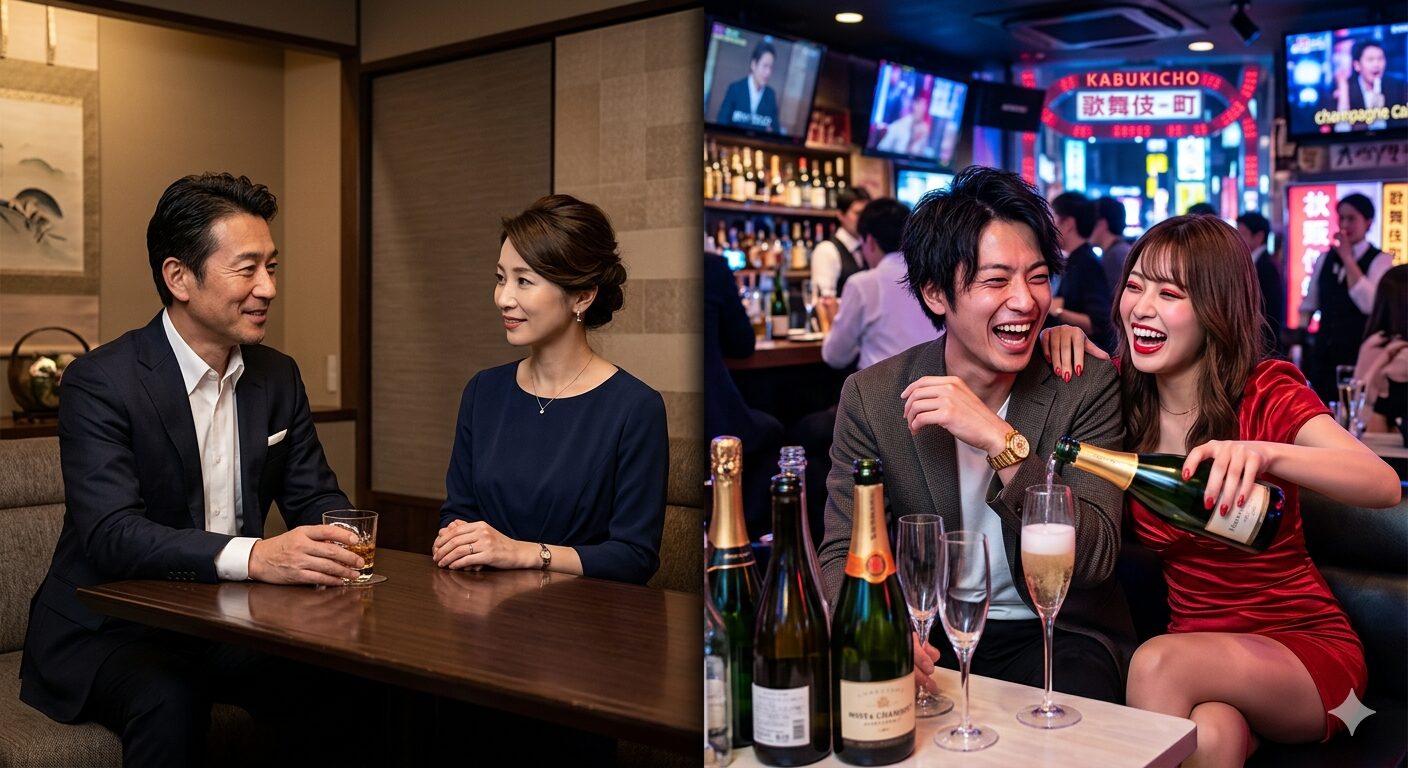
A Comprehensive Study of
Married Men & Their
Cabaret Club Obsession
Multi-Dimensional Analysis from Neuroscience, Depth Psychology & Social Structural Perspectives
Introduction — The Marketisation of Pseudo-Romance & the Weight of “Roles” Borne by Married Men
In contemporary Japanese society, the “night district” — the cabaret club in particular — has long transcended its function as a mere venue for drinking to operate as a highly structured “emotional marketplace.” The psychology of married men who become deeply immersed in this space, inviting economic, social, or domestic ruin, cannot be captured by the simple framework of individual preference or moral deficiency. Behind it lies the runaway of the brain’s reward circuitry as examined by neuroscience, the projection of the “inner feminine” as understood by Jungian psychology, and the refined exploitation structure known as “emotional labour,” all intertwined in complex ways.
At the core of what married men seek in the cabaret club is liberation from social responsibility — from the layered “masks (persona)” of “worker,” “father,” and “husband.” In the modern work environment, men are frequently confronted with the self-image of “replaceable cogs in the machine,” while within the home they tend to have their roles fixed as “the provider of living expenses” or “the unreliable presence.” This fixation of roles arouses a fundamental anxiety about one’s own worth — and the cabaret club functions as a refuge to fill that sense of emptiness. What is provided inside the venue is not merely alcohol and conversation, but unconditional affirmation as “just a man” — a simulated experience of “omnipotence” mediated by money.
This report examines in detail the deep psychology and structural factors underlying why married men become absorbed in cabaret clubs, and at times arrive at the catastrophic behaviour that can only be called “madness” — drawing on the latest available insights from multiple disciplines.
Chapter I — The Neuroscientific Mechanism: Hacking the Reward Circuit & Biochemical Dependency
The essence of cabaret club dependency can be defined as a dysfunction of the brain’s reward circuit and a “hacking” by neurotransmitters. Human beings reinforce and repeat actions because the brain judges that those actions yield rewards advantageous to survival — and pseudo-romance artificially, yet powerfully, stimulates this circuit.
The “A10 neural circuit” — running from the ventral tegmental area (VTA) of the midbrain to the nucleus accumbens (NAcc) of the limbic system — is at the heart of addiction. Praise from the cabaret hostess and positive reactions (the so-called “sasisseso” technique) stimulate the male sense of self-efficacy to the extreme, triggering a massive release of dopamine in the nucleus accumbens. Dopamine governs not “pleasure” itself but rather the “prediction of pleasure” and “expectation of reward” — and it overreacts to stimuli that evoke “future rewards” such as a LINE message from a cast member or the reservation for the next visit. The tendency for dopamine neurons to fire strongly in response to “unexpected rewards” is particularly significant. An “uncertain reward” — such as a cast member who is usually businesslike suddenly confiding a personal worry in a moment of apparent spontaneity — entraps the brain by precisely the same mechanism as gambling addiction.
| Neurochemical | In-Venue State (Euphoria Phase) | Following Morning (Depletion Phase) | Psychological Impact |
|---|---|---|---|
| Dopamine | Excessive release (reward system activated) | Sharp decline (below baseline) | Euphoria reverses into powerlessness |
| Serotonin | Relative suppression (in the shadow of excitement) | Severe deficiency | Anxiety, depression, self-reproach |
| Oxytocin | Secreted (pseudo-attachment formed) | Disappearance → intensified loneliness | Fixation on the cast member; craving to return |
| GABA | Suppressed (brake lost) | Slow recovery → hypersensitivity | Irritability, emotional instability |
As this oscillation between “euphoria” and “depression” is repeated, the brain can no longer maintain its normal baseline state (homeostasis) and progresses toward “reward deficiency syndrome” — a loss of interest in everyday life. The brain is, in effect, being slowly disassembled by the very circuitry meant to reward survival.
Chapter II — Depth Psychology: The Projection of the Anima & the Fiction of the “Ideal Woman”
Behind married men seeking “salvation” outside the home lies a powerful psychological process described in Jungian psychology: the projection of the “Anima.” This is the phenomenon in which the feminine personality element existing in the male unconscious is reflected onto an external woman. Men need to walk the path of recognising their inner Anima and integrating it into their own identity (individuation) — yet many married men substitute this process with outward activities such as “social success” or “maintaining the family.” The repressed Anima is consequently projected with intense force onto the cabaret hostess, who performs the man’s ideal to perfection.
Physical allure, instinctual desire. Closest to early designation choices and the more overtly sexual elements. The most primitive level of projection.
“A fateful encounter” and “a woman who needs me as her hero” (Romantic); the exhausted man’s “ultimate consolation” and “unconditional affirmation” (Spiritual). These are the core of the dependency — the most frequently stimulated stages in the cabaret environment.
Guide of the soul. An elevated stage that cannot be reached in a state of dependency. It appears only when genuine individuation has been achieved — the integration, rather than the projection, of the inner feminine.
When dependency moves toward ruin, the projection converts from “ideal” to “shadow.” When the man is confronted with the reality that the cast member to whom he entrusted his entire fortune — and whom he believed to be his ideal woman — was treating him simply as “business,” he cannot endure the collapse of the projection and is seized by intense anger and the desire for revenge. This is the true nature of stalker behaviour, verbal abuse within the venue, and what is called the “client’s madness.” The projected “screen” has shattered, and behind it stands not the fantasy but the cold logic of a commercial transaction.
Chapter III — The Dynamics of Masculine & Feminine: The Qualitative Difference Between Possession & Connection
The “sense of lack” underlying dependency is common to both sexes, but its modes of expression are deeply coloured by the characteristics of masculine and feminine energy. By comparing married men who sink into cabaret clubs with women who become absorbed in host clubs, the pathology specific to men — “possession” — comes into sharp relief.
For men, the act of paying money frequently carries the meaning of “acquiring the right to control the other party.” The cabaret club apparatus provides “pseudo-dominance” backed by economic power, satisfying the drive inscribed in male survival instinct — “the desire to be the stronger party.” The very act of restoring self-esteem, eroded in the social arena, through the weapon of banknotes becomes the object of dependency itself.
Chapter IV — A Behavioural Economics Perspective: The Sunk Cost Trap & the Illusion of Omnipotence
Why do men who should be rational adults find themselves unable to stop investing in a situation where they clearly understand they are losing? This is deeply connected to the “sunk cost fallacy” and the “Concorde Effect.”
For a customer who has ordered hundreds of thousands of yen’s worth of champagne in a single sitting and invested millions in total, those funds are already “sunk costs” — irrecoverable. Yet a powerful psychological bias operates in human beings: the urge not to waste prior investment (status quo bias). “If I go just one more time, she might become serious.” “If I stop now, everything I’ve spent will have been wasted.” This cognitive distortion is identical to the psychology of a gambling addict who believes “the next round will win it back.” In the case of married men particularly, when those funds represent “the family savings” or the “mortgage,” acknowledging the loss connects directly to acknowledging “a failure of one’s life” — making it even harder to stop the chase (throwing good money after bad) to sustain the illusion.
| Economic Behaviour | Psychological Background | Consequence |
|---|---|---|
| High-value bottle orders | Display of dominance; superiority over other customers | Short-term dopamine release; mounting financial pressure |
| Frequent “douhan” (escorting) & after-hours | Encroachment of the venue into reality | Dissolution of public/private boundary; proliferation of lies to family |
| Expensive gifts to cast members | Satisfaction of possessive desire; cultivation of debt-feeling in target | Growth of sunk cost; psychological inability to withdraw |
Chapter V — The Emotional Scale’s Volatility: The Fall from Craving to Powerlessness
Abraham’s “22-stage emotional guidance scale” vividly explains the changes in psychological energy that characterise cabaret club dependency. Men in a state of dependency believe themselves to be at the higher end (high vibration) of the scale while in reality stagnating at its lowest levels. In the moment of excitement at the venue, the man feels he is at stage 2 (Passion) or stage 3 (Enthusiasm) — yet the source of that energy is a sense of lack, “I am not being recognised,” meaning his actions are actually grounded in stage 10 (Frustration) or even lower.
- 01★ Joy / Knowledge / Freedom / Love / Appreciation — Post-sublimation: “Those days were good”
- 02Passion — (Illusion) The high inside the venue; during champagne calls
- 03Enthusiasm / Eagerness — Anticipation of the next visit; possessive desire for the host
- 04Positive Expectation / Belief
- 05Optimism
- 06Hopefulness
- 07Contentment — The daily life now lost: home and workplace
- 08Boredom — The monotony of work; the homogeneity of home life
- 09Pessimism — Doubt about the future; doubt about one’s own worth
- 10Frustration — (The true departure point) “I am not being recognised”
- 11Overwhelment — The pressure of payments and debt
- 12Disappointment — Glimpsing the cast member’s true motives
- 13Doubt — “Am I being handled as pure business?”
- 14Worry — Impact on family; depletion of assets
- 15Blame — Shifting responsibility to the venue, cast, or society
- 16Discouragement
- 17Anger — Violent backlash at the moment of rejection
- 18★ Revenge — Stalking; harassment of the venue; verbal abuse
- 19Hatred / Rage
- 20Jealousy — Intense envy toward wealthier customers
- 21★ Insecurity / Guilt / Self-reproach — The next morning’s self-loathing; sense of betraying the family
- 22Powerlessness / Despair / Self-abasement — Psychological death after losing everything
Chapter VI — The Sociological Boundary: Emotional Labour as Capitalism’s “Shadow”
From a sociological perspective, the cabaret club space is the ultimate business model in which “emotion” has been commodified. The “kindness” provided here is not the virtue of a human relationship, but the product of carefully calculated “emotional labour.” The “kindness” demanded of cast members is not the compassion that helps the other person grow as a human being, but “the professional commitment to performing the illusion the other desires, for as long as the money holds out.” A genuinely kind person would withdraw before the other’s life breaks apart — but such behaviour is antithetical to the venue’s “revenue,” making it logically difficult to “keep selling” in this industry.
| Parameter | Ginza (Premium Venues) | Kabukicho / Mass-Market |
|---|---|---|
| Dominant emotion | Superiority, status, intellectual curiosity | Intoxication, conquest drive, urgent need for recognition |
| Cast’s role | “A good confidante” / “intellectual companion” | “An adoring lover” / “a woman captivated by you alone” |
| Pace of dependency | Gradual and long-term (chronic dependency) | Rapid and short-term (acute dependency) |
| Form of ruin | Gradual asset erosion; cooling of the home | Debt; family collapse; criminal incidents (“madness”) |
Treats the in-venue experience as “a sophisticated role-playing game” and is able to return instantly to the persona of “husband / father / employee” the moment they step outside. They possess the autonomy to consume illusion as entertainment.
Comes to believe that the total affirmation inside the venue represents “the truth of their own worth,” and begins to resent the real world (home, workplace) as “a hostile place that refuses to recognise me.” This loss of metacognition is the single greatest factor leading to social death — debt, divorce, dismissal.
Conclusion — The Solitude of the Modern Man & the Ethical Contradiction of the “Emotional Market”
As this report has made clear, the cabaret club dependency of married men is not confined to a matter of individual ethics — it is the product of the multi-layered factors of the brain’s reward system, the deep psychological process of projection, and the advanced commodification of emotional labour under capitalism. In contemporary society, there are extremely few places where men can expose their weakness as “just a human being” and be unconditionally accepted. In the battlefield of “roles” that is home and workplace, the cabaret club functions, in one respect, as the only “safe refuge.”
Yet precisely because that refuge is a “fantasy fuelled by money,” the reality that arrives the moment the fuel runs out is more severe than ever before. Recovery from dependency requires not merely the suppression of behaviour, but the indispensable process of looking squarely at the true nature of the “sense of lack” within oneself — the Anima projection — and rebuilding, not through monetary control, but through genuine self-worth and connection with others.
Discerning the boundary of the “kindness” offered by the night district; managing one’s own emotional vibration; recovering the autonomy to consume illusion as entertainment. This alone is the path by which married men can find true “freedom” without being swallowed by capitalism’s shadow.
- [01]RIC Mental Clinic — Cabaret Club / Host Club Dependency: A Psychiatric Approach (2025)
- [02]Tarzan Web — The Mechanism of Addiction as Seen through Neuroscience
- [03]Ginza Taimei — The Neuroscience of Romance: Dopamine and the Reward System
- [04]IAP Counselling — Addiction and the Brain’s Mechanisms
- [05]tainew.com — The Psychology of the Misguided “Girls Bar” Client
- [06]theories.co.jp — The Concorde Effect: The Psychological Mechanism of Sunk Cost
- [07]YouTube — Related Video: Addiction & Cabaret Club Psychology Explained