A Treatise on Cosmic Consciousness & Human Evolution
Cosmic Intent & the
Evolution of Humanity
The Sublimation of Emotion as the Path to Self-Awakening
A multi-perspective inquiry into why souls descend into matter, what joy and suffering are truly for, and how the Earth itself was designed as the universe’s most demanding school.
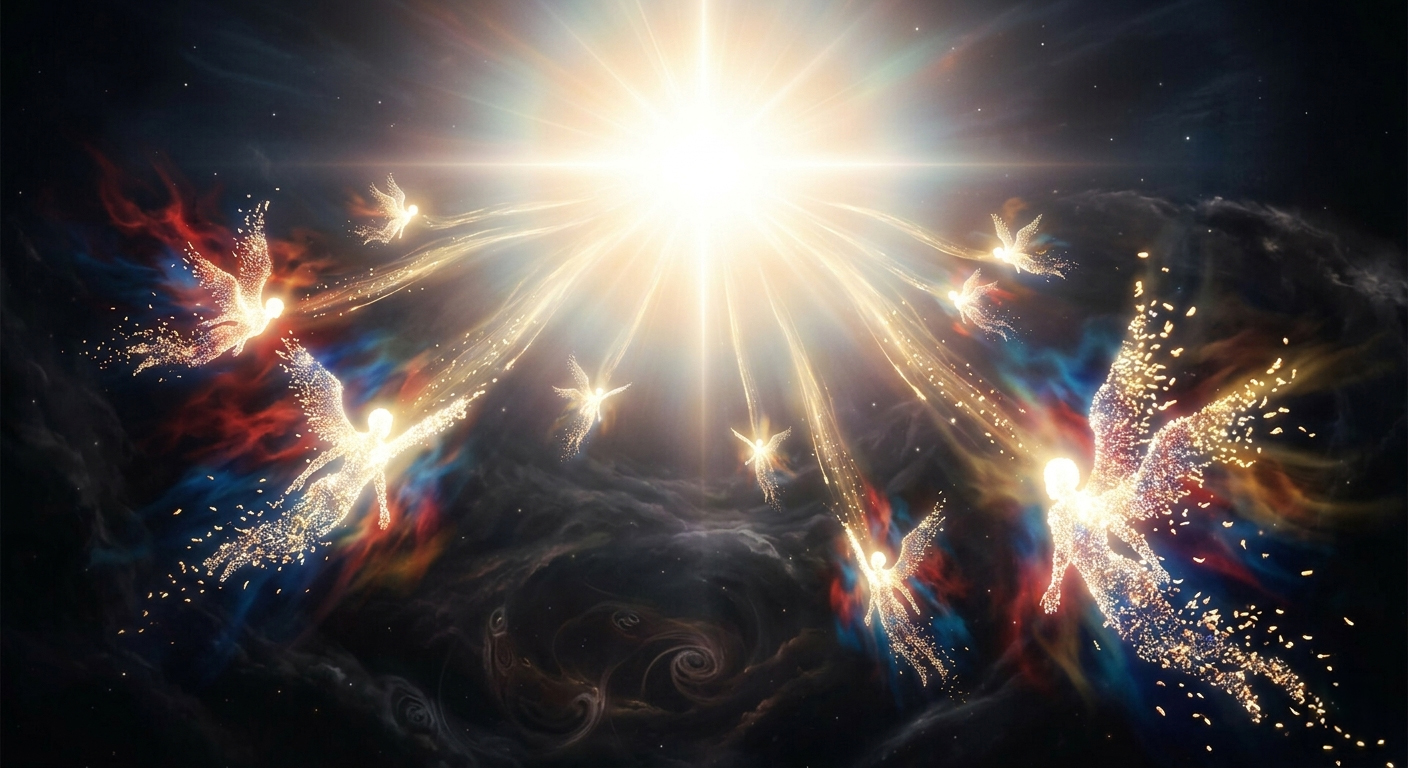
The universe, as interpreted across mystical traditions, did not arise from accident. It arose from intention — from a singular, primordial act of will that sought to know itself through the infinite variety of experience. This One Original Thought, as some traditions call it, could not perceive its own light without first creating shadow. And so the cosmos unfolded: a vast stage upon which consciousness could encounter itself from every conceivable angle.
This treatise examines that cosmic purpose through the lenses of Gnostic mythology, comparative religion, evolutionary psychology, and existential philosophy — asking not merely why we suffer, but what our suffering is in service of.
The Primordial Motive: From Bliss to Experience
At the heart of most esoteric cosmologies lies a paradox: the Absolute — perfect, boundless, and self-sufficient — nonetheless generates a universe of limitation, loss, and longing. The reason offered is consistent across traditions: pure completeness cannot experience itself. Light without shadow has no edges. Joy without contrast has no depth.
The original creative impulse, then, was not a mistake. It was an act of sublime curiosity. The One willed multiplicity so that it might encounter itself as the Many — in joy, in fury, in grief, and in wonder. The emotions we carry are not accidents of biology. They are the very medium through which the universe performs its self-examination.
| Constituent | Creative Mechanism | Nature of Experience | Ultimate Outcome |
|---|---|---|---|
| The Monad | Self-fragmentation for self-recognition | Absolute stillness & unity | Infinite potential unfolded |
| The Aeons | Emanations of divine fullness (Pleroma) | Pure attributes: Wisdom, Love, Truth | Mirrors of the Source |
| Material World | Duality born of deficiency or error | Emotion, pain, physical constraint | School of the soul |
| Humanity | Embodied vessels carrying a divine spark | Longing for wholeness amid separation | Return to Source through awakening |
The Fall of Sophia: Emotion as Cosmic Origin
The Gnostic myth of Sophia — Wisdom personified — offers the most psychologically rich account of why the material world carries such emotional intensity. Sophia, the youngest of the divine Aeons dwelling in the Pleroma, was seized by a passion no other Aeon shared: the desire to know the Father directly, unmediated, alone. This desire — beautiful in its sincerity, catastrophic in its isolation — ruptured the harmony of the divine fullness.
Cast out into the void, Sophia experienced a cascade of states that became the very substance of the material cosmos: terror condensed into matter; grief became the animating sorrow of the soul; longing for the light became the invisible tether that draws every human heart toward something it cannot name.
The emotions we carry are not ours alone. They are Sophia’s. Every time we grieve and seek the light, we replay her ancient drama — and inch her, and ourselves, back toward home.
— Gnostic interpretive traditionSophia did not leave the material world empty-handed. Before the Demiurge — the blind craftsman who built this world in ignorance — could seal off the cosmos entirely, she breathed a Divine Spark into each human being. This is why we are double creatures: imprisoned in flesh, yet burning with a fire that does not belong to flesh.
Alchemical Note
The Divine Spark (Pneuma)
In Gnostic anthropology, the pneuma is the fragment of Sophia’s own luminous nature hidden within the human soul. It cannot be destroyed by the Demiurge because he does not know it is there. Its recognition — gnosis — is the act of liberation. What we call “spiritual awakening” is, in this framework, simply the spark remembering what it is.
The Earth School: A Curriculum Designed in Darkness
The concept of Earth as a “school for souls” recurs across indigenous wisdom, Theosophical literature, and contemporary near-death experience research. What distinguishes this school from all others is the sheer density of its curriculum: nowhere else in the known spectrum of existence can a consciousness experience the full emotional spectrum — grief and ecstasy, rage and forgiveness — compressed into a single lifetime, inside a mortal body that amplifies every sensation.
The Veil of Forgetting is the school’s masterstroke. Before incarnating, the soul consents to amnesia. It forgets its divine origin. This is not cruelty; it is pedagogy. A student who already knows all the answers cannot truly learn. The curriculum requires genuine stakes, genuine loss, genuine bewilderment — so that the eventual remembering carries the full weight of hard-won truth.
According to researchers such as Michael Newton, souls do not stumble into lifetimes at random. In the interlife state — the lucid interval between incarnations — each soul designs its coming lesson plan in consultation with guides and soul-group members. The adversaries we encounter, the losses we sustain, the patterns we cannot seem to escape: all are chosen, with clear-eyed courage, by a self wiser than the one currently reading these words.
Suffering, reframed through this lens, is not punishment. It is advanced coursework. The soul that has contracted to learn compassion through loss, or sovereignty through oppression, is not being tortured by a capricious universe. It is executing a plan it authored itself.
Key Mechanism
Karma as Feedback Loop
Earth operates under the law of cause and effect with unusual fidelity. Unlike subtler planes where intention and consequence are simultaneous, the three-dimensional world introduces delay — allowing the soul to experience the full arc of its choices. Unresolved patterns (karma) recycle through lifetimes not as punishment but as unfinished lessons seeking completion.
Suffering Across Traditions: Five Roads to the Same Summit
Every major religious tradition has grappled with the same central problem: if existence is fundamentally good, why does it hurt so much? Each has arrived at a version of the same answer — that suffering is not the enemy of spiritual life, but its primary teacher.
| Tradition | Root of Suffering | Path of Sublimation | Final Liberation |
|---|---|---|---|
| Buddhism | Ignorance & attachment | Noble Eightfold Path, meditation, compassion | Nirvana — cessation of grasping |
| Hinduism | Karma & maya (illusion) | Dharmic duty, devotion (bhakti), jnana | Moksha — union of Atman & Brahman |
| Christianity | Sin & separation from God | Faith, grace, agape love | Eternal life in the Kingdom of God |
| Islam | Trial (fitna) of faith | Sabr (patient endurance), righteous action | Nearness to God in the hereafter |
| Judaism | Human responsibility & free will | Torah observance, tikkun olam, prayer | Redemption; the Messianic Age |
What is remarkable is not the diversity of these answers but their convergence: in every case, the raw material of suffering is not to be escaped but transmuted. The Witness consciousness — the capacity to observe one’s own emotional states without being consumed by them — appears across Buddhist vipassana, Hindu viveka, Christian contemplative prayer, and Sufi muraqaba. Different names; one practice.
The Alchemy of Emotion: Sublimation as Transformation
The word sublimation carries its meaning from chemistry — the process by which a solid passes directly into vapor, bypassing the liquid state. Applied to inner life, it describes the transformation of heavy, dense emotional energy into something refined, luminous, and universally useful.
The lead of grief, the iron of rage — these are not waste materials. They are the very substance from which gold is forged, given sufficient inner heat and the willingness to endure the refiner’s fire.
— Hermetic traditionFreud identified sublimation as the redirection of socially unacceptable drives toward art, intellect, and culture. But the deeper alchemical tradition points to something more radical: not the redirection of energy, but its elevation. The anger that recognizes injustice can become the will that corrects it. The grief that cannot release its beloved can become the compassion that recognizes suffering in every face. The fear of death can become the fire of creative urgency.
What prevents sublimation is not the intensity of the emotion but our relationship to it. Repression — the attempt to seal the energy below consciousness — creates pressure that deforms the psyche. Identification — believing oneself to be the emotion — creates floods that sweep away discernment. The third way, the alchemical way, is witnessing with full presence: feeling the emotion completely while remaining larger than it.
| Emotion | Evolutionary Function | Spiritual Dimension | Neural Substrate |
|---|---|---|---|
| Joy | Reinforces cooperative behaviour and goal attainment | Affirmation of existence; reunion with Source | Dopamine / reward circuitry |
| Anger | Mobilises defence of resources and boundaries | Establishes will; transforms into directed passion | Amygdala / sympathetic nervous system |
| Grief | Signals loss; solicits communal support | Releases attachment; deepens empathy | Anterior cingulate; reduced oxytocin |
| Pleasure | Strengthens social bonds; buffers stress | Channels creativity; expands through play | Endorphin system |
The Ladder of Awakening: Consciousness in Ascent
The culmination of the soul’s work on Earth is not the elimination of emotion but its integration: the achievement of a state in which one may feel deeply without being lost; in which the full spectrum of human experience is met with equanimity, even gratitude. Various traditions map this ascent differently, but their stages rhyme.
| Stage | Subjective Experience | The Decisive Shift |
|---|---|---|
| Awakening | A first glimpse beyond the purely physical narrative | The illusion of the isolated self begins to crack |
| Kenshō | A direct, if fleeting, glimpse of one’s true nature | The beginning of an irreversible opening |
| Satori | Over half of awareness identifies with the Absolute | The sense of fundamental separation dissolves |
| Self-Realisation | The personal self is subsumed into Universal Self | “I AM All” — wholeness embodied, not merely known |
| Ascension | Permanent migration to higher-dimensional awareness | Full shift to love; the body itself becomes light |
Threshold Principle
The 51% Rule
Some contemporary teachers describe a critical tipping point: when the proportion of one’s consciousness that identifies with the Absolute — however slightly — exceeds the proportion that identifies with the separate self, a threshold is crossed from which there is no regression. Daily life continues to bring joy and sorrow, but those states no longer have the power to obscure the underlying presence. One weathers the weather without becoming it.
The Spiral Home: A Grand Synthesis
We began with a universe that wanted to know itself. We end with a species in the process of remembering that it is that universe. The arc is not linear but spiral — each revolution returning to what was always true, but deeper, richer, more fully known.
Primordial Unity
The One before differentiation. Pure potentiality. A stillness that contains all motion.
Descent & Experience
The plunge into matter, amnesia, and the full intensity of the emotional spectrum. The school in session.
Witnessing & Integration
The shift from being the emotion to observing it — from drowning in the river to standing on its bank without turning away.
Awakened Return
Homecoming — but richer than departure. The Source knows itself now through the texture of ten thousand lifetimes.
Sartre was not wrong: there is no pre-given essence waiting to be discovered. But the mystics are also not wrong: there is a fire in the human chest that did not originate in chemistry. The existentialist and the Gnostic are describing the same being from different angles — a creature radically free, radically responsible, and carrying, whether it knows it or not, a light it did not earn and cannot lose.
We are not souls striving toward enlightenment. We are enlightenment that agreed, for a time, to forget itself — so that the joy of remembering might be real.
The graduation called ascension comes not when suffering ends, but when every emotion — including the hardest ones — can be met as a sacred messenger. On that day, the curriculum is complete. The spark returns to the flame, carrying everything it learned in the dark, and the universe knows itself a little more fully than before.
References & Further Reading
- Calameo — Source Document
- Ancient Origins — “The Gnostic Creation Myth”
- Quora — “What role does Sophia play in the Gnostic story of the human soul?”
- Gnosticism Explained — Sophia
- Gaia — “World’s Soul: The Gnostic Myth of Sophia”
- Healing in America — “What Do We Mean by Ascension?”
- Hidden Insight — “Infinite Life”
- Aaravindha — “Enlightenment, Self-Realization and Spiritual Awakening”