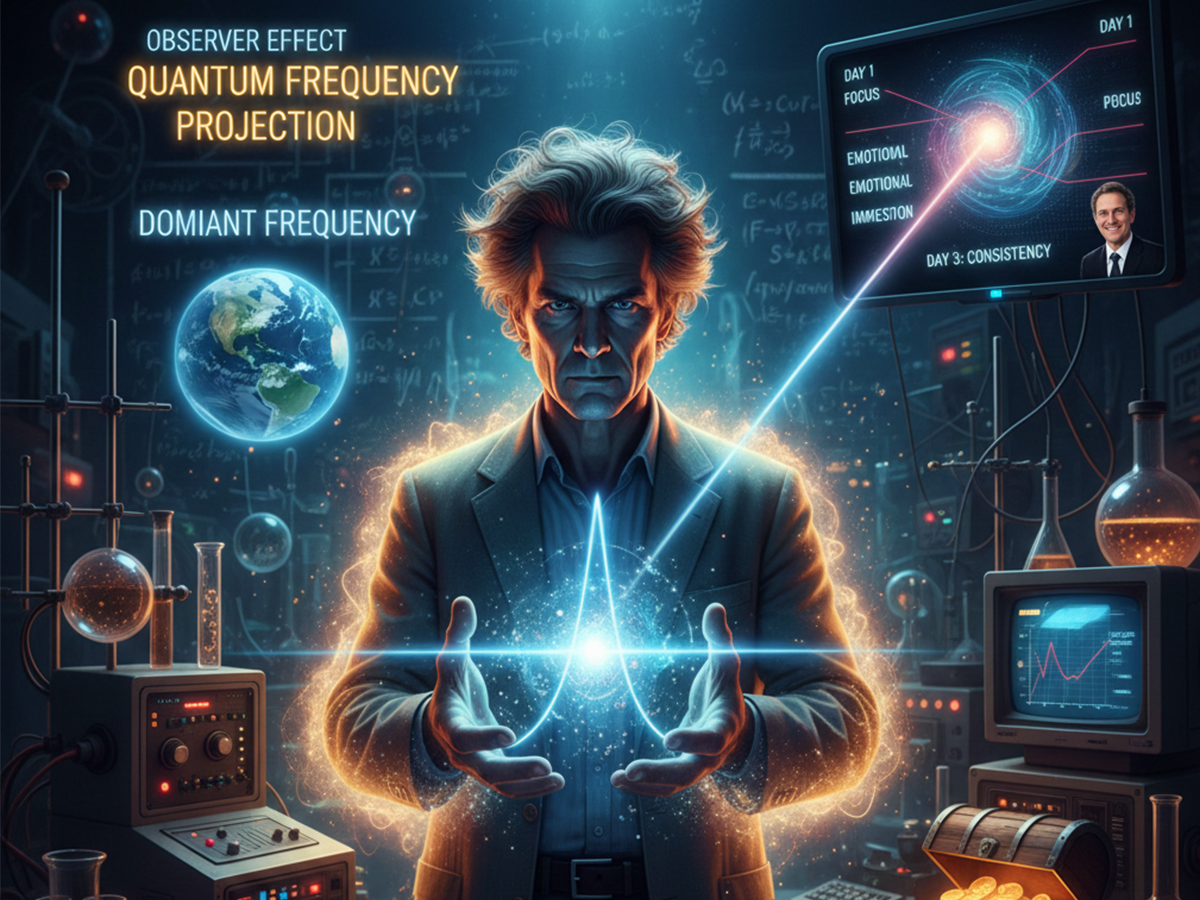
The Active Role of Consciousness in Quantum Physics and Dynamic Considerations of Reality Selection
The Academic Turning Point of 1998 and Scientific Validity of the “Dominant Frequency Projection Method”
- The Quantum Mechanical Observer Problem and Physics of Consciousness
- The Academic Collision of 1998: Historical Background of Heretical Consciousness Physics
- Princeton PEAR Research: 28 Years of Quantitative Analysis of Mind-Matter Interaction
- HeartMath Foundation and Electromagnetic Output of the Heart: Physiological Basis of Reality Projection
- Double-Slit Experiment and Reality Determination: Wave Function Collapse by Consciousness
- Scientific and Logical Validity of the “Dominant Frequency Projection Method (Three-Day Frequency Amplification Method)”
- Collective Consciousness Influence: Global Consciousness Project (GCP)
- Mechanisms of Reality Selection: Non-locality of Information and Temporal Transcendence
- Summary of Scientific Validity and Future Prospects
The Quantum Mechanical Observer Problem and Physics of Consciousness
Since the dawn of quantum physics, the influence of the observer on physical systems has reigned as one of the most profound and intractable paradoxes in science. Within the framework of traditional physics, particularly the Einsteinian objective worldview, physical reality is assumed to exist independently, regardless of the presence or absence of an observer. However, the standard interpretation of quantum mechanics—the Copenhagen interpretation—suggests that through the process of wave function collapse, the act of observation crystallizes a probabilistic “superposition” state into a single “reality.”
Purpose of This Report: Focusing on the expulsion of quantum physicists from academic societies around 1998, this report examines the validity of claims that consciousness manipulates quantum probability and selects specific realities. In particular, it integrates the vast experimental data from Princeton University’s Engineering Anomalies Research (PEAR) laboratory spanning 28 years, HeartMath Foundation’s electromagnetic research on the heart, and evidence of consciousness interference using double-slit experiments to discuss how the concept of “Dominant Frequency Projection Method (Three-Day Frequency Amplification Method)” is positioned within the boundary regions of modern physics.
The debate over whether human consciousness mediates this “observation” process, or whether mere physical interaction suffices, transitioned from philosophical speculation to rigorous experimental science by the late 1990s. The “PEAR proposition” that consciousness functions not merely as a processor of information but as a constructor of physical reality represents one of the most radical challenges to conventional scientific paradigms, entangled with political, cultural, and personal factors.
The Academic Collision of 1998: Historical Background of Heretical Consciousness Physics
1998 was a year when tensions in academia reached their zenith over whether consciousness research could be established as science. During this period, multiple researchers exploring the boundary between the physical and mental worlds experienced de facto exclusion from mainstream academic communities. Behind this “expulsion” lay a sense of crisis that claims of consciousness bringing order to physical randomness would shake the very foundations of scientific objectivity.
The Political Nature of Anomalies Research
The pursuit of “Anomalies” in physics inherently involves political processes. Research institutions like the PEAR Lab, specializing in Mind-Machine Interaction, faced personal and interpersonal pressures unprecedented in traditional scientific scholarship for over a quarter-century.
Around 1998, while these research findings were denounced as “pseudoscience,” organizations such as the International Consciousness Research Laboratories (ICRL) and Society for Scientific Exploration (SSE) began constructing platforms to continue describing and demonstrating phenomena at a distance from the mainstream—a significant watershed in the history of science.
Rediscovery of Phenomena
The migration to organizations like the SSE reveals how physicists had to deliberately detach from existing organizational frameworks to keep their research “scientific.” Considering that the etymology of “Phenomenon” is “to appear, to shine, to become manifest,” these physicists can be seen as pioneers attempting to bring the phenomenon of “observer influence,” previously obscured by existing theories, back into the light.
Princeton PEAR Research: 28 Years of Quantitative Analysis of Mind-Matter Interaction
Princeton University’s Princeton Engineering Anomalies Research (PEAR) laboratory investigated the non-local influence of consciousness on physical systems with scientific rigor for 28 years from 1979 to 2007. At its core were experiments using micro-electronic random number generators (RNG). RNGs generate bit strings of 0s and 1s based on inherently random physical processes such as radioactive decay or electronic noise, directly reflecting the behavior of quantum probability fields.
Statistical Deviation of Intention on RNGs
PEAR Lab researchers asked subjects (operators) to “intend” for RNG outputs to bias in specific directions (e.g., increasing or decreasing the ratio of 1s). The results showed that across millions of trials, deviations caused by individual intention reached statistically significant levels.
| Experiment Type | Cumulative Trials | Statistical Deviation (Z-score) | Divergence from Expected Value (p-value) |
|---|---|---|---|
| Individual Operators (With Intention) | Millions of trials | 2.5 – 4.2 | < 0.001 |
| Control Group (No Intention) | Millions of trials | 0.0 – 0.5 | > 0.500 |
| Emotionally Bonded Pairs | Tens of thousands of trials | 5.0 or higher | < 0.0001 |
One of PEAR Lab’s most shocking findings was that consciousness’s influence depends on bit rate—the speed of information generation. In MegaREG experimental sets conducted before 2004, while positive responses aligned with intention at rates of 200 bits per trial, reducing the rate to 2 bits per trial revealed a perplexing phenomenon: the magnitude of influence increased but the direction reversed to negative.
This “reversal phenomenon” suggests that consciousness-physical system interaction is deeply involved not merely in energetic interference but in the complexity and structure of information.
Emotional Resonance and “Field Consciousness”
PEAR’s research demonstrated not only individual intention but also the possibility that collective emotional energy brings order to the physical world. In scenarios like professional baseball games where tens of thousands of spectators simultaneously experience strong emotions (anticipation, excitement, disappointment), momentary and pronounced fluctuations were observed in RNG output patterns.
This suggests that consciousness is not a phenomenon confined within individual brains but spreads as a “field” in space, possessing the property of organizing random physical processes within that space. Notably, when “bonded pairs” in romantic relationships or deep trust participated jointly in experiments, their influence reached approximately six times that of individuals alone.
Critical Discovery: This fact indicates that the power of consciousness in reality selection depends more on emotional “coherence” with others than on the strength of individual will.
HeartMath Foundation and Electromagnetic Output of the Heart: Physiological Basis of Reality Projection
The heart plays an extremely significant role as the “physical amplifier” for consciousness to interfere with quantum probability fields. HeartMath Foundation’s research proved that the heart is not merely a blood pump but the most powerful electromagnetic field generator and information processing center in the body.
The Heart’s Electromagnetic Field and Its Propagation
The heart’s electrical contraction process (ECG) simultaneously generates a powerful magnetic field. This cardiac magnetic field can be detected by high-sensitivity sensors up to 15 feet (approximately 4.5 meters) away from the subject’s body. This substantiates that information subjectively perceived as “atmosphere” or “vibes” when humans face each other is actually physically transmitted through electromagnetic fields radiated from the heart.
Cardiac Information Encoding
The heart’s magnetic field is not merely an energy wave but encodes complex patterns (information) reflecting the person’s emotional state.
Dynamic Balance
The heart, nervous system, hormones, and mechanical control systems constantly interact non-linearly and dynamically even in steady states, with healthy optimal function being the result of this complex dynamic balance.
Coherence State
When this state is achieved, the heart transmits highly organized signals called “coherence,” which function as powerful “projections” onto surrounding quantum fields.
Consciousness and Earth’s Magnetic Field Resonance: Global Coherence
HeartMath Foundation pursues the possibility that individual cardiac coherence interacts beyond inter-individual communication with Earth-scale physical environments (geomagnetism, ionosphere, Schumann resonances, etc.). According to observational data from the Global Coherence Initiative (GCI), changes in solar storms and solar wind, as well as collective emotional fluctuations accompanying large-scale global tragedies, leave characteristic signatures on geomagnetic and RNG networks.
| Field/Energy Type | Detectable Distance | Related Physiological/Physical Processes |
|---|---|---|
| Brain’s Magnetic Field (MEG) | Several centimeters | Neural activity, information processing |
| Heart’s Magnetic Field | Approximately 4.5 meters or more | Emotional state, heart rate variability (HRV) |
| Earth’s Magnetic Field (GCI) | Global scale | Collective consciousness, geomagnetic activity |
This extensive electromagnetic field generated by the heart is thought to function as a carrier wave for transmitting consciousness’s “intention” into the quantum field.
Double-Slit Experiment and Reality Determination: Wave Function Collapse by Consciousness
In quantum physics, the greatest scientific basis for claims that consciousness selects reality is the “observer effect” seen in the double-slit experiment. This experiment demonstrates that quanta such as electrons or photons behave as waves when unobserved (forming interference patterns) and as particles the moment they are observed (reality determination).
Many researchers, including Dr. Dean Radin, tested whether human consciousness could substitute for physical observation equipment in this experimental system. When subjects strongly “intended” or “observed” particles passing through one slit, statistically significant attenuation of interference fringe contrast was confirmed.
This suggests that consciousness itself interferes with quantum probability amplitude |Ψ|² and serves as a direct “collapse factor” for manifesting specific realities.
Consciousness Action Beyond Spacetime
Furthermore, these effects operate beyond spacetime. According to PEAR Lab research, in experiments on precognition and clairvoyance, cases were reported where subjects accurately described characteristics of target locations dozens of minutes before visiting them. This indicates that consciousness-based reality selection is a non-local process not constrained by current physical position or time.
Scientific and Logical Validity of the “Dominant Frequency Projection Method (Three-Day Frequency Amplification Method)”
The “Dominant Frequency Projection Method (Three-Day Frequency Amplification Method)” presented by users can be considered a concept integrating the aforementioned PEAR Lab findings and HeartMath Foundation’s electromagnetic knowledge into a practical protocol. The validity of this method is interpreted as follows based on provided evidence.
Physical Definition of Dominant Frequency
While the word “frequency” physically refers to the number of vibrations per unit time f, in the context of consciousness it means the spectral distribution of electromagnetic waves generated by the heart and brain, and their coherence (phase consistency). As PEAR Lab research shows, the influence of intention on RNGs is not transient but has cumulative effects.
Relation to Quantum Zeno Effect: Maintaining a specific “frequency (intention)” as “dominant” in consciousness may induce the “Quantum Zeno Effect” at macro-scale. The Quantum Zeno Effect is a phenomenon where continuously observing a system suppresses state changes (transitions), fixing it in a specific state.
The act of maintaining specific intention over three days (three-day frequency amplification) can be interpreted as “sustained observation” that prevents the wave function of desired reality from diffusing and continues increasing its probability.
Biological and Physical Significance of the Three-Day Period
Several physiological and statistical inferences are possible regarding why “three days.”
- Hormonal and Neural Reorganization: Maintaining strong emotions (coherence) requires several days for cycles where stress hormones like cortisol decrease and regenerative hormones like DHEA increase to become established.
- Signal-to-Noise Ratio Improvement: As PEAR Lab data shows, consciousness influence is minute, so extracting “signal” as reality from statistical “noise” requires continuous input over a certain period.
- Morphic Resonance Threshold: According to Rupert Sheldrake’s theory, establishing new habits or knowledge in collective “fields” requires repeated trials, and three days may be the minimum unit for information transfer from individual consciousness to field consciousness.
Collective Consciousness Influence: Global Consciousness Project (GCP)
The power of consciousness to select reality becomes even more robust at collective levels beyond individuals. The “Global Consciousness Project (GCP)” by Dr. Roger Nelson and colleagues monitors a 24/7 network of RNGs (EGGs) placed worldwide, investigating correlations between humanity’s collective consciousness state and physical devices.
Large-Scale Events and RNG Deviations
According to GCP analysis, during events where billions of people worldwide focused attention on a single point—such as the 9/11 terrorist attacks, Princess Diana’s funeral, or Olympic opening ceremonies—RNG outputs showed order so pronounced it cannot be explained by chance (probabilities of one in millions). This can be seen as an example where millions of individual consciousnesses synchronized to the same “frequency” (entrainment), exerting enormous ordering pressure on Earth-scale physical reality.
| Event Nature | Characteristics | RNG Network Response |
|---|---|---|
| Global Tragedies (9/11, etc.) | Shock, deep sadness, fear | Sudden and massive deviations |
| Peaceful Celebrations (New Year, etc.) | Joy, anticipation, unity | Gentle and sustained ordering |
| Group Meditation | Intentional coherence | Six times stronger response than individuals |
These data indicate that when a specific “reality” is simultaneously “selected” or “attended to” by many people’s consciousness, physical randomness disappears and the probability of physical events accompanying that reality increases dramatically.
Mechanisms of Reality Selection: Non-locality of Information and Temporal Transcendence
The process of reality selection by consciousness harbors the possibility of reversing the causality we are accustomed to (causes producing effects). PEAR Lab’s precognition experiments and Sheldrake’s “sense of being stared at” experiments demonstrate that consciousness transmits and acts on information beyond not only spatial distance but temporal separation.
In “sense of being stared at” experiments, it was statistically proven that subjects’ nervous systems respond merely by being stared at through closed-circuit television by a person in a distant location (hit rate being non-random at 1 in 3.8 million probability). This means our “attention” itself possesses energetic attributes that influence targets beyond physical boundaries.
Considering such non-local properties, the “Dominant Frequency Projection Method” can be defined not simply as “wishing for future reality” but as tuning present consciousness to the “already-determined future frequency” in non-local information fields, consequently converging the current timeline toward that future.
Summary of Scientific Validity and Future Prospects
Through this investigation, it has become clear that behind the historical fact of physicist expulsion in 1998 lay a serious paradigm collision over consciousness as the “greatest anomaly for objective science.” PEAR Lab’s 28 years of data, HeartMath Foundation’s cardiac electromagnetics, and GCP’s collective consciousness data all consistently support the following conclusions.
- Consciousness Agency: Consciousness possesses the ability to bring order (negentropy) to physical random systems.
- Cardiac Information Radiation: The magnetic field generated by the heart functions as a physical interface projecting individual internal emotional states onto surrounding quantum fields.
- Intentional Probability Control: Human intention can bias quantum probability distributions at statistically significant levels, forming the basis for physically describing the process of reality selection.
Final Conclusion
While the concept of “Dominant Frequency Projection Method” tends to be labeled as scientific “pseudoscience,” its components (coherence, sustained attention, emotional amplification) align remarkably with physical and physiological principles demonstrated by PEAR Lab and HeartMath Foundation. The “PEAR proposition” that consciousness plays a proactive role in establishing objective reality holds potential as a missing link integrating physics and psychology, or matter and mind, in future science.
If “phenomena” in science are not merely objects of observation but results of co-creation with observers, then the horizon aimed for by the physicists expelled in 1998 is now precisely the time to be re-evaluated as a new frontier of quantum mechanics. The insight that material reality is merely a temporary crystallization floating atop the invisible information field of consciousness compels a redefinition of humanity’s fundamental power—what realities we can select by controlling our “dominant frequency.”