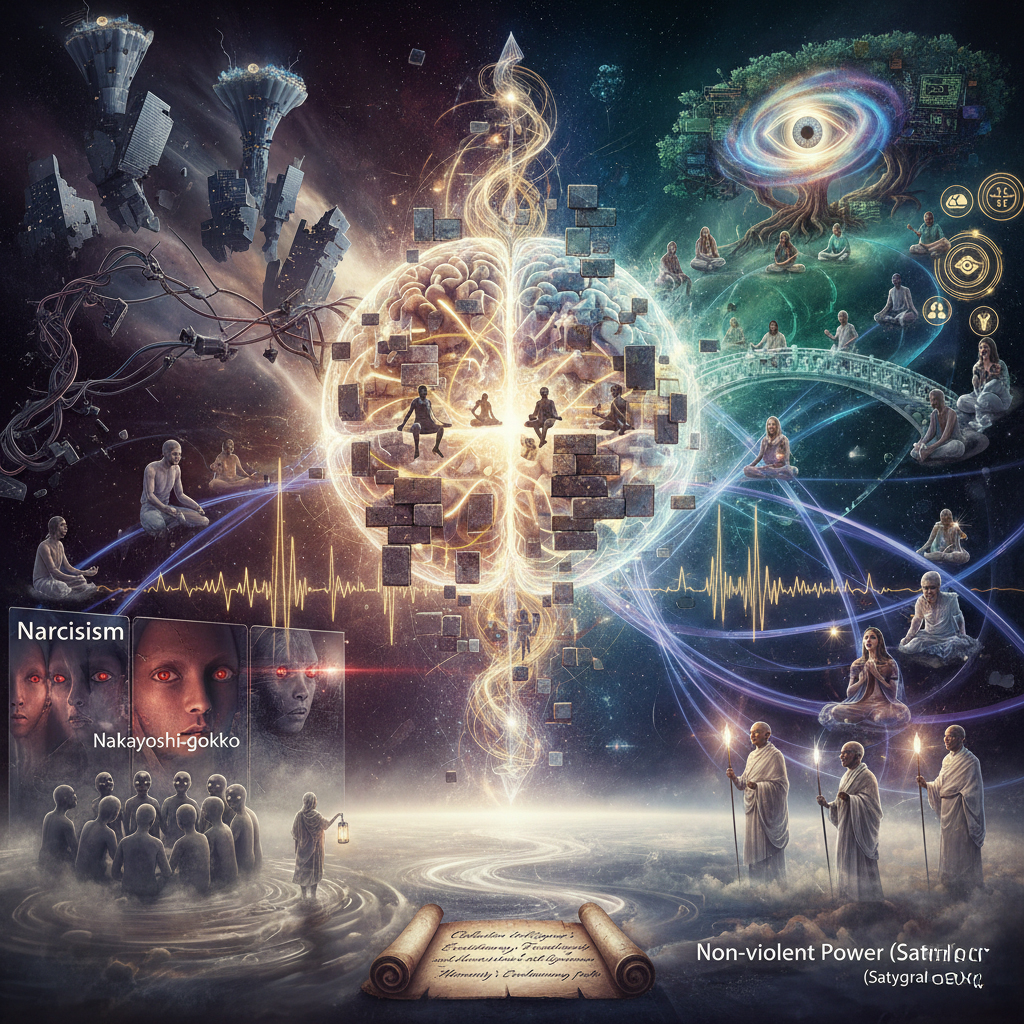
Evolutionary Transitions and Neuroscientific Foundations of Collective Intelligence
A Structural Analysis of Intelligence Decline in Modern Society and the Return to Advanced Spiritual Unity
When surveying the evolutionary history of humanity, it becomes clear from an evolutionary anthropological perspective that the decisive factor distinguishing Homo sapiens from other primates and extinct human species is not “brain size” or individual “intelligence (IQ)” per se, but rather the ability to share, accumulate, and develop information among individuals—namely, “Collective Intelligence.” Humans have evolved not through the development of individual brains, but through the evolution of entire social networks functioning as a unified “Collective Brain.”
- The Formation of the “Collective Brain” in Human Evolution and the Limits of Individual Intelligence
- Theory of Group IQ (c-factor) and Its Components
- Neuroscience of Collective Intelligence: Mechanisms of Interpersonal Neural Synchrony (INS)
- Decline of Collective Intelligence in Modern Society: Narcissism and Transformation of Family Structure
- “False Harmony” and “Groupthink”: Superficial Accord That Robs Judgment
- High Spirituality and True Unity: Pathways to Regaining Collective Intelligence
- Conclusion: “Resonating Intelligence” Opening Humanity’s Future
- References & Citations
The Formation of the “Collective Brain” in Human Evolution and the Limits of Individual Intelligence
According to the “Cultural Brain Hypothesis,” the human large brain was selected not for generating knowledge to adapt to environments individually, but for efficiently learning and transmitting adaptive culture, technology, and social norms from others. In this process, each individual human plays a role similar to a “neuron” within a massive information-processing network called a group.
While extremely vulnerable as individuals with limited survival capabilities in natural environments, functioning as a collective enables “cumulative cultural evolution” that far exceeds the lifespan of any single genius.
A symbolic example supporting this theory is the failure of past explorers. Highly educated European explorers with presumably high individual IQs, when stranded in harsh environments such as the Arctic or Australian deserts, starved or died from poisoning within mere weeks because they lacked the “detoxification techniques” and “water procurement methods” that indigenous peoples had accumulated over tens of thousands of years. This clearly demonstrates that the intelligence necessary for survival exists not “within individual minds” but “within collective culture.”
Three Levers Supporting Cultural Evolution
The speed at which collective intelligence functions and technological innovation occurs is determined by three main elements, or “levers.” The combination of these elements has enabled humanity to achieve dramatic environmental adaptation beyond mere biological adaptation.
| Lever | Definition and Functional Role | Impact on Collective Intelligence |
|---|---|---|
| Sociality | Group size and network interconnectivity | Maximizes the number of learning models and increases opportunities for “recombination” of different ideas |
| Transmission Fidelity | The degree to which information is transmitted accurately without loss | Improved through “psychological technologies” such as education, language, writing, and printing, preventing degradation of knowledge across generations |
| Cultural Trait Diversity | The breadth of different perspectives and technologies existing within a group | Serves as “raw material” for generating new innovations from combinations of heterogeneous information |
The “Flynn Effect” (rising IQ scores across generations) resulting from these levers functioning is interpreted not as biological brain changes, but as the result of society’s collective intelligence becoming more refined, enabling individual members to utilize more sophisticated mental models.
Theory of Group IQ (c-factor) and Its Components
The measure of how intelligently a group can perform has recently been defined as “Group IQ” or “c-factor,” analogous to individual IQ (g-factor). According to research from MIT and Carnegie Mellon University, surprisingly, group intelligence shows almost no correlation with “members’ highest IQ” or “members’ average IQ.”
Collective intelligence is not the sum of individual members’ abilities, but an “emergent capability” arising from the quality of interactions among members. Research has identified three decisive factors for enhancing c-factor:
1. Social Sensitivity
The ability of members to perceive each other’s emotions and intentions. Groups with more members capable of detecting subtle psychological states from others’ eyes and facial expressions demonstrate improved problem-solving abilities. This is because communication noise is minimized when receivers correctly interpret senders’ intentions.
2. Evenness of Conversational Turn-taking
Groups where everyone has equal opportunities to speak, without specific “loud-voiced” members dominating discussions, show high c-factor. The presence of a dominant leader blocks diverse information held by other members, reducing the group’s overall information processing capacity to the limits of the leader’s individual ability.
3. Gender Diversity and Proportion of Women
Teams with a higher proportion of women statistically tend to show higher group IQ. This is related to women generally having higher “social sensitivity,” and the team’s emergent intelligence is enhanced through the simultaneous provision of diverse perspectives and interpersonal relationship coordination.
Neuroscience of Collective Intelligence: Mechanisms of Interpersonal Neural Synchrony (INS)
Collective intelligence is not merely a psychological or social construct, but is supported by physical physiological phenomena in the brain. Recent “hyperscanning” (simultaneous measurement of multiple brains) technology has confirmed “Interpersonal Neural Synchrony (INS)”—the temporal alignment of neural activity patterns among individuals engaged in cooperative activities.
Neural synchrony is the biobehavioral foundation for humans to function not as mere “individuals” but as a unified “social unit.” Synchronization in the following brain regions particularly supports advanced decision-making and judgment:
| Brain Region | Synchronization Function and Role | Impact on Judgment |
|---|---|---|
| Prefrontal Cortex (PFC) | Executive function, strategic thinking, control of cooperative behavior | Goal sharing in complex tasks and unification of strategic decision-making |
| Temporoparietal Junction (TPJ) | Mentalizing (inferring others’ intentions), self-other distinction | Enhances accuracy of predicting others’ roles and behaviors, enabling smooth cooperation |
| Inferior Frontal Gyrus (IFG) | Language comprehension, mirror neuron system, empathy | Facilitates non-verbal information sharing and strengthens emotional unity |
| Anterior Cingulate Cortex (ACC) | Monitoring reward prediction errors, risk detection, conflict resolution | Improves group-wide error avoidance capabilities and responsiveness to uncertainty |
These synchronization phenomena are called “Hyper-brain cell assemblies,” functioning as if multiple brains were integrated into a single network. Research shows that teams with higher EEG coherence (degree of synchronization) perform beyond the sum of individual abilities in solving complex problems.
Enhanced “Judgment” Through Synchronization
Advanced neural synchronization with trusted companions corrects individual cognitive biases and dramatically improves judgment accuracy. Brain-level synchronization converts “true unity” into judgment power through three processes:
Joint Attention: When multiple individuals direct attention to the same object, the error rate of overlooking important information decreases.
Uncertainty Reduction: Synchronization in the anterior cingulate cortex allows sensitivity to environmental risks and threats to be shared, enabling rapid group-wide responses.
Affective Attunement: Through delta and theta wave synchronization, excessive tension and anxiety are alleviated, promoting calm logical judgment (beta-gamma activity).
Decline of Collective Intelligence in Modern Society: Narcissism and Transformation of Family Structure
The “collective brain” mechanisms acquired by humanity through evolution are suffering serious dysfunction due to psychological and structural factors specific to modern society. In particular, the spread of “narcissism” and the structure of “isolated nuclear families” are eroding the foundation of collective intelligence.
The Pathology of Collective Narcissism
The most destructive psychological barrier inhibiting collective intelligence is “Collective Narcissism.” This refers to a psychological state combining excessive sense of privilege—”our group is exceptional but not properly recognized by others”—with paranoid dissatisfaction.
Collective narcissism has fundamentally different qualities from healthy “collective self-esteem.”
| Comparison Item | Collective Narcissism | Healthy Collective Self-esteem |
|---|---|---|
| Attitude toward Others | Hatred of outgroups, prejudice, retaliatory aggression | Pride in ingroup without hostility toward outgroups |
| Information Processing | Prone to conspiracy theories, views criticism as “attack” | Accepts feedback, focuses on realistic problem-solving |
| Decision-making Quality | Prioritizes protecting group image, loses objective judgment | Makes decisions based on public interest and rationality |
| Leadership | Fanatically supports dominant, populist leaders | Prefers leaders who respect diversity and facilitate group dialogue |
While narcissistic leadership may have functioned as temporary “strength” during evolution, in modern society facing complex challenges, it significantly reduces organizational “c-factor” and leads to fatal misjudgments.
Nuclearization of Families and Disruption of Social Learning
Changes in family structure, particularly the shift from extended families to isolated nuclear families, have destroyed the “social infrastructure” for nurturing collective intelligence. While nuclearization has freed individuals, it has brought about intelligence decline in the following aspects:
Degradation of Social Learning Period Quality: The human large brain develops through learning from diverse adults (alloparenting) during a long childhood. In isolated environments, learning models are limited, compromising intelligence diversity.
Breeding Ground for Narcissism: In closed nuclear families, especially “narcissistic family” structures, children are treated as parents’ “status symbols” and grow up unable to learn empathy or boundary construction with others.
Loss of Social Capital: With severed connections to neighborhood residents and kinship networks, the “social trust” capital for solving common challenges has been depleted.
Individuals raised in such environments find it difficult to acquire high “social sensitivity,” resulting in a vicious cycle where they cannot contribute to improving group IQ (c-factor) even when joining organizations.
“False Harmony” and “Groupthink”: Superficial Accord That Robs Judgment
The most common misuse of “collective intelligence” is escape into mere “false harmony.” Attitudes that prioritize superficial harmony and avoid conflict are the polar opposite of true intelligence.
The Abilene Paradox and Mismanagement of Agreement
The “Abilene Paradox” is a phenomenon where the worst decision is made because all group members internally think “that’s wrong,” yet mistakenly believe everyone else agrees, so no one voices dissent. This is caused not by absence of conflict, but rather by the well-intentioned desire to “not break harmony”—a “mismanagement of agreement.”
Groups in this state exhibit the following “deterioration of judgment”:
Pluralistic Ignorance: Believing one’s concerns are a minority view, choosing silence reinforces false consensus.
Self-censorship: Fearing disruption of team harmony, withholding provision of important information.
Illusion of Unanimity: Viewing silence as consent, accelerating action based on unfounded omnipotence.
True collective intelligence arises not from “eliminating differences” but from “integrating differences.” Groups where dissidents’ voices go unheard are like brains with partial necrosis and cannot adapt to complex environmental changes.
High Spirituality and True Unity: Pathways to Regaining Collective Intelligence
To reconstruct lost collective intelligence and acquire advanced judgment, we need “deepening of spirituality” and “redesigning social spaces” that transcend mere improvement of communication skills.
1. Improving Social Sensitivity and Quality of “Dialogue”
Social sensitivity, the core of collective intelligence, can be improved through intentional training.
Listening Rehearsal: Training to hear not just the literal meaning of words but the emotions and “unspoken intentions” behind them.
Regular One-on-One Sessions: Creating spaces within organizations that allow “emotional exchange,” raising the baseline for neural synchronization by increasing psychological safety.
Structuring Speaking Time: Equalizing speaking time to eliminate dominant individual influence, establishing rules for environments where everyone can contribute intellectually.
2. Implementing the Cultural Code of Evolution (CCE)
The “Cultural Code of Evolution (CCE)” is a new paradigm integrating creativity, morality, ethics, and spirituality to overcome the global crises facing humanity.
Pursuit of Inner Integrity: Resolving personal internal conflicts and engaging in dialogue with sincerity enhances overall group coherence.
Feedback-Rich Environment: Cultivating a culture of receiving external environmental and others’ criticism as “gifts” and constantly self-correcting.
Power of Nonviolence (Satyagraha): Pursuing unity based on spiritual strength and “love” rather than physical force or domination. Gandhi’s proposed “Ahimsa (nonviolence)” is redefined as a “science” that transforms individual consciousness and brings tremendous change to collectives.
3. Utilizing Oneness Experiences
Experiences of “oneness” obtained through meditation or deep concentration dissolve self-boundaries in the brain and dramatically enhance neural synchronization with others. Sharing such consciousness states as a group enables decision-making beyond language, improving judgment speed and accuracy.
4. Transition to Creative Democracies
Construction of “Creative Democracies” using collective intelligence as society’s engine is required, abandoning modern rigid hierarchies.
| Feature | Conventional Organizational/Social Structure | Creative Democracy (Collective Intelligence Model) |
|---|---|---|
| Source of Decision-making | Top authority, past successes | Interactions among diverse individuals, real-time synchronization |
| Information Flow | Top-down, information monopoly | Omnidirectional transparency, symbiosis |
| Handling Conflict | Avoidance or suppression | Welcoming constructive conflict as an integration process |
| Goals | Self-interest, maintaining status quo | Public interest, life sustainability, cultural enrichment |
Conclusion: “Resonating Intelligence” Opening Humanity’s Future
Humanity has survived because we instinctively knew we “cannot be wise alone” and acquired the art of synchronizing our brains with others to function as a collective. Many crises facing modern society—climate change, social division, economic stagnation—are nothing but reflections of our inability to properly operate this evolutionary “collective brain.”
Escaping “false harmony” and “narcissistic isolation” to regain true unity with companions of high spirituality is not mere idealism but a survival strategy for humanity’s continued existence. When each person refines their social sensitivity, values dissenting opinions, and sincerely engages in dialogue, our brains begin resonating again, and “true judgment power” far exceeding individual limits emerges.
The path to reconnecting with the “great source of wisdom” called collective intelligence still lies quietly open in the simplest act humanity has repeated since ancient times—deeply connecting with those before us and thinking together. Reviving this “resonating intelligence” in modern times will be the dawn of a new civilization.
References & Citations
Theoretical framework and overview of empirical research on Group IQ (c-factor)