A Multidisciplinary Study on the Divergence of Logical Thinking and Artistic Sensibility:
Cognitive Neuroscience, Behavioral Genetics, and Metaphysical Perspectives
// Does the rise of generative AI bridge this divide — or deepen it?
// A comprehensive analysis from both scientific and metaphysical frameworks.
Hemispheric Lateralization and the Opposition of Cognitive Modes
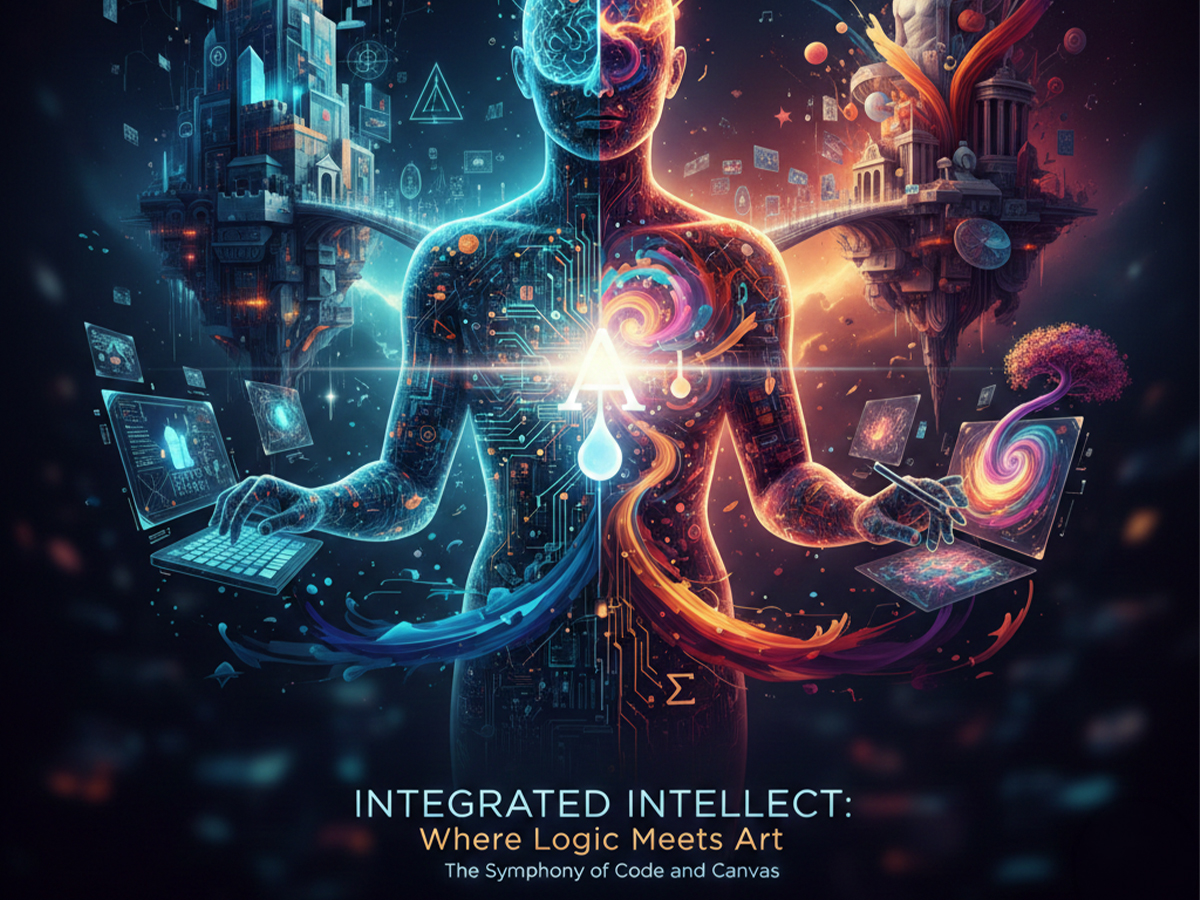
Human cognitive activity has traditionally been divided into two distinct processing modes: “left brain” and “right brain.” This classification functions as a neurologically grounded metaphor, helping to explain the divergence between logical tasks such as programming and cryptanalysis, and sensory tasks such as design and artistic expression.
The left-brain mode primarily governs verbal activity, logical reasoning, and sequential processing — forming an indispensable foundation for productivity, speed, and accuracy in business and engineering. In programming, the ability to decompose complex problems into minimal logical units and reconstruct them according to strict syntactic rules is precisely what the left brain excels at.
In contrast, the right-brain mode centers on non-verbal activity, governing sensation, intuition, and holistic pattern recognition. Artistic sensibility and design ability rely heavily on this right-brain capacity to “grasp the whole at once” and to “process spatial relationships.”
| Characteristic | LEFT_MODE (Logic / Language) | RIGHT_MODE (Sensation / Intuition) |
|---|---|---|
| Primary Functions | Language processing, logical analysis, mathematical computation | Visual/spatial processing, intuitive understanding, artistic sensibility |
| Processing Style | Sequential, linear, detail-focused | Simultaneous, holistic, pattern recognition |
| Typical Activities | Programming, cryptanalysis, strategic planning | Painting, music, narrative creation, design |
| Core Values | Accuracy, efficiency, objectivity | Creativity, sensibility, subjectivity |
The difficulty that logically-oriented individuals face when “creating something from nothing” is thought to stem from insufficient activation of the right-brain mode, or excessive suppression by the left-brain mode. Research in Clinical Art suggests that it is not the act of creating artwork itself that activates the brain — rather, a structured, logic-based program is required to trigger the switch. This implies that even highly analytical individuals can unlock dormant creativity by engaging in a process that deliberately induces a “shift to right-brain mode.”
The Structural Divergence of Convergent and Divergent Thinking
In psychology, problem-solving approaches are divided into two categories: “Convergent Thinking” and “Divergent Thinking.” The balance between these two cognitive modes is the decisive factor that generates the gap between logical expertise and artistic talent.
Convergent thinking is the process of deriving the single correct or optimal solution to a clearly defined problem using logic, precision, and existing knowledge. When programmers build algorithms or perform mathematical calculations, they employ this mode to its fullest extent. However, over-reliance on it risks “cognitive rigidity” — becoming trapped within known frameworks and systematically eliminating novel ideas before they can emerge.
Divergent thinking, by contrast, refers to the process of temporarily suspending judgment and generating a diverse range of possibilities or solutions from a single starting point. The experience of “having no ideas at all” in design can be restated as a condition where the divergent idea-generation process is being immediately short-circuited by the convergent evaluation of “feasibility.”
| Thinking Type | CONVERGENT | DIVERGENT |
|---|---|---|
| Originator | J.P. Guilford (1956) | J.P. Guilford (1956) |
| Goal | Derive a single optimal solution | Generate diverse possibilities |
| Characteristics | Logical, linear, restrictive, analytical | Non-linear, expansive, imaginative, intuitive |
| Brain Network | Executive Control Network | Default Mode Network |
| Cognitive Operations | Re-application of knowledge, skill accumulation | Semantic flexibility, associative fluency |
To achieve outstanding creative results, it is crucial to separate these two thought processes and apply them in the appropriate sequence. The cycle of first securing a “quantity” of ideas through divergent thinking, then refining them through convergent thinking from the perspective of “quality” and “feasibility,” is the key to innovation. The reason people who excel at programming struggle in the arts is thought to be that logical self-censorship interferes with the “free-association” phase — the phase requiring suspended judgment.
Cognitive Inhibition and the Dynamics of Creative Potential
Behind the tendency for highly logical individuals to struggle with artistic design, there may be a neuropsychological mechanism known as “Cognitive Inhibition.”
Cognitive inhibition is the brain’s function of filtering out information irrelevant to the current task in order to maintain focus. In logical thinking and mathematical problem-solving, this suppression mechanism operates with great precision — eliminating noise and enabling the shortest path to a solution. However, in artistic creation, it is precisely this “irrelevant information” that becomes the source of new connections and inspiration.
| Cognitive State | Inhibition Strength | Impact on Creativity |
|---|---|---|
| High Cognitive Control | Strong | Logical accuracy improves, but novel ideas are suppressed |
| Disinhibited State | Weak | Access to normally hidden associations; creativity increases |
| Adaptive Engagement | Variable | Switches between inhibition and disinhibition for efficient creation |
Highly intelligent individuals — particularly those in logical professions — tend to have a reinforced inhibition function. Their brains immediately process ideas that appear irrational or non-logical as “errors,” making it impossible to incorporate the “play” and “chance” necessary in the early stages of artistic design. To enhance creativity, it is necessary to temporarily lower this inhibitory control and permit “mind-wandering” — allowing thought to flow without self-censorship.
The Origins of Talent: Genetics, Environment, and Early Education
Whether artistic sensibility and logical ability are formed solely through personal effort or by innate disposition has long been a subject of debate. Modern behavioral genetics and educational science offer the answer: “the interaction of genetics and environment.”
What matters most is that artistic talent contains substantial elements that can be developed through acquired experience. Even without artists in one’s family, it is entirely possible to cultivate that talent through training in creative thinking — divergent thinking exercises, the KJ Method, the NM Method, and other ideation techniques.
The “STEAM Education” framework (Science, Technology, Engineering, Arts, Mathematics) — now gaining attention in the educational world — aims to achieve coexistence of logical thinking and artistic sensibility by integrating Art into scientific and technological education.
| Evaluation Item | STEAM_EFFECT (vs. Conventional) |
|---|---|
| Mathematics Assessment Scores | +23% |
| Critical Thinking & Problem Solving | +25% |
| Creative Fluency (Number of Ideas) | +37% |
| Originality (Unique Ideas) | +33% |
| Scientific Interest & Curiosity | Significant increase |
When children accumulate experiences in which their personal sensibilities — such as “I want to paint the sky purple” — are respected, they develop the confidence to express themselves freely. This fosters a positive orientation toward future learning and builds self-efficacy. Conversely, children raised in educational environments that seek only logically correct answers risk having their right-brain sensory mode switched “off,” increasing the likelihood that they will hit the wall of “I can’t think of any design ideas at all” in adulthood.
The Transformation of Left-Brain Thinking in the Age of Generative AI
The rise of Generative AI (GenAI) has become a powerful “cognitive prosthetic” for left-brain-dominant individuals, supplementing creative output. This phenomenon has significant implications not only for individual workflows, but also for self-efficacy and professional identity.
For left-brain thinkers — programmers in particular — design and visual composition have long been a difficult domain grounded in “tacit knowledge” and “uncertain sensibility.” Generative AI has made it possible to instantly produce artistic output through “logical instructions” in the form of prompts. As a result, these individuals can now outsource “the agony of creating from nothing (divergent thinking)” to AI, and instead focus on “evaluation and selection (convergent thinking)” — choosing the best option from a multitude of generated proposals.
| AI Usage Pattern | Content | Cognitive Impact |
|---|---|---|
| Information Retrieval & Clarification | Data search, concept organization | Efficiency gains, reduced cognitive load |
| Idea Testing & Critique | Validation and refinement of existing ideas | Strengthened logical coherence |
| Thought Outsourcing | Delegating decisions to AI | Reduced self-efficacy, paralysis of critical thinking |
| Co-creation | Using AI as a sounding board | Expanded creative domain, new discoveries |
For learners and professionals who struggle with expression, using generative AI can help accumulate small successes and thereby strengthen self-efficacy. However, witnessing AI produce high-quality work in a matter of seconds simultaneously risks triggering feelings of inferiority — “Is my own effort worthless?” — and a sense of lost uniqueness.
For those who regard creative activity as a core part of their identity, this “erosion of confidence” through comparison with AI can go beyond a mere psychological issue, potentially leading to reduced motivation, stress, and burnout. In this context, the critical shift is to redefine AI not as a “competitor” but as a “partner,” and to relocate the human role toward “final judgment and meaning-making.”
Rare Integration: The Cognitive Architecture of Polymaths and the “Creative Coder”
Individuals who demonstrate exceptional ability in both programming and artistic design have historically been called “Polymaths” or “Renaissance Men.” Typified by Leonardo da Vinci, these individuals do not pit logic against sensibility — they treat the two as a single integrated system.
The defining characteristic of a polymath is the ability to find “connectivity” between different fields. Rather than partitioning knowledge into isolated categories (silos), they practice “systems thinking” — viewing all phenomena in the universe as intimately interconnected. For example, when studying anatomy, da Vinci connected blood circulation to the flow of water, and applied those observations to his depictions of flowing hair and the folds of fabric in his paintings.
| Characteristic | POLYMATH Thinking (Integrated) | Specialist Thinking (Siloed) |
|---|---|---|
| Intellectual Curiosity | Broad and boundless | Deep focus within a specific domain |
| Boundary Perception | Crosses and connects disciplinary boundaries | Maintains boundaries, guards specialization |
| Problem Solving | Cross-disciplinary, lateral thinking | Linear, deep-dive approach |
| Brain Activation | Broad simultaneous activation | Concentrated activation in specialized areas |
Modern roles such as “Design Technologist” and “Creative Coder” can be understood as contemporary attempts to reproduce this polymath quality within the digital environment.
A Metaphysical Approach: Reincarnation and the Accumulation of Vāsanā
Beyond scientific explanation, the perspective of “reincarnation” is elaborately systematized in Eastern philosophy — particularly in Indian karma theory. From this vantage point, individual differences in ability are understood not as mere worldly coincidence, but as the result of an incomprehensibly vast accumulation of time.
In Indian philosophy — particularly in the Yogācāra school and Vedānta — all past actions, thoughts, and intentions are said to be imprinted as “Vāsanā” (latent impressions, 習気) deep within consciousness. The “Ālayavijñāna” (storehouse consciousness, 阿頼耶識) — which persists even after the body perishes and carries karma into the next life — and “Samāna-vāsanā” (habitual impressions) — through which past repeated actions emerge as future tendencies — provide the theoretical foundation.
According to this theory, a person skilled in programming — the “logical and mathematical manipulation” of the current life — has accumulated similar intellectual and logical training across previous lives, and those “seeds” germinate with ease in this lifetime. Similarly, design ability that “simply does not function” may reflect a history of having neglected to cultivate that domain in past lives, or of having trained with an overly logic-heavy orientation.
| Concept | Meaning | Influence on Talent |
|---|---|---|
| Karma (業) | Intentional action and its consequences | Determines environment and physical characteristics as karmic fruits |
| Vāsanā (習気) | Psychological tendencies formed by past experience | “Natural aptitude” and rapid acquisition in specific fields |
| Saṃskāra (形成力) | Formation of latent memories and dispositions | Personality and unconscious walls such as “I can’t think of design ideas” |
| Prārabdha Karma (宿命) | Karma predetermined to manifest in this lifetime | Innate genius — or, conversely, an insurmountable weakness |
This perspective makes it possible to reframe the current gap in abilities — rather than viewing it as an “unbridgeable divide” to despair over — as “one stage in a longer arc of evolution.” A person who has fully inhabited the “left-brain type” in this lifetime may, in the next, take on the challenge of developing “right-brain sensibility,” equipped with the logical foundation they have now built.
Integrative Reflection: Transcending the Divide and the Future of Intelligence
The divergence between logical thinking and artistic sensibility is explained neurologically through “cognitive inhibition” and “hemispheric lateralization of processing modes,” supported educationally by “early childhood environment,” and interpreted metaphysically as the “accumulation of the soul.” These perspectives are not mutually exclusive — they illuminate different facets of a multilayered reality.
Modern society, in its relentless pursuit of efficiency, tends to force individuals into a binary choice: “cog in the logical machine” or “intuitive artist.” Yet as the example of Leonardo da Vinci demonstrates, authentic intelligence does not partition these two modes — rather, it recognizes that “sensibility is sharpened precisely because of logic, and logic comes alive precisely because of sensibility.” They exist in a mutually complementary relationship.
// FINAL_OUTPUT: Conclusion
It cannot be denied that the gap between logical and artistic talent appears “unbridgeable” because of the strong neural wiring of the brain in this lifetime and the deep psychological tendencies (Vāsanā) carried forward from the past. Yet as the outcomes of STEAM education and polymath research demonstrate, by deliberately toggling the cognitive switch and persistently knocking on the door of different modes, that gap is gradually bridged.
AI as a new technology becomes the catalyst that dramatically accelerates this bridging. What matters is not to accept one’s “type” as fixed destiny, but to adopt an “integrative stance” — using one’s dominant mode (left brain) as a foundation while incorporating the outputs of a different mode (right brain).
To make the fullest use of the tool called “intelligence” at hand, and to attempt to connect different domains — that act itself may be the most noble redefinition of human creativity.
“Sensibility is sharpened precisely because of logic — and logic comes alive precisely because of sensibility.”
- [01] Sports for Social — “Art as a Life Force: Right-Brain Art Born from Zero” (Clinical Art and right-brain activation program insights)
- [02] Soroban Kawagoe — “Why You Should Train the Right Brain?” (Right-brain processing, spatial recognition, and intuition)
- [03] POGSS — “How to Extend Talent” (Behavioral genetics: gene–environment interaction and talent development)
- [04] Ameba Blog — “Artistic Sensibility and Respect for Self-Expression in Early Childhood” (Early education and the formation of a creative foundation)
- [05] K-ART SCHOOL — “STEAM Education and the Role of Art: Measurable Effects” (Outcomes of art integration in STEAM education)
- [06] SMEAI Education — “AI Inquiry-Based Learning and Scientific Self-Efficacy” (Impact of generative AI use on learner self-efficacy)