Empathic Threshold and Social Awakening in Empaths:
An Integrative Analysis of Neurobiology, Traumatic Hyperarousal, and Metaphysical Intuition
- Introduction: Multilayered Redefinition of the Empath Concept
- Empath Positioning Within the Sensitivity Spectrum
- Neurobiological Foundation: Mirror Neuron and Interoceptive Sensation Interaction
- Trauma Adaptation Theory: “Room Reading Ability” as Hyperarousal
- Projection and Empathy Limits: Understanding Through Experienced Pain
- Deception Detection and Social Power Dynamics
- Conflict and Trouble Dialectics: Collision as Truth Manifestation
- Metaphysical Considerations: Astral Resonance and Buddhic Intuition
Introduction: Multilayered Redefinition of the Empath Concept
In contemporary psychology and sensitivity research, the “empath” concept transcends mere definition as “highly empathetic people,” being understood as a multilayered phenomenon encompassing neurobiological characteristics, developmental psychological adaptation strategies, and even metaphysical consciousness hierarchical structures.
This characteristic, commonly recognized as “ability to read room atmosphere,” refers to processes of directly incorporating subtle non-verbal signals—vocal tones, body language, silence quality, and even emotional energy emitted by others—into one’s own nervous system and processing them as internal experiences.
Empaths share all characteristics of “HSP (Highly Sensitive People)” defined by Dr. Elaine Aron, yet their sensitivity extends even deeper. While HSPs “react” to environmental stimuli (light, sound, smell) and others’ emotions, empaths “absorb” those emotions and physical suffering, characterized by blurred self-other boundaries.
Empath Positioning Within the Sensitivity Spectrum
Sensitivity and empathy are understood as continuous spectrums. At one extreme end of this spectrum lies “empathy deficit disorders (narcissistic personality disorder, sociopathy, psychopathy)” completely unable to sense others’ suffering, with empaths positioned at the opposite pole.
| Spectrum Position | Characteristics | Cognitive/Emotional Function |
|---|---|---|
| Extremely Low Empathy | Psychopaths, Sociopaths, Narcissists | Unable to comprehend others’ pain or coldly exploit it |
| Standard Empathy | General Population | Sympathy, situational empathy, clear self-other boundaries |
| High Sensitivity | HSP (Highly Sensitive People) | Low stimulus threshold, deep information processing, high reactivity |
| Extremely High Sensitivity | Empaths | Emotional absorption, self-other boundary fusion, energy sensing |
Neurobiological Foundation: Mirror Neuron and Interoceptive Sensation Interaction
The phenomenon of “reading the room” is not abstract intuition but supported by concrete bodily processes. Within empath brains, “mirror neuron systems” that reproduce others’ states internally are suggested to be more actively functioning than average.
Mirroring and Bodily Oneness
When observing others’ actions or emotions, brain regions like anterior cingulate cortex (ACC), supplementary motor area (SMA), anterior insula (AI), and inferior frontal cortex (IFG) activate. These regions also activate when directly experiencing pain or emotions oneself.
For empaths, this “pain matrix” resonance is extremely strong—merely witnessing someone being reprimanded creates experiences like chest pain or stomach discomfort as if personally being scolded.
Interoception and Predictive Coding
Another mechanism supporting empaths’ “social radar” is heightened interoception (ability to sense internal bodily states). High sensitivity to self-bodily signals like heartbeat changes, muscle tension, and breathing depth enables immediate detection of subtle environmental tensions or dissonances as fluctuations in self-bodily responses.
This system functions as “social prediction.” The brain cross-references “vast internal libraries of social patterns” constructed from past experiences, instantly predicting subsequent developments from slight changes in others’ facial expressions or voices. This processing occurs non-verbally and ultra-rapidly, often feeling like “intuition” or “psychic ability” to individuals, though essentially resulting from highly developed pattern recognition.
Trauma Adaptation Theory: “Room Reading Ability” as Hyperarousal
Whether empath characteristics are innate temperament or arise from environmental factors has been debated for years. Recent research indicates many empathic traits may be rooted in “hypervigilance” as “survival strategies” within unstable environments.
For children raised under abuse, negative interference, or emotionally unstable caregivers, quickly sensing caregiver moods becomes essential technology for ensuring physical and psychological safety. Ability to detect slight vocal quality changes or facial rigidity one step before caregivers become consciously angry functions as “early warning systems” for avoiding conflict and protecting from attacks.
“Wave Calming” Acts as Self-Defense
Empaths’ attempts to solve others’ problems or comfort them don’t necessarily stem from pure altruism. Others’ negative emotions flowing into one’s nervous system cause unbearable suffering, leading to self-defensive motivations of calming others to stop this “noise.” Psychology calls this “egoistic empathy hypothesis,” explaining helping behaviors as reducing one’s own discomfort from witnessing others’ suffering.
| Motivation | Process | Outcome |
|---|---|---|
| Altruistic Empathy | Purely wishing for others’ welfare | Reduction of others’ suffering |
| Egoistic Empathy | Wanting to eliminate self-discomfort from others’ suffering | Self-stress relief, intervention avoiding disturbance |
| Hypervigilance | Scanning surroundings to avoid threats | Safety securing, boundary loss |
Projection and Empathy Limits: Understanding Through Experienced Pain
The question “Can empaths only understand pain they’ve personally experienced?” strikes at empathy’s cognitive mechanism essence. Autobiographical Memory (AM) functions as important models for understanding others’ mental states.
Simulation Through Autobiographical Memory
When inferring others’ states, humans use self-past experiences as templates. When observer and subject subjective experiences match, empathy becomes accurate and deep. However, when both experiences diverge, using self-experience as model actually causes “projection” misrecognizing others’ states.
For instance, empaths with trauma from intense rejection experiences may overreact to others merely remaining silent as “being rejected,” assuming “they dislike me” when others have no such intention. This isn’t reading others’ current states but “projecting” self-past pain onto others’ attitudes.
Debate on Pain Experience Necessity
Conversely, neuroscience research shows brains can represent others’ pain without direct physical pain experiences. Even people with congenital pain insensitivity (congenital analgesia) show empathy-related brain region (ACC etc.) activation similar to healthy individuals when viewing others’ suffering imagery. However, subjective “empathy degree” assessments tend lower than healthy individuals.
Deception Detection and Social Power Dynamics
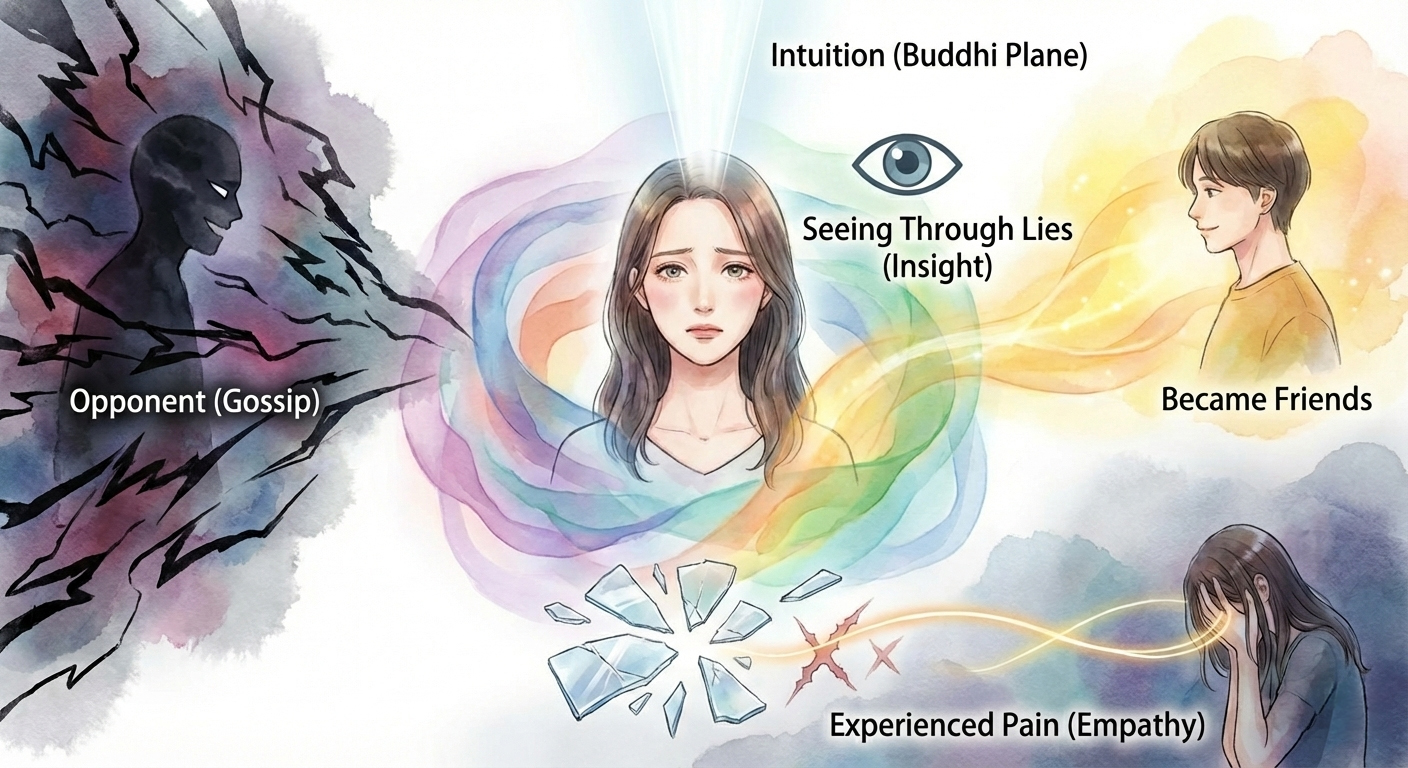
While empaths are considered highly capable of “detecting lies,” this ability has clear limitations and conditions. Particularly when opponents are “more skilled” or hold higher social status, this detection system easily becomes invalidated.
Detecting Dissonance: Incongruent Meta-messages
Primary clues when empaths detect lies are “incongruence” between words and emotional energy. When opponents smile yet harbor subtle hostility or irritation (micro-hostility) beneath, empaths catch this dissonance as “unease.” This “unease” often manifests as bodily discomfort rather than logical analysis.
- Skilled Manipulators: Individuals believing their own lies or completely controlling emotional leakage (those with psychopathic traits) generate no internal incongruence, preventing empaths from sensing “unease.”
- Power Relation Influence: Research shows socially powerful individuals have low motivation considering others’ perspectives, making stereotype-based judgments easily, yet when having clear “lie detection” goals, their accuracy improves.
| Variable | High Power Holders | Low Power Holders / General Empaths |
|---|---|---|
| Lie Detection Accuracy | Relatively high (goal-oriented) | Relatively low (truth bias/emotional contagion influence) |
| Empathy Accuracy | Low (lack others’ perspective-taking) | High (catching subtle signals) |
| Stereotype Usage | High | Low |
| Judgment Confidence | Very high | Situationally variable (prone to self-doubt) |
Conflict and Trouble Dialectics: Collision as Truth Manifestation
The perspective that “true nature only becomes apparent through trouble” emphasizes “conflict’s role” in relationship deepening. Empaths tend toward pacifism avoiding conflict, yet ironically collision itself becomes the catalyst stripping others’ “masks (personas)” and exposing essence.
In psychology, conscious conflict is expressed as “powerful offerings for learning self and revealing hidden truths.” For others simply passed over, maintaining superficial harmony is easy. However, for deep involvement, one must pass through “trouble” processes where mutual boundaries collide and latent needs or values emerge.
- Boundary Clarification: Conflict highlights boundaries of “acceptable to here but cannot concede from here” between self and others. For empaths with ambiguous boundaries, trouble becomes opportunities redefining self-outline.
- Projection Resolution: When trouble occurs and one must confront others directly, “fears” or “expectations” previously projected onto others are corrected by facts.
- Shadow Integration: Strong discomfort or “difficulty” felt toward others often arises when others embody self-suppressed aspects (shadows).
Metaphysical Considerations: Astral Resonance and Buddhic Intuition
When discussing empath abilities, the word “intuition” is often used, yet from theosophical perspectives, strictly distinguishing these as “astral plane (emotional plane)” levels and “buddhic plane (intuitional plane)” levels is necessary.
| Principle (Sanskrit) | Plane (Hierarchy) | Characteristics | Sensitivity Form |
|---|---|---|---|
| Atma | Spiritual Plane | Pure will, pure consciousness | Divine self-awareness |
| Buddhi | Intuitional Plane | Love-wisdom, unity, integration | Universal oneness, true intuition |
| Manas (Upper) | Mental Plane | Abstract thought, philosophy | Mental discrimination, insight |
| Manas (Lower) | Mental Plane | Concrete thought, logic | Cognitive empathy, analysis |
| Kama (Astral) | Emotional Plane | Desire, emotion, sensation | Emotional absorption, empathic resonance |
| Prana | Etheric Plane | Life force, vitality | Energetic sensitivity |
| Sthula Sharira | Physical Plane | Material form | Bodily resonance, mirror-touch |
Integrative Conclusion: From Sensitivity’s Curse to Sovereign Empathy
What this analysis reveals is that empath characteristics are not “single abilities” but complex entanglements of biological hypersensitivity, psychological adaptation, and spiritual developmental stages.
“Room Reading” Identity: This is highly developed “social radar,” often hypervigilance byproducts honed for surviving unstable childhood environments.
Projection and Compatibility Issues: Much “unease” or “aversion” empaths feel may be self-past pain projections. However, by becoming aware of these projections and deliberately not avoiding “trouble,” projections dissolve and sublimate into deeper relationships.
Deception Detection Conditions: Lie detection ability depends on power balance with opponents and opponents’ emotional suppression skills. Empaths “losing” to “more skilled” opponents isn’t sensitivity lack but neural overwhelming or “truth bias.”
Intuition Evolution: Evolution from emotion-swayed “astral empaths” to “buddhic intuitives” contemplating wholes from still points becomes the ultimate challenge for sensitivity holders.
For empaths, liberating self-sensitivity from narrow frameworks of “personally experienced pain,” cultivating intelligence (manas) treating it as objective data, and love-wisdom (buddhi) embracing all becomes keys for functioning this characteristic as “power” rather than “difficulty” in modern society.
- [01] Reddit — CPTSD: Participant discussions on empath-hyperarousal relationships
- [02] Reddit — Critical examination of empath concept and boundary issues
- [Note] This report comprehensively references neuroscience, developmental psychology, trauma research, and theosophical literature. Detailed bibliographic lists will be provided when published as academic papers.