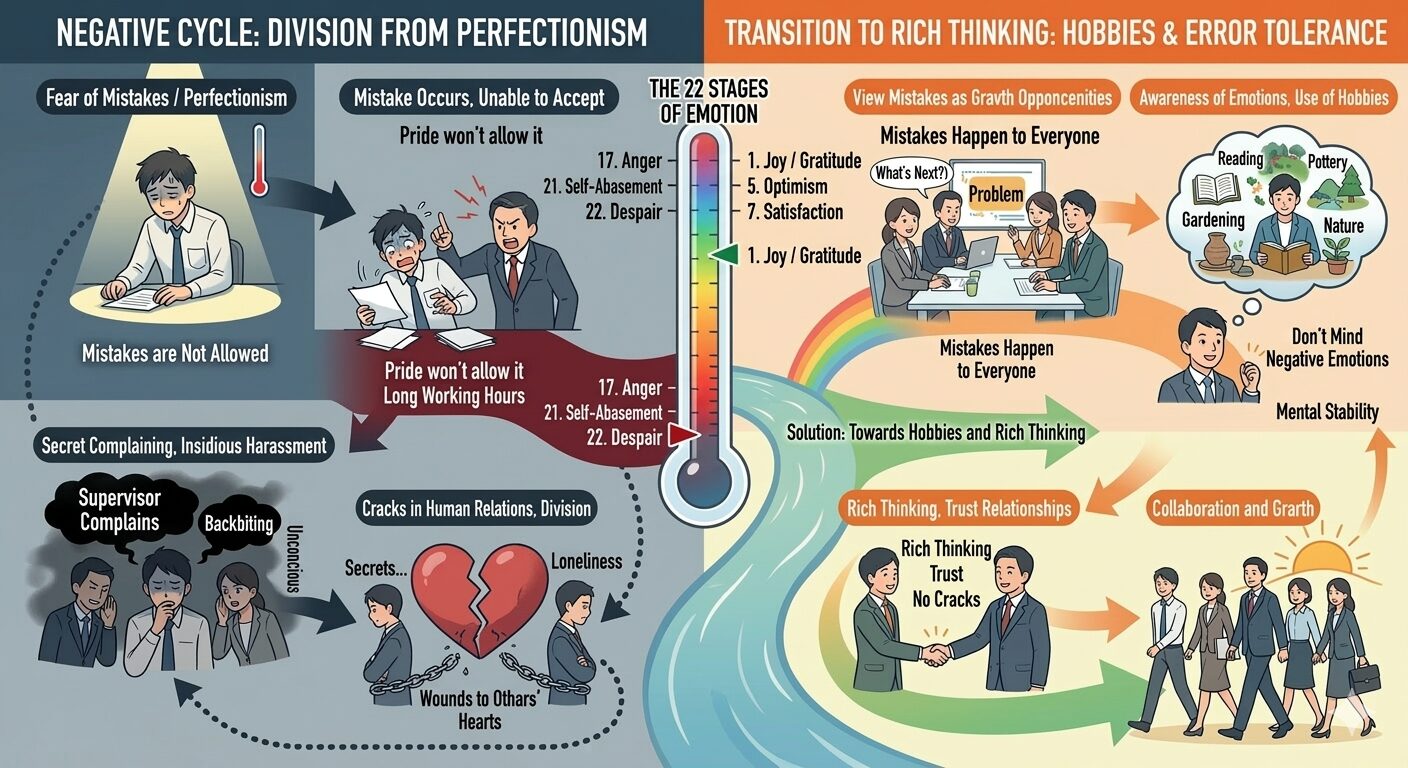
The Anatomy of
Toxic Workplace
Relationships
How Japanese perfectionism fractures teams — and the neuroscience of getting out
In Japan’s social structure, seriousness and perfectionism were vital behavioural norms that underpinned post-war reconstruction and the period of rapid economic growth. In the mature information society and increasingly complex workplace environments of today, however, these norms sometimes bare their teeth in the form of “intolerance toward mistakes” — becoming a catalyst for the fragmentation of human relationships and the emergence of insidious conflict structures. Japanese people have traditionally carried, alongside a collectivism that prizes harmony, a strict self-discipline and a hypersensitivity to the evaluations of others. This report examines the psychological mechanisms by which mistakes cannot be accepted, the effects of overwork on the physical structure of the brain, and organisational models revealed through Japan–US cultural comparison — proposing concrete improvements using the Abraham Emotional Scale and Adlerian psychology.
// CH.01 The Psychodynamics of Perfectionism & Failure Rejection Why mistakes become someone else’s problem
Behind the defensive reactions — blame-shifting and dark humour — that Japanese people display when they cannot face their own mistakes lies a distortion of self-oriented perfectionism. Perfectionism is not simply a matter of setting high goals; in many cases it rests on a conditional self-worth: “If I am not perfect, I have no value.”
Research indicates that self-oriented perfectionism, while raising the quality of work, simultaneously induces “procrastination” — delaying engagement out of fear of failure. Extreme tension also impairs the brain’s executive function, paradoxically triggering further error behaviour. When a mistake then occurs, the individual’s pride (maintenance of self-image) cannot tolerate the fact, and to resolve the psychological dissonance they resort to “External Attribution” — escaping into “it’s someone else’s fault” or “it’s the environment’s fault.”
Professor Edmondson of Harvard University defined “psychological safety” as the conviction that admitting mistakes within a team will not invite censure — yet Japanese workplaces tend to rank extremely low on this measure. In a psychologically unsafe workplace, individuals are dominated by four distinct anxieties.
| Anxiety Category | Concrete Workplace Behaviour | Organisational Consequence |
|---|---|---|
| Fear of appearing ignorant | Avoiding important questions; pretending to understand | Critical misalignment and recurring errors |
| Fear of appearing incompetent | Concealing mistakes; highlighting only successes | Organisational learning halts; problems deepen |
| Fear of being disruptive | Suppressing constructive criticism and suggestions | Conformity pressure blocks innovation |
| Fear of appearing negative | Avoiding pointing out risks or expressing concerns | Latent project crises left unaddressed |
In an environment where mistakes invite blame, the duality of “putting on a good face for the boss while complaining behind their back” becomes entrenched as a survival strategy to protect self-esteem. This is not merely a personality issue — it is an adaptation response to an organisational evaluation system based on “deduction of points.”
// CH.02 Overwork & the Physical Transformation of the Brain It’s not just tiredness — your brain structure literally changes
The “length of working hours” cited as a reason why “rich thinking” becomes difficult is a problem that extends beyond mere mental fatigue — it involves physical changes to the brain itself. Recent neuroscientific research has clarified that overwork inflicts serious damage on the brain regions governing empathy and judgement.
A survey of 110 subjects by a Korean research team reported that the brains of individuals engaged in overwork exceeding 52 hours per week exhibit physical “changes in neural structure.” Compared with those working standard hours, the overworked brain shows increased grey matter volume in certain regions. Most significantly, the volume of the middle frontal gyrus — deeply involved in cognitive function, planning, executive capacity, and emotional management — was found to be 19% greater in long-hours workers.
This volume increase is termed a “neuroadaptive change,” the result of the brain altering its structure in an attempt to withstand excessive load — and it is emphatically not good news. Science Alert has noted that this structural change may increase the risk of long-term cognitive decline and mental illness. When the brain is in such an “emergency mode,” the capacity to empathise with others’ emotions and the “rich thinking” needed to view complex interpersonal situations from above are biologically cut off.
| Work / Sleep Condition | Brain Impact | Specific Symptoms |
|---|---|---|
| 52+ hours/week | Middle frontal gyrus volume +19% | Difficulty managing emotions; distorted executive function |
| 25+ hours/week (age 40+) | Cognitive ability decline | Slowed judgement; errors in information processing |
| Single all-nighter | Brain ages 1–2 years equivalent | Loss of cognitive flexibility; short-term memory impairment |
| Chronic sleep deprivation | Accumulation of neural damage | Emotional instability; collapse of stress tolerance |
In this state of “brain wear,” the capacity for tolerance toward mistakes — which every human ought to possess — is lost, and fertile ground is prepared in which “insidious harassment” for the sake of protecting one’s own pride takes root as an unconscious habit. Overwork is not a personality issue. It is a problem that physically alters the structure of the brain.
// CH.03 Japan vs. USA: Error Culture & System Design Human error vs. system error — a fundamental philosophical split
Japanese “seriousness” and American “freedom” embody contrasting structures in their approach to failure. American workplace culture — particularly in fields where safety is paramount, such as IT and aviation — operates on the thorough premise that “human beings make mistakes.” When a problem occurs, the question asked is not “who did it?” but “which part of the system failed?” — the “system error” approach. In Japan, by contrast, the human error perspective that “mistakes can be prevented by sufficient concentration” remains deeply rooted, with a persistent tendency to link mistakes to “individual carelessness” and “lack of responsibility” — attaching them to character.
// CH.04 The Abraham Emotional Scale: Locating Your Position Where does blame-shifting and backstabbing sit on the 22-rung ladder?
The “22 emotional stages” serve as a useful indicator not only in spiritual contexts but also in contemporary emotional management. The Abraham Emotional Guidance Scale assigns higher numbers to lower “vibrational” states — increasing helplessness and suffering. Crucially, jumping from stage 22 (despair) directly to stage 1 (joy) is impossible. Progress can only be made one “baby step” at a time.
- 01Joy · Appreciation · Freedom · Love
- 02Passion
- 03Enthusiasm · Eagerness · Motivation
- 04Positive Expectation · Belief
- 05Optimism
- 06Hopefulness
- 07Contentment
- 08Boredom
- 09Pessimism
- 10Frustration · Irritation · Impatience
- 11Overwhelment
- 12Disappointment
- 13Doubt
- 14Worry
- 15★ Blame — shifting fault onto others
- 16Discouragement
- 17Anger
- 18★ Revenge — backstabbing, covert complaints
- 19Hatred · Rage
- 20Jealousy
- 21Insecurity · Guilt · Unworthiness
- 22Fear · Grief · Depression · Powerlessness
The states described as “shifting responsibility onto others” and “complaining behind someone’s back” correspond primarily to stage 15 (Blame) and stage 18 (Revenge). While backstabbing may appear “aggressive (anger)” on the surface, it most often conceals, at its root, the stage 22 “powerlessness” of someone who feels unable to change their situation — and the stage 21 “loss of self-confidence” of someone who cannot admit to a mistake. The baby-step principle: anger (17) is better than powerlessness (22), because anger at least represents the beginning of self-assertion — the claim that “something is wrong, and I deserve more respect.”
// CH.05 Adlerian Psychology: Separation of Tasks The single most powerful tool for toxic workplace survival
The most powerful tool for maintaining one’s own psychological stability and repairing fractured relationships in a workplace rife with insidious harassment and blame-shifting is the Adlerian concept of the “Separation of Tasks.” In Adlerian psychology, all interpersonal troubles arise from intruding uninvited into another’s tasks, or from allowing another to intrude into one’s own.
| Category | Your Task (Controllable) | Others’ Task (Uncontrollable) |
|---|---|---|
| Concrete subject | Quality of your work · How you handle your mistakes | Others’ moods · Their evaluation of you · Their mistakes |
| Thought pattern | “Did I give my best?” | “How they feel about it is their freedom.” |
| Response | Sharpen your skills; report honestly | Do not be swayed by gossip or unjust blame |
| Form of support | Signal that you are willing to cooperate | Do not shoulder others’ responsibilities |
Even if a boss is gossiping about you behind your back, that is “the boss’s task” — not something you can control. Investing energy there only further depletes your own “rich thinking.” The “I-Message” technique is essential: rather than saying “You made a mistake” (You-message, which puts the other person on the defensive and triggers blame-shifting), say “I am concerned that this error will cause the schedule to slip.” This conveys the facts without lowering the vibrational energy into blame. Seeking the positive intention behind even aggressive behaviour — “they want the project to succeed,” “they want to be recognised” — allows you to reframe them as an “immature ally” rather than an “enemy,” lifting your emotional scale from anger toward hope or optimism.
// CH.06 The Biological Approach: Serotonin & the Power of Hobbies Neurochemistry as armour against workplace toxicity
“Having hobbies” is, from a neuroscientific perspective, an extremely sound method of psychological stabilisation — one intimately linked to the action of neurotransmitters in the brain, especially “serotonin.” Serotonin acts on the emotional centres of the brain, suppressing anxiety and irritability and maintaining psychological stability. With adequate serotonin secretion, even exposure to others’ negative emotions (gossip, blame) can be received without over-reaction, allowed to pass through. It also regulates the autonomic nervous system disrupted by overwork, stabilising heart rate and blood pressure to cultivate a relaxed state.
When workplace relationships become the sole “arena of evaluation,” failure there feels like the end of the world — this is what sends perfectionism into runaway mode. Having hobbies means cultivating an identity within oneself that is not solely “the worker.” Even when you make a mistake at work, if there is another pillar — “I have guitar,” “I have the satisfaction of a marathon finish” — it prevents the collapse of self-esteem. Rhythmic activities — walking, jogging, crafts, cooking — focus the brain on “here and now,” halting ruminative thought (replaying past mistakes and others’ grievances). This directly activates serotonin neurons. Interacting with friends or pets through hobbies secretes oxytocin — the “trust and bonding hormone” — creating a synergistic effect with serotonin to ease anxiety.
// CH.07 Concrete Countermeasures & Organisational Rebuilding A practical roadmap — for individuals and institutions alike
-
Emotional LabellingWhen you feel unpleasant, give it an objective name: “I’m currently at stage 15 (Blame) on the emotional scale.” This alone suppresses excess amygdala arousal and restores rational control by the prefrontal cortex.
-
Physical ResetWhen you sense that your brain is exhausted from overwork, rigorously implement a 15-minute nap or early-morning sunlight exposure (serotonin synthesis). No psychological approach will be effective unless the brain has physically recovered.
-
Defending Boundaries (Separation of Tasks)Practise not assuming that others’ bad moods are your fault. Even if someone is complaining about you behind your back, draw a line internally: “That is a problem with that person’s emotional processing capacity — it is unrelated to my worth.”
-
Celebrating “Intelligent Failure”Following the example of innovative US companies, deliberately share “high-quality failures” arising from novel challenges and cultivate a culture that praises the learning extracted from them.
-
Role ClarificationBy defining at a contractual level who is responsible for what and to what extent, create a structure in which blame-shifting and “behind-the-scenes offloading” are physically impossible.
-
Redefining the Manager’s RoleRedefine the manager’s job not as “surveillance” or “evaluation” but as “support” — enabling subordinates to produce results. The flat relationships where an American manager is addressed as “Mike” remove unnecessary fear and promote immediate reporting of mistakes.
- [01]Osaka University Repository — Research on Perfectionism and Psychological Adaptation (jjisp_13_15.pdf)
- [02]JMAM (Japan Management Association) — What is Psychological Safety?
- [03]Mynavi HR Trend Lab — Psychological Safety & Organisational Development Column
- [04]oneHR — Psychological Safety: A Management Strategy Perspective
- [05]Panasonic — Healthy Management: Building Workplace Wellbeing
- [06]Gigazine — Too Much Work Is Reshaping the Brain (2025)
- [07]Viestyle Magazine — The Role of Serotonin & How to Increase It
- [08]WAccel — Organisational & AI Column (December 2025)
- [09]Starpo — Abraham Emotional Scale: Detailed Explanation
- [10]Heisei Medical Association — Serotonin and Mental Health Column