Paradigm Shift
in Life Science
& the Re-integration
of Ancient Knowledge
A comprehensive research report on genetics, medical history,
and the structure of the human organism — from the calcification
of the Central Dogma to the holobiont.
FIG. 1 — DNA disruption & paradigm shift: from fixed dogma to dynamic open system
- Dynamics of Theoretical Change & Simplification
- The Calcification of the Central Dogma & Its Expansion by Epigenetics
- The Flexner Report & the Constructive Simplification of Modern Medicine
- The Rise of Transgenerational Epigenetic Inheritance (TEI)
- Chimerism & the Holobiont: Redefining Individual Identity
- Ancient Records & Modern Genetics: Intersecting Narratives
- Three Hypotheses: Evidence, Rebuttal & Most Defensible Interpretation
- From Simplified Dogma toward a Complex Symbiotic & Circulatory System
Dynamics of Theoretical Change & Simplification
The foundational theories of modern life science and medicine appear, at first glance, to represent an unshakeable accumulation of truth. Yet a detailed analysis of their historical evolution reveals that significant conceptual revisions — and sweeping simplifications made in the name of education and popularisation — occurred at specific junctures. The Central Dogma of molecular biology and the Flexner Report that determined the framework of modern medical education stand as the most telling examples of this pattern.
The Calcification of the Central Dogma & Its Expansion by Epigenetics
Proposed by Francis Crick in 1957, the Central Dogma presented the concept that genetic information flows in a single direction — from DNA to RNA to protein. This theory became an extraordinarily powerful model for understanding life as a form of digital information processing, underpinning the explosive advances in molecular biology during the second half of the twentieth century.
In the course of its popularisation, however, the possibility of “bidirectional information flow” and complex mutual interaction — which Crick himself had envisaged from the outset — was discarded. The theory became dogmatised as a simple, unidirectional DNA determinism. In the twenty-first century, this simplified model has been forced into substantial revision by discoveries of “reverse information flow” and “non-genomic inheritance.”
| Theoretical element | Textbook model (late 20th c.) | Revised / expanded model (21st c.) |
|---|---|---|
| Information flow | DNA → RNA → protein | DNA ⇌ RNA ⇌ chromatin → protein |
| Determinants of heredity | DNA base sequence alone | Sequence + epigenetic marks + symbiotic microbiota |
| Role of environment | Selective pressure only; offspring unaffected | Environmental signals imprinted on germline via epigenome |
| Role of the genome | Static blueprint | Dynamic reactive system |
The discovery of long non-coding RNAs (lncRNAs) is overturning the Central Dogma at its foundations. More than 60,000 lncRNAs — three times the number of protein-coding genes — exist in the human genome and actively alter DNA methylation and chromatin structure. This implies that RNA functions as “software” rewriting the “hardware” of DNA: the flow of information is far more circulatory than originally assumed.
The Flexner Report & the Constructive Simplification of Modern Medicine
Published by Abraham Flexner in 1910, the Flexner Report fundamentally reorganised medical education across North America. Its aim was to eliminate “proprietary therapies” lacking a scientific basis and to establish the German-style experimental-science model — allopathic medicine — as the sole legitimate form of medical practice.
While this reform raised and standardised the quality of physicians, it imposed three critical simplifications on the medical world.
1. Establishment of the reductionist disease model: A model seeking causes of disease solely in cellular or molecular abnormalities became dominant, marginalising complex interactions with mental and environmental factors.
2. Systematic exclusion of alternative knowledge: Homeopathy, herbal medicine, nutritional therapy, and osteopathy were expelled as “unscientific.” The 160 medical schools in 1904 were reduced to 66 by 1935.
3. Separation of social and preventive medicine: Medical attention became concentrated on disease treatment; public health, preventive medicine, and social determinants of health were separated from clinical practice.
The Rise of Transgenerational Epigenetic Inheritance (TEI)
According to the traditional “Weismann barrier,” traits acquired by an individual during their lifetime cannot be passed to offspring. Modern research has demonstrated, however, that environmental stress, nutritional state, and even trauma — “lived experience” — can be transmitted from somatic to germline cells via extracellular vesicles, altering the phenotype and health of descendants.
The implication is that life’s blueprint is not fixed in an immutable DNA code alone, but is perpetually updated through the epigenome — a responsive annotation of environmental encounter. This finding stands as the most fundamental rebuttal to the twentieth-century genetics that so radically stripped away life’s complexity.
Chimerism & the Holobiont: Redefining Individual Identity
Microchimerism: the “Other” living within
Microchimerism refers to the phenomenon in which a non-trivial number of genetically distinct, foreign-origin cells are stably resident within a single individual. Once considered an extremely rare occurrence, it is now understood to arise universally through pregnancy, blood transfusion, and organ transplantation.
Particularly striking is the bidirectional cell traffic between mother and foetus during pregnancy. Foetal cells cross the placenta, spread throughout the maternal body — reaching the heart, lungs, and deep brain structures — and survive there for decades. Male-origin Y chromosomes were detected in approximately 63% of female brains examined in one recent study.
| Type | Route of acquisition | Sites of engraftment | Potential effects |
|---|---|---|---|
| Foetal | Foetus → mother during pregnancy | Blood, bone marrow, brain, viscera | Tissue repair; autoimmune modulation |
| Maternal | Mother → foetus during pregnancy | Immune system, various organs | Immune tolerance; infection defence |
| Transfusion / transplant | Medical procedures | Blood, peri-transplant tissue | Rejection control; immune tolerance |
| Multi-generational / twin | Prior pregnancies; co-twin | Systemic | Increased genetic diversity |
Holobiont theory: the human being as an ecosystem
From a broader perspective, the human being is understood as a holobiont — a collective comprising roughly 30 trillion human cells alongside approximately 39 trillion microbial cells. Millions of microbial genes inhabit our bodies, collaborating with the human genome to govern metabolism, immunity, hormonal regulation, and even mental states via the gut–brain axis.
Ancient Records & Modern Genetics: Intersecting Narratives
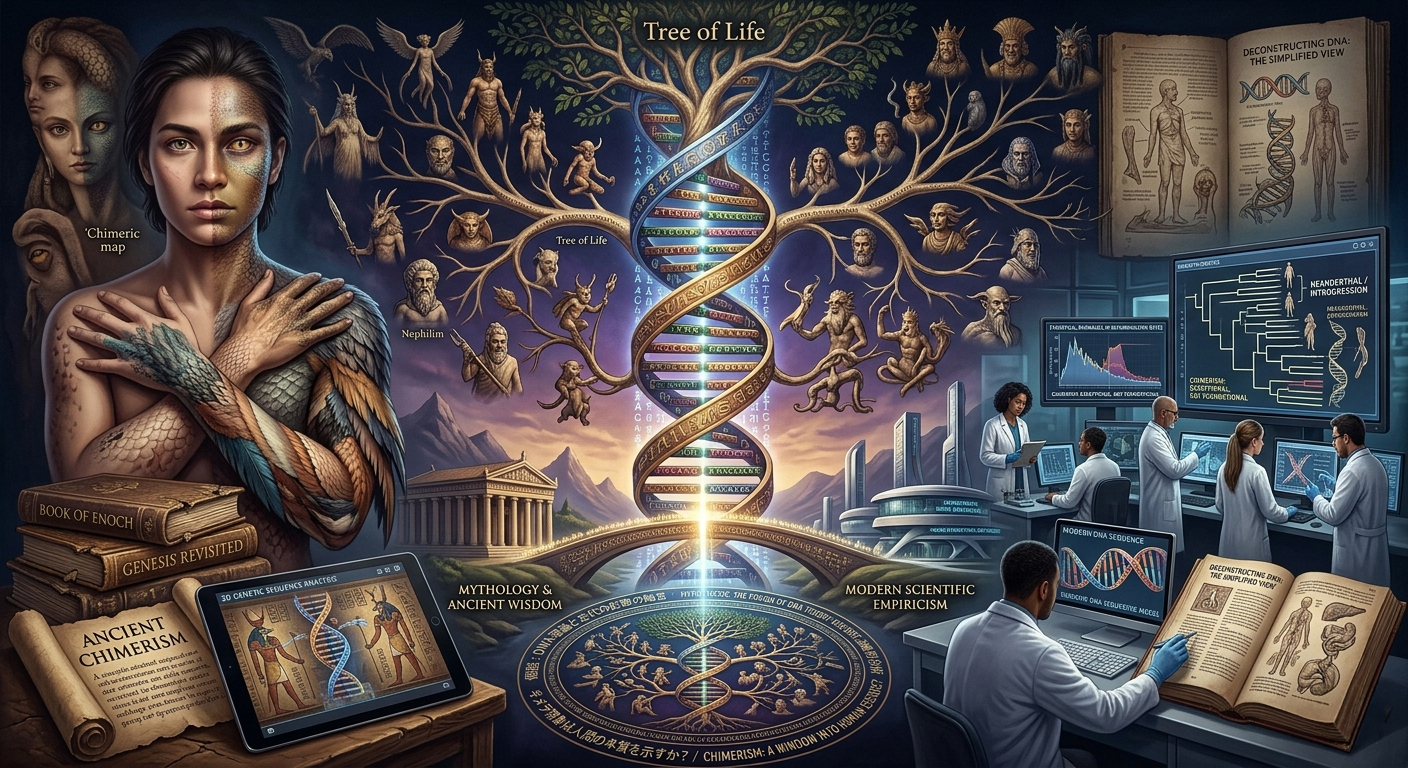
The memory of interbreeding: the Nephilim and archaic humans
Modern palaeogenomics has established that, after leaving Africa, anatomically modern humans interbred frequently with Neanderthals and Denisovans across Eurasia and carry those genes to this day.
| Ancient description | Modern finding | Hypothesised correspondence |
|---|---|---|
| “Sons of God” interbreeding with human women | H. sapiens ✕ Neanderthal / Denisovan admixture | Memory of encounter between distinct human species |
| Nephilim (extraordinary strength, unusual appearance) | Archaic-derived traits: robust skeleton, altitude adaptation | Deification of traits acquired through interspecies mating |
| Fallen angels transmitting civilisation | Rapid introgression of brain size & FOXP2 | Cognitive leap accompanying genetic introgression |
| Flood as implied “genetic cleansing” | Population bottlenecks in human evolution | Selective extinction during major environmental upheaval |
Scientific rebuttal of the Anunnaki hypothesis
Sitchin’s Sumerian translations are dismissed by specialists as creative invention that ignores established linguistics and archaeology. Modern genomic analysis demonstrates clear evolutionary continuity between humans and other primates, with no need to postulate an abrupt external insertion of code. The ENCODE project has shown that non-coding regions are not meaningless junk but an exquisitely precise regulatory system governing gene expression.
Three Hypotheses: Evidence, Rebuttal & Most Defensible Interpretation
Hypothesis 1 — DNA theory and medicine were deliberately altered
Rather than a conspiracy of deliberate concealment, what occurred is better described as “simplification of models for practical convenience, and the cognitive rigidity that followed.” The “exceptions” pruned away in that process have proven, in the modern era, to be the very essence of life.
Hypothesis 2 — Chimerism is an intrinsic structural feature of the human being
The individual is not a “closed circle” but “an open system that perpetually exchanges information with others and physically continues to incorporate them.” Chimerism should be positioned not as a mere exception but as one essential attribute symbolising life’s networked nature.
Hypothesis 3 — Ancient records and modern genetics share meaningful correspondences
Mythology represented the highest-order “narrative description” available to ancient peoples for biological realities they witnessed — archaic humans of exceptional physical capacity, acquired traits transmitted across generations. Modern genetics elucidates the mechanisms behind those narratives; it does not confirm the events occurred literally as described.
From Simplified Dogma toward a Complex Symbiotic & Circulatory System
What this research makes clear is that life science is returning — from “simplified dogma” toward a “complex symbiotic and circulatory system.” A century ago, humanity organised and simplified the mysteries of life in order to make science a practical tool. The result was antibiotics, vaccines, and the technology to manipulate genetic information digitally.
Yet the “overlapping of life (chimerism),” the “dialogue with the environment (epigenetics),” and the “memory of interbreeding stretching back to antiquity” that were lost in that process are being redefined, ironically, by the very latest technologies.
The human being is not a machine driven by a single code. It is the totality of an open process — carrying a genome inscribed with thousands of years of interbreeding history, harbouring a parent’s experience in the epigenome, sheltering countless others and microorganisms within the body, and ceaselessly exchanging information with the environment.
What the science of the future requires is a perspective that transcends twentieth-century separatism — reintegrating this complex information and regarding each individual not as an “isolated unit” but as part of a “continuum of life.” That is nothing other than the beginning of a grand paradigm shift in which medicine, biology, and history once again join hands to approach the truth of what it means to be human.
References
- PMC — Central Dogma of Molecular Biology (review)
- EBSCO — Central Dogma of Molecular Biology
- PMC — Epigenetics and transgenerational inheritance
- Frontiers in Ecology and Evolution — Holobiont theory
- Wikipedia — Flexner Report
- PMC — Microchimerism research
- Tikvah Health — The Flexner Report and modern medicine
- Psychology Today — Medical monopoly and the Flexner Report
- NDNR — Flexner’s impact on naturopathic medicine
- World Journal of Gastroenterology — Gut–brain axis
- PubMed — Male microchimerism in the human female brain