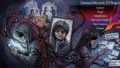
Social Pathology — Depth Psychology Analysis Report
The Deep Structure of the
“Untouchable Person”
The Collapse of Trust, Dark Personality,
and the Complementarity of Good and Evil
A forensic dissection of the social structures that manufacture individuals with nothing left to lose — tracing the dark triad, covert aggression, digital deindividuation, and the Jungian shadow toward a theory of why evil may be inseparable from the good it defines.
Introduction
- Redefining the “Untouchable Person” for the Contemporary Era
- The “Absence of Loss” Manufactured by Social Structure
- The Psychological “Untouchable” State and Dark Personality
- Deindividuation in Digital Space and the Acceleration of Degraded Behavior
- Fate, Choice, and Immaturity: Why People Choose to “Fall”
Redefining the “Untouchable Person” for the Contemporary Era
In contemporary Japanese society, the nuance carried by the phrase muteki no hito — roughly, “the untouchable person” — has begun eroding from its original image of the extreme criminal into something far more quotidian and psychological. First popularized around 2008 as internet slang attributed to Hiroyuki Nishimura, the concept originally described individuals who, having nothing left to lose socially, feel no deterrent from legal sanctions such as arrest or capital punishment.
Re-Definition — The Contemporary Extension
Today, “untouchability” has expanded beyond mere absence of material assets or social standing to encompass those who have voluntarily abandoned trust and ethical feeling in human relationships — people carrying a specifically psychological form of “loss of what is worth protecting.” They need not commit spectacular violence; approaching under the guise of goodwill, they betray and attack insidiously, destroying others’ psyches while hurtling toward their own ruin.
Chapter 01 — Social Structure
The “Absence of Loss” Manufactured by Social Structure
1.1 Statistical Profile and the Dimensions of Isolation
The backdrop against which the untouchable person surfaced as a social problem is the economic instability and collapse of traditional community life that has characterized Japan since the 2000s. Studies by the Ministry of Justice and others found that perpetrators of major indiscriminate crimes were almost universally mired in economic deprivation and intense social isolation.
| Dimension | Survey Findings |
|---|---|
| Age Group | Large majority male, aged 39 or under (37 subjects) |
| Employment | Formally employed: extremely rare (4 subjects); most non-regular or unemployed |
| Monthly Income | Approx. 24% earning under ¥100,000; approx. 84% with zero income |
| Relationships | Majority with no female acquaintances; close friends extraordinarily rare (3 subjects) |
| Stated Motive | Resentment toward personal circumstances most common (22 subjects) |
1.2 The Trap of Self-Responsibility Ideology and the Inversion Toward Hatred
The doctrine of personal responsibility that pervades contemporary society praises success as the product of individual effort while harshly condemning failure as individual laziness. The isolated person who internalizes this logic is initially tormented by intense self-negation and shame. But there is a limit to the self-loathing a human being can sustain — at a certain point the direction reverses outward.
Émile Durkheim’s concept of anomie — the normless state — provides an apt model for the psychological transformation by which the individual severed from society’s shared values comes to perceive all of society as “the enemy.” The distorted logic that “society, which failed to help me, is to blame” is sublimated into a “justice” whose true purpose is self-esteem recovery.
Chapter 02 — Dark Personality
The Psychological “Untouchable” State and Dark Personality
2.1 The Dark Triad: Three Elements of the Personality’s Shadow
Those who manipulate those around them to satisfy their desires — corroding workplaces and organizations from within — frequently exhibit high levels of the three traits known collectively as the Dark Triad.
Machiavellianism
Manipulative Cunning
No means is off-limits in pursuit of an end; others are manipulated with sophistication. Human relationships are chess pieces; strategically betraying trust produces no hesitation.
Narcissism
Grandiose Self-Centrism
Excessive self-regard and craving for admiration. Appropriates others’ achievements without shame; attacks anyone who disagrees to confirm personal superiority.
Psychopathy
Cold Antisociality
Dramatically reduced empathy; impulsive and ruthless decisions. Insensitive to others’ pain; ethical standards are disregarded as inconvenient constraints.
2.2 Covert Aggression: The Tactics of the Hidden Attacker
More insidious still is the practitioner of covert aggression — the one who “approaches wearing the mask of a good person and then betrays without compunction.” Avoiding direct violence, they use psychological manipulation to isolate the target and bring about their mental collapse.
Chapter 03 — Digital Space
Deindividuation in Digital Space and the Acceleration of Degraded Behavior
3.1 The Deindividuation Phenomenon and the Collapse of Self-Regulation
When anonymity is guaranteed in an SNS environment, human beings become prone to the “deindividuation phenomenon.” According to Philip Zimbardo, the following four factors suppress self-regulatory consciousness and amplify aggression.
Anonymity
The illusion that one’s identity cannot be revealed generates omnipotence — the conviction of “I will not be punished.”
Diffusion of Responsibility
“Everyone else is piling on” dilutes individual guilt to near zero.
Excitement & Stimulation
The real-time feedback loop of digital space heightens emotion and strips away the capacity for calm judgment.
Physical Distance
Unable to see the target’s anguished face, the empathy faculty ceases to function altogether.
3.2 Conformity Pressure and the Bystander Effect
Online attacks emerge less as solo acts than as collective conformist behavior. The sensation of belonging to the majority delivers its own intense intoxication of “righteousness.” Meanwhile, witnesses are rendered passive by the bystander effect.
Chapter 04 — Fate / Choice / Immaturity
Fate, Choice, and Immaturity: Why People Choose to “Fall”
4.1 The Intersection of Innate Disposition and Environment
Recent neuroscience suggests that dark personality traits such as psychopathy carry genetic and biological underpinnings. But whether that disposition germinates into “evil” depends heavily on the early childhood environment — above all, on the formation of what developmental psychology calls “basic trust.”
Deprivation of Learning Opportunities
The deficits of “no close friends” and “no romantic relationships” mean that these individuals have been robbed of the very learning opportunities needed to build trusting relationships. Their indifference to trust is not simply chosen; it is partly the passive consequence of a fate in which no relationship worth caring about was ever available.
Active Choice Toward Nihilism
As Nietzsche observed, when existing moral and value systems collapse, the individual may choose to perform “evil” as an existential proof of self. The transient superiority gained from betraying and undermining others is an immediate, visceral pleasure — a substitute for the slow rewards of conventional social success.
Psychological Regression and Immaturity
The inability to perceive others as subjects with their own inner lives — seeing them only as instruments of one’s desire — constitutes a “psychological regression”: a failure to break free from the infantile omnipotence of early childhood. As the threshold for mature adulthood rises in an increasingly complex society, those who have not fully grown up seek to discharge their inadequacy by bullying those around them.
Chapter 05 — Shadow & Complementarity
The Complementarity of Good and Evil and the Function of the “Shadow”
5.1 The Jungian Shadow and Its Integration
Carl Gustav Jung taught that the more consciously a person strives toward “good,” the more the repressed “evil — the shadow” accumulates in their wake. The shadow is the aggregate of psychological content that the individual has discarded as intolerable.
■ The Shadow Mechanism (Projection)
- One projects one’s own unacknowledged vileness onto others and attacks them relentlessly
- The illusion of personal innocence is thereby maintained
- The pursuit of moral purity paradoxically summons the eruption of shadow
- The harder society tries to eliminate evil, the more concentrated and destructive the shadow becomes
■ Complementarity and the Wisdom of Integration
- Good and evil are two sides of one coin — neither can be recognized without the other
- Evil is “an inseparable part of the human system” (Hayao Kawai)
- The mature challenge is not elimination but containment and integration
- Those who integrate the shadow approach what Jung called genuine wholeness
5.2 The Buddhist View: The Experience of Evil and the Discovery of Good
Avidya — Fundamental Ignorance
Human beings are constitutionally unable to see things as they actually are; we fabricate a world shaped by our own convenience. This avidya (fundamental ignorance) is the root cause of evil.
Good Discovered Through Negation
The reason we articulate goodness in negative forms — “thou shalt not kill,” “thou shalt not lie” — is that an intense reality called evil already exists at the foundation. Only by experiencing evil and understanding the suffering it produces does the human being discover “good” as the means of avoiding that suffering.
The Buddha as One Who Has Fully Understood Evil
The teaching that a Buddha is not one who has severed evil but one who has “completely understood evil (the karma of humanity)” offers a profound insight for accepting this irrational reality. The “symbol of evil” functions as a mirror — reminding us of the mechanisms of suffering and directing us toward genuine ease.
Chapter 06 — Resilience
Conclusion: Policy Proposals and Building Societal Resilience
The normalization of the untouchable person and the destruction of trust by dark personalities are expressions of structural pathology in contemporary society. The over-pursuit of efficiency and personal responsibility has eroded the “social tolerance” that once accommodated human weakness, completing the conditions in which isolated individuals tip into becoming symbols of evil.
⚠ The Paradox of Exclusion
We should not respond to those who choose a degraded existence — attacking others with the resolution to descend into hell — with mere disgust and exclusion. That only fixes the relationship of “enmity” they desire, making them yet more untouchable.
Individual-Level Countermeasures
The knowledge to correctly recognize the tactics of covert aggression and the dark triad, and to maintain clear personal boundaries, is essential. The first step in self-defense is keeping in mind that a pathological will to dominate may lurk behind the social mask of someone who appears perfectly “reasonable” and “logical.”
Structural Reform at the Social Level
Rebuilding safety nets in which failure is not a fatal blow — and diversifying the relationships through which anyone can say “help me” (securing third places and equivalent structures) — is urgent. The existence of somewhere isolated individuals can reach out as a last resort is the most powerful social apparatus for suppressing the manufacture of the hollow monster that is the untouchable person.
Rediscovering Trust as a Shared Commons
Caring for the trust built with each person one at a time appears inefficient and fragile — yet it is the only and most unbreakable shield against the hollow monster that is the untouchable person.
Accepting the ironic truth that good stands out because evil exists, we share the responsibility of reconstructing a mature society — one that does not make weakness a cause for shame, and does not let isolation become a fatal wound.