Emotional Consumption &
Self-Destructive Psychology
in the Host Club
The Clash Between Capitalist Exploitation & Spiritual Salvation in the Pseudo-Intimacy Market
Introduction — The “Monetisation of Emotion” in Modern Capitalism & the Social Function of the Host Club
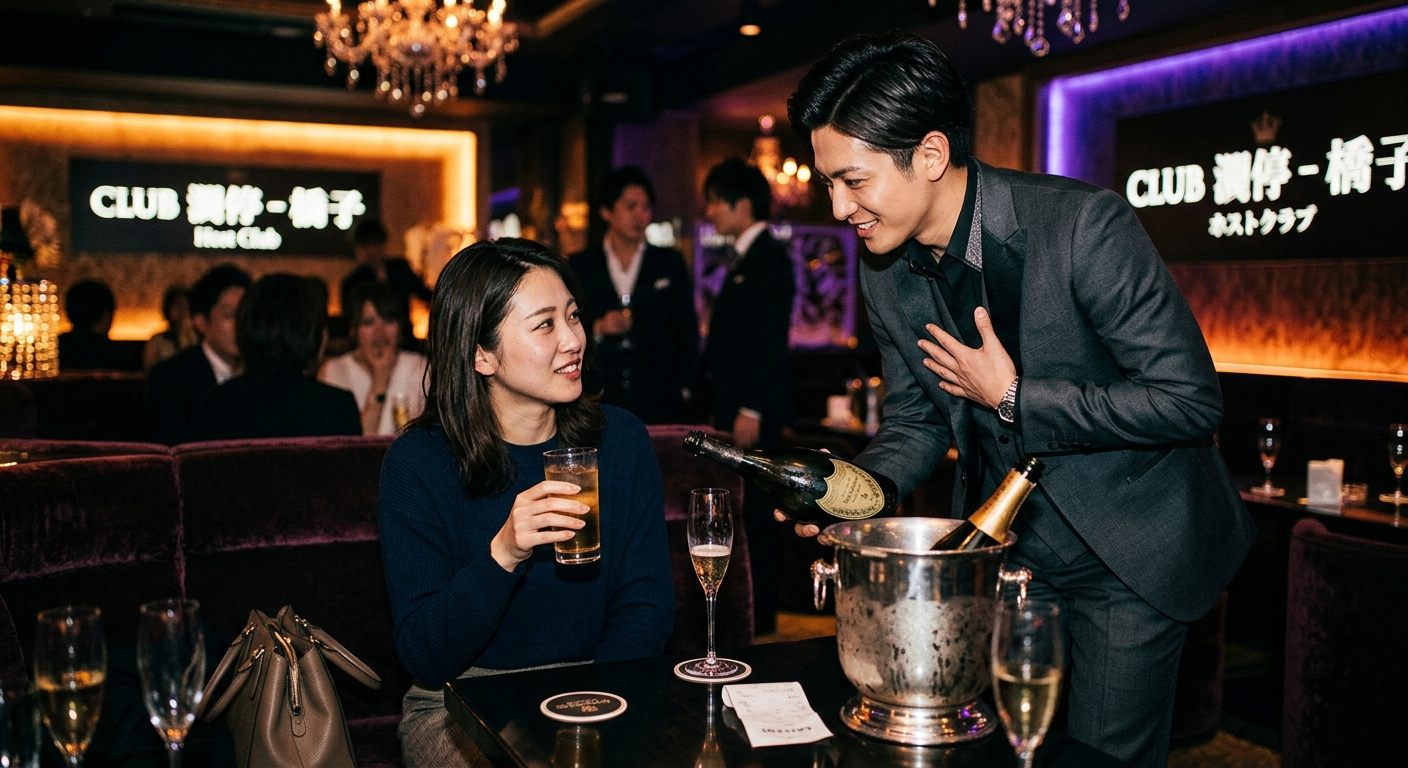
In today’s advanced capitalist society, every human relationship is exposed to the tide of commodification — and the host club stands as its extreme manifestation: a singular pseudo-intimacy market. Within this space, “affection,” “recognition,” and “empathy” — which ought by nature to be freely given — are packaged as meticulously calculated services and traded at extraordinarily high prices. Examining the psychology of women who immerse themselves deeply in host clubs is not merely an analysis of addiction; it is, rather, an exercise in illuminating the abyss of loneliness that contemporary society carries and the crisis of self-identity.
The host club apparatus provides a “sanctuary of unreality” severed from the “reality” of everyday life. Here, through the medium of money, customers enjoy the temporary status of “princess” or “special being.” Yet maintaining this extraordinary experience exacts a tremendous economic price — frequently leading to the “ruin” of debt, a transition into the sex industry, and the breakdown of personal relationships. Nevertheless, the existence of those who view that experience as “a glorious page in their lives” suggests that psychological gains exist there that transcend mere financial loss.
This report analyses in detail — from the perspective of professional expertise and based on available research — the multi-layered psychological structure, the neuroscientific mechanisms, the process of emotional transformation, and the capitalist ethics on which this industry rests.
Chapter I — Psychological Background & Individual Factors Forming Host Club Dependency
Among women who are strongly drawn to host clubs and engage in self-destructive financial support (tributing), several prominent psychological characteristics and environmental backgrounds are observed. These factors do not operate independently — they interweave in complex ways to forge an inescapable chain of dependency.
One of the most powerful factors underlying dependency is a markedly low sense of self-worth. For women unable to perceive themselves as valuable beings, praise from others and being treated as special become essential “nourishment” for maintaining the self. The host club is a place where this nourishment can be obtained instantly and reliably upon payment of money. When a customer’s financial investment visibly translates into the “magnitude of love” for her host — publicly celebrated through in-store “champagne calls” — the experience provides an intense sense of self-utility: “I am someone valuable enough to move this much money” and “I alone am the irreplaceable benefactor of my chosen host.”
| Psychological Risk Factor | Characteristic Behaviour & Psychology | Social Background Influence |
|---|---|---|
| Low self-esteem | Excessive reliance on external evaluation (host’s compliments) to maintain a sense of self-worth | Destabilisation of self-evaluation in a performance-oriented society |
| Hypertrophied need for recognition | Receiving attention from others becomes a near-survival instinct, intensified by social media | The spread of digital narcissism |
| Loneliness and desolation | Seeking pseudo-intimacy to fill voids left by thin parental bonds or few friends | Dissolution of local communities and families |
| Drive to serve and dedicate | Finding existential purpose in supporting (financially sponsoring) someone: “I am indispensable” | Skewed valuation of care labour |
| Rivalry and vanity | Enjoying temporary superiority by winning against other female customers (rivals) | Status competition in a stratified consumer society |
A common background among women who become deeply absorbed in host clubs includes limited romantic experience, an absence of close female friendships, and thin parent-child bonds. When appropriate emotional exchange and recognition from parents were not obtained during the developmental period, there is a strong tendency to attempt to fill that deficit in adulthood through the presence of the host. This dynamic resembles what psychology calls “attachment disorder” — the host’s conditional attention is unconsciously mistaken for the “unconditional love” that was craved. Limited romantic experience heightens vulnerability to the stimulation of the “pseudo-romance” that hosts strategically stage. For women lacking confidence in communication, the host club — where they can enjoy only the positive aspects of romance (dopamine-driven pleasure) while avoiding the friction and responsibilities of equal relationships — becomes a place of refuge.
Chapter II — Neuroscientific Approach: The Dopamine Reward System & Maintaining “Unreality”
The mechanism by which people become absorbed in host clubs and continue attending even while accumulating enormous debt can be explained by the action of neurotransmitters in the brain — in particular, dopamine. The host club experience powerfully stimulates the brain’s reward system, forming neural circuits closely resembling those of substance addiction.
Dopamine is involved in “pleasure” and “anticipation,” activating the reward system that projects from the ventral tegmental area of the midbrain to the nucleus accumbens. Sweet words from the host, the glittering interior décor, and the attention received when placing high-value drink orders all function as triggers for a massive release of dopamine. This state resembles a form of “mania,” bringing feelings of omnipotence and euphoria — but its effects are not sustained, and tolerance develops. The problem lies in the “rebound” after pleasure is experienced. Following the sharp rise in dopamine levels, the following day sees its secretion suppressed, plunging the person into a “dip” state below normal baseline — triggering intense emptiness, depressive mood, and a powerful craving: “I will die if I cannot taste that pleasure again.”
| Neural Brain State | Psychological / Behavioural Response | Concrete Host Club Situation |
|---|---|---|
| Dopamine Rush | Euphoria, heightened activity, dissolution of resistance to extravagance | During champagne calls; intimate conversation with the host |
| Dopamine Dip | Intense depression, listlessness, irritability, self-loathing | Loneliness after returning home; confronting the reality of depleted funds |
| Reward circuit transformation | Rising threshold for stimulation (craving stronger stimulus) | Placing higher-value orders than before; fixation on becoming the “ace” customer |
| Prefrontal cortex decline | Loss of rational judgement; difficulty suppressing impulsivity | Attending even while in debt; ignoring collapse of daily life |
The difference between those who “want to live in unreality and maintain that state” versus those who “break down and become mentally ill” is thought to originate in differences in the brain’s resilience and in the cognitive function that performs “meaning-making” from experience. Women who “break down and become ill” lose the ability to manage the violent swings between dopamine-driven mania and depression, entering a state of complete collapse of the brain’s balance (homeostasis). When serotonergic dysfunction is additionally present, anxiety and fear become uncontrollable, precipitating panic disorder or severe depression.
Unable to manage the extreme oscillation between dopamine mania and depression; brain homeostasis collapses. Serotonergic dysfunction compounds the problem, resulting in panic disorder or severe depression.
They can only perceive the ruin as “the demon who stole everything from me” — and remain fixed in the abyss of powerlessness.
Possess dopamine receptors naturally sensitive enough to maintain positive emotion from smaller stimuli, or neural flexibility to recover from dip states. Alternatively, they perform “narrativisation” via higher-order cognitive functions.
Reconstruct their tragedy as the dramatic story of a “tragic heroine,” converting pain into entertainment through a dissociative defence mechanism.
Chapter III — Abraham’s 22 Emotional Stages: The Ascent from Despair to Gratitude
The process by which the host club experience is positioned as spiritual growth or a “good experience” is analysed using Abraham’s “Emotional Guidance Scale” — a 22-stage classification of human emotions as frequencies of energy, where 1 represents the most positive state and 22 the most negative. The essence of the host club’s service technique is “emotional navigation” — lifting the customer’s emotions swiftly from a lower stage to a higher one. When a woman who feels “despair and powerlessness (22)” or “loss of confidence (21)” in her daily life is raised all the way to “joy, love, gratitude (1)” or “passion (2)” at the host club, that “leap of 20 stages” becomes an overwhelmingly intense experience — as though her life has been saved. For this enormous emotional gain, customers become willing to pay a high price.
- 01★ Joy / Love / Gratitude / Freedom — Unity with host; supreme happiness
- 02Passion — Sense of mission in supporting the top host
- 03Enthusiasm / Motivation — Anticipation of the next visit
- 04Positive Expectation / Belief
- 05Optimism
- 06Hopefulness
- 07Contentment — Daily life outside the club
- 08Boredom
- 09Pessimism
- 10Irritation — Dissatisfaction when the host attends rival customers
- 11Overwhelm — The pressure of payments
- 12Disappointment
- 13Doubt — Suspicion that the host is lying
- 14Worry
- 15Blame — Self-loathing; blaming others
- 16Discouragement
- 17Anger
- 18★ Revenge — Intense jealousy of rivals; rage at the host who belittles you
- 19Hatred / Rage
- 20Jealousy
- 21Guilt / Despair
- 22★ Powerlessness — Massive debt; psychological death when facing ruin
Those who can still say “those days were good” even after ruin have completed the process of reversing this scale. After experiencing “despair (22),” they undertake the work of redefining that experience as “learning” or “gratitude (1).” Specifically — “That money taught me what love (or something like it) feels like for a whole lifetime”; “Because I experienced that hell, I can now appreciate the value of the peaceful life I have today” — by generating feelings of gratitude like these, they transform past trauma into an asset. Whether or not one can perform this “generation of meaning” is the watershed between breaking down and continuing to relish life. Meanwhile, those who break down remain fixed in “powerlessness (22),” able only to see the host as “the demon who stole everything from me (blame: 15),” unable to climb the emotional staircase at all.
Chapter IV — The Clash of Masculine & Feminine Energies & the Deep Psychology of “Tributing”
Analysing the act of “tributing” through the lens of masculine and feminine energies reveals both a reversal of contemporary gender roles and a distorted expression of biologically rooted primal drives. Generally, masculine energy is said to be symbolised by outward forces such as “acquisition,” “protection,” and “provision,” while feminine energy is symbolised by inward forces such as “receptivity,” “empathy,” and “nurturing.” In the host club, however, the woman’s act of “tributing” means she substantively assumes the masculine role of “provider.”
| Attribute | Biological / Psychological Tendency | Manifestation in the Host Club |
|---|---|---|
| Masculine-side aspect | Testosterone influence, aggression, desire for dominance, pride as provider | Competition to push one’s host to the top ranking; aggression toward other customers via “receipt warfare” |
| Feminine-side aspect | Oestrogen influence, empathy, receptivity, maternal instinct | The capacity to embrace the host’s troubles (“dark side”); a drive to serve and support |
Women absorbed in host clubs attempt to liberate the “desire for dominance (masculine aspect)” suppressed in their social lives through the act of tributing, while seeking to maintain their emotional balance through the “devotion (feminine aspect)” they show the host. Hosts, for their part, deliberately display “vulnerability” and “weakness” (“dark side marketing”) to stimulate women’s maternal instinct (nurturing drive), grant them the superiority of being a “provider,” and loosen their purse strings.
Chapter V — The Host Industry as the Apex of Capitalism: The Dilemma of Kindness & Boundaries
The host profession is the ultimate form of “emotional labour,” with thoroughgoing capitalist rationality flowing at its foundation. This is a gruelling business that genuinely kind people cannot sustain — or that demands a sophisticated alternation between “kindness and boundaries.”
The essence of the host’s work is to continue showing the customer a “dream” — yet the price of that dream is managed with extreme rigour. Even a low-spending customer, if they show the potential to earn money through night work (sex industry, etc.) and become a high-spending “ace,” is an investment target for the host’s time and effort. This is closer in sensibility to asset management than to education or nurturing. Throughout this process, the host must continue providing the customer with “false intimacy.” However destitute the client’s life, however mentally ill they become, the ability to smile and say “just one more bottle of champagne” in order to meet the store’s sales targets requires a cold-bloodedness. Without strong “boundaries” of their own, hosts are crushed by guilt over their customers’ misfortune.
Treating the customer’s “dark side” and “dependency” purely as business challenges, without synchronising one’s own private emotions with them.
Adhering to regulations including the revised Entertainment Business Act (effective 2025) while maximising revenue strategically within those constraints.
Those who are too kind find these boundaries grow blurred — they sympathise too deeply with the customer’s suffering and become unable to perform the necessary “pressure” (payment demands). Alternatively, they are swallowed by the customer’s dependency, fall into a co-dependent relationship, and their own life and mental health collapse. Long-term success in this profession therefore requires an indispensable dissociative capacity: using empathic ability as a “tool” while at one’s core remaining a cold-blooded business operator.
Conclusion — The Landscape of “Meaning” Glimpsed at the Edge of Ruin
Women who step into the labyrinth of the host club, pile up debt, drag others into their downfall, and arrive at ruin — at first glance, they appear to be nothing more than tragic victims of contemporary society. But as this analysis has shown, among them are those who sense a kind of “extreme living” reachable only through that very ruin.
Human beings do not seek merely stable happiness (around stage 7 on the emotional scale). At times, we are creatures who crave an emotional “leap” — a moving experience of such violent amplitude that it destroys the self (the jump from 22 to 1). The dopamine radiance obtained at the moment of that leap has the potential to become the “myth” that sustains the rest of one’s life.
Those who can say “those days were a good experience” are people who paid the steep tuition of ruin to acquire an intense self-recognition: “I am someone who loved (supported) another human being this deeply, and who has the strength to survive even in this broken state.”
Those who break down and become ill, on the other hand, can only perceive that ruin as “something taken from them” — leaving the reins of their own lives with the host, they remain in the abyss of powerlessness. The “pseudo-intimacy market” that capitalism created continues to expand, fed by human loneliness and the hunger for recognition. But whether the experience there ends in “ruin” or becomes the nourishment for “rebirth” is, in the final analysis, entrusted to the power of the spirit — to how fully each individual can define their own life as “a story of their own choosing.”
- [01]host-work.com — Psychology and Characteristics of Women Who Become Absorbed in Host Clubs
- [02]Waseda Mental Clinic — Psychiatric Analysis of Host Club Dependency
- [03]givers.be — Hosts and Women: The Structure of Pseudo-Intimacy
- [04]Grant-in-Aid for Scientific Research — KAKENHI-PROJECT-18K07401 (Related Research)
- [05]Smile Navigator — Neuroscience of Bipolar Disorder: The Dopamine Reward System
- [06]Reddit / SeriousConversation — Discussion of Psychological Differences (Japanese Translation)
- [07]hosuriku.com — Host Industry Service Techniques & Emotional Labour