The Deep Boundary Between AI-Generated Music and the Human Voice
Psychoacoustics, Frequency Analysis, and the Architecture of Hit Songs
What the staff lines reveal — between “calculation” and “life”
- The Technical Frontier of AI Music Generation and an Engineering Analysis of Rhythmic Structure
- The True Nature of “Talent” in the Human Voice: The Sources of Individuality Through Acoustic Analysis
- Frequency and Neuroscience: 1/f Fluctuation and the Correlation with Healing Frequencies
- Structural Analysis of Hit Songs: The Moment “Dislike” Transforms into “Trend”
The Technical Frontier of AI Music Generation and an Engineering Analysis of Rhythmic Structure
In the contemporary music industry, the advances made by multimodal generative AI systems such as Google’s Gemini have triggered a paradigm shift that far surpasses anything the era of vocal synthesizers could have imagined. AI-generated music now permeates every platform, and systems like Gemini are capable of producing full compositions in roughly eight seconds—complete with natural pronunciation that fluidly blends Japanese and English. Yet behind this technical progress lies a deep and persistent divide between the physical generation of sound and the expression of music produced through a human body.
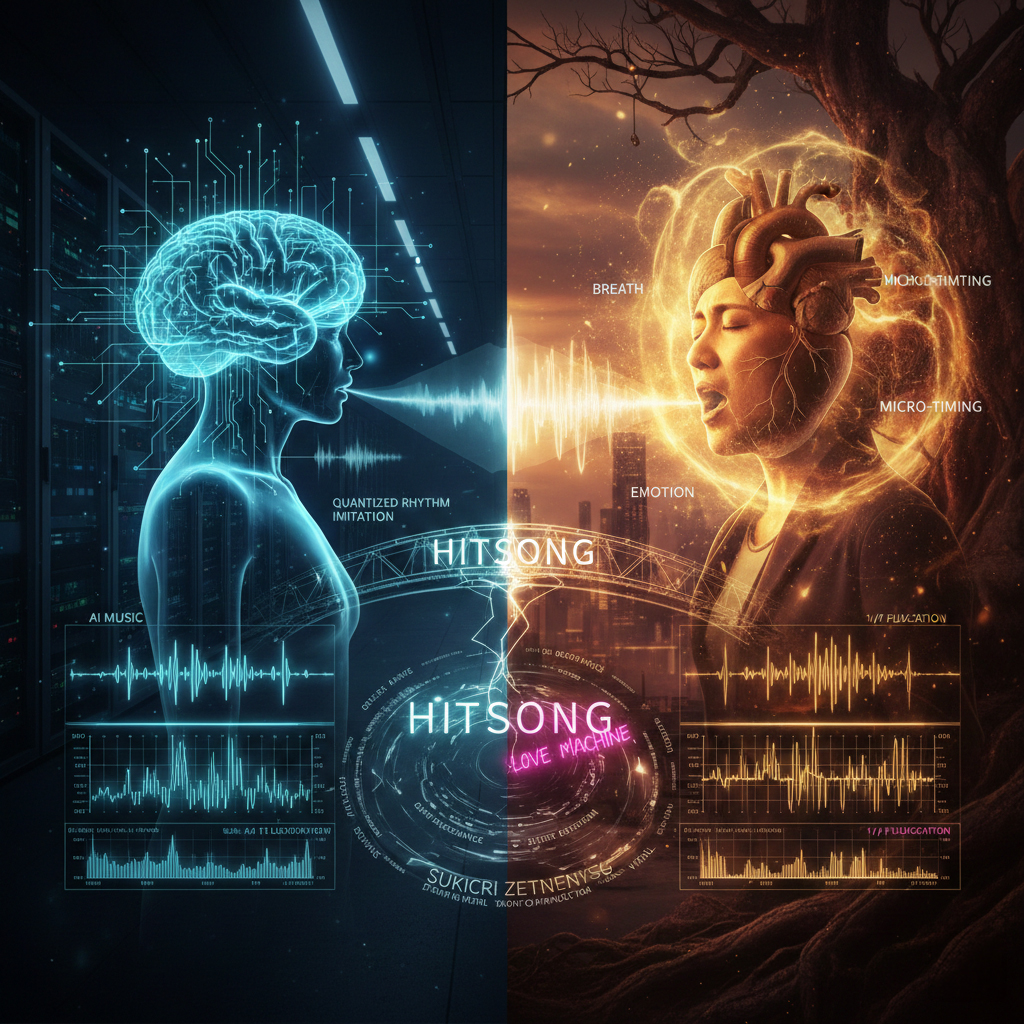
Analyzed from the perspective of rhythm, AI-generated music is characterized by extraordinary mathematical precision. The rhythms AI produces are grounded in a quantized grid, leaving almost no margin of error in the temporal placement of notes. And yet, the “nostalgia” and “comfort” that great songs and popular hits evoke in listeners arise precisely from micro-timing deviations—subtle departures from mathematical correctness—and from the distinctly human technique of tame (held-back tension). While AI systems are increasingly able to extract these patterns from vast training datasets and simulate a kind of synthetic “fluctuation,” what they produce remains, at its core, a statistical imitation.
Human rhythm—particularly what might be called “the rhythm only that person can produce”—is something irreversible, born from the physical constraints that accompany the body’s life-sustaining processes: heart rate, breathing, and the speed of muscular contraction. The rhythmic sensibility found in artists such as Kazutoshi Sakurai of Mr.Children, Koji Tamaki, and Noboru Uesugi of WANDS does not follow the beats on a score; it synchronizes intimately with the singer’s own breath and the vowel structure of the lyrics.
| Technical Element | Characteristics of Generative AI | Characteristics of Human Professionals |
|---|---|---|
| Generation Speed / Efficiency | Full compositions generated in seconds | Weeks to months of creative work and refinement |
| Rhythmic Precision | Mathematically perfect synchronization (quantization) | Dynamic “fluctuation” driven by emotion and breath |
| Vocal Naturalness | Smooth but emotionally flat expression | Intentional pitch deviation and textural variation |
| Learning Process | Probabilistic and statistical pattern learning | Physical training and the accumulation of sensibility |
The True Nature of “Talent” in the Human Voice: The Sources of Individuality Through Acoustic Analysis
The quality that makes certain singers’ voices “impossible to imitate” is a unique frequency signature formed through the intricate interplay of the vocal cords’ physical shape, the volume of the resonating chambers (larynx, oral cavity, nasal cavity), and the neural systems that govern them.
Kazutoshi Sakurai: “Emotional Breath” and Acoustic Singularity
Acoustic analysis of Kazutoshi Sakurai’s vocals reveals an exceptionally distinctive frequency composition. Analysts have noted the presence of frequency components resembling “the voice of a child throwing a tantrum”—components that cut directly into the listener’s subconscious and produce that visceral sense of being pierced.
One of the most defining features of his vocal technique is the deliberate act of “missing” pitch. While pitch accuracy is generally considered a mark of technical skill, stirring a listener’s emotions sometimes demands throwing notes roughly, or destabilizing the pitch intentionally, to convey urgency and raw feeling. Rhythmically, he tends to place Japanese syllables not at equal intervals but according to “the speed of breath,” allowing vowels to resonate softly and roundly with the flow of air—functioning as a kind of physical vibration within the body.
Noboru Uesugi: The Physics of Resonance and the “Ringing” Voice
The vocals of Noboru Uesugi, formerly of WANDS, are defined by an overwhelming richness of resonance. Acoustic analysis reveals his voice to be extraordinarily dense with overtone components—the “sizzling and buzzing” harmonics produced by the forceful closure of the vocal cords under high respiratory pressure.
His technique achieves a sophisticated balance: securing pharyngeal resonance (downward projection) as a foundation, while deploying nasal-centered upward resonance in the mid-to-high register. In particular, the way he slightly extends his jaw to expand the resonating space and generate a thick, powerful timbre underpins the persuasive authority of his rock vocals. This ability to physically amplify specific frequencies is cultivated through years of training, and carries a “density of energy” that AI cannot reproduce simply by mimicking surface-level waveforms.
Koji Tamaki: The Aesthetics of “Breakdown” and Weighty Rhythm
Koji Tamaki’s rhythmic sensibility transcends the precision of a metronome, built instead through a sophisticated technique of kuzushi—intentional destabilization—that freely shifts between strong and weak beats, and breaks rhythms down into triplet subdivisions at will. His singing creates a dense groove that feels like a conversation with the backing ensemble, and the extraordinary volume of breath (and with it, overtones) he generates means that even a whispered tone carries with exceptional presence.
It is precisely this improvisatory rhythmic variation—something that can only emerge “in that moment, in that place”—that constitutes the decisive difference between his art and the high reproducibility of AI-generated music.
Frequency and Neuroscience: 1/f Fluctuation and the Correlation with Healing Frequencies
When considering the effects of music on human beings, the physiological impact of specific frequency components on the brain cannot be overlooked. Natural sounds—and the voices of certain exceptional singers—carry a characteristic known as “1/f fluctuation”: a variation in which the power spectrum is inversely proportional to frequency. This property has the effect of relaxing the human brain and inducing alpha wave activity.
Recent psychoacoustic research has also drawn attention to the theory that specific “solfeggio frequencies” contribute to physical and mental restoration. For instance, 528 Hz is said to facilitate “DNA repair,” while 444 Hz is associated with “immune system enhancement.” The voices of exceptional vocalists are said to carry these “healing frequencies” richly embedded as overtones—and listeners, on a bodily level, find themselves drawn to that resonance.
Structural Analysis of Hit Songs: The Moment “Dislike” Transforms into “Trend”
The instinct Tsunku♂ of Shȧ LȧQ brought to “Love Machine,” and the cultural phenomenon surrounding M!LK’s “Sukisugite Metsu!,” both cut to the essence of what makes popular music genuinely addictive.
Tsunku♂ and the Intentional Staging of “Dissonance”
The story of how Tsunku♂ rejected the original choreography for “Love Machine”—dismissing what was described as “normally cool” moves as “not what I had in mind” and ordering everything redone from scratch—is well known. What emerged was a set of movements so peculiar that the group members themselves reportedly wondered, “are we really doing this?” Yet it was precisely this sense of wrongness, born from intentional awkwardness and strangeness, that triggered Attentional Capture—forcibly seizing the listener’s attention—and lodged the song in memory far more durably than any merely pleasant piece of music could have.
M!LK’s “Sukisugite Metsu!”: The Contrast Between Weight and Lightness
The reason M!LK’s “Sukisugite Metsu!” exploded across social media lies not in its apparent absurdity as a “tonchiki song,” but in what is, in reality, an exquisitely calculated compositional strategy. The track deploys contemporary internet slang—“waraigusa w” and “biju ga ii” (lightness)—while weaving in, at the opposite extreme, historical vocabulary such as “Ushiwakamaru” and “Yang Guifei” (weight).
This gap operates much like the technique of pairing a luxury brand’s bold logo with traditional materials—lending the track a persuasive authority that never feels cheap. Furthermore, on platforms like TikTok, videos that convey “unrestrained emotion”—deadpan expressions verging on mania, or a gaze tinged with darkness—tend to outperform those showcasing perfect dance technique. The song’s addictiveness is deeply synchronized with a visual mode of self-expression.
The fundamental difference between AI-generated music and human singing lies in whether the sound is “the outcome of calculation” or “the result of a will straining against the limits of the body.” AI excels at assembling an aggregate of average “likability,” but it cannot produce the one-time, self-contradictory emotion of “I hate it, but I love it”—the kind that pierces the human heart.
In the years ahead, AI technology will grow further refined, and music “engineered for the brain”—consciously incorporating 1/f fluctuation—will be produced in vast quantities. Yet humans are instinctively sensitive to the “absence of life.” The reason the voices of Kazutoshi Sakurai and Koji Tamaki cut through to us is that we feel, within them, the mass of “living breath” and “the vibration of a body.”
Music that achieves popularity always carries both this “corporeality” and an “intentional dissonance” of the kind Tsunku♂ engineered. Music is not merely the management of harmony—it is the supremely human alchemy of taking discord, and transmuting it into the energy of a crowd.