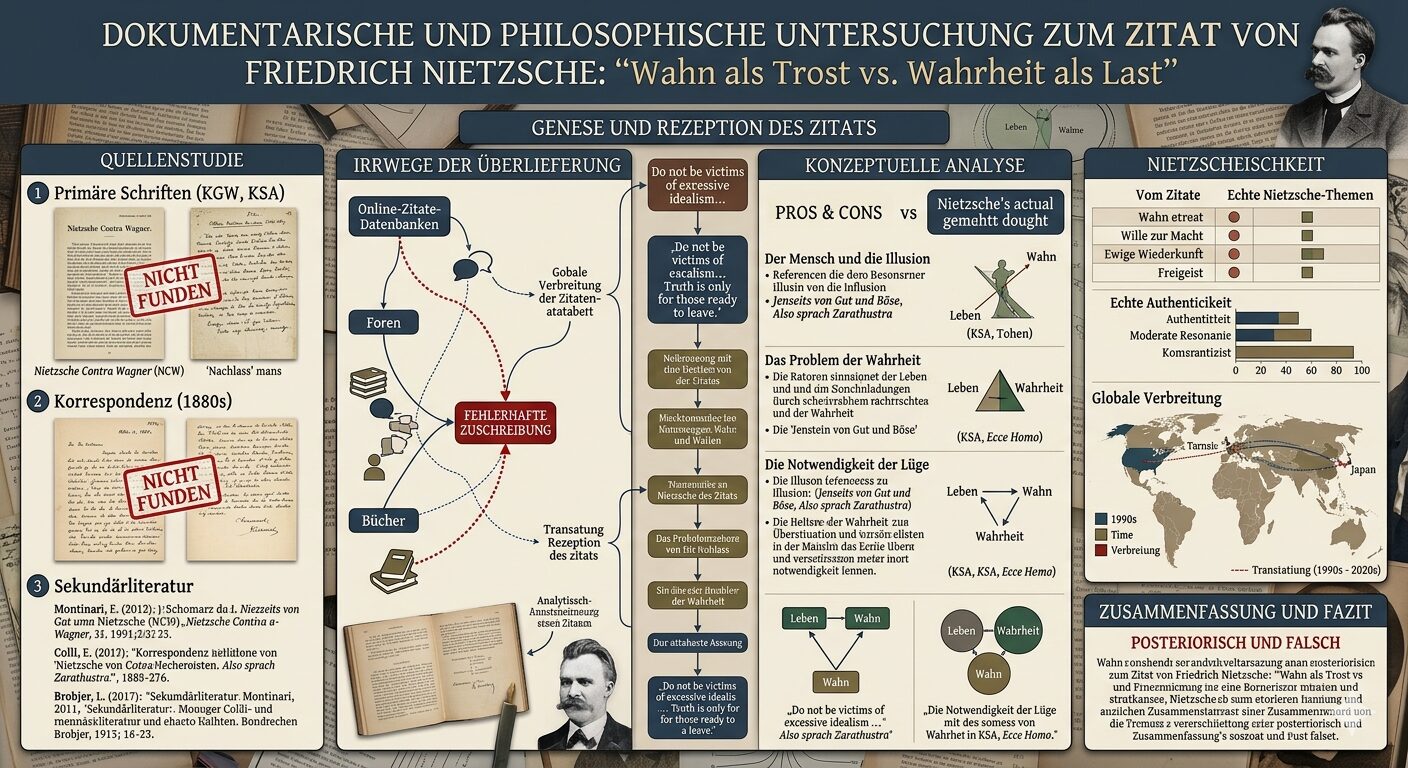
This Is Not NietzscheWho actually wrote the “aphorism” attributed to him?
A passage warning against “falling victim to excessive idealism” circulates widely online as a quotation from Nietzsche. This report searches the complete critical edition (KGW / KSA) and weighs the text against his actual philosophy to render a scholarly verdict.
Do not fall victim to excessive idealism and believe that telling the truth will bring you closer to people. People love and reward those who can soothe them with illusions. Since ancient times, humanity has only punished those who speak the truth. If you want to stay among people, share their illusions. The truth is spoken only by those who are ready to depart.
- Background and the Text in Question
- Philological Verification: Absence from the Primary Sources
- Origin and Circulation of the Misattribution
- A Philological Comparison with Nietzsche’s Thought
- A Summary of the Philosophical Divergence
- Nietzsche’s Actual Texts Behind the Three Core Claims
Background and the Text in Question
Across the internet, social media, and a number of public forums and self-help-adjacent commentary, the passage above circulates widely as a quotation from the German philosopher Friedrich Nietzsche (1844–1900).
This report applies the rigorous standards of Nietzsche scholarship and intellectual history to determine whether this passage actually appears anywhere in his published works, letters, unpublished notebooks (Nachlass), lectures, or addresses. It further traces the origin and circulation of the misattribution, and sets the passage against Nietzsche’s own philosophical system in precise comparison, in order to arrive at a settled scholarly assessment.
Philological Verification: Absence from the Primary Sources
To state the conclusion first: neither this passage nor any corresponding German or English original exists anywhere in Nietzsche’s published works, his Nachlass, his correspondence, his lectures, or any recorded address.
A full-text search was conducted across the standard scholarly databases that index Nietzsche’s complete works, notebooks, and letters — Nietzsche Online and the critical edition (KGW / KSA) — using the following German and English key phrases drawn from the core claims of the passage.
“Wahrheit sagen bringt den Menschen näher” / “telling the truth will bring you closer to people”
“Menschen mit Illusionen beruhigen / trösten” / “soothe them with illusions”
“Wahrheit sprechen nur diejenigen, die bereit sind zu gehen” / “spoken only by those who are ready to depart”
The search returned no matching or directly translatable source text anywhere in the published corpus (spanning the entire period from The Birth of Tragedy to Ecce Homo), in the vast body of unpublished notebook fragments from the 1880s, or in the complete correspondence, including letters to Overbeck and Wagner.
It is therefore philologically settled that this passage was not written by Nietzsche himself.
Origin and Circulation of the Misattribution
Tracing how this passage came to be misattributed and circulated as Nietzsche’s own words reveals a process of rapid, multilingual spread across the internet beginning in the 2020s.
Spread in English- and Arabic-Language Spaces
Examination of the circulation pattern shows the same text appearing, within a similar timeframe, as a “Nietzschean aphorism” across English-language knowledge-sharing platforms (Reddit, the Vivaldi forums, among others), literary-introduction sites (such as Nebo-lit), and Arabic-language news outlets and forums. A precisely matching Arabic version appears in Middle Eastern outlets such as Oman Daily and Nordic-Arabic media such as Al-Kompis, introduced there as “words of the philosopher Nietzsche.”
How the Misattribution Took Hold
The rapid attachment of this passage to Nietzsche’s name rests on a popular public image of him as a thinker who spent his life delivering fierce critiques of the masses (critiques of the “herd”), expressing deep skepticism toward truth, and affirming solitude. The passage appears to be a modern, third-person composition — or a heavily paraphrased mosaic — that skillfully recombines partial motifs drawn from Nietzsche’s actual writing into the kind of sentimental, cynically nihilistic life-advice that circulates easily on social media today.
A Philological Comparison with Nietzsche’s Thought
This section examines precisely where each claim in the passage aligns with, and where it diverges from, Nietzsche’s actual works and philosophical system — Beyond Good and Evil, Thus Spoke Zarathustra, On the Genealogy of Morality, Twilight of the Idols, and The Antichrist, among others.
“Victim of Idealism” and the Departure from Nietzsche’s Ethical Critique
The passage opens with a warning not to “fall victim to excessive idealism.” In contemporary Nietzsche scholarship, his ethical approach is understood as a thoroughgoing critique of altruism as a form of “flight from the self.” Nietzsche attacks metaphysical “ideals” and moral “idealism” as products of ressentiment — a means of denying life as it actually is and fleeing the self one actually has. While the passage’s warning bears a surface resemblance to Nietzsche’s critique of morality, the substance of his critique is not aimed at “a strategy for avoiding sacrifice,” but at self-overcoming (Selbstüberwindung) as a means of intensifying the energy of life.
“Truth and Distance from People”: Passive Solitude versus Active Distance
The passage cautions against believing that “telling the truth will bring you closer to people” — a sentiment that partly overlaps with Nietzsche’s notion of the pathos of distance (Pathos der Distanz), a condition of the noble spirit. Yet for Nietzsche, “truth” is never merely a means of keeping distance from others. He longed, from the depths of illness and isolation, for readers — “good Europeans” — who could share in the unprecedented spiritual trauma of “the death of God” and help construct, together with him, a new dawn for culture. The passage’s air of cynical resignation to being misunderstood stands in sharp contrast to Nietzsche’s urgent longing for a “friend” with whom truth could be shared, and for a genuine solidarity of life.
The Function of “Illusion and Comfort”: A Mismatch with Nietzsche’s Therapeutic and Artistic Framework
The passage advises an extremely passive conformity: “people love and reward those who can soothe them with illusions,” and “if you want to stay among people, share their illusions.” Nietzsche did indeed recognize that human beings need a “veil of illusion” in order to live and act at all. But in On the Genealogy of Morality and The Antichrist, he relentlessly exposed how priests and Christian moralists prescribe “unhealthy illusions” to the masses, numbing them in order to preserve their own power. The passage’s compromised, self-protective counsel to “share people’s illusions” in order to fit into society is a clear betrayal of Nietzsche’s revolutionary will — his project to expose the deceptions of the masses and to push toward spiritual independence from them, culminating in the revaluation of all values.
A Summary of the Philosophical Divergence
| Phrase in the Passage | Nearest Nietzschean Concept | Essential Point of Divergence |
|---|---|---|
| “Do not fall victim to excessive idealism” | Critique of the martyr in Beyond Good and Evil, §25 | Nietzsche rejects idealism itself outright, as a pathology of the weak |
| “Telling the truth won’t bring you closer to people” | The “Pathos of Distance” (§257) | Truth is not a tool for connecting with others, but a touchstone of one’s own strength |
| “People love and reward those who soothe with illusions” | Untruth as a condition of life (The Birth of Tragedy, §7) | Illusion is not mere narcotic comfort, but “art” that activates and intensifies life |
| “If you want to stay among people, share their illusions” | The “mask” worn among the crowd (Zarathustra, Part III) | The mask is a temporary self-protection, not essential surrender or assimilation |
| “Truth is spoken only by those ready to depart” | The affirmation of “going under” (Untergang) | “Departing” is an active overcoming, not defeatist flight |
Nietzsche’s Actual Texts Behind the Three Core Claims
For each of the three core claims embedded in the passage, the following sections present Nietzsche’s actual writing and explain the context from which it has been lifted and distorted.
“People love illusion”
Nietzsche argued that because confronting the harsh truth of existence directly makes action impossible, sustaining life requires the artistic “veil” of illusion.
The Birth of Tragedy, §7: “Knowledge kills action; action requires the veils of illusion.”
“Truth-tellers are punished”
Destroying the shared illusion of established morality threatens the very foundation of life for a mass that depends on that illusion — so the creative destroyer is naturally hated.
Thus Spoke Zarathustra, Prologue §9: “Whom do the good and the just hate most? Him who breaks their tables of values, the breaker, the law-breaker — but he is the creator.”
“Only those ready to depart may speak”
“Going under” (Untergang) is not flight from despair at society, but an active spiritual voyage — announcing the collapse of old values and setting out toward a new horizon of value-creation.
The Gay Science, §343: “Our ships may now set out again… perhaps never before has there been such an ‘open sea.'”
Final Verdict: A Later Invention
Absence of philological evidence — An exhaustive search of Nietzsche’s complete works (KGW / KSA), letters, and manuscript databases turns up not a single line, in German or English, corresponding to this passage.
A distinctly modern circulation pattern — The passage shows clear signs of having spread rapidly, with no traceable origin, across multilingual social media, online forums, and columns as a “famous quote” beginning in the 2020s.
A “castration” and distortion of Nietzsche’s core ideas — The passage skillfully borrows the surface vocabulary of Nietzsche’s philosophy, while its actual prescription — submission and conformity to the herd — recommends precisely the posture of the “last man” (letzter Mensch) that Nietzsche attacked most fiercely.
This passage is therefore neither a genuine Nietzsche quotation nor a faithful paraphrase of his thought. It mimics his famous aphoristic style while conveniently neutering its content into a piece of modern, cynical, conflict-averse life advice — a later invention. This is the most academically defensible conclusion.
- forum.vivaldi.net/topic/101824/aphorisms-quotes-statements/186?page=4
- nebo-lit.com/Religion/imagination.html
- omandaily.om — ما الذي يبقى من الفردية؟
- kalamanas.com/articleEN.aspx?aid=9707
- binance.com/en/square/post/22135404900289
- alkompis.se — الانزعاج من حقيقة المقارنة بين حرق الم…
- intempestivemeditations.wordpress.com — Nietzsche and Shakespeare
- blog.tatsuru.com/2020/03/02_1756.html
- reddit.com/r/philosophy — BBC documentary on the three great
- note.com/hys2go/n/nf6e5596ca91b
- reddit.com/r/Nietzsche — most formidable disciple Yukio Mishima
- seiryo-u.ac.jp — Journal Collection No. 35 (PDF)
- forum.vivaldi.net/topic/101824/aphorisms-quotes-statements/21?page=2
- reddit.com/r/philosophy — obsessed with the eternal