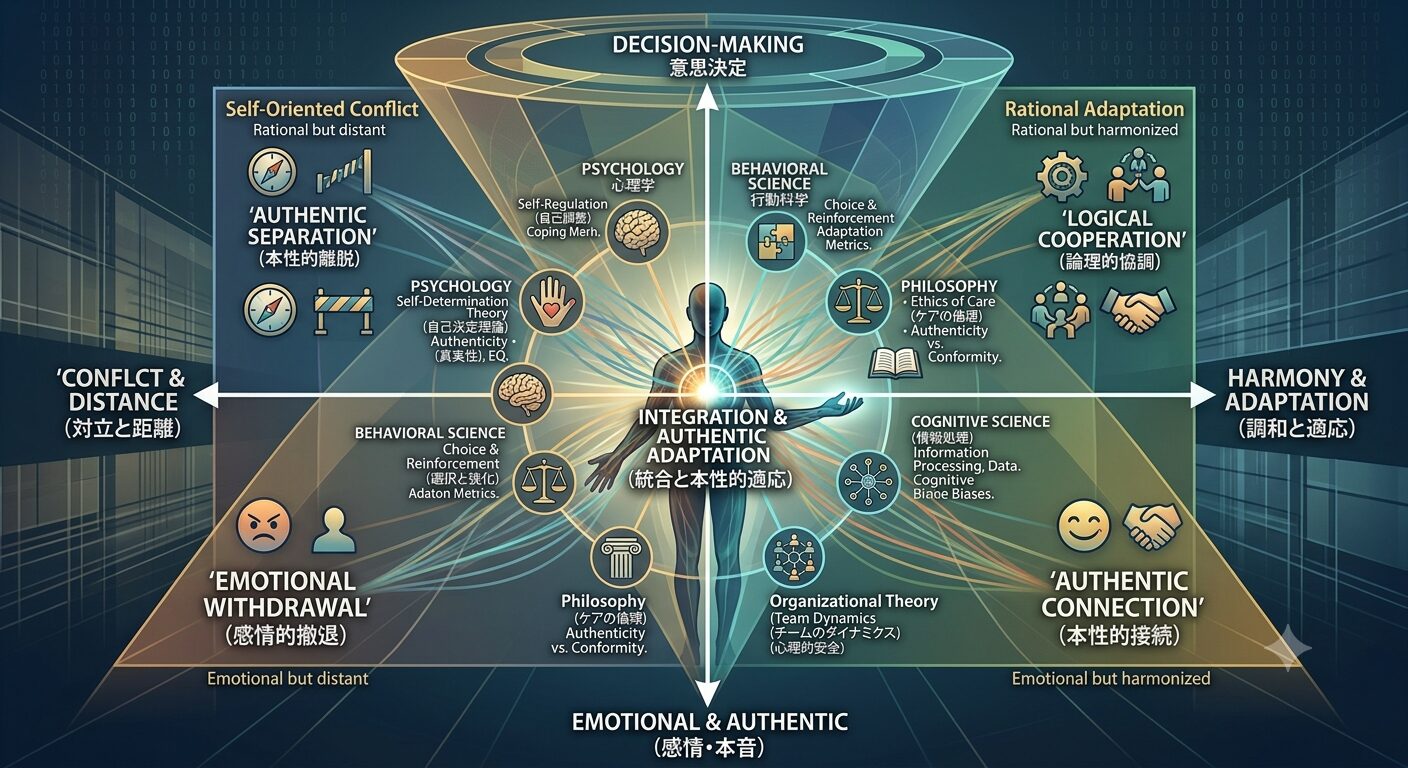
The Tension and Integration of Authentic Self vs. Social Adaptation:
A Multidisciplinary Analysis of Decision-Making and Interpersonal Dynamics
A practical roadmap for integrating emotion and reason — autonomy and cooperation — through the lens of Wise Mind. Drawing on Self-Determination Theory, DBT, the EVLN Model, and Authentic Leadership Theory to map the optimal strategy for decision-making and human relationships.
Intrinsic Autonomy
Mutual Trust
Academic Definition of “Authentic Self”: Theories of Authenticity and Autonomy
The concept widely used in self-help culture — living by one’s “authentic self” — aligns closely with the academic constructs of Authenticity and Autonomy in psychology, cognitive science, and philosophy. Far from being mere subjective feelings, these are empirically studied dynamic personality traits that fundamentally shape an individual’s mental health and subjective well-being.
In Self-Determination Theory (SDT), proposed by Edward Deci and Richard Ryan, autonomy is identified as one of the three most fundamental basic psychological needs (alongside competence and relatedness) necessary for healthy functioning and self-actualization. Autonomy here refers to the subjective sense that one’s behavior arises not from external coercion or obligation, but from one’s own will, intrinsic motivation, and integrated self-concept. According to Deci’s Causality Orientations Theory, individuals high in “autonomy orientation” tend to perceive their actions as self-initiated and volitional.
Multiple academic models have mapped out the multidimensional nature of authenticity:
| Model | Key Dimensions | Academic Definition & Cognitive-Behavioral Characteristics |
|---|---|---|
| Multicomponent Model Kernis & Goldman |
① Awareness ② Unbiased Processing ③ Behavior ④ Relational Orientation |
A multifaceted process of deeply understanding and accepting all aspects of the self — including contradictions and weaknesses — without defensive distortion, acting in alignment with core values, and openly disclosing one’s authentic self in close relationships |
| Three-Component Model Wood et al. |
① Avoiding Self-alienation ② Authentic Living ③ Not Accepting External Influence |
A personality orientation that minimizes the gap between one’s “true self” and lived experience, chooses behavior consistent with personal values and beliefs, and resists blind conformity to social pressures |
| 4C Model Lehman et al. |
① Consistency ② Conformity ③ Connection ④ Continuity |
A dynamic concept capturing four distinct relational fits: consistency between external traits and internal values; conformity with social norms; connection with others and things; and continuity as an ongoing developmental process across one’s lifespan |
In the philosophical tradition, existentialist thinkers such as Kierkegaard and Heidegger laid the groundwork for authenticity. Heidegger criticized the “inauthentic” mode of being — in which individuals are absorbed into the anonymous crowd (das Man) and avoid confronting their own mortality — and emphasized the importance of “authentic existence”: consciously choosing and owning one’s own possibilities with full awareness of one’s finitude. This existentialist ethic provides the philosophical backbone for the modern psychological concept of living by one’s core self rather than in dependence on external validation.
The Boundary Between Authentic Self and Pathological Narcissism: A Clinical Psychiatric Analysis
Living authentically is often confused with egocentric behavior or clinical narcissism. However, the findings of psychiatry and clinical psychology clearly demonstrate that there is a decisive boundary between true authenticity (healthy self-esteem) and pathological narcissistic tendencies — in terms of psychodynamics, developmental origins, and interpersonal functioning.
In Heinz Kohut’s Self Psychology and Otto Kernberg’s Object Relations Theory, the essence of pathological narcissism lies in a “grandiose but fragile self” — a self-representation that is simultaneously inflated and deeply vulnerable.
✔ True Authenticity (Authentic Self)
✗ Pathological Narcissism / Egocentric Behavior
Sam Vaknin argues that genuine self-love and pathological narcissism are fundamentally opposite mental states. Pathological narcissists and psychopaths lack not only empathy toward others but also — crucially — genuine compassion and acceptance toward themselves (self-love), which is why they are prone to self-destructive and recklessly impulsive behavior.
True self-acceptance rests on four pillars: “self-awareness” (viewing oneself objectively, including ugly and destructive impulses); “self-validation” (recognizing one’s worth even in imperfection); “self-trust” (the sense of being one’s own greatest advocate); and “self-efficacy” (the felt capacity to achieve realistic goals autonomously through experience). It is the collapse of these four pillars that compels the formation of an inflated, hollow mask — the essence of pathological narcissism.
The Cognitive and Behavioral Science of Emotion-First Living: Benefits and Risks
The idea of “following your feelings, instincts, and excitement 100%” is an intuitively appealing notion — but from the perspectives of cognitive science and behavioral science, it carries both clear benefits and significant functional risks.
Marsha Linehan, founder of Dialectical Behavior Therapy (DBT), classified the human mind into three states: “Emotion Mind,” “Reasonable Mind,” and “Wise Mind” — the latter representing a higher-order synthesis of the two.
Emotion Mind
An evolutionary survival system that bypasses deliberate appraisal and triggers fight-or-flight responses instantly in emergencies. Essential for deep empathy, love, artistic intuition, and sensing intrinsic desires
Reasonable Mind
Superior in cold information processing, planning, and social conformity — but over-reliance leads to emotional suppression, chronic cardiovascular burden, and burnout
Wise Mind
Integrates both. Validates emotions while simultaneously processing objective facts, arriving at decisions that pass the Tomorrow Test without future regret
Evolutionary Benefits of Emotion Mind
Emotion Mind is an evolutionary survival system that bypasses slow cognitive appraisal and immediately activates fight-or-flight responses when biological survival is at stake. The richest human experiences — emotional synchronicity with others (deep empathy, intimate love, altruistic behavior), artistic expression, intuitive inspiration, and feelings of profound awe and joy — are only possible when Emotion Mind is vibrantly active. For the authentic self to function as a compass — sensing one’s intrinsic will (Wille) — this emotional sensor must operate properly.
Social Maladaptation Risks of Emotion Mind
Using Emotion Mind as the primary driver of social decision-making, however, carries enormous risks from the perspectives of cognitive science and social adaptation.
Amplification of Cognitive Distortions
When dominated by intense emotion, objective information processing is impaired. Maladaptive cognitive distortions such as “Emotional Reasoning” (“I feel angry, therefore the other person must be attacking me”) and all-or-nothing thinking (“Anyone who doesn’t support me is my enemy”) become chronic patterns.
Rapid Erosion of Social and Professional Capital
Impulsivity — directly converting negative emotions into action (e.g., verbally abusing a coworker, abruptly quitting over minor friction) — generates fruitless conflict in professional and social settings, and directly destroys long-term career development and robust social support networks.
The Collapse of the “Venting” Myth
Much pop psychology and spiritual discourse recommends “venting” negative emotions rather than suppressing them. However, contemporary psychological science clearly refutes this. Research shows that externalizing anger through venting positively reinforces the brain’s anger-related synaptic networks, promotes rumination, and ultimately makes anger more persistent, more intense, and more entrenched as an aggressive personality pattern.
Outputting emotional data directly into real-world decision-making — without the step of cognitive reappraisal — is a decisively maladaptive process that significantly lowers subjective well-being and ultimately leads to social isolation.
Suppression vs. Regulation: Neuropsychological and Physiological Process Models
To prevent Emotion Mind from running unchecked, forcibly overpowering emotions through “suppression” is not considered an adaptive behavior. James Gross’s “Process Model of Emotion Regulation” systematizes strategies according to which temporal stage in the emotional generation process one intervenes.
First 4 stages = Antecedent-focused (early intervention) | Last stage = Response-focused (post-hoc intervention)
✔ Cognitive Reappraisal (Regulation)
- Antecedent-focused: reframes the meaning of a stimulus before the emotional response is fully established
- VLPFC → DLPFC → SMA → Angular Gyrus → STG pathway down-regulates amygdala hyperactivation early
- No excessive sympathetic arousal; no sharp rise in blood pressure or heart rate
- P300 ERP amplitude increases → reward sensitivity, joy, and motivation healthily maintained
- Reduced risk of depression and anxiety; subjective vitality, self-esteem, and resilience improve long-term
✗ Expressive Suppression (Suppression)
- Response-focused: forcibly inhibits the behavioral expression of an already-activated emotional response
- Amygdala activity remains elevated; prefrontal cortex sustains overload, depleting brain energy
- Sympathetic vascular tone markedly elevated → chronic cardiovascular burden and autonomic dysregulation
- Stimulus-Preceding Negativity (SPN) ERP significantly attenuated → chronically blunted reward responsivity
- Worsening depressive symptoms, self-alienation, increased chronic fatigue and psychosomatic risk
Suppression — treating emotions as if they don’t exist — imposes destructive stress costs on the brain and cardiovascular system. Truly healthy, adaptive maintenance of one’s authentic self is achieved only through repeated practice of “cognitive reappraisal”: gently accepting emotions as they arise, then using higher-order metacognition in the prefrontal cortex to reframe the situation more realistically and flexibly.
The Integration Mechanism: How Highly Adaptive People Unite Emotion and Reason
Highly socially adaptive individuals fall into neither the trap of cold “hyper-rationalism” that excludes emotion, nor the trap of impulsive “emotion dominance.” Drawing on Daniel Kahneman’s dual-process theory and DBT’s Wise Mind clinical model, we dissect the full architecture of this cognitive integration.
◆ System 1 (Emotion Mind) ◆
"This environment feels dangerous." / "I am deeply uncomfortable and can't bear it."
                    |
                    ↓  (received as active data)
        ┌─────────────────────────────┐
        │        Wise Mind            │ ──→ "Tomorrow Test"
        │  · Validation of emotion    │     "What action best serves my
        │  · Simultaneous fact-check  │      long-term well-being months
        │  · Assertive optimal output │      from now?"
        └─────────────────────────────┘
                    ↑  (self-regulation and moderation)
◆ System 2 (Reasonable Mind) ◆
"What are the current contractual terms, the financial risks of resignation,
and where are the negotiable boundaries with others?"
Active Reception of Emotional Signals (System 1 Monitoring)
Highly adaptive individuals do not dismiss inner signals — discomfort, mistrust, excitement — as “illogical noise.” They understand that emotions are evolutionarily refined “physiological raw data” that signal, before words can form, whether one’s core values and boundaries (authentic self) are being threatened or honored.
Cognitive Inhibitory Control (Activating System 2)
The moment Emotion Mind activates, they immediately interrupt the circuit that would translate impulse directly into reactive behavior (verbal outbursts, abrupt relationship termination, self-destructive social media posts). They consciously engage System 2’s self-monitoring function to secure the position of “describing and validating” the emotion rather than being “controlled” by it.
Wise Mind: Mediating and Integrating the Data
They place both opposing data streams on the table and execute a mediation process:
- “This intense rejection response (System 1) — which of my non-negotiable core values (authentic self) has been violated to trigger it?”
- “What are the cold objective facts of this situation, the other person’s context, and my long-term goals (System 2)?”
Passing the “Tomorrow Test” and Integrated Decision-Making
A decision made purely to satisfy an emotional impulse produces rational regret later (System 1 failure). A decision made by completely suppressing emotion produces psychological burnout later (System 2 failure). Highly adaptive individuals choose decisions they can confidently stand behind tomorrow, weeks from now, and years from now — decisions that honor both their core values and social reality. This mediated resolution most often takes the form of the most intellectually sophisticated and assertive social behavior: honest, yet delivered with measured care and precision.
Deconstructing the “Law of Attraction”: Cognitive Filtering and Behavioral Science
The spiritual discourse of “vibrational frequency,” “like attracts like,” and “raise your vibration to attract your desired reality” has zero scientific basis from the perspectives of physics, neuroscience, and electromagnetism — it is classified as pseudoscience. No empirical data demonstrates that human thoughts or brain waves propagate as specific electromagnetic waves through the universe to attract particular people, events, or opportunities.
Nevertheless, the dramatic subjective transformation that believers in these narratives experience — suddenly encountering like-minded people and opportunities — is fully explained by the brain’s precise cognitive filtering and information selection functions, as elucidated by modern cognitive psychology and neuroscience.
① The Reticular Activating System (RAS) and Cognitive Filtering
To prevent cognitive overload, the brain uses the RAS — a neural network in the brainstem — to selectively filter the millions of bits of sensory information arriving each second, passing only a few dozen bits of survival-relevant information to the cortex (consciousness). What the RAS “passes” vs. “discards” is entirely programmed by what the individual currently believes is most important.
Establishing a clear authentic self (clear values and life purpose) is equivalent to rewriting the brain’s RAS filter. As a result, previously invisible “others with similar values,” “business opportunities,” and “useful information” suddenly become visible and audible. This is the selective attentional shift known as the “cocktail party effect” and “color bath effect.”
② Confirmation Bias and Hijacking the Reward Circuit
Once a person holds the belief that “the world is wonderful and I am worthy of love,” confirmation bias leads them to actively collect confirming evidence (others’ kindness, encouragement) while ignoring or minimizing disconfirming evidence. Furthermore, when a prediction is confirmed by reality (“just as I thought”), the brain’s reward circuit (striatum, etc.) activates, releasing dopamine. This neurochemical reward generates a strong post-hoc conviction that “my elevated vibration attracted this wonderful reality” — solidifying a subjectively constructed reality.
③ Transformation of Non-verbal Signals Through Neuroplasticity
Vividly imagining oneself “filled with love and abundance” (through imagery training and positive self-concept maintenance) changes synaptic connections in the brain via neuroplasticity. As the self-concept becomes healthier and more stable, the individual’s autonomic nervous system relaxes, dramatically improving non-verbal communication — facial expressions, vocal tone, eye contact, and open body language. Others who receive these “safety signals” intuitively feel trust and warmth, drawing similarly healthy individuals into that person’s orbit — a very physical and psychological reciprocity loop.
④ Mathematical Proof of Probabilistic Encounter via Trial Frequency
What is subjectively described as “chance encounters” and “fateful connections” is, in most cases, the probabilistic inevitability of “autonomous behavioral activation” and a dramatic increase in the number of attempts — both consequences of a clarified authentic self. People with a clear core Will participate in compelling events, venture into new domains, and approach others far more frequently than those paralyzed by fear of failure.
Even assuming a very low single-trial probability p = 0.05 (5%) of meeting a life-changing person, the probability P of encountering at least one such person over n attempts is defined as:
Probability of a “Life-Changing Encounter” vs. Number of Attempts — P = 1 − (1 − p)ⁿ (p = 0.05)
What is experienced subjectively as “happening by chance” is entirely explained by a very concrete physical and behavioral process: clarification of self-concept (authentic self) → reconfiguration of the brainstem’s RAS cognitive filter → explosive increase in autonomous behavior and trial frequency → probabilistic encounter with fortune.
Decision Criteria in Conflict: The EVLN Model and the Boundary Between Adaptation and Exit
When facing a relationship or organization that doesn’t fit, repeatedly “cutting ties the moment discomfort arises” increases social and professional vulnerability. Conversely, continuing to “suppress oneself entirely to meet others’ expectations” is the worst possible choice for mental and physical health.
The EVLN Model (Exit-Voice-Loyalty-Neglect), developed by Albert Hirschman and later extended to interpersonal and organizational contexts by Rusbult and Farrell, provides a rigorous framework for decision-making in situations of conflict and dissatisfaction.
🗣 Voice
Proactively expressing dissatisfaction, making proposals, and engaging in dialogue and negotiation (assertion) to improve or resolve the situation. Prioritized when dialogue is possible and the investment in the relationship is significant.
🌱 Loyalty
Patiently waiting for natural improvement, avoiding conflict, supporting the other party, and quietly maintaining the current relationship. Valid when there is hope for improvement but immediate intervention is not optimal.
🚪 Exit
Complete departure from the relationship, group, or organization — through resignation, separation, or physical removal. To be executed deliberately when the other party displays pathological narcissism or abuse, psychological safety is zero, and viable alternatives are already secured.
😶 Neglect
Remaining in the relationship while reducing voluntary effort — through tardiness, absenteeism, minimizing communication, and emotional shutdown. A non-cooperative, passive response that leads to physical and mental exhaustion and social isolation.
The 4 Decision Variables: Voice or Exit?
① Belief in Improvement
If there is a reasonable basis for hope that the other party will genuinely engage with feedback — including a track record of partial improvement — adaptation efforts should continue. However, if the other party exhibits pathological narcissism (refusing to acknowledge any fault, projecting all responsibility onto others) and dialogue has been demonstrably futile 100% of the time, Voice efforts should be immediately abandoned and Exit should be planned.
② Investment Size & Action Cost
If accumulated trust, shared projects, and intangible assets (investment size) in the relationship are large, and the social and financial costs of Exit are enormous, Voice and mediated negotiation should be pursued to the fullest extent first. Conversely, if the relationship offers no substantive benefit and exit costs are minimal, a prompt Exit is rational.
③ Quality of Alternatives
If concrete and healthy alternative relationships, communities, or workplaces are already established, Exit should be executed without hesitation. Impulsive Exit without adequate alternatives heightens social anxiety and risks secondary maladaptation — including cult-like dependence on harmful self-help groups.
④ Internal Locus of Control
Individuals with a high internal locus of control are better equipped to choose proactive Voice over passive Neglect. As long as there is a realistic expectation that assertive action can modify the environment (a sense of situational modification efficacy), attempting adaptive negotiation while preserving one’s authentic self is the recommended path for personal growth.
What Socially Successful Authentic People Have in Common: Authentic Leadership Theory
What separates individuals who rigidly impose their desires on others and become socially isolated from those who maintain strong internal consistency while earning overwhelming trust and exercising exceptional leadership?
Decades of empirical research in organizational behavior and positive psychology demonstrate that the latter group consistently embodies Authentic Leadership (AL) — a sophisticated transformational personality profile. Based on the conceptual model of AL (Luthans & Avolio, 2003; Walumbwa et al., 2008), four core factors distinguish those who most successfully reconcile authentic self with social adaptation:
Self-Awareness
Objectively accepts one’s emotions, values, and limitations, and continuously updates one’s self-understanding
Relational Transparency
Does not wear a role-based mask; honestly discloses one’s mistakes and vulnerabilities to others
Balanced Processing
Objectively analyzes data and opposing views — even those that challenge personal beliefs — without defensive distortion
Internalized Moral Perspective
Does not yield to arbitrary external pressures; consistently acts according to a strong internal moral compass
The development of these four factors has been confirmed by numerous peer-reviewed empirical studies to directly contribute to increased employee engagement, higher job satisfaction, lower turnover rates, and the establishment of robust psychological safety within teams.
Furthermore, socially successful individuals combine this “authenticity (consistency)” with “Adaptive Leadership” — the capacity to tailor their approach to the situation — as a sophisticated adult social contract.
Those who master the adaptive approach never bend their core values or beliefs by even a millimeter — but they flexibly translate those values into the language and method most receivable to each specific person, given their profile, cultural background, and communication style. They are professionals who wisely adapt “how they express themselves (Me)” — as a means — in order to maximize “the common good (We)” — as the end — grounded in the deepest respect and trust for the other person.
Mapping Key Psychological and Cognitive Science Theories
Precise Alignment with Self-Determination Theory (SDT)
The developmental process in SDT is essentially equivalent to the gradual internalization of social norms — from an “other-directed” axis to an “authentic self” axis. SDT describes motivation as progressing through the following continuous stages of self-regulation:
Individuals who reach Integrated Regulation (authentic self) can voluntarily embrace — and willingly fulfill — even seemingly mundane social norms and demands for cooperation, so long as they deeply understand how these serve their long-term values and overall well-being.
Developmental Psychology: Ego Identity (Erikson)
Erik H. Erikson’s developmental concept of “ego identity” refers to an inner conviction of self-continuity — a settled answer to “Who am I, what do I value, and how do I live consistently within society?” An unestablished identity is called “identity diffusion” — the very state of other-directedness and maladaptive conformity.
What Erikson’s theory most powerfully emphasizes is that only a person with a firmly established ego identity (authentic self) can engage with others as an equal, risk vulnerability, cross relational boundaries, and healthily achieve “Intimacy” — genuine emotional bonds. Without an authentic self, one oscillates between pathological extremes: excessive exclusivity (fearing merger with others) or catastrophic dependency (losing the self entirely). In short, healthy social adaptation — building intimate relationships — is only possible on the foundation of a firmly established authentic self.
Emotional Intelligence (EQ) as Dynamic Complement
Emotional Intelligence, systematized by Daniel Goleman, comprises five ability domains: Self-Awareness, Self-Regulation, Motivation, Empathy, and Social Skills. The capacity to accurately sense one’s own deep emotions and authentic voice — the input function of the authentic self — is precisely “Self-Awareness” in the EQ framework.
Highly adaptive, successful individuals connect this self-awareness (authentic self) with Self-Regulation (wisely governing oneself according to context), Empathy (sensitively reading others’ hurt and needs), and Social Skills (assertively and constructively guiding conflict toward agreement). EQ functions as the “cognitive interface” that transforms raw emotional expression into structured, socially adaptive output — while preserving autonomy.
Cognitive Control Through CBT
Cognitive Behavioral Therapy holds that it is not events themselves but the individual’s subjective “schemas” (assumptions, beliefs) about events that determine emotional and behavioral maladaptation. The extreme judgment seen on social media — “Anyone who makes me even slightly uncomfortable has incompatible energy and is essentially evil” — is identified in CBT as a classic maladaptive cognitive distortion: “Personalization” and “Overgeneralization.”
CBT (and mindfulness-based approaches) provide practical cognitive tools: placing the “maladaptive automatic thoughts and beliefs” underlying one’s emotional reactions on the table for objective scrutiny, and autonomously reconstructing “alternative adaptive thoughts” that are more realistically grounded and consistent with one’s long-term goals.
The Pathology of “Authentic Self” Discourse in Social Media and Self-Help: Spiritual Bypassing and the Over-Adaptation Backlash
The language of “authentic self,” “follow only your excitement,” and “fade out immediately from uncomfortable environments” — now explosively consumed in social media and the commodified self-help industry — is being sharply flagged by clinical psychologists and counselors as a “defensive mechanism trap” causing serious psychological regression and relational destruction.
① Spiritual Bypassing: Using Transcendence to Justify Interpersonal Avoidance
“Spiritual bypassing,” coined by Buddhist psychotherapist John Welwood in 1984, is defined as “a sophisticated self-defensive mechanism in which individuals conveniently misuse spiritual concepts and appealing self-help language to avoid and bypass the genuinely difficult, messy psychological and developmental challenges they carry within — such as deep self-mistrust, attachment trauma, and a deficit of social skills.”
The seductive social media advice “cut off anyone who makes you uncomfortable, anyone whose frequency doesn’t match yours, right now” powerfully activates this spiritual bypass. The vital developmental challenge of human relationships — sitting with disagreement and interpersonal conflict, facing one’s own inner immaturity, learning negotiation and assertive dialogue, and deepening mutual understanding — is bypassed and beautified under the guise of “our vibrational layers are different” or “I refuse to lie to myself.” The escape is aestheticized as spiritual elevation.
While this easy transcendence brings temporary relief, it imposes enormous long-term costs: developmental arrest in interpersonal skills; chronic deepening of core self-worthlessness; physical stress responses (chronic insomnia, migraines, somatic complaints); and ultimately, social isolation.
② The Over-Adaptation Pendulum: All-or-Nothing Thinking as Backlash
Many consumers who seize on “authentic self” as a product are victims of Japan’s collectivist educational and corporate culture — people who spent years with 100% of their antennae tuned to others’ expectations while completely silencing their own intrinsic desires. These are the clinical subjects of “Over-adaptation.” As a result of sacrificing the self entirely for others, their emotional sensor — the ability to feel what they themselves truly want — has gone numb, and they have been driven into a state of psychological depletion and depression.
When these individuals encounter the “authentic self” of the self-help world, the long-suppressed defensive energy of the psyche rebounds, triggering the cognitive distortion of all-or-nothing thinking (extreme splitting):
100% Other-Directed (Over-Adaptation)
Complete blind conformity to others’ expectationsSuppression of own emotions and total self-sacrifice
Accumulation of physical exhaustion and depression
Pendulum
Swing
100% Self-Directed (Narcissistic Isolation)
Disregarding others’ rights and boundariesLabeling uncomfortable others as “low vibration” and cutting them off
Impulsive resignation, conflict, and social isolation
They completely bypass the effort to learn the genuinely nuanced, high-order skill of “respecting others’ boundaries while simultaneously upholding one’s own deep core values (authentic self)” — what DBT calls Wise Mind. The result is an extreme pendulum swing to pathological narcissism (other-exclusion mode): “I won’t follow a word anyone else says. Anyone who makes me uncomfortable is the enemy.” This futile oscillation between extremes only destroys the individual’s social life and accumulates further “difficulty in living.”
Conclusion: The Academically Optimal Strategy for Decision-Making and Life Design
The comprehensive, science-based conclusion of this analysis regarding the ultimate tension between “should I live by my emotions (authentic self, intuition, excitement)” vs. “should I live by logic (social adaptation, cooperation, cold facts)” vs. “should I integrate both” is as follows: Implement “Wise Mind” — an organically integrated dynamic cognitive system of emotion and reason — translate spiritual intuitive data into objective behavioral science and probabilistic models for reinterpretation, and achieve assertive social adaptation (adult social contract).
| Approach | Benefits & Recommended Contexts | Risks & Maladaptation | Scientific & Clinical Assessment |
|---|---|---|---|
| Emotion-First Living (Emotion Mind Dominant) |
Rapid sensing of core Will via emotional sensor. Acquisition of deep emotional bonds, love, and artistic/creative intuition | Maximal amplification of cognitive distortions (emotional reasoning, all-or-nothing thinking). Destruction of social and career capital through impulsive behavior | Excellent as a physiological “alarm system,” but catastrophic if treated as a direct social decision-making output |
| Logic-First Living (Reasonable Mind Dominant) |
Thorough cold information processing, career and financial planning. Conformity to social norms and professional conduct | Chronic sympathetic hyperactivation and severe cardiovascular burden from expressive suppression. Chronic anhedonia and burnout from reduced P300 reward potentials | Indispensable as an execution skill, but over-reliance leads to profound self-alienation and chronic depletion of long-term well-being |
| Integrated Living (Wise Mind) |
Optimal balance of personal values (authentic self) with others’ boundaries and social reality. Acquisition of decisive, regret-free decision-making backed by the Tomorrow Test | Requires daily training in higher-order metacognition and emotional monitoring (EQ), as well as the learning investment of mindfulness practice | The only optimal adaptive solution in neuroscience, psychiatry, and clinical psychology. Maximizes both life satisfaction and social success simultaneously |
Three Practical Action Steps for Living Authentically While Thriving Socially
Receive Emotions as Signals — Translate Them into Assertive Language via CBT
Fully accept and validate — without judgment — the emotions (System 1) that arise in your body and mind: discomfort, fear, excitement. Then, using CBT techniques, logically extract: “Why am I so reactive to this situation? What boundary or core value (authentic self) am I feeling violated?” Take that extracted authentic self (Will), calibrate it to the other person’s communication style, and output it to the world as a refined, assertive self-expression (adult social contract): “I deeply value X. Given that, I’d like to propose Y in this situation.”
Execute “Attraction” as a Probability Model: RAS Goal-Setting + Increasing Trial Frequency
Stop engaging in “spiritual bypassing” — retreating from dialogue under the guise of “their frequency doesn’t match mine” or “their energy is low.” Instead, vividly articulate your autonomous vision in writing to deliberately set a “selective attention filter” in the brain’s RAS. Use this filter to actively perceive — through your senses — the “wonderful like-minded people and opportunities” you were previously filtering out, raise the energy of autonomous behavioral activation, and repeat approaches proactively. By systematically accumulating n ≥ 50 trials, you probabilistically manifest — with approximately 92% certainty — the “dramatic encounters and outcomes” aligned with your convictions as physical reality.
For Misaligned Relationships: Apply EVLN for Cold-Eyed Cost Assessment, Then Negotiate or Exit
When you feel misaligned with those around you, fully restrain the impulse toward impulsive aggression or neglect, or toward emotionally explosive relational severance (destructive Exit). Based on the EVLN decision variables, objectively quantify on paper — as cold factual data — four criteria: ① the realistic prospect of improvement, ② the investment size in the relationship, ③ psychological safety (whether your self-respect is being violated), and ④ the quality of available alternatives. If there is negotiation room (psychological safety) and the trust built with the other party represents a significant investment, maintain an adaptive posture and devote full energy to proactive, constructive negotiation (Voice). However, if the other party repeatedly perpetrates violence, control, or dishonest narcissistic violation — chronically threatening your mental health — and a safe alternative is already in hand, execute a planned, refined Exit without destructive impulse as an autonomous withdrawal strategy protecting your long-term well-being.
Human beings are not designed to live as isolated, inorganic cells. We are biologically built to experience our greatest well-being within the rich, organic network of relationships with others and community. The true “authentic self” is not a grandiose mask used to withdraw into one’s own whims and refuse engagement with the world. It is the anchor of belief and self-acceptance — authenticity — lowered deep into the seabed of one’s spirit, from which one masterfully trims the sails to meet the roughness of social seas, and sets out with agency toward the rich voyage of mutual trust with yet-unseen others. That is nothing less than the most intellectually sophisticated and resilient expression of human potential.
References
- How to Build Your Authentic Self-Axis — Zapass Blog
- The Authentic Self Through Brain Science and Psychology — Lab Brains AS-1 (April 2025)
- What Is the Law of Attraction? — True Buddhism
- The Meaning of Having an Authentic Self — Minchalle
- What Is the Authentic Self? — Schoo Summary
- Authentic Self vs. Other-Directed Living — Heartlife Counseling
- Causes and Overcoming Over-Adaptation — S-Office K
- NLP and the Authentic Self — NLP Japan