A Human Study of Desire,
Loneliness, and Commitment
From the changing shape of sex and love through history, to the self-destruction found in literature, to the actual structure of psychological maturity — why do people, even while pulled toward temptation, keep choosing to stay with one person?
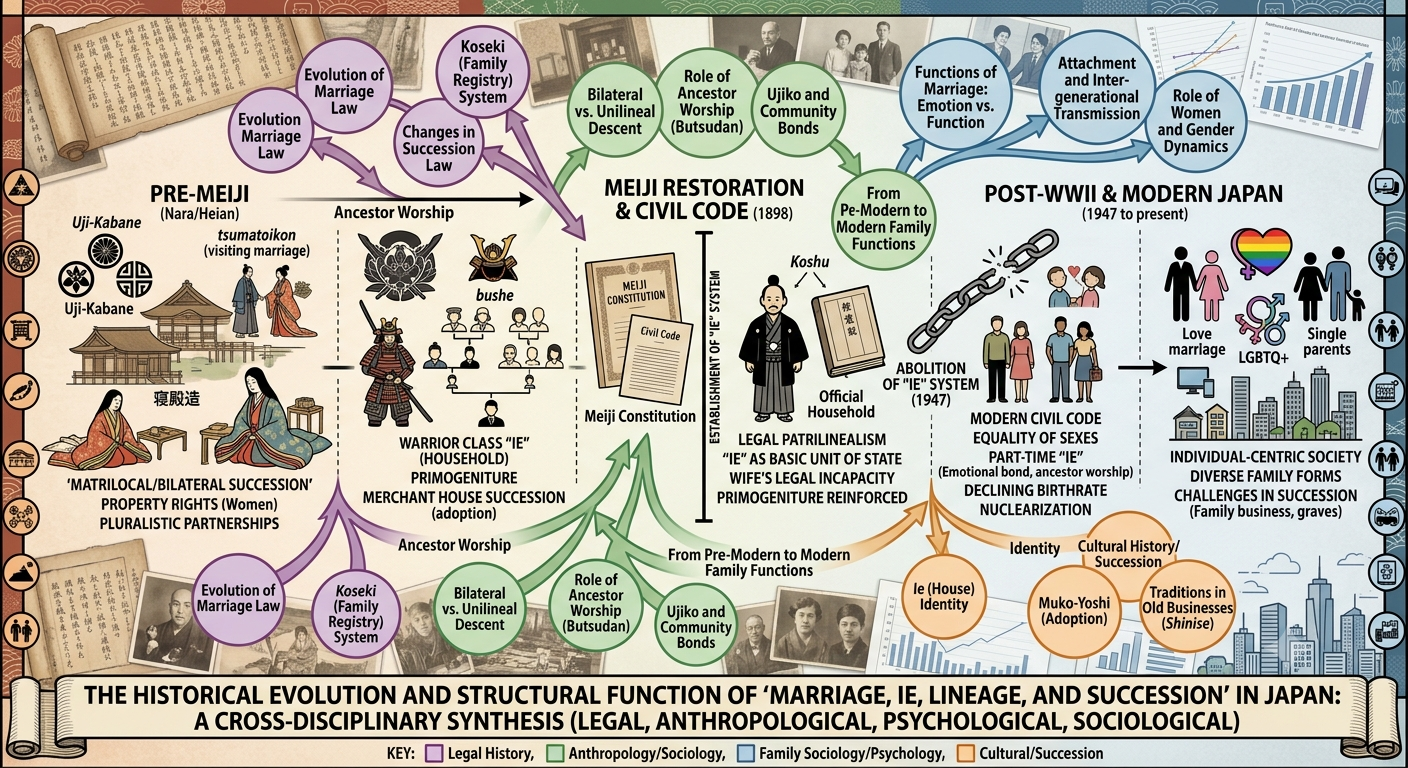
Romantic feeling, sexual desire, and marriage as a social bond — these three have not always occupied the same space, historically speaking. In Edo-era Japan, marriage as a way of preserving the household and the pursuit of sexual and emotional connection in the pleasure quarters were institutionally, deliberately separate. The idea that “you fall in love with the one person fated for you, and marriage is the proof of that bond” — the romantic love ideology most people now take for granted — only became dominant quite recently. This essay traces, through history, literature, psychology, philosophy, and Buddhist thought, the question of why people try to remain devoted to one person at all, and why that attempt so often fails.
Sex, Romance, and Marriage in Japanese History
The institutional separation of sex and marriage before modernity
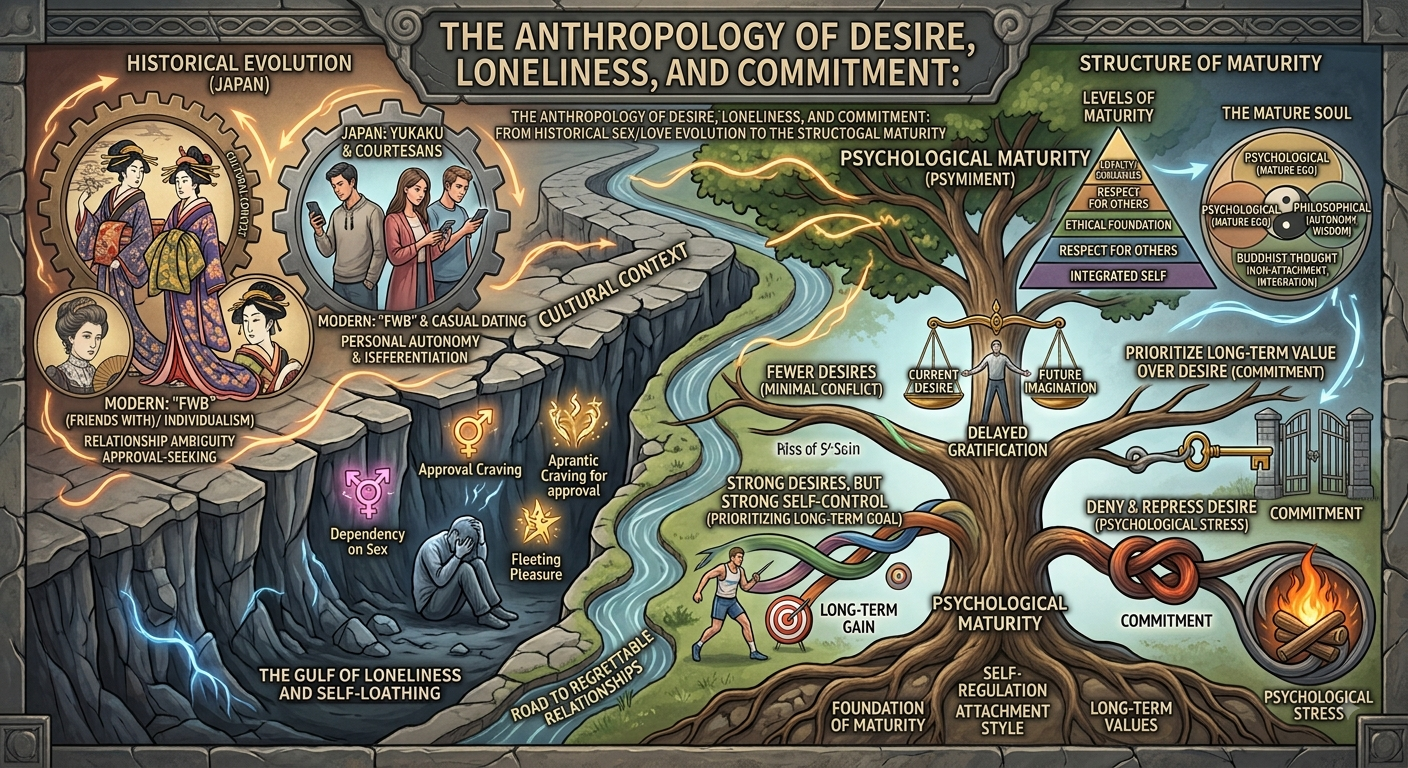
Across most of Japanese history, romantic feeling, sexual relationship, and marriage as a social and economic bond were never automatically unified in one relationship. In the Edo period especially, marriage functioned less as personal fulfillment than as an economic and status-based arrangement serving the continuity of the household. The pleasure quarters — licensed and regulated by the shogunate and regional domains — filled a separate role, as spaces for sexual desire and emotional companionship. Courtesans there were never simply objects of transaction; they were expected to carry real cultivation, artistry, and conversational skill, and relationships with clients unfolded through an established, almost ceremonial protocol. Under this arrangement, a marriage that also happened to involve romantic love was the exception rather than the rule — and when the two aligned too intensely outside sanctioned bounds, it could end in something as extreme as a double suicide.
The modern arrival of “romantic love ideology”
Following the Meiji era, as Western ideas of the modern family took hold, a new ideology arrived that fused romance, sex, and marriage into a single unit. It didn’t actually become the dominant social norm in Japan until sometime between the late 1960s and the 1970s. Once the model — falling in love with one fated person, deepening intimacy, and sealing that bond permanently through marriage — became the accepted standard, anything outside it, whether sex without romantic attachment or romance outside marriage, was pushed to the margins as an ethical lapse.
“Friends with benefits” versus the historical courtesan relationship
Today’s “friends with benefits” arrangement might look, on the surface, like the historical pleasure-quarter relationship — sex without romantic feeling attached — but the underlying structure and psychology are fundamentally different.
| Axis | Pre-modern pleasure quarters | Modern friends with benefits |
|---|---|---|
| Institutional framework | A licensed, commercial system of prostitution | An informal, personal agreement outside any institution |
| Economic exchange | Mandatory (fees, payment structures) | Generally involves no exchange of money at all |
| Norms and role expectations | Bound by ritual protocol and status hierarchy | No clear norms; the relationship itself stays ambiguous |
| Psychological motive | Institutionalized pleasure and social company | Relief from loneliness, need for validation, avoidance of commitment |
The modern FWB dynamic is a genuinely new phenomenon, emerging from the free dating market, matching technology, and the gradual relativizing of romantic love ideology itself. It’s best understood as a transitional kind of relationship: individuals, freed from institutional pressure, trying to meet physical need and loneliness while sidestepping both the risk and the responsibility that real intimacy carries.
The Pathology of Longing in Literature: No Longer Human
The psychology of Ōba Yōzō
Osamu Dazai’s No Longer Human traces, in unflinching detail, how desire, loneliness, the hunger for approval, and self-loathing tangle together and pull a person toward relationships that ultimately destroy them. At the root of the protagonist, Ōba Yōzō, sits a fear of other human beings and an isolating sense that he is fundamentally different from everyone around him. To hide this, he adopts what the text calls “clowning” — an exaggerated strategy of preemptively performing what others expect of him, both to avoid attack and to win a counterfeit kind of acceptance.
For Yōzō, sex functions less as a pursuit of love than as an escape from existential dread. In every relationship he enters, he remains passive, essentially parasitic on the maternal warmth the women around him offer. A woman’s body and affection become, for him, a temporary shelter from a terrifying human world. But every relationship he forms ends up wounding both parties and ultimately drives him toward ruin. His pathology follows a specific self-destructive logic: he craves approval, but fear of rejection keeps him from ever revealing his true self, so he falls back on temporary, compensatory emotional and sexual bonds — bonds that only deepen the self-loathing that started the cycle in the first place.
A literary lineage of self-destructive attachment
The theme of wanting love and approval, and then choosing precisely the relationships that will wound you, recurs across world literature. In Sōseki Natsume’s Kokoro, “Sensei” carries such deep guilt over betraying a close friend that he holds his own wife at an emotional distance even while loving her deeply, effectively imprisoning himself in psychological isolation. In Dostoevsky’s Notes from Underground, the narrator’s crushing pride and hyper-self-consciousness make a healthy relationship impossible; when a prostitute named Liza offers him genuine tenderness, he wounds her with a display of superiority and rejects her love outright, sealing his own loneliness for good. What these works share is a kind of moral perversity of feeling: a deep human wish for connection and approval that, precisely because of a fear of one’s own imperfection and vulnerability, produces choices that end up dismantling the self instead.
The Psychology and Behavioral Science of Sex and Relationships
Attachment style and sexual behavior
Attachment theory offers one of the strongest frameworks available for understanding adult romantic and sexual behavior. Securely attached people carry high self-worth and trust in others, and tend to deepen sexual intimacy while balancing closeness with genuine independence. Anxiously attached people, driven by a strong fear of abandonment, often try to compensate for low self-regard through others’ approval — they frequently conflate love with sex, using physical closeness to manufacture a sense of emotional unity. Avoidantly attached people, distrustful of others at a basic level, actively avoid the vulnerability that real emotional closeness demands — they gravitate toward emotionally detached casual sex or short-term relationships with multiple partners, treating sex as stress relief or a physical need rather than a path toward intimacy.
Sex as emotional regulation, and where gender enters
Sexual behavior doesn’t only satisfy physical desire — it can also function as a form of self-compensation, suppressing or regulating loneliness and low self-efficacy. Impulsive sexual behavior undertaken specifically to soothe an uncomfortable feeling tends, afterward, to produce real regret and guilt. A gender gap shows up here consistently: women report higher psychological regret after casual sex than men do, a pattern that reflects not only the asymmetric biological risk of pregnancy but the ongoing double standard applied to women’s sexual autonomy, which adds its own separate psychological weight.
Temporal discounting and the mechanics of regret
Behind the pattern of choosing momentary pleasure and regretting it later lies a mechanism from behavioral economics known as temporal discounting — the cognitive bias of overvaluing a small reward available right now over a larger reward available only in the future. When prefrontal self-regulation is insufficient, or when stress or alcohol impairs the brain’s inhibitory systems, people fall into hyperbolic discounting: the value of an immediately available desire spikes disproportionately, while the real future cost — regret, a damaged relationship — gets pushed almost entirely out of view.
Rusbult’s investment model
Caryl Rusbult’s investment model of commitment offers a robust framework for understanding what actually keeps relationships intact and prevents impulsive infidelity.
| Factor | What it captures |
|---|---|
| Satisfaction | The degree to which a relationship’s rewards — emotional support, trust, intimacy — outweigh its costs |
| Quality of alternatives | How appealing life would be with someone else, or on one’s own, instead |
| Investment size | Total resources put into the relationship — intrinsic (time, emotion) and extrinsic (shared property, mutual friends) |
Once commitment reaches a high enough level, several self-sustaining maintenance mechanisms kick in automatically: accommodation (responding to a partner’s misstep constructively instead of retaliating), willingness to sacrifice one’s own interest for the relationship, forgiveness of past wrongs, positive illusions that idealize a partner’s strengths, and actively derogating attractive alternatives outside the relationship. Rusbult’s research suggests that staying devoted is rarely about feeling no temptation at all — it’s that accumulated investment and commitment actively engage these cognitive biases, neutralizing the pull of the alternative before it can gain traction.
How aging and parenthood shift values
Developmental psychology explains why people, after aging or becoming parents, often look back on their younger, more impulsive behavior as foolish. Erik Erikson’s stage theory frames early adulthood’s central task as intimacy versus isolation, but describes that task shifting, in midlife, toward generativity versus stagnation. Laura Carstensen’s socioemotional selectivity theory shows something similar: as remaining time in life starts to feel finite, people’s preferences narrow toward a small number of deep, high-quality relationships rather than broad exploration. Becoming a parent tends to trigger a real cognitive reappraisal — the self-concept expands from “the one pursuing momentary desire” to “the protector of someone genuinely vulnerable.” Seen through that lens, choices once rationalized as youthful freedom get reconstructed as real risk — emotional harm, real vulnerability exposed — producing the retrospective judgment: that was a foolish choice.
Dissecting “Devotion”
Instinct versus social and ethical learning
Is devotion to one person a biological instinct, or a product of social learning? The human sciences today land somewhere in between: devotion is not a simple instinct, but a higher-order ethical and volitional choice built on top of an evolutionary foundation. Humans are not a strictly monogamous species — we carry a strong tendency toward pair-bonding alongside a flexible mating strategy that, given the opportunity, also pursues extra-pair mating. Feeling drawn to someone other than your partner is, in itself, a perfectly natural response wired into the brain’s reward system. What we call devotion, then, is not the absence of that pull — it’s the psychological capacity to govern a biological impulse through internalized social norms.
| Paradigm | Passive (unreflective) devotion | Active (willed) devotion |
|---|---|---|
| Mechanism | Simply not drawn to others; low libido or interest | Recognizing the pull of temptation, and choosing the valued relationship anyway |
| Psychological basis | Absence of temptation; a tightly closed attachment style | Executive self-control; ongoing commitment to a chosen value |
| Resilience | Fragile when genuinely strong temptation or crisis arrives | Realistic and durable, having already weathered real conflict |
Ethics and psychology alike rate the second, active form of devotion more highly. It’s impossible to fully control the feeling of attraction to someone else — but it is entirely possible to choose how to act on that feeling. The real substance of devotion isn’t suppressing sensation; it’s the repeated, willed re-choosing of a relationship one has already decided matters.
Kierkegaard and Frankfurt
The Danish philosopher Søren Kierkegaard divided human ways of living into an “aesthetic” stage and an “ethical” stage. The aesthetic stage is governed by desire, momentary sensation, and the pursuit of novelty; because someone chasing the moment can never build a continuous, lasting identity, that stage ends, inevitably, in despair. The ethical stage accepts responsibility and commitment — and its emblem is marriage. Ethical marriage, in this frame, doesn’t reject aesthetic romantic feeling; it is the willed act of making a fleeting aesthetic moment eternal, a repeated decision — “I will live with this person” — made again and again inside a future that remains genuinely unpredictable.
The contemporary philosopher Harry Frankfurt, in The Reasons of Love, describes love as a kind of volitional necessity. To genuinely care about something, on his account, means constraining one’s own fickle first-order desires — the pull toward someone new, the wish to play — with a higher-order will, and binding oneself to that object. It is only by placing oneself under this kind of chosen unfreedom that a person achieves real identity and genuine autonomy.
Psychological Maturity and the Governance of Desire
The idea that a psychologically mature person simply doesn’t feel desire is false. Maturity isn’t the disappearance of desire — it’s a transformation in one’s relationship to it.
| Type | Strength of desire | Psychological outcome |
|---|---|---|
| 1. Low-desire type | Low (temperamental) | No temptation to fight, but possibly a real deficit in passion and depth |
| 2. Willpower-suppression type | High | Constant conflict with desire, steadily depleting willpower; real risk of collapse under stress |
| 3. Value-integrated type (mature) | High to moderate | Feels desire fully, but can relativize it against long-term values |
| 4. Repression / defense type | High (latent) | Denies and represses desire; it tends to resurface distorted, and can trigger sudden relationship collapse |
Psychological maturity refers specifically to Type 3 — the value-integrated, relativizing type. Someone in this state genuinely feels sexual desire and attraction to someone new, but can weigh it against what they’ve already identified as their most important relationship, treating the present impulse as comparatively small.
In Buddhist teaching, suffering is rooted in craving (tanha) and attachment (upadana). Liberation is not achieved by forcibly suppressing desire; it comes through observing impermanence and non-self closely enough to recognize desire’s emptiness, and letting attachment go. This maps remarkably well onto how contemporary Acceptance and Commitment Therapy defines maturity: accepting desire without denying it, while still choosing action aligned with one’s deeper values.
Closing Synthesis: The Difficulty, and the Meaning, of Staying Devoted
Devotion is genuinely difficult for human beings because our very structure carries layered, competing contradictions. Biologically, two opposing mechanisms are wired in at once: an interest in a variety of sexual partners, which helps secure genetic diversity for the species, and strong pair-bonding with one specific partner, which supports raising a helpless infant over years. Psychologically, unresolved attachment anxiety and loneliness create a pull toward quick fixes — validation from others, momentary sexual connection — as an easy patch. And existentially, no matter how deeply two people bond, each person remains, at bottom, unavoidably alone; the fear of that solitude can push people toward consuming others, or toward relationships too fleeting to mean anything, simply to dull the fear.
And yet people also possess something else: the capacity for mental time travel — reflecting on the past, vividly imagining an uncertain future, and relativizing a present impulse against that much larger timescale. Living devotedly does not mean no longer feeling temptation. It means recognizing, honestly, that the desire to find someone else attractive genuinely exists within you — and choosing, again, based on your own values, to keep the relationship you’ve already decided matters. It’s that repeated act of choosing that slowly accumulates what Rusbult calls investment — shared memory, trust, history — into a bond sturdy enough to withstand a single gust of feeling.
Four hypotheses about psychological maturity
Psychological maturity is the capacity to relativize immediate desire through an expanded sense of time.
A lower temporal discounting rate, developed prefrontal executive function, and the long-term commitment-maintenance mechanisms described in the investment model.
Over-prioritizing future value can drain the emotional spark of the present moment and tip into rigid, neurotic over-restraint.
Psychological maturity is the ability to separate attachment anxiety from sexuality, and to bear one’s own loneliness autonomously.
Securely attached individuals tend not to use sex as a compulsive emotional-regulation tool, deploying it instead to build genuine mutual connection.
Pushing too hard toward total self-sufficiency in loneliness risks tipping into avoidant, false independence — refusing the dependence that real intimacy requires.
Psychological maturity is not the extinguishing of desire but active, sustained commitment to a chosen value.
Kierkegaard’s “choice of choice,” Frankfurt’s volitional necessity, and the active cognitive mechanisms shown to sustain commitment.
Maintaining commitment even to a genuinely harmful relationship risks curdling into a sunk-cost fallacy or unhealthy attachment.
Psychological maturity is a shift away from self-centered momentary consumption, toward building something together with others and caring for the next generation.
Erikson’s generativity versus stagnation, Carstensen’s socioemotional selectivity theory, and research on the cognitive reappraisal that parenthood triggers.
Treating parenthood or caregiving as a required marker of maturity risks a pronatalist bias that overlooks the autonomous life course of the childfree, and the equally high forms of ego development available to people who remain unpartnered.
In closing
Living devotedly was never about desire disappearing, or temptation ceasing to register at all. It lies in honestly recognizing your own attraction to someone else, and choosing — again, deliberately — to stay in the relationship you’ve already decided matters. Only by shifting the center of gravity from consuming momentary pleasure to building something lasting can a person arrive at real psychological coherence, and something close to genuine peace of mind.
- 01Osaka University Repository (PDF)
- 02PubMed 29166227
- 03PMC9916622
- 04PMC12680027
- 05PMC12111273
- 06PMC4394850
- 07PMC12867395
- 08PMC10402343
- 09PMC8853360
- 10YouTube
- 11Wikipedia — Investment model of commitment
- 12yukaichou.com
- 13butterflyandtea.com — The Structural Dialectic of Norms, Repression, and Paraphilia
- 14butterflyandtea.com — The Mental Structure of Osamu Dazai