1994 — 2026
The Disappearance of Jacobo Grinberg
Did "the man who decoded the code of reality" ever really exist?
SCROLL TO INVESTIGATE
What if this world were made of "code"?
But one thing needs to be said first.
There is, without question, a real scientist and real research behind this story. But the claim that he "decoded the code of reality" is a separate matter entirely.
This piece is built to keep confirmed fact, the man's own theory, and the legend that grew up around him clearly apart.
Confirmed Fact, His Own Theory, and the Later Legend
Throughout this piece, four badges mark the nature of each claim. None of them mean "false" — they simply mark different levels of certainty.
Established by multiple primary sources or public records.
A theory or interpretation put forward by Grinberg himself or his co-authors.
A story told online in later years, which cannot be traced back to a primary source.
A Mexican psychophysiologist, born 1946
A real researcher who studied at UNAM and worked in the field of consciousness studies.
Syntergic Theory and the "Lattice"
A theoretical framework he proposed to explain the relationship between consciousness, the brain's neuronal field, and an informational structure he called the "Lattice."
"He vanished 12 hours after decoding the code of reality"
A story that spread on social media in recent years, unconfirmed in any primary source from 1994.
Jacobo Grinberg-Zylberbaum
He is best understood not as a "fringe scientist," but as someone who worked the border between mainstream science and its edges.
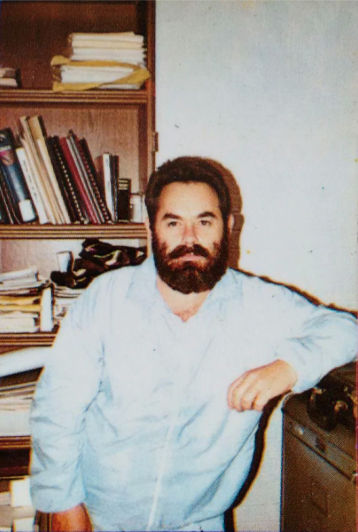
Grinberg was based at Mexico's National Autonomous University (UNAM), where he worked in psychophysiology and consciousness research. He had studied psychophysiology in the United States, and after returning to Mexico, used mainstream scientific methods — EEG measurement chief among them — to investigate territory that mainstream science of the time rarely touched: purported telepathic phenomena, shamanism, and altered states of consciousness.
UNAM
He was affiliated with Mexico's National Autonomous University, working within the framework of psychology and neuroscience.
Consciousness Research
He sought to capture the relationship between brain and consciousness through empirical methods, including EEG measurement.
Telepathy Research
He attempted to experimentally test the correlation reportedly seen in brain activity between two separated subjects.
Shamanism Research
He recorded the states of consciousness and healing rituals of Mexican traditional healers (curanderos/curanderas) as objects of scientific observation.
Work with Pachita
He observed the healing sessions of the healer Pachita (Bárbara Guerrero), studying the relationship between states of consciousness and physical phenomena.
Syntergic Theory
He built an original theoretical framework integrating consciousness, the neuronal field, and the "Lattice."
Pachita — Approaching the Border
His research later moved closer to shamanism. Through the 1970s and 80s, Grinberg regularly visited the Mexican traditional healer Pachita (Bárbara Guerrero), recording her sessions and states of consciousness. For him, this was not a turn toward the occult, but an extension of a consistent research stance: applying the methods of mainstream experimental psychology to phenomena at the edge of the field.

Timeline
Tap any entry to expand it. With JavaScript disabled, every entry is already expanded and fully readable.
1946Born
Born in Mexico.
1960sEncounters psychology and mysticism
While studying psychology, he broadens his interests to mysticism and Eastern thought.
1970sStudies in the U.S.; psychophysiology research
He learns the methods of psychophysiology in the United States, then returns to Mexico to pursue research in earnest.
1970s–80sShamanism and the Pachita research
He investigates Mexican traditional healers, chief among them Pachita.
1980sSyntergic Theory
He publishes a series of works developing his own theory linking consciousness, the neuronal field, and the Lattice.
1987A consciousness research institute
He is involved in founding an institute dedicated to consciousness research.
1994The "Transferred Potential" paper
With his co-authors, he publishes a paper in the journal Physics Essays reporting a "transferred potential" [1].
Dec 1994Disappearance
He vanishes from his apartment; his whereabouts have never been confirmed since.
2020Documentary released
A documentary covering his life and disappearance is released, and covered by major Mexican media outlets [3].
2024The "vanished 12 hours later" social media story
A specific story — that he disappeared 12 hours after decoding the code of reality — is found circulating on social media [8].
What Was Syntergic Theory?
What he called the "Lattice" rests on a broader framework he built to explain consciousness, the neuronal field, and information together: Syntergic Theory.
Conceptual diagram: a simplified rendering of Grinberg's theoretical framework. Not a scientifically established model.
NEURONAL FIELD
A field, purportedly generated by neural activity in the brain, that underlies consciousness. The idea is that it's not individual neuron firing but the overall pattern of activity that bears on consciousness.
LATTICE
The "Lattice" Grinberg spoke of is different from "code" as in a modern computer program. For him, the Lattice was a speculative concept: an informational lattice-work said to span the entire universe, which consciousness accesses to give rise to perception and the sense of reality.
PERCEPTION
Perception is framed as the process by which the brain "reads" the informational structure of the Lattice.
INFORMATION
Treated as a basic constituent of reality alongside matter and energy.
SYNTERGY
"Syntergy" is a term he coined to describe the integrated working of consciousness, neuronal field, and information together.
DECODING
A word used in his writing for the process of accessing and interpreting the Lattice. "Decoding" is a simplifying translation of the concept, and its context differs from modern cryptographic decoding.
The 1994 Paper — Transferred Potential
In 1994, he and his co-authors published the results of an EEG-based experiment in an academic journal [1].
The Einstein-Podolsky-Rosen Paradox in the Brain:
The Transferred Potential
The outline of the experiment was as follows.
Subjects
Two subjects.
Distance / setting
Approximately 14.5m apart, in electromagnetically shielded rooms.
Procedure
A light stimulus was given to only one subject, while EEG was recorded from both.
Reported phenomenon
The authors reported that a corresponding change also appeared in the EEG of the subject who received no stimulus, which they termed the "transferred potential."
This paper was published in Physics Essays in 1994.
The authors reported observing a correlation between the EEGs of two shielded subjects, which they described as a non-local, EPR-like correlation in the brain.
This result does not amount to "scientific proof of telepathy." Replication and independent verification have been limited, and it is not an established finding within the scientific community.
THE CODE
But are these really his words?
His own writing — No direct statement that he "decoded the code of reality" has been found in his own books or papers.
Contemporary 1994 sources — This specific phrase does not appear in interviews or press material from around the time of his disappearance either.
Later social media and web articles — This phrasing is widely used in 2020s social media posts and roundup articles [8].
No primary source currently confirms that Grinberg himself ever said he "decoded the code of reality." The most accurate way to put it is this: in later years, an online story has circulated claiming that Grinberg decoded the code of reality.
12
HOURS
Where does this number come from?
The disappearance
Documentary released
The Matrix connection begins to circulate
The "vanished 12 hours later" story is found on social media [8]
Spread
STATUS: NOT VERIFIED
The specific figure of "12 hours" cannot, in the sources checked for this piece, be traced back to a primary source from 1994. Rather than declaring the story false outright, the accurate statement is that it cannot be confirmed by a primary source.
Did He Really Decode "The Matrix"?
Lattice ≠ Computer Code
They look alike. But they are not the same theory.
The Disappearance
1994.12
He vanished.
Sources disagree on the exact date he was last confirmed seen; December 8 is most commonly cited as the date of disappearance. Neither his body nor any further trace of him has since been found. Several hypotheses about the case are still discussed today.
The wife, Teresa, theory
A hypothesis that a close family member may know more than has been disclosed. No primary source establishes any criminal involvement.
CIA/FBI involvement theory
A hypothesis that draws on the unusual nature of consciousness research as a field. No public record supports it.
Voluntary disappearance theory
A hypothesis that he disappeared of his own will. This, too, lacks conclusive evidence.
None of these theories rises above the level of hypothesis, and this piece endorses none of them.
Evidence Level
A summary of where each claim sits on the scale of certainty.
How This Urban Legend Was Born
A real person, a real theory, an inexplicable case, the cultural image of The Matrix, and reconstruction through social media — this diagram shows how these elements fuse into an urban legend.
The real complexity of the scientist's own life, and of his theory, is difficult for most readers to absorb directly. Layer onto that a dramatic, inexplicable disappearance, then connect it to the easily-grasped cultural metaphor of The Matrix, and let it become something anyone can re-edit and repost on social media — and the line between fact and fiction blurs quickly. This is the typical process by which a real person becomes an urban legend.
Did He Decode the Code of Reality?
It cannot be confirmed.
But the question he left behind has not gone away.
Are we looking at the world — or is the brain constructing it?
FURTHER READING
The items marked JP are Japanese-language blog posts and articles. They are included here as further reading on how this story has been discussed online, not as primary evidence for any of the claims above.
Frequently Asked Questions
Six questions that come up again and again throughout this piece, organized here as a quick reference. The answers match the body text exactly, and use the same FACT/THEORY/LEGEND classification.
Did Grinberg himself really exist?
Yes. He was a real Mexican psychophysiologist, born in 1946, who worked in consciousness research based at Mexico's National Autonomous University (UNAM).
Did the 1994 paper scientifically prove telepathy?
The authors reported a correlation between the EEGs of two subjects in shielded rooms roughly 14.5m apart. But this result does not amount to "scientific proof of telepathy." Replication and independent verification have been limited, and it is not an established finding in the scientific community.
Is the "Lattice" he spoke of the same as computer program code?
No. Grinberg's Lattice is a speculative theoretical concept for explaining the relationship between consciousness and information; its context differs from "code" as in a modern computer program. The two look alike, but they are not the same theory.
Did Grinberg really say he "decoded the code of reality"?
No direct statement to this effect has been confirmed in his own writing or in sources from 1994. The most accurate framing is not "he said he decoded the code of reality," but rather "in later years, an online story has circulated claiming he decoded the code of reality."
Is it true that he vanished 12 hours after decoding the code of reality?
The specific figure of "12 hours" cannot, in the sources checked for this piece, be traced back to a primary source from 1994. Rather than declaring the story false outright, the accurate statement is that it cannot be confirmed by a primary source. The story has been observed circulating on social media since around 2024.
Is the truth behind Grinberg's disappearance known?
No. He vanished in December 1994 and has never been located since. Several hypotheses circulate — involving his wife Teresa, possible CIA/FBI involvement, or a voluntary disappearance — but none is backed by conclusive evidence, and this piece endorses none of them.
RESEARCH NOTE
- This piece distinguishes between confirmed fact, claims made by Grinberg or those close to him, later hypotheses, and legends formed online.
- Where sources disagree, that disagreement itself is recorded rather than resolved by assumption.
- Information that cannot be confirmed is not presented as fact.
SOURCES & REFERENCES
PRIMARY SOURCES
Grinberg-Zylberbaum, J., Delaflor, M., Attie, L., & Goswami, A. (1994). "The Einstein-Podolsky-Rosen Paradox in the Brain: The Transferred Potential."
doi.org/10.4006/1.3029159Grinberg-Zylberbaum, J. — his own books and papers on Syntergic Theory
ACADEMIC / SCHOLARLY
Psi Encyclopedia — entry on Jacobo Grinberg-Zylberbaum
Bibliographic listings for related papers in academic databases such as EBSCO and Semantic Scholar
JOURNALISM / DOCUMENTARY
"The Secret of Doctor Grinberg" (documentary, released 2020)
SECONDARY SOURCES
Commentary from researchers and historians of science; book reviews
ONLINE / SOCIAL
Examples of the "vanished 12 hours after decoding the code of reality" story circulating in social media posts, YouTube videos, and roundup blogs
Source Reliability
Primary sources / original papers
Used as the most reliable evidence in this piece. The 1994 paper itself falls in this tier.
Academic databases / highly reliable reporting
Used to corroborate his biography and career.
Secondary sources / documentary film
Used to reinforce explanation and background context.
Blogs / roundup articles
Used only as reference to understand the content of the legend, not for fact-checking.
Social media / anonymous posts
Low reliability for fact-checking, but valuable as material for tracing how the urban legend spread.