DEEP TIME · EARTH ROTATION · CHRONOBIOLOGY
The Evolution of Earth’s Rotation and Orbit Across Deep Time, and the Physical and Physiological Nature of Time
The “day” was never a fixed unit. Trace 4.6 billion years of tides grinding down Earth’s spin, through the hard evidence of geology, paleontology, and genetics.
- The Basic Physics Behind Earth’s Rotational History and the Structure of Timescale
- How the Length of the Day Has Changed
- Day = ~2–5 hours / Year = ~1,750–4,380 days
- Day = ~6–10 hours / Year = ~876–1,460 days
- Day = 16.9 hours / Year = ~518 days
- Day = ~19.0 hours (locked) / Year = ~461 days
- Day = 21.9 hours / Year = 400 days
- Day = ~22.8 hours / Year = ~398 days
- Day = 23.5 hours / Year = 372 days
- Day = 24.0 hours (86,400 s) / Year = 365.24 days
- A Nonlinear Deceleration Mechanism
- “The ancient Earth’s day was 5–6 hours long”
- “The ancient Earth’s year held 700 days”
- “The dinosaur era had a year of over 400 days”
- “The year itself used to be longer”
- “365 is a fundamental number of the universe”
- “Earth’s rotation is still slowing today”
- “The Moon receding is what’s slowing Earth’s rotation”
- “Short sleepers experience time differently”
The Basic Physics Behind Earth’s Rotational History and the Structure of Timescale
The relationship between the “day” and the “year” is not a fixed astronomical constant — it is a transitional system, continuously reshaped by the transport of angular momentum through tidal forces.
Earth’s rotation has been slowing over the long term, meaning each day was shorter the further back in time you go. The principal driver of this deceleration is tidal friction torque — the drag between Earth’s surface and oceans caused by the tidal bulge raised by the gravity of the Moon and Sun.
Because Earth spins far faster than the Moon orbits, the ocean’s tidal bulge sits slightly ahead of the Earth-Moon line, in the direction of rotation. This phase offset creates a pull-back torque from the Moon, which strips angular momentum from Earth’s spin while transferring that same momentum into the Moon’s orbit. The result: Earth’s rotation slows, days grow longer, and the Moon recedes from Earth at roughly 3.82 cm per year.
Earth’s “year” — the roughly 8,760-hour orbital period around the Sun — is, by contrast, affected only by the Sun’s minuscule mass loss from nuclear fusion and by perturbations from other planets, and has remained highly stable across billions of years. So the phenomenon of “a year with 400 days in the deep past” does not reflect a longer orbital period — it reflects a shorter rotation period, meaning more spins of the Earth fit inside that unchanged year.
How the Length of the Day Has Changed
The length of day (LOD) in each geological epoch has been quantitatively reconstructed through growth-line analysis in organisms, the layered periodicity of tidal sediments, and the reading of astronomical climate cycles (Milankovitch cycles) preserved in rock strata.
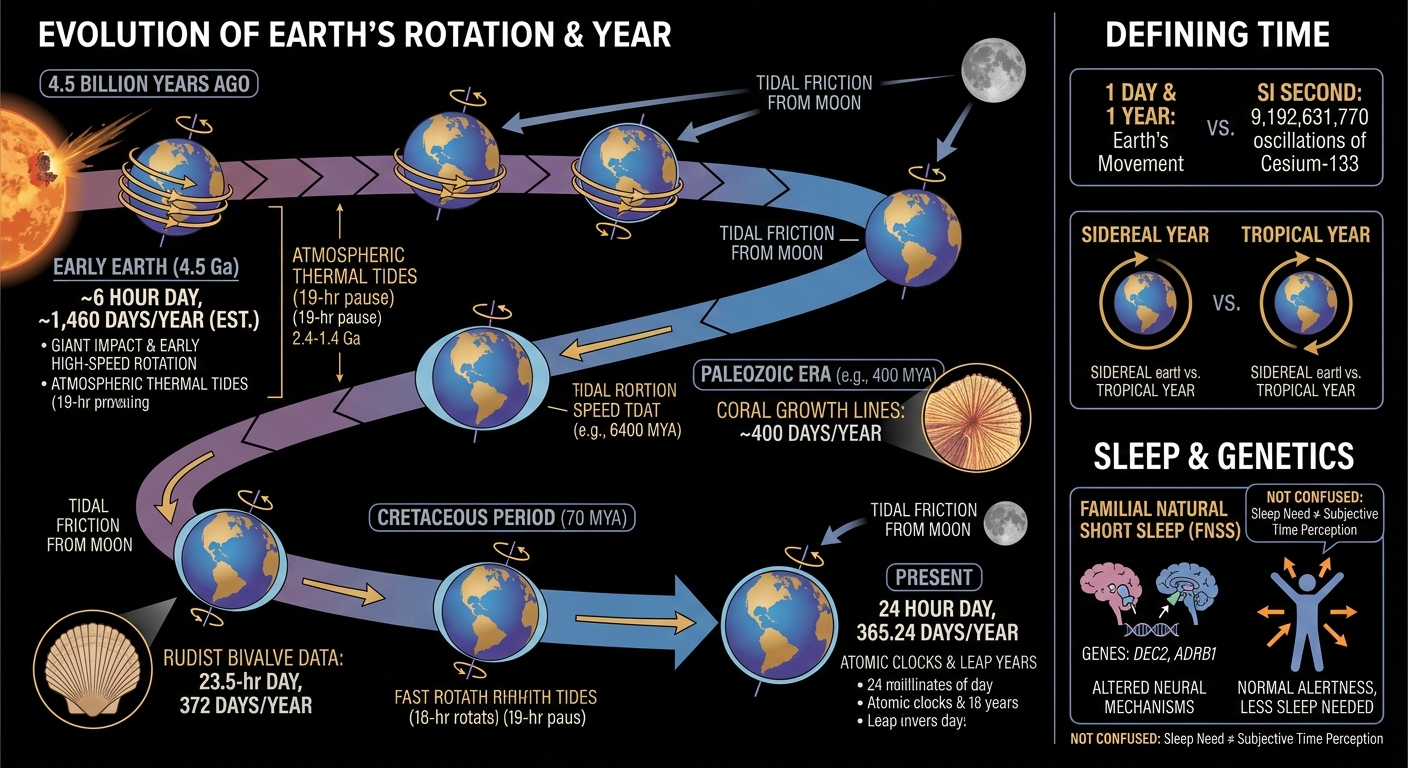
Conceptual diagram: the long-term trajectory of length of day (LOD), passing through a roughly 19-hour stall in the mid-Proterozoic before asymptotically approaching today’s 24 hours.
Day = ~2–5 hours / Year = ~1,750–4,380 days
High-angular-momentum giant-impact models suggest Earth, immediately after the Moon’s formation, may have been spinning at a rate near the centrifugal limit at which its shape would flatten severely.
Canup (2012); Ćuk & Stewart (2012)Day = ~6–10 hours / Year = ~876–1,460 days
Day = 16.9 hours / Year = ~518 days
Day = ~19.0 hours (locked) / Year = ~461 days
Day = 21.9 hours / Year = 400 days
Day = ~22.8 hours / Year = ~398 days
Day = 23.5 hours / Year = 372 days
Day = 24.0 hours (86,400 s) / Year = 365.24 days
A Nonlinear Deceleration Mechanism
Earth’s rotational slowdown has not proceeded smoothly at a constant rate. Solar heating of the atmosphere generates a 12-hour cycle of atmospheric pressure waves — the atmospheric thermal tide — which acts as an accelerating torque, pushing Earth’s rotation forward. In the mid-Proterozoic, the thermal tide’s natural resonance period (roughly 10.5–11.5 hours) came to match half the rotation period of the time, reaching a state of atmospheric tidal resonance. This resonance maximized the accelerating torque of the solar thermal tide, bringing it into a complete standoff against the Moon’s decelerating oceanic torque — producing an extraordinary stall in which the length of day held fixed at roughly 19 hours for about a billion years.
Further, in the Paleozoic (roughly 650–240 Ma), Huang and colleagues (Huang et al. 2024, PNAS) demonstrated through cyclostratigraphic data analysis that rotational deceleration followed a “staircase pattern.” Periods of rapid slowdown (650–480 Ma and 350–280 Ma) alternated with a roughly 150-million-year interval (500–350 Ma) during which deceleration nearly stopped — reflecting how continental drift reshaped the geography of shallow seas and dramatically altered the efficiency of oceanic tidal energy dissipation.
The Number of Days in the Ancient Year — Recorded in Organisms and Rock
The daily and seasonal growth lines etched into the skeletons and shells of ancient organisms, and the fine layered deposits of sediment, are the physical evidence behind our knowledge of how many days the ancient year contained.
Fine Growth Lines in Fossil Coral — Wells (1963)
In 1963, John Wells noticed that corals lay down both fine “daily growth increments,” from day-to-day skeletal deposition, and coarser “annual bands,” from seasonal changes in growth density. Measuring Devonian rugose coral fossils under a microscope, he found an average of 398 fine growth lines (ranging 385–410) within a single annual band — showing that the Devonian year held roughly 400 days, with each day lasting about 22.8 hours.
Ultra-High-Resolution Chemical Analysis of Rudist Bivalves — de Winter et al. (2020)
Niels de Winter and colleagues applied 10-micrometer laser ablation analysis to fossils of the Late Cretaceous rudist bivalve Torreites sanchezi, using cyclical variation in trace-element concentration and isotope ratios to fully separate and count the fast-growing daytime layers, driven by photosynthetic symbiotic algae, from the growth-arrested nighttime layers. The result: 372 ± 8.4 daily laminae within a single year, pinning down the length of day at the time to 23.5 hours with extraordinary quantitative precision.
Tidal Rhythmites and Stratigraphic Cycles
For the Precambrian, where body fossils are scarce, tidal rhythmites — sandstone and mudstone deposited in layers by the ebb and flow of tides — become a crucial indicator. Daily tidal cycles, the semi-monthly spring-neap cycle, and seasonal cycles are all preserved as variation in layer thickness. Analysis of Australia’s 620-million-year-old Elatina Formation has yielded a clear figure: 13.1 ± 0.1 synodic months per year, 30.5 solar days per synodic month, giving 400 ± 7 solar days per year (a day of 21.9 hours).
| Sample | Geological epoch | Days per year | Length of day | Method |
|---|---|---|---|---|
| Rudist bivalve | Late Cretaceous (~70 Ma) | 372 ± 8.4 days | 23.5 hours | Laser ablation mass spectrometry of shell |
| Rugose coral fossil | Devonian (~400 Ma) | 398 (385–410) days | 22.8 hours | Microscope measurement of daily growth lines and annual bands |
| Elatina tidal rhythmite | Neoproterozoic (~620 Ma) | 400 ± 7 days | 21.9 ± 0.4 hours | Regression analysis of tidal periodic layering |
| Banded iron formation (BIF) | Paleoproterozoic (~2.46 Ga) | ~518 days | 16.9 ± 0.2 hours | Ratio calculation from Milankovitch cycles |
Against the debate over whether “the ancient year itself was longer, or the day was shorter,” celestial mechanics offers a consistent answer. The orbital period defined by Earth’s orbital radius and the Sun’s mass has remained nearly constant across billions of years, apart from a minuscule change from the Sun’s mass loss. What changed was Earth’s rotation speed: because each day was shorter, more rotations were tallied within the unchanged span of a year. That is the physical reality.
What “365 Days” Means, and How Physical Time Is Defined
That today’s year holds roughly 365.24 days is not a universal constant — it is simply the incidental ratio between Earth’s current orbital speed and its current rotation speed. If Earth spun twice as fast as it does now, the year would hold roughly 730 days.
Tropical, Sidereal, and Anomalistic Year — Three Kinds of “Year”
Tropical Year
The period from the Sun departing the vernal equinox to its return. Roughly 20 minutes shorter than the sidereal year, due to the precession of Earth’s axis. This is the basis for the calendar.
Sidereal Year
The period for Earth to complete a full 360-degree orbit of the Sun, measured against distant fixed stars. The true orbital period in celestial mechanics.
Anomalistic Year
The period from perihelion (closest approach to the Sun) back to perihelion. Slightly longer than the sidereal year because perihelion itself shifts under the gravitational perturbation of other planets.
The physical reason a leap year is needed is that the tropical year (roughly 365.2422 days) is not a whole-number multiple of the rotation period — the “day” (24 hours). Left unaddressed, this roughly 0.2422-day remainder (5 hours, 48 minutes, 46 seconds) would put the calendar about one day out of step with the seasons every 4 years, and about 24 days out every century. The Gregorian calendar inserts a leap day once every 4 years while treating years divisible by 100 but not by 400 as common years, converging the average year length to 365.2425 days and keeping the seasonal drift within a practical margin for millennia.
Projected Change in Days per Year
Day = ~25 hours, Year = ~350 days
Day = ~26.5 hours, Year = ~330 days
Day = ~35 hours, Year = ~250 days
The SI Second and Leap Seconds
The “second” was once defined as 1/86,400 of a mean solar day, but because Earth’s rotation speed constantly fluctuates minutely — driven by weather, tides, and the behavior of the molten interior — it proved unfit as a standard for precision science. In 1967, the International System of Units (SI) decoupled the “second” from Earth’s rotation, redefining it as a physical property of the atom: the duration corresponding to 9,192,631,770 cycles of radiation associated with the transition between two hyperfine levels of the ground state of the caesium-133 atom. The ongoing, cumulative, minuscule drift between the rotational “day” and 86,400 SI seconds has since been reconciled by inserting “leap seconds” into Coordinated Universal Time (UTC).
Short Sleepers and the Physiological Nature of the Circadian Rhythm
There is no direct evolutionary connection between an ancient Earth where the day lasted 17–20 hours and the sleep needs of modern humans. By the time Homo sapiens emerged roughly 300,000 years ago, the day had already reached nearly 24 hours.
The Genetic Mechanism Behind Familial Natural Short Sleep (FNSS)
Some people need no alarm clock, remain healthy in both body and mind, and maintain high cognitive function on just 4–6 hours of sleep a night. Research by Ying-Hui Fu and colleagues at the University of California, San Francisco has identified the following genetic variants behind this trait.
DEC2, a transcription factor in the circadian rhythm’s negative feedback loop, normally represses the expression of orexin, a wakefulness peptide. The variant weakens this repression, sustaining wakefulness on less sleep.
A variant in the gene encoding the β1-adrenergic receptor. It raises the membrane potential and excitability of wake-promoting neurons in the dorsal pons of the brainstem, enabling full brain recovery on less sleep.
Enhances neuropeptide S receptor signaling, promoting wakefulness while conferring neuroprotection against the memory impairment and anxiety response associated with sleep deprivation.
Does Their Sense of Time Actually Change?
Sleep is explained by the two-process model: the interaction between “Process C,” the roughly 24-hour circadian rhythm kept by the suprachiasmatic nucleus, and “Process S,” the buildup of sleep-promoting substances such as adenosine during wakefulness. FNSS carriers show a distinctly efficient rate of Process S accumulation and of clearance of metabolic waste in the brain, completing recovery in a short window. But as for whether short sleepers actually perceive the passage of time as longer, there is no evidence that these genetic variants alter time perception itself. When they describe “a long day,” it reflects the sheer volume of subjective experience that comes from being awake for a physically longer stretch — 18 to 20 hours a day — not a neurophysiological distortion of time perception.
Fact-Checking Popular Claims About Earth’s History and Time
Eight claims commonly seen in online articles and popular books, checked against current knowledge in geophysics, paleontology, and genetics.
“The ancient Earth’s day was 5–6 hours long”
Celestial mechanics models confirm that in the earliest Earth, from the late Hadean into the early Archean (roughly 4 billion years ago), the rotation period was around 6 hours.
“The ancient Earth’s year held 700 days”
Calculated from the early Proterozoic rotation period (~17 hours, ~2.5 Ga), the year would have held roughly 500–700 days — consistent with the model. But direct fossil evidence, covering only the last 600 million years, tops out at about 400 days.
“The dinosaur era had a year of over 400 days”
The dinosaur era (Mesozoic, ~252–66 Ma) had a year of roughly 370–385 days. Years exceeding 400 days belong to a far more distant past — the Devonian and earlier — so linking that figure to the dinosaur era is a misplacement in time.
“The year itself used to be longer”
The orbital period — the absolute length of a year — has remained nearly constant. What was greater in the past was the number of days packed into that year, a consequence of the day being shorter.
“365 is a fundamental number of the universe”
The figure 365.24 is simply the incidental quotient of Earth’s current orbital position and rotation speed — not a cosmological constant.
“Earth’s rotation is still slowing today”
The long-term action of tidal friction continues to lengthen the day at an average rate of roughly 1.7–2.3 milliseconds per century.
“The Moon receding is what’s slowing Earth’s rotation”
The causal direction is reversed. What actually happens: Earth’s oceanic tidal friction slows the rotation, and the angular momentum lost is transferred to the Moon, causing it to recede as a result.
“Short sleepers experience time differently”
FNSS variants enhance wakefulness maintenance and sleep efficiency; there is no evidence they alter the neural mechanisms of time perception.
Summing Up the Ancient Earth’s Day and Year
The time it takes Earth to circle the Sun once — the span of a year — has stayed at roughly the same 8,760 hours no matter how many hundreds of millions of years back you look. But because the ancient Earth spun like a top, far faster than it does now, a day in the dinosaur era lasted only about 23.5 hours; in the Devonian, roughly 400 million years ago, about 22.8 hours; and 2.5 billion years ago, only about 17 hours.
The accurate way to understand “the ancient year held 400 or 500 days” is this: it was not that the year, as a whole span of time, was longer — it was that the day was shorter, so more days were counted within that unchanging yearly frame. The single greatest brake slowing Earth’s rotation, bit by bit, has been tidal friction driven by the Moon’s gravity, and the rotational energy lost to that brake has been transferred to the Moon — which is why the Moon still drifts away from Earth today, at roughly 3.8 cm per year.
Established facts
Earth’s rotation has been on a long-term decelerating trend due to tidal friction, meaning days were shorter — and years held more days — the further back in time.
The Late Cretaceous year held 372 days, with each day lasting 23.5 hours.
In the mid-Proterozoic (roughly 1.8–0.8 Ga), resonance between the atmospheric thermal tide and the ocean tide produced a stall, holding the length of day at roughly 19 hours.
Open questions
Reconstructing a continuous rotational-deceleration curve for the Archean through Hadean (2.5–4.5 Ga), where stratigraphic data is scarce.
Rigorously pinning down the initial rotation speed immediately after the giant impact.
Fully verifying, through quantitative dynamical simulation, how the reshuffling of shallow-sea geography during supercontinent formation and breakup affected oceanic tidal resonance.