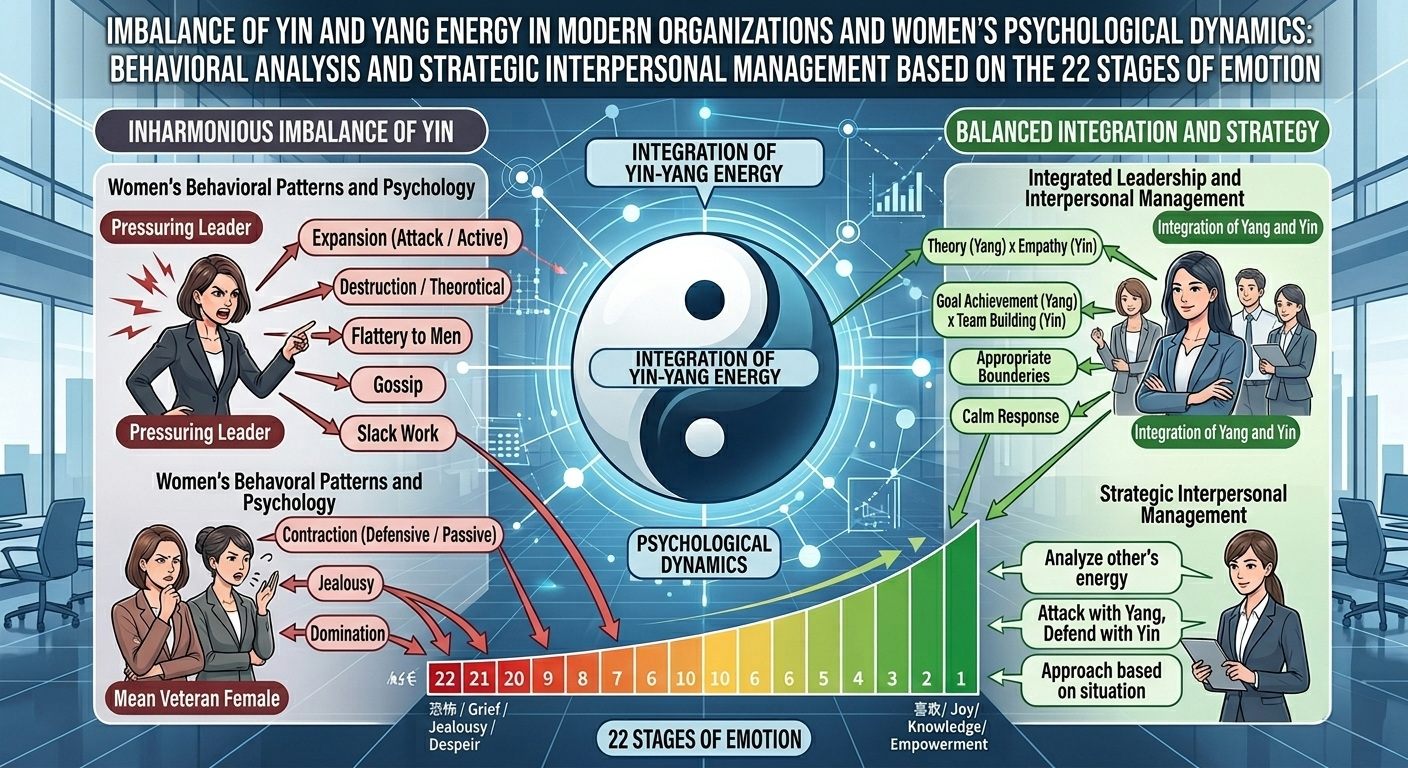
Organizational Psychology × Ancient Wisdom
Yin-Yang Energy Imbalance in Modern Organizations
Behavioral Analysis Through the 22 Stages of Emotion
Female Psychological Dynamics & Strategic Interpersonal Management
Introduction
- Redefining Yin-Yang for the Modern Workplace
- Yin-Yang Distortion: Anatomy of Workplace Archetypes
- Mapping Problem Behavior onto Abraham’s 22 Stages of Emotion
- Female Aggression & the Mechanisms of Manipulation
Redefining Yin-Yang for the Modern Workplace
Yin-Yang philosophy — which explains all phenomena in the universe through two opposing yet complementary energies — is far more than an ancient dualism. It provides an effective analytical framework for modern organizational psychology as well.
☀ Yang (Masculine Energy)
- Expansion & initiative
- Logical, direct communication
- Breaking existing frameworks
- Creative disruption toward new creation
In modern society, the divergence between biological sex and psychological disposition has become pronounced. Gender identity disorders — where physical sex and mental self-identification diverge — suggest that the internal distribution of yin-yang energy within an individual is fluid, transcending conventional social stereotypes.
This article dissects the expression of negative femininity in the workplace using the lens of yin-yang imbalance and Abraham Hicks’ “22 Stages of Emotion,” and presents professional defense and improvement strategies.
Energy Analysis
Yin-Yang Distortion: Anatomy of Workplace Archetypes
Analyzing workplace troublemakers through the yin-yang framework reveals that they have lost the nurturing power of authentic “yin,” and instead wield a “distorted yin” or “runaway yang” as their weapon.
The Exclusive Veteran (The Gatekeeper Type): Yin at Its Stagnated Extreme
The behavior of veteran employees commonly referred to as “gatekeepers” can be defined as the negative extreme of yin’s quality of “contraction and defense.” Yin’s inherent nature is to preserve harmony and enrich the internal environment — but when distorted, it mutates into the exclusive vector of “territorial dominance” and “hoarding of vested interests.”
These individuals devote all their energy to preventing change in the workplace, working to eliminate younger employees or prominent individuals who bring fresh perspectives. This is the result of yin’s “protective” quality being converted from constructive maintenance into destructive rejection. In this state, logical dialogue (yang) is refused, and subjective emotion combined with relational manipulation (distorted yin) takes priority.
The Leader Who Alternates Between Intimidation & Flattery: Yang Rampage × Yin Regression
A leader who “applies pressure,” “flatters male superiors,” and handles work carelessly exhibits yang and yin energy mixed in an extremely dysfunctional form. The “pressure” she exerts on subordinates is an expression of yang energy’s negative side — “domination and destruction.” Yet her flattering attitude toward male superiors simultaneously reveals a regression into the negative side of femininity: “passive dependence” and “defining the self through others’ approval.”
Rather than pursuing results through actual work performance (constructive yang expansion), this type maintains her position through political maneuvering and impression management.
| Dimension | Healthy Yang | Healthy Yin | Toxic Distortion |
|---|---|---|---|
| Core Vector | Expansion, pioneering, reform | Stability, receptivity, nurturing | Domination or exclusive stagnation |
| Communication | Logical, direct, fair | Empathic, mediating, receptive | Pressure, flattery, gossip, manipulation |
| Work Attitude | Goal achievement, accountability | Environment building, process focus | Cutting corners, irresponsibility, credit theft |
| Effect on Others | Stimulates ambition | Elevates psychological safety | Jealousy, isolation, forced dependence |
Emotional Framework
Mapping Problem Behavior onto Abraham’s 22 Stages of Emotion
The 22 Stages of Emotion classify the vibrational states of human consciousness from Stage 1 (highest) to Stage 22 (lowest). The behaviors of workplace troublemakers map clearly onto the lower tiers of this scale.
| Behavioral Pattern | Emotional Stage | Psychological Energy State |
|---|---|---|
| Goal achievement, gratitude, love | Stage 1 | Peak positivity — full empowerment |
| Work neglect, blame-shifting | Stage 15: Blame | Abdication of personal power; attacking surroundings |
| Intimidation, power harassment, outbursts | Stage 16: Anger | Explosion and transference of frustration |
| Persistent harassment, entrapment | Stage 17: Revenge | Destructive retaliatory emotion |
| Gossip, strong rejection, factionalism | Stage 18: Hatred | Deep aversion and negation of others |
| Attacks on capable/young colleagues | Stage 19: Jealousy | Low self-worth; envy of others |
| Flattery, ingratiation, self-preservation | Stage 20: Insecurity | Fear of rejection; dependency |
| Irresponsibility, apathy, self-deprecation | Stage 21: Powerlessness | Despair — harbinger of deeper collapse |
Psychology
Female Aggression & the Mechanisms of Manipulation
The aggression seen in female workplace troublemakers differs from male physical or direct aggression — it is characterized by being indirect, concealed, and psychological in nature. Understanding these mechanisms is indispensable for developing appropriate defenses.
Relational Manipulation & the Passivity of “Being Chosen”
Psychological research indicates that female aggression specializes in skillfully manipulating relationships to socially and psychologically isolate targets. Historical and social backgrounds contribute as well: women who have historically secured status by “being chosen by men” intensify same-sex comparisons of “attractiveness and value,” which feeds directly into the logic of jealousy and exclusion.
The leader who “flatters men” while simultaneously “attacking female colleagues” is bringing this passive competitive logic into the workplace. For her, the workplace is not a space for performing work — it is a battlefield for proving her “chosenworthy value” and outmaneuvering competitors (other women).
Psychological Domination by the Manipulator
The person who is “careless with work but guards their position through gossip and manipulation” is called a “manipulator” in psychology. They skillfully exploit others’ goodwill and guilt, and manage surrounding impressions to place themselves in an advantageous position.
Gaslighting
Making the target doubt themselves — “Am I the one who’s wrong?” — causing them to lose self-confidence through sustained psychological manipulation.
The “This Is for Your Own Good” Disguise
Disguising attacks as advice or genuine concern, thereby sealing off the target’s ability to counter or resist.
Impression Management (Double-Tongued Strategy)
Playing the role of a capable, obedient subordinate for superiors (especially authoritative male managers) while covertly running a smear campaign against the target behind the scenes.
Defense Strategies
Restoring Self-Sovereignty: Establishing Psychological Boundaries
Reacting emotionally to toxic female colleagues — or attempting to persuade them — is in most cases counterproductive. This is because doing so drags you down into their low energy state (Stages 15–22). The core of strategic response lies in setting “psychological boundaries” and “energy separation.”
Building Boundaries: The Immigration Officer Metaphor
Visualize your own mind as an “independent nation state,” and recognize yourself as the “immigration officer” who guards it.
Emotional Quarantine
When anger, pressure, or gossip is directed at you, step back and ask: “Is this worth bringing into my nation?” If not, declare it “rejected” and mentally return it to the sender’s domain.
Information Distance
Manipulators weaponize personal information. Share nothing private — maintain only task-essential communication, conducted matter-of-factly.
Grey Rock Method
Respond to provocations with the dull inertia of a grey rock — polite but emotionally featureless. This denies manipulators the reactive “energy” they feed on, redirecting their attention elsewhere.
Evidence Accumulation
Refuse to engage with emotional arguments. Keep all exchanges grounded in numbers, facts, and records. Log inappropriate instructions or statements with timestamps as objective evidence.
| Type | Primary Behavior | Core Psychology (Stage) | Action Plan |
|---|---|---|---|
| Jealousy-Type Gatekeeper | Ignoring, excluding, snide remarks | Jealousy (19) | Minimize contact while feigning humility. Build trust through results; let work speak. |
| Intimidation-Type Leader | Yelling, applying pressure | Anger (16) | Maintain composure. Cowering intensifies attacks. Report facts to higher management. |
| Flattery-Manipulation Type | Flattering men; spreading gossip | Insecurity–Powerlessness (20–21) | Never reveal you’ve detected her manipulation. Respond with diligent documentation; close off escape routes. |
| Negligence-Blame Type | Abandoning duties, blame-shifting | Blame–Powerlessness (15, 21) | Formalize task allocation in writing (email). Build a firewall so her failures don’t reach you. |
Organizational Perspective
Organizational Health & Personal Energy Management
Female employee conduct issues in the workplace should not be dismissed as individual character flaws — they must be understood as a circulation failure of the organization’s overall yin-yang energy balance.
The Yin-Yang Balance of Excellent Organizations
In outstanding organizations, yang energy (goal achievement, innovation, logic) and yin energy (psychological safety, cultivation, empathy) are in exquisite balance. Workplaces where troublemakers run rampant are almost always skewed toward either “yang rampage driven by results-first ideology” or “yin stagnation rooted in insularity.”
The Gratitude Game
Reduce the time spent focusing on unpleasant workplace events. Instead, consciously direct attention toward “what went well today” or “who helped me” — even small moments — to elevate your own vibration.
Reinforcing Self-Affirmation
Stop seeking approval from others — especially from distorted evaluators. Define your own worth by yourself. Authentic confidence in your unguarded self becomes your most powerful shield.
Conclusion: Returning to Integrated Nature
Malicious colleagues and overbearing leaders — regardless of their biological sex — are “energy wanderers” who have lost their inner yin-yang balance, trapped in low emotional stages of low self-worth and anxiety.
Their conduct is not an expression of the qualities of “yin” or “yang” as such, but a product of the “shadow” that emerges when those qualities are obstructed.
As the one responding, what is required is not correcting the other person (yang intervention) nor over-empathizing and becoming entangled with them (yin assimilation) — but the exercise of a sophisticated “self-sovereignty”: maintaining a high frequency, identifying the other party’s “stage” with detached clarity, and guarding one’s boundaries uncompromisingly.
In an increasingly diverse modern society, cultivating the insight to see through to the quality of underlying energy and emotional state — without being misled by labels of gender or title — will be an indispensable key to achieving true leadership and self-realization within any organization.