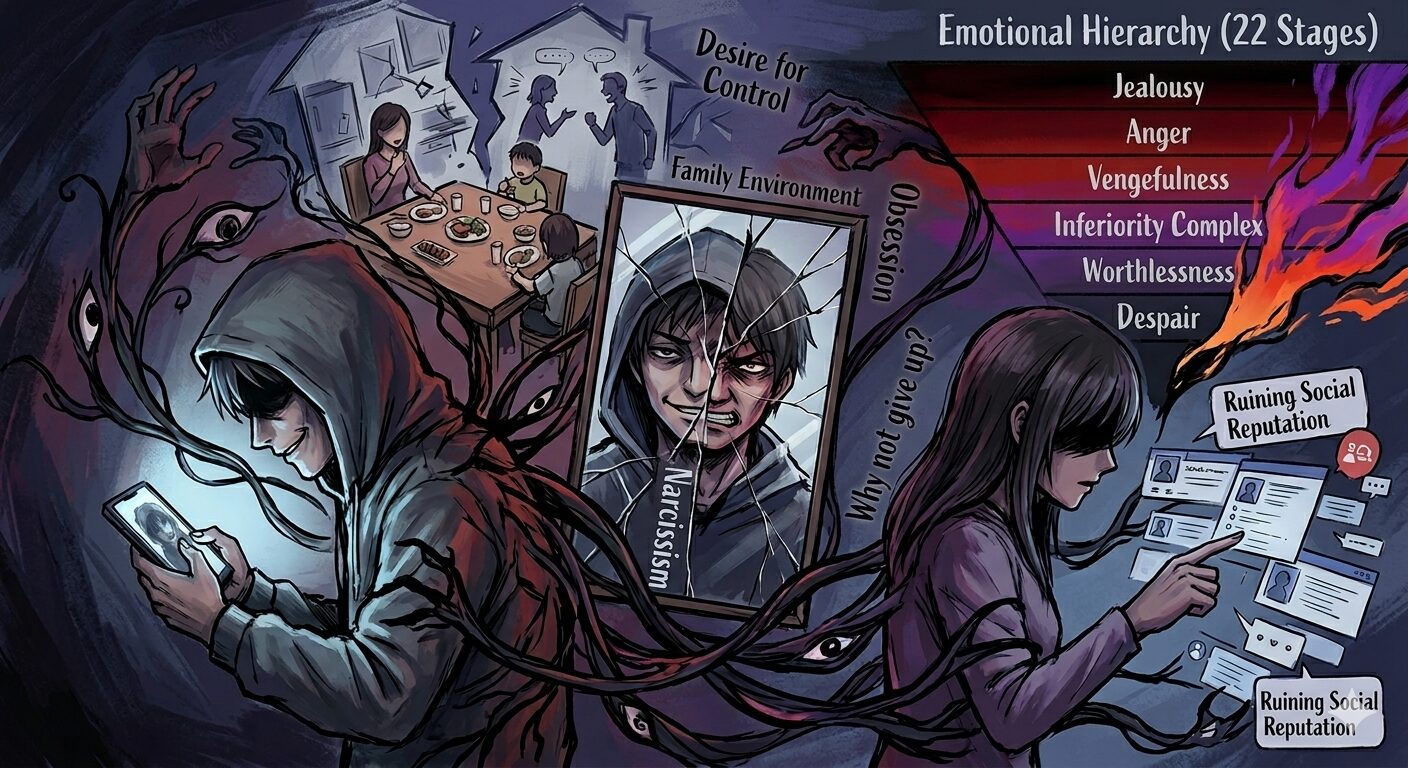
Clinical Psychology — Multi-Perspective Analysis Report
The Pathology of Obsession
Persistence, Gender Differences, and
Narcissistic Architecture in Stalking Behavior
A forensic dissection of the mechanisms sustaining predatory fixation: the paradox of rejection as fuel, narcissistic personality disorder, the performance of normalcy, and the developmental roots of attachment failure.
Section 01
- The Paradox of Obsession: Rejection as Psychological Fuel
- Gender Differences in Stalking: A Comparative Behavioral Analysis
- The Pathology of Narcissism: The Cognitive Architecture That Ignores Unlikability
- The Public Mask and the Performance of Normalcy: The Dissociation Between Social Persona and Internal Instability
- Positioning Stalker Psychology on Abraham’s 22 Emotional Stages
- Family Environment and Attachment Disorder: The Developmental History of the Stalking Personality
The Paradox of Obsession: Rejection as Psychological Fuel
As stalking has deepened as a social crisis, the psychological dynamics that allow perpetrators to completely ignore explicit rejection from victims, social sanctions, and objective observations that they possess no qualities that would attract affection — and yet continue their harmful conduct — are extraordinarily complex and defy the frameworks of ordinary interpersonal communication.
Core Paradox
In ordinary relationships, rejection signals the end of connection. But within the stalker’s internal world, rejection itself functions as fuel — a paradoxical structure in which the very act of being pushed away is used to justify the continuation of the relationship and intensify the fixation.
At the root of this persistence lies “denial” — a powerful defense mechanism that converts reality into something self-serving. Perpetrators cognitively distort explicit signals of rejection (“never contact me again,” “I’ve filed a police report”) into readings such as “they’re testing me” or “they really love me but are just too shy to show it.”
The Reward System of Dominance and Conquest
The escalation of stalking behavior into relentless harassment involves a deeply embedded reward circuit centered on the fulfillment of the desire for domination and the sensation of conquest. When perpetrators confirm that their target is frightened, or that their own presence is disrupting the target’s life, they experience an inflated sense of omnipotence — a feeling of having “overwhelming influence” over another person. This distorted sense of control forms a catastrophic feedback loop: the deeper the target’s distress, the more completely the stalker’s need for conquest is satisfied.
The Absence of Mentalization and “Instrumental Perception”
The clinical explanation for this persistence points to disrupted attachment formation in early childhood — specifically, a failure to develop the capacity known as “mentalization”: the ability to perceive oneself and others objectively and accurately infer another person’s emotional state. Because this capacity is dysfunctional, stalkers do not perceive victims as independent human beings with their own inner lives, but as “tools” for satisfying their own needs, or as extensions of themselves.
Section 02
Gender Differences in Stalking: A Comparative Behavioral Analysis
Research in criminal psychology and statistical data from law enforcement agencies make clear that the forms, motivations, and persistence of stalking behavior differ significantly by the perpetrator’s gender. For many years, the dominant picture has been that approximately 85–90% of recognized stalking perpetrators are male and the majority of victims are female. Recent research, however, demonstrates that female perpetrators exist in a non-negligible proportion and that their methods carry distinct characteristics of their own.
▲ Male Offenders
- Physical contact, ambushing, surveillance, gifts
- Excessive extension of “classic courtship behavior”
- Risk of physical violence and predatory sexual assault
- Digital tools (GPS) used for physical tracking
- Median duration: approx. 21 weeks (high-intensity burst)
▲ Female Offenders
- Psychological harassment, fulfilling dependency needs
- Reputational destruction, defamation campaigns
- SNS attacks via impersonation accounts
- Systematic dismantling of the target’s relationships
- Median duration: approx. 31 weeks (tenacious, long-term)
| Dimension | Male Perpetrators | Female Perpetrators |
|---|---|---|
| Perpetrator Rate | Approx. 85.9–86.9% | Approx. 11–14% (rising trend) |
| Primary Focus | Physical approach, ambush, surveillance, gifts | Psychological domination, relentless contact, SNS surveillance, defamation |
| Violence & Risk | Physical assault, threats, predatory sexual violence | Reputational destruction, false accusations, psychological coercion |
| Duration (median) | Approx. 21 weeks (explosive, short-burst) | Approx. 31 weeks (tenacious, prone to escalation) |
| Typical Motive | Predatory, rejected suitor, resentful | Rejected (52%), intimacy-seeking (36%), resentful |
| Digital Methods | Covert GPS installation, physical tracking | Impersonation accounts, 24-hour monitoring via anonymous profiles |
⚠ The Characteristic Psychology of Female Perpetrators
A deeply held victim-identity — “I was treated unjustly” — serves as a powerful weapon for self-justifying stalking behavior as “rightful protest against someone who betrayed me.” Even after police warnings and social censure, the logic of “I am the true victim here” sustains the fixation.
Section 03
The Pathology of Narcissism: The Cognitive Architecture That Ignores Unlikability
The phenomenon of “persisting in fixation even when everyone around you can objectively see there is nothing to be liked about you” can be explained as a severe dissociation between the “grandiose self” and “objective reality” characteristic of Narcissistic Personality Disorder (NPD). For the narcissistic individual, the self is always the center of the world; other people are nothing more than “mirrors” whose purpose is to admire and sustain that self.
The Collapse of Realistic Self-Appraisal and the Defense Mechanisms
The narcissistic individual presents on the surface as arrogant and brimming with self-confidence, but internally harbors an extremely fragile “unstable self-evaluation” that can collapse at any moment. When they genuinely lack likable qualities, recognizing that fact would mean the destruction of the self — so they mobilize the following defense mechanisms to seal off reality.
Section 04
The Public Mask and the Performance of Normalcy: The Dissociation Between Social Persona and Internal Instability
One of the most commonly overlooked characteristics of stalking perpetrators is that, in many cases, they are recognized in daily life as polite, logical, and socially well-regarded individuals — generating genuine bewilderment in victims and third parties who insist “there is no way that person could do something like this.” The perpetrator is perceived in their workplace and social circles as a calm and reasonable person, while directing fixation, surveillance, and threatening behavior exclusively toward their target — a radical duality.
The Dual Function of the “Normalcy Performance”
This social mask — clinically referred to as the “False Self” — does not function simply as a strategic disguise to deceive others. What is clinically striking is that perpetrators use the performance of this “normal self” as a form of self-sedation against their own internal instability. In other words, the public face of likability simultaneously serves two purposes: deceiving others and supplying the self with reassurance.
Clinical Point
For the narcissistic perpetrator, “being treated as a normal person” is an act of confirming self-worth. The fact that those around them see them as intelligent, logical, and decent temporarily plasters over the internal Stage 21–22 reality of “worthlessness and powerlessness.” Abusive behavior and exemplary social conduct are not opposites — they are two symptoms produced by the same underlying self-deficiency.
Logical Armament and the “Language of Justification”
The scenes in which perpetrators “say reasonable-sounding things” to victims or third parties are intelligible within this same framework. They frequently deploy psychological terminology, moral language, and logic dressed as “concern for the other person” to package their fixation as legitimate. “I contacted you because I was worried about you.” “It’s my right to express my feelings.” “Anyone in my position would do the same.” These are phrases designed to be difficult to rebut, used to control the narrative.
This is not simple lying or sophistry — it arises because the perpetrators themselves genuinely believe they are right. Within the narcissistic cognitive structure, their own behavior is always justified; fixation wrapped in language that sounds logical and ethical is processed internally as “proof of love.”
Section 05
Positioning Stalker Psychology on Abraham’s 22 Emotional Stages
The “Emotional Guidance Scale” of 22 stages proposed by Abraham (Esther and Jerry Hicks) visualizes the states of human emotional vibration. Mapping the psychology of stalking perpetrators onto this scale illuminates, with mechanical clarity, why they experience their destructive fixation as “legitimate” and feel compelled to continue it.
⚠ The Paradox of “Climbing the Ladder”
For a person dwelling in the despair of Stage 22, the “anger” and “revenge” of Stages 17–18 actually represent movement to a higher (more bearable) energy state. Telling the perpetrator “doing this will only make you more hated” is nothing other than pushing them back down into Stage 22 powerlessness — triggering an instinctive, violent resistance in the form of even more intensified harassment.
| Stage | Emotional State (Abraham’s Definition) | Correlation with Stalker’s Internal Psychology & Behavior |
|---|---|---|
| 1 | Joy, appreciation, freedom, love, empowerment | The illusory state the perpetrator believes they deserve to reach |
| 17 | Anger | Initial reaction to rejection; energy used to escape powerlessness |
| 18 | Revenge | Primary battleground; harassment creates the feeling “I am not powerless” |
| 19 | Hatred / Rage | State of narcissistic rage; target is seen as “an enemy to be destroyed” |
| 20 | Jealousy | Ferocious envy and hatred toward target’s freedom and other relationships |
| 21 | Insecurity / Guilt / Unworthiness | The perpetrator’s true self-image; the root inferiority complex driving fixation |
| 22 | Fear / Grief / Despair / Powerlessness | Fundamental home state; fixation and abuse are performed to escape from here |
Section 06
Family Environment and Attachment Disorder: The Developmental History of the Stalking Personality
Clinical evidence consistently indicates that the narcissistic personality and pathological fixation of stalkers is formed less by innate predisposition than by “attachment failure” in the early childhood developmental environment. Their behavior, while housed in an adult body, reflects an internal fixation at the stage of an infant — who panics and gives chase the moment the caregiver disappears from view, feeling their survival is threatened.
Patterns of Attachment Formation Failure
Overcontrol / Overprotection and “Conditional Love”
When a parent treats a child as a possession or accessory — offering praise only when the child meets expectations and withholding it otherwise — the child internalizes a powerful anxiety: “I have no value as I am.” This becomes the seed of the compulsive grandiose self in adulthood, and of extreme dependence on whoever can be made to sustain that inflated self-image.
Neglect and Emotional Starvation
A child who does not receive appropriate care and affection during the critical developmental window grows up with a persistent hollow at the center of their inner world — “narcissistic hunger.” For them, other people are a “nutrient source” that fills the void; having that supply cut off triggers a panic equivalent to facing death.
Failure of Mentalization
When the parent carries unresolved trauma, or lacks the capacity to mirror the child’s emotional states back to them, the child cannot develop the foundational understanding that “other people have their own inner lives.” The result is an adult who can only perceive others as “tools for regulating my own emotional state.”
Intergenerational Transmission of Abuse and Neurological Impact
Children raised with physical or psychological abuse live in a state of chronic hypervigilance, constantly reading the room for survival. This chronic stress impairs the brain’s emotional regulation systems and makes impulse control difficult. The maintenance of appropriate relational distance — healthy boundaries — remains an unlearned, foreign concept.
Section 07
Structural Conclusions and Implications for Social Intervention
The multi-perspective analysis throughout this report makes clear: the psychology that drives stalkers to continue their fixation regardless of the harm they cause is not simply “deviant romantic feeling” — it is a “pathological survival strategy” deployed to prevent the collapse of the self.
Gender-Based Risk Management and Countermeasures
Intervention: Male Perpetrators
The elevated risk of physical violence, predatory sexual assault, and sudden coercive action means that hard physical enforcement — police-issued restraining orders and similar measures — must be the first priority.
Intervention: Female Perpetrators
The strong tendency toward “resentful” and “rejected” subtypes means the risk skews toward long-running psychological warfare: reputational destruction, online defamation, and revenge pornography. Vigilance against impersonation and proxy attacks on the victim’s social network is essential.
The Limits of Emotional Appeals and the Necessity of Third-Party Intervention
For the perpetrator, ceasing the fixation means sinking back into the unbearable depths of “powerlessness and worthlessness” — which means their capacity for rational judgment is non-functional. Emotional appeals and moral arguments are without power.
⚠ Final Intervention Principle
It is indispensable to introduce third-party intervention early — police, lawyers, medical professionals — and to create conditions in which the perpetrator is forced to confront their own root problem of “powerlessness.” Only when their behavior toward the target ceases to function as a means of control (i.e., when the chain of success experiences is broken) does the perpetrator first acquire the possibility of confronting their own pathology. Even through that process, careful, staged law enforcement combined with psychological intervention is required in order to avoid triggering an explosion of narcissistic rage.
The True Nature of Obsession: The Externalization of Self-Regulation
Stalkers suffer from a decisive deficiency in their internal “self-regulation function” — the capacity to generate self-esteem and process emotion from within. To compensate for that deficiency, they attempt to absorb the external object — the target — as “a part of the self” and to dominate it.
The reason they cannot recognize what everyone around them can see — that they have no likable qualities — is that what they are looking at is not their real self, but the phantasm of an “omnipotent self” that is supposed to be reflected back from the mirror of the target.
Dissolving this pathology at its root requires not moral appeals to the individual, but multi-layered social, medical, and legal intervention — combined with a long-term clinical commitment to supporting the reconstruction of the “secure base” the perpetrator was denied in early childhood.