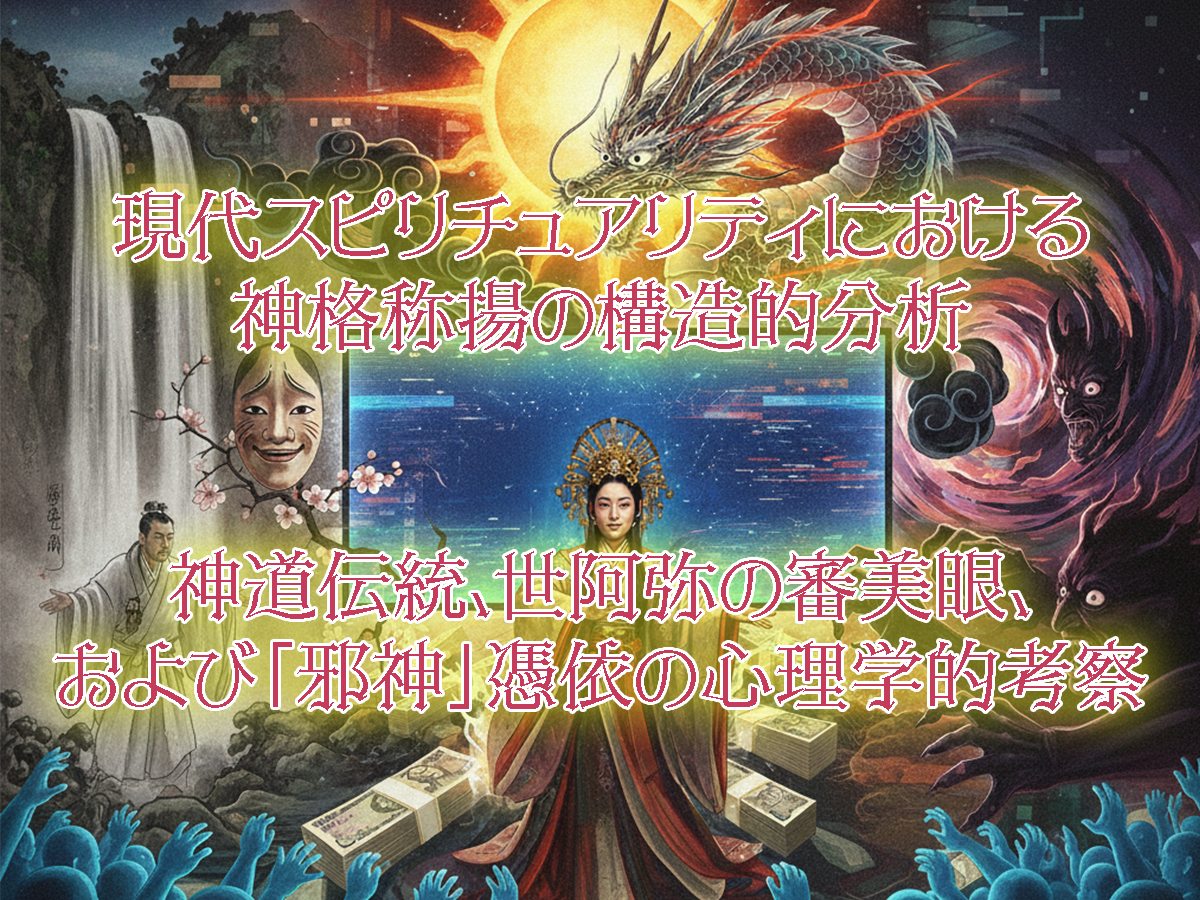
Structural Analysis of Divine Glorification in Contemporary Spirituality
Shinto Tradition, Zeami’s Aesthetic Vision, and Psychological Examination of ‘Evil Spirit’ Possession
- Introduction: Transformation of Kotodama and the Crisis of Spiritual Discourse in Modern Times
- Chapter One: The Logic of Purification in Shinto and Social Responsibility of Spiritual Practitioners
- Chapter Two: The Aesthetics of “Hiden” and the Secrecy of Spiritual Truth
- Chapter Three: Dynamics of Evil Spirit Possession and Correlation with “Desire”
- Chapter Four: Monetary Systems and Spiritual Degradation from a Galactic Perspective
- Chapter Five: Identifying Spiritual Maturity Through Reactions to Criticism
- Chapter Six: The Path True Spiritual Practitioners Should Walk and Practice of “Misogi”
- Chapter Seven: Wisdom of “Saniwa” (Divine Discernment) in Modern Times
- Conclusion: Return to Cosmic Harmony and Establishment of Self-Responsibility
- References & Citations
Introduction: Transformation of Kotodama and the Crisis of Spiritual Discourse in Modern Times
In contemporary Japanese society, self-promotion by “spiritual practitioners” through social media and video platforms has expanded to unprecedented scales. In particular, claims of “direct connections” with Amaterasu Omikami, the ancestral deity of the imperial family, or dragon deities as symbols of powerful natural energies, function as powerful catchphrases in the spiritual marketplace. However, these claims show significant divergence from the aesthetics of “hiden” (if hidden, becomes a flower) cultivated by Japan’s ancient belief systems and traditional performing arts, as well as from the process of thorough self-purification through “misogi” (purification) and “norito” (ritual prayers).
This report provides a multifaceted analysis of why the act of casually exploiting sublime divine figures such as Amaterasu Omikami and dragon deities for self-authorization is considered “untrustworthy” from the perspective of traditional spirituality. Specifically, we examine Zeami’s concept of “hiden,” the true meaning of misogi and norito in Shinto, and how negative energies known as “evil spirits (demons)” connect with human desires for recognition and money, ultimately forming a “blame-shifting space” that attracts followers with dependency tendencies, based on expert knowledge.
Chapter One: The Logic of Purification in Shinto and Social Responsibility of Spiritual Practitioners
When those who claim to be spiritual practitioners are truly connected to high-level divine spirits, thorough “self-erasure” and “purification” are required as prerequisites. In Shinto, humans are believed to originally possess “naohi” (pure nature), but accumulate “kegare” (impurity/depletion of spirit) and “sin” in daily life. The specific techniques for wiping away this impurity and recovering one’s original divinity are “misogi” and “norito.”
Recovery of Humanity and Spiritual Foundation Through Misogi
The act of “misogi” is not merely physical cleansing. It is fundamental training whereby, through recovering one’s human nature, your destiny will certainly improve, contributing to personal growth, family happiness, and furthermore to social and world peace. Spiritual practitioners with genuine power are required to first be in a state of “ku” (emptiness) appropriate as vessels for the divine, before touching the glory of divine spirits.
What is important in this process is the thorough elimination of self “desire” and “ego.” Proclaiming connection with supreme divine figures like Amaterasu Omikami is itself an expression of “ego” that should be stripped away through misogi. Therefore, the act of loudly advertising connections with specific high-level deities can be interpreted not as the culmination of training, but rather as revealing a lack of training. Sincere spiritual practitioners, as their influence grows, perform even more misogi and discipline themselves.
Norito (Ritual Prayers) and Responsible Exercise of “Kotodama”
The “Misogi Harae no Kotoba (Amatsu Norito)” becomes “kotodama” (spirit of words) when recited aloud, an act of purifying sins and impurities by borrowing the power of the gods. Kotodama refers to spiritual power dwelling in words, believed to directly affect the physical world.
True spiritual practitioners are well aware of the fearsome nature of kotodama. Casually uttering the names of “dragon deity” or “great god” and using them for self-branding is nothing other than fixing that divine figure’s energy to a specific context and appropriating it. The true intent of norito lies entirely in the humble attitude of service: “requesting and being purified by the eight million gods.” In contrast, the act of using gods as one’s “backbone” for promotional purposes cannot escape criticism as abuse of kotodama and disrespect toward divine spirits.
“Sincerity” when reciting norito is nothing other than the effort to kneel before the gods and approach becoming a transparent conduit, rather than claiming equal relationship with them.
Chapter Two: The Aesthetics of “Hiden” and the Secrecy of Spiritual Truth
The words “If hidden, it becomes a flower; if not hidden, it cannot become a flower” that Zeami explained in “Fushikaden” expound on the secrets of traditional performing arts, but their essence deeply connects to the handling of spiritual training and truth.
Value Generation Through Secrecy and Protection of Mystery
The “flower” that Zeami speaks of refers to the power to move audiences, or the “novelty” and “unexpectedness” that performers show at that moment. Zeami taught that keeping the true nature of this “flower” secret from the audience, that is, keeping it hidden, generates infinite value.
| Concept | Public Declaration (Not Hidden) | Concealment (If Hidden) |
|---|---|---|
| Presence | Consumed through exposure, boredom arises | Stimulates imagination through blank space |
| Source of Value | Degraded to explainable logic | Maintains inexplicable mystique |
| Quality of Emotion | Remains predictable satisfaction | Becomes unexpected impact (flower) |
| Spiritual Weight | Falls to tool of self-display | Preserves dignity as sacred space |
A spiritual practitioner proclaiming “I am connected to Amaterasu Omikami” is like revealing a magic trick beforehand, degrading sacred energy that should function as a “flower” to mere “information.” According to Zeami’s logic, those who truly possess the flower do not let others perceive even that they possess it, and merely promote deep transformation in others’ hearts as a result. The principle that value increases through not revealing everything applies equally to spiritual power, and special meaning dwells precisely in the choice not to speak.
Continuation of “Shoshin” and Avoidance of Complacency
Zeami also explained the importance of constantly recognizing one’s immaturity and avoiding complacency through the words “Never forget the beginner’s mind.” This does not simply refer to “the feelings when you started,” but indicates the attitude of remembering the “immature self” at each stage and age, and devoting oneself to training throughout life.
Spiritual practitioners who solidify themselves as “special beings connected to gods” and display superior positions toward others have completely lost this “shoshin.” Those who truly seek to master the way, even if they reach high states, regard this as “nothing special” and never neglect daily discipline (misogi and norito). The attitude of continually polishing one’s art is an absolute requirement for “mastering the way” across eras.
Chapter Three: Dynamics of Evil Spirit Possession and Correlation with “Desire”
Phenomena frequently observed in “publicly proclaiming spiritual practitioners” who are subjects of this investigation include reinforcement of followers’ dependency and excessive reactions to criticism. From a spiritual perspective, these are often explained as intervention by “evil spirits (demons).”
Definition of Evil Spirits (Demons) and Target Selection
“Evil spirits” can be defined not as mere fictional monsters, but as negative energy entities that multiply using human “desire” as breeding ground. Particularly, humans with strong egos such as desire for fame, possessiveness, and greed for money become ideal targets for evil spirits. Such humans pursuing desires begin to use divine figures that should be invisible as “signboards” to display their own power.
The act of using high-level gods (Amaterasu Omikami, etc.) as tools of self-proclamation generates “separation” and “arrogance” opposite to the original nature of those divine figures. At this time, what the spiritual practitioner is actually connected to is highly likely not sacred beings, but low-level spiritual entities “impersonating” that god’s name, or illusions projected by their own inflated ego. This is called “makyo” (demonic realm) or “evil spirit possession.” Evil spirits envelop targeted humans in omnipotence that “I am special” and block warnings and criticism from surroundings.
Distortion Brought by Psychological Structure of Dependency and Blame-Shifting
People attracted to publicly proclaimed “special powers” often have strong tendencies toward “dependency and blame-shifting thinking.” Rather than taking responsibility for their own lives (self-responsibility), they seek immediate material salvation like “winning the lottery” or “eliminating unpleasant opponents” by borrowing powerful divine power.
Spiritual practitioners declaring they are “connected to gods” generate negative correlations that hinder healthy independence, as shown in the following formula:
Where R is “spiritual risk (dependency level),” A is “divine authority (promotional strength),” D is “follower’s sense of deprivation,” and Sₛ is “degree of self-discipline and self-reflection.”
The more flashy the promotion (A increases), the more layers seeking easy salvation without self-discipline gather, and the spiritual vibration frequency of that entire community decreases. Such environments become sources of “low-level energy” that evil spirits most prefer.
Chapter Four: Monetary Systems and Spiritual Degradation from a Galactic Perspective
As users point out, the perspective that in the distant past galaxy there were planets where “paper currency systems” did not exist is extremely important. The greatest problem in contemporary spiritual circles is the lack of this cosmic, broad-scope perspective.
Absence of Monetary Systems and Fundamental Abundance
In advanced spiritual civilizations that once existed, individual value was not measured by owned “paper currency” or “assets.” Energy exchange was conducted based on pure intention and harmony, with no room for concepts of “competition” or “exploitation” to intervene.
However, many contemporary “self-proclaimed spiritual practitioners” use divine connections as tools for “expensive sessions” or “product sales.” This fundamentally contradicts the “universally illuminating” nature possessed by universal cosmic will or Amaterasu Omikami as a symbol of universal light. Thinking that high-level gods knowing worlds without currency systems would bless “public proclamations” or “business” based on contemporary petty greed for money is an extremely shallow “anthropocentric” distortion.
The Illusion That “Gods Accept”
Humans possessed by evil spirits fall into strong illusions that “gods also support me.” However, true divinity does not work in directions that expand human “ego” or “desire.” Rather, the more one touches sacred things, the more naturally humans know their own smallness and become more humble and quiet.
Boldly proclaiming, gathering dependents and gaining profit is an act of dragging sacred energy down to “heavy vibrations (lower dimensions),” greatly deviating from universal law (Dharma). Believing that gods accept such actions is itself decisive proof of already being under evil spirit control.
Chapter Five: Identifying Spiritual Maturity Through Reactions to Criticism
One of the clearest indicators for distinguishing truly sincere and powerful spiritual practitioners from those possessed by evil spirits (or false practitioners) is “attitude toward criticism.”
Mechanisms of Complaint and Self-Justification
Sincere practitioners have the capacity to either regard criticism as “insufficiency of their own misogi” or let it pass as “the way of the world.” They understand that their value is not influenced by others’ evaluations, so they need not be indignant.
On the other hand, spiritual practitioners whose authority depends on external labels of “connection with gods” perceive denial of that label as “denial of their very existence” and react violently. In fact, many publicly proclaiming spiritual practitioners tend to complain and engage in aggressive behavior when criticized by others. This is because “peace” does not exist within them, and they constantly need “nourishment” of external approval.
Aggression Generated by Lack of Hidden “Flower”
Zeami taught that what is hidden gives opponents carelessness and brings unexpected victory (emotion). Conversely, those who proclaim everything are psychologically and spiritually very vulnerable because they have exposed their hand. Because they do not protect the essence of secrets that “even being sensed must not happen,” once their logical contradictions are pointed out, they can only protect themselves through aggression.
| Aspect | Sincere Practitioners | Self-Proclaimed Practitioners to Distrust |
|---|---|---|
| Treatment of Divine Names | Revere as sacred, rarely utter | Frequently proclaim for authority |
| Training Content | Continue self-purification like misogi/norito | Emphasize only privileged “connections” |
| Response to Criticism | Tolerance, silence, or self-reflection | Complaints, attacks, blaming others |
| Quality of Followers | Sincere people seeking independence | Those with strong dependency/blame-shifting thinking |
| Activity Foundation | Service and harmony | Approval-seeking and business success |
| “Flower” State | Hidden depth (if hidden, becomes flower) | Fully exposed “artificial flower” |
Chapter Six: The Path True Spiritual Practitioners Should Walk and Practice of “Misogi”
Sincere and powerful spiritual practitioners demonstrate their sincerity through actions rather than decorating themselves with words. What they value most is not public proclamation, but daily “misogi” and recitation of “norito.”
Daily Life as Training and Maintenance of “Ku”
Spiritual ability is not personal property, but something “entrusted” by gods and buddhas. Therefore, it is necessary to constantly keep that vessel pure. Misogi does not only refer to being struck by waterfalls or bathing in water. It is a continuous process of removing “poison” from daily thoughts, words, and actions, and facing the world in a constantly refreshed state.
Even when reciting norito, they do not do so to fulfill “their own wishes,” but simply devote themselves to wishing for universal harmony and serving as bridges for the gods’ will to properly manifest on earth. This state of “selflessness” is the only gate for truly connecting with high-level divine spirits.
Educational Approach to Breaking Dependency
True spiritual practitioners dislike consultants depending on them. This is because they know that dependency stops the soul’s growth of consultants and furthermore becomes a burden (impurity) for the practitioners themselves. They guide consultants to stand up on their own and realize the “naohi (divinity)” dwelling within themselves.
In contrast, those possessed by evil spirits try to strengthen control by binding believers to themselves and inciting fear and elitism. This is behavior directly opposite to the will of original gods who respect soul freedom.
Chapter Seven: Wisdom of “Saniwa” (Divine Discernment) in Modern Times
In modern times, the role of “saniwa” (one who discerns divine will) to not take spiritual practitioners’ words at face value and discern their authenticity is entrusted to each of us.
Courage to Trust Your Sense of Discomfort
The “slight discomfort” felt when hearing grandiose statements like “I am connected to Amaterasu Omikami” is a warning issued by one’s own soul. Sacred things are accompanied by overwhelming silence and dignity that need no explanation through words. The very situation of having to advertise noisily tells of inner emptiness.
Observe Attitudes Toward Criticism
If you want to know whether that spiritual practitioner is genuine, observe their attitude “when things don’t go as planned” or “when criticized.” If complaints and behavior belittling others are seen there, what they are connected to is not gods, but their own “ego” or “evil spirits” that feed on it.
Conclusion: Return to Cosmic Harmony and Establishment of Self-Responsibility
As clarified through this report, the act of publicly proclaiming connections with high-level divine figures like Amaterasu Omikami and dragon deities reveals its insincerity from both aspects of traditional “misogi/norito” spirit and Zeami’s aesthetic vision of “hiden.”
From the magnificent perspective of galactic history, the “appropriation of divine figures” and “inducement toward money and dependency” seen on current Earth is merely temporary “illness” in the process of spiritual evolution. However, we must face the reality that this illness invites negative energy called evil spirits (demons) and stagnates many people’s souls.
True spiritual practitioners harbor truth in blank space without displaying themselves, and promote consultants’ independence. We need to discern the “purity or impurity” of kotodama that person emits, from their “behavior” and “silence,” without being misled by flashy signboards or divine figure labels.
The attitude of not choosing easy paths of dependency or blame-shifting, but carving one’s own life through one’s own “misogi.” This is precisely how humans should be that gods truly desire, and becomes the only shield to repel evil spirit temptations. Cultivating wisdom to discern the “true flower” behind words can be called true training imposed on us living in this era of confusion.
References & Citations
Philosophical examination of “if hidden, becomes flower” thought in Fushikaden
Zeami’s concept of “shoshin” and importance of continuous discipline
Discussion on the concept of kotodama and practical significance of norito
Pointing out problems in contemporary spiritual circles