Where Sanctity Meets the Profane
When Darkness Is Shattered by Light
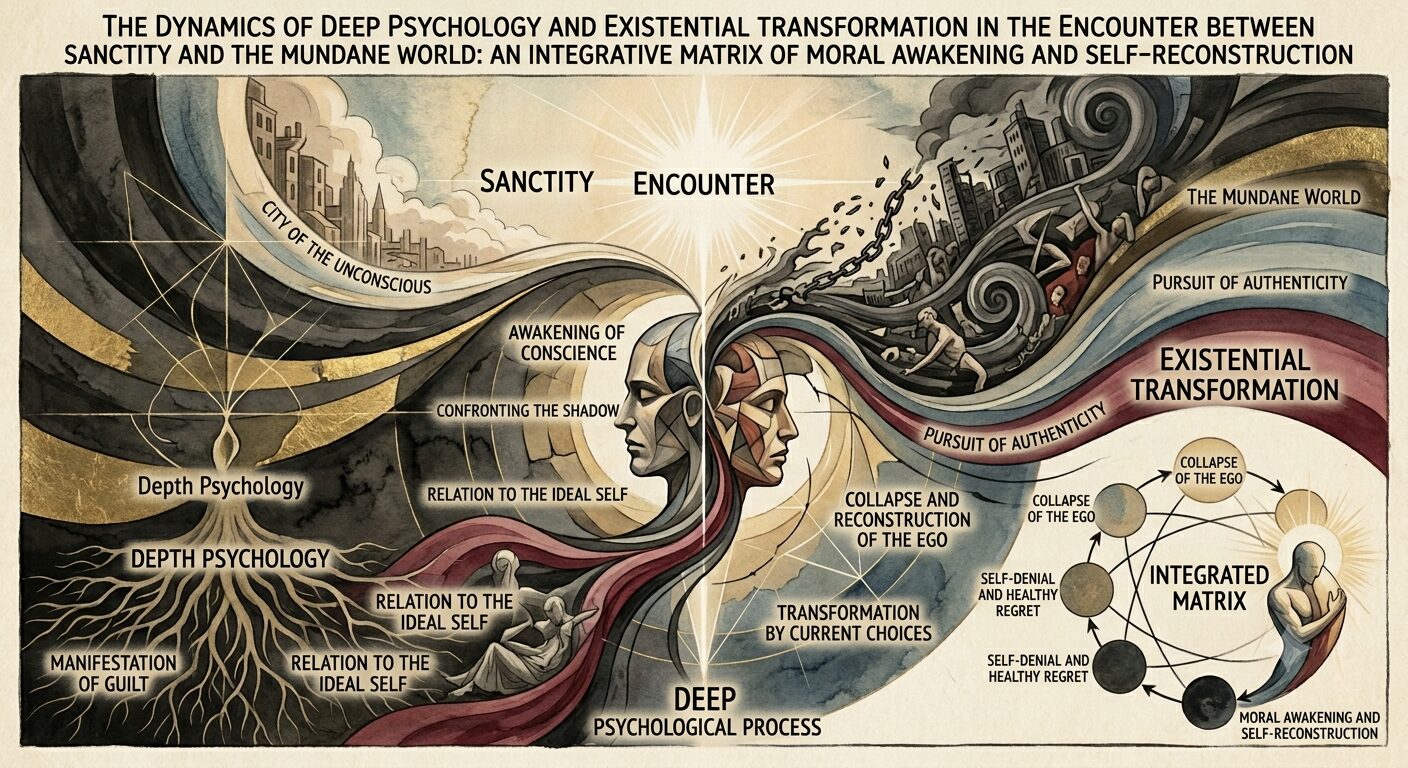
A soul steeped in vice and crime meets another who is sincere and pure. In that instant, a guilt long numbed is violently reawakened. This is the collapse of a psyche — and, at once, the beginning of its rebirth. This report traces the full course of that transformation, bridging psychology, existential philosophy, religious studies, and mythology.
A subject who has lived a life saturated with moral transgression — dissolution, crime — encounters another person of pure and unguarded sincerity. This dramatic meeting can violently awaken a guilt and self-loathing that had been suppressed, or entirely numbed. It is one of the most dramatic turning points the human psyche can undergo.
This event, a kind of tectonic shift in the soul, is no mere passing tremor of feeling. It is a profound process that shakes the subject’s ego structure, worldview, and very mode of existence to their foundations. This report dissects this multidimensional phenomenon from the standpoints of depth psychology, existential philosophy, comparative religion, mythology, relational theory, and systemic models of psychological transformation, and proposes an integrative model of that transformation.
- The Dynamics of Mirrored Cognition and the Splitting of the Self
- “Guilt” as Limit-Situation, and the Attainment of Authenticity
- Sacred Light and the Agony of Purification
- The Conflict Between Asymmetry and Equality
- The Collapse and Reconstruction of Identity
- The Existential Metanoia Model (EMM)
- Closed Integration — The World of I-It
- Shock — Encounter with a Pure Other (the Mirror Effect of the Psyche)
- Existential Collapse — Positive Disintegration, Confrontation with the Limit-Situation
- Choice — The Existential Decision (Taking Up the Facticity of the Past)
- Active Reconstruction — The Creation of I-Thou
- Higher-Order Reintegration — The Attainment of Authenticity
The Dynamics of Mirrored Cognition and the Splitting of the Self
The other, as mirror, reflects back the reality one has concealed
The Other as Mirror: How Guilt Surfaces
A subject who has lived a transgressive life typically builds a sophisticated “cognitive defense system” to conceal his own capacity for harm and his ethical decay. This includes projection — assuming that everyone else is equally selfish and corrupt — and rationalization — telling himself “I had no choice, to survive.” But an encounter with a genuinely “pure and sincere other,” someone wholly without calculation or malice, instantly disables these defenses.
A sincere other functions as an undistorted “mirror of the spirit.” The blade of mistrust and deceit that the subject has long aimed at others does not bounce off this person — it is reflected straight back, piercing the subject with the image of his own ugly reality. Contact with this unresisting sanctity violently reawakens the conscience that had lain dormant within him, bringing to the surface a guilt he had not felt in years.
The Dynamics of the Ego, the Ideal Self, and the Superego
Within the framework of psychoanalysis, this phenomenon is explained as the reactivation of the superego (conscience) and its ferocious assault on the ego. The transgressor has, through repression and dissociation, numbed the moral demands of the superego formed in his development. But the presence of a pure other appears as the external embodiment of an “Ideal Self” — one the subject once held, or unconsciously longed for, since childhood.
When the subject becomes aware of the overwhelming gap between this externalized Ideal Self and his thoroughly dishonest “actual self,” the ego falls into extreme dissonance. The energy generated by this psychic distance turns inward as a merciless self-loathing and an existential sense of self-negation.
The Shadow, and the Projection of the “Bright Shadow”
In Jungian psychology, the “Shadow” ordinarily refers to the immoral or destructive impulses the conscious mind has repressed. But for a subject whose psyche has been optimized for crime and dissolution, it is, ironically, the constructive qualities — purity, sincerity, unconditional love for others, ethical duty — that have been repressed and exiled into the unconscious as Shadow (what Jung’s interpreters call the Bright Shadow, or Golden Shadow).
An encounter with a pure other begins with a powerful projection of this dormant “bright shadow” onto that person. The subject discovers, in the other, the “lost goodness” he himself once relinquished and buried. Reclaiming that projection is an intensely painful process: the brighter the light illuminating the darkness of his own heart, the more unbearable his own existence becomes to him.
Self-Negation (Shame) versus Healthy Regret (Remorse): A Structural Difference
The negative emotions that arise in this process divide, by function, into shame, guilt, and remorse — and which one predominates determines the entire course of the psychic transformation.
| Emotion | Focus of Evaluation | Subjective Experience | Dominant Behavioral Tendency | Function in Transformation |
|---|---|---|---|---|
| Shame | The whole self “I am, in my very being, evil” |
Self-diminishment, worthlessness, fear of others’ gaze | Avoidance, withdrawal, severing relationships, sometimes redirected anger toward others | Defensive regression, self-destruction, resistance to change |
| Guilt | A specific act “I did something wrong” |
A sense of having broken a rule or norm; pangs of conscience | Apology, compensatory action, seeking to redo or repair what was done | Adjustment of social relationships, restoration of moral balance |
| Remorse | A past decision and the trajectory of one’s life “I went astray; I must change” |
A sense of responsibility toward one’s ethical self; deep existential grief | Active self-transformation; a fundamental change of life’s direction | Ontological metanoia (conversion); higher-order reintegration of the personality |
When a subject becomes fixed in the stage of shame, he tends toward an outright negation of his own existence, and is prone to a paradoxical self-justification — “I’m a filthy person anyway, so why fight it” — or to self-destructive impulses. If, however, he can sublimate that pain into remorse, the subject can acknowledge his past wrongs while still drawing on the existential energy needed to choose a new self.
“Guilt” as Limit-Situation, and the Attainment of Authenticity
The tension between the facticity of the past and the freedom open to the present
The Tension Between the Determinations of the Past and the Freedom of Present Choice
In the existentialist philosophy represented by Sartre and Heidegger, the human being is not born with an essence already fixed, but is a free existence that defines itself through ceaseless choice. Yet a person who has lived by harming and deceiving others remains heavily bound by the “facticity” of that past.
An encounter with a pure other brings tremendous tension between this facticity and the free “transcendence” open toward the future. The subject confronts, at once, a deterministic dread — the fear that his criminal or dissolute history has fixed his very essence (domination by the past) — and the abyss of freedom: the realization that, from this very moment, he could choose an entirely different, sincere way of living. This friction is the philosophical root of an unbearable guilt.
Karl Jaspers’s “Limit-Situations” and Existential Awakening
Karl Jaspers defined as a “limit-situation” any fundamental wall that human intellect and will can neither avoid nor change, naming as its paradigm cases death, suffering, struggle, and guilt. The self-loathing felt by the dissolute or the criminal upon meeting a pure being is precisely a head-on collision with this limit-situation of guilt (Schuld).
In the comfortable complacency of everyday existence (Dasein), a person forgets his own guilt and takes refuge in self-deception. But in the presence of a pure other, it becomes impossible to look away from the fact of the moral violations he has committed. According to Jaspers, when a subject confronts this limit-situation, he can shatter his deceptive everyday self and, for the first time, gain the chance to awaken to genuine existence — his true self. It is precisely the stance of refusing to evade the pain of guilt, and instead existentially taking it up as one’s own guilt (an inward turning), that becomes the greatest occasion for self-transformation.
Martin Buber’s “I and Thou”: The Recovery of Authenticity
Martin Buber taught that a human being relates to the world in one of two ways: the “I-It” (Ich-Es), which treats the other as a tool or an object of observation, and the “I-Thou” (Ich-Du), which confronts the other with one’s whole being.
The worldview of someone who has lived amid dissolution and crime is wholly governed by the world of “I-It” — one in which others are thoroughly exploited and consumed as tools for satisfying his own desires. But a pure other who, without calculation, trusts the subject as a full person and meets him with sincerity shakes this dominating structure to its foundations. The other’s unguarded sincerity refuses to be manipulated or merely observed as an “It,” and forcefully demands entry into an “I-Thou” relationship.
Having experienced a genuine “I-Thou” encounter, the subject is struck by an absolute guilt at having, in the past, treated so many others as mere “Its,” stripping them of their dignity. This guilt is an existential indictment of the fundamentally “inauthentic” mode of his own survival — and it is the cry of a soul seeking to recover authenticity through genuine, personal encounter with another.
The Secular, Psychiatric Approach
Where guilt is located: A psychiatric maladjustment resulting from the breakdown of defense mechanisms, or a symptom of depression.
How the past is treated: A behavioral pattern determined by upbringing, trauma, and social learning.
The goal of treatment: The reduction of guilt, the stabilization of the ego through cognitive restructuring, and social adjustment.
The Existential and Dialogical-Philosophical Approach
Where guilt is located: An essential psychological phenomenon within the “limit-situation” that is unavoidable in existential awakening.
How the past is treated: A “facticity” placed before present choice — something to be reinterpreted through the subject’s own decision.
The goal of transformation: To take up the guilt of the past, attain authenticity within an “I-Thou” relationship, and rebuild one’s ethical self.
Sacred Light and the Agony of Purification
The light that illuminates the darkness is first experienced as pain
Christian “Metanoia” and the Paradox of Divine Grace
In the Christian tradition, this phenomenon is interpreted as metanoia — a turning of the soul. As exemplified in Christian literature (the relationship between Raskolnikov and Sonya in Crime and Punishment, for instance), when a person sunk in vice happens to meet a being of purity, what he first experiences is not sweet salvation but an unbearable despair at the sinfulness that has been nesting within him.
This pain arises because a sacred “light” illuminates the subject’s “darkness.” Light expels darkness — but for a soul long accustomed to darkness, the sudden exposure to light is experienced as a “purifying flame” that drags one’s own impurity into the open. Self-reproach and tears are understood as a sacred agony — the burning away of the old self through the pure other who mediates divine grace, by which one recovers the image of God (imago Dei) originally bestowed.
Buddhist “Shame and Conscience” and the Sympathetic Resonance of Buddha-Nature
In Buddhist thought, this awakening of guilt is precisely located as the manifestation of two wholesome mental factors: hri (intrinsic shame) and apatrāpya (extrinsic shame, or “conscience”). The first refers to a deep shame at one’s own immorality, judged against sublime principle and one’s own conscience, arising from inner reflection. The second refers to shame at one’s evil deeds as judged by the eyes of others and the objective morality of the world.
No matter how lawlessly a person has lived, the moment he is touched by another of bodhisattva-like purity — or by that person’s compassion — the “Buddha-nature” (the latent potential for enlightenment) dormant in the depths of his being awakens in resonance with that purity. This is called kannō dōkō, sympathetic resonance with the sacred. The intense shame and conscience (self-loathing) that arises in this moment marks the beginning of the purification of past evil karma inscribed in the storehouse consciousness (ālaya-vijñāna), and is affirmed as the emergence of bodhicitta — the aspiration to walk alongside others, breaking free from a self-centered mode of survival.
Mystical Thought and Alchemy: “Nigredo,” the Blackening
In medieval alchemical thought and mysticism — and in Jung’s psychological application of them — the transformation of the spirit corresponds to the transformation of matter. The violent self-loathing and collapse of identity triggered by an encounter with a pure being correspond to the first stage of alchemy: Nigredo, the blackening.
Nigredo is the process in which matter is dissolved by heat into a viscous mass, putrefies, and falls into a jet-black chaos. This is an extremely unpleasant and frightening stage, but it cannot be bypassed if the hardened old self (solve) is to dissolve and recrystallize as a new, higher spirit (coagula). The darkness of guilt is the cradle of a “spiritual death and rebirth” through which the soul is reborn as gold — the truly integrated self.
Mythological Motifs: The Descent to the Underworld (Nekyia), and the Transformation of “Beauty and the Beast”
In mythology, this process appears as the heroic motif of the nekyia, the descent to the underworld. To establish his own identity, the hero must descend into a dark underworld teeming with monsters and the dead — the abyss of his own unconscious, the weight of his past sins. The pure, innocent other appears in this underworld journey as guide, or as a “sacred anima” — a guide of the soul. As Beatrice does for Dante in the Divine Comedy, the guidance of an innocent being forces the subject to look directly at the full extent of his hell — his own past sins — and to pass through it.
The “Beauty and the Beast” motif, common to folk tales and myth across cultures, symbolically represents this same transformation. The beast — the dissolute or criminal man who has resigned himself to his own bestiality — is, for the first time, made to feel shame and anguish at his “beastliness” when confronted with the unconditional acceptance of a beautiful, sincere maiden (purity itself). The unconditional love the maiden offers, and the beast’s own pain of being ashamed of himself, act as catalysts: in the end his bestial hide — his persona — is stripped away, and he is transformed into the noble prince, the integrated, authentic self.
The Conflict Between Asymmetry and Equality
Can the roles of saint and sinner ever be transcended?
The Depth Psychology of Feeling “Unworthy,” and the Fear of Contamination
The subject’s sense that he is “unworthy” of the other is not merely a matter of lowered self-esteem; it is rooted in an unconscious fear — a fear of contamination — that his own impurity will defile the other’s sanctity. A subject with a tainted past fears dragging a sincere other into his own darkness and ruining that person’s purity. This arises from an extreme cognitive asymmetry, in which he excessively sanctifies (idealizes) the other while demonizing himself. In this state, the other is treated not as a living, breathing person but as a “moral yardstick” by which the subject measures his own sin — and no genuine relationship has yet begun.
The Ethical Choice Between Fleeing Guilt and Facing It
When exposed to this overwhelming self-loathing, the subject is offered two survival strategies.
Securing Distance (Avoidance)
A strategy of fleeing the relationship, unable to bear his own ugliness — or claiming the moral justification of “protecting the other’s purity.” This is a result of being governed by shame: it protects self-esteem temporarily, but existentially it is an act of running from one’s own wrongdoing, and it permanently forecloses any chance of self-transformation.
Confronting the Guilt (Engagement)
A strategy of openly acknowledging one’s imperfections and past wrongs in the presence of the other’s sincerity, and standing firm without fleeing that pain. This, grounded in remorse, is the only path that opens onto sincere, reparative commitment toward the other.
The Conditions Under Which a Person with a Troubled Past Can Build an Equal Relationship with a Pure Other
Can a transgressor transcend the imbalanced dynamics of dominance and submission, or of rescuer and rescued, to build a genuinely equal partnership with a pure other? The answer to this question depends on whether the subject can complete the reclamation of his projections and achieve individuation — the integration of the self.
The single greatest obstacle to establishing an equal relationship is an attachment to the fixed, asymmetrical roles of “saint and sinner.” The pure other, too, is a living person, with her own conflicts and weaknesses. Only when the subject discards his idolization of the other’s “purity” (humanizing the other), while at the same time refusing to hide his own past and taking it up as fact (taking subjective ownership of himself), and fulfills his responsibility for his present conduct — only then can the two meet as two autonomous beings with different histories. The sin of the past does not vanish, but by converting sincere remorse for that sin into a capacity to deeply respect and care for the other, the asymmetry dissolves, and a co-creative “I-Thou” relationship comes into being.
The Collapse and Reconstruction of Identity
Beyond mere “regret”: the total collapse of a worldview
The self-loathing triggered by an encounter with a pure other is not a partial, corrective process like cognitive “regret.” It is the total systemic failure of the entire value system, belief structure, and self-definition — “I am a strong man who survives in a dog-eat-dog world,” “dishonesty is the only viable survival strategy” — that had until then sustained the subject and adapted him to the outside world.
The “theory of positive disintegration” proposed by the Polish psychologist Kazimierz Dąbrowski explains this dynamic beautifully. According to Dąbrowski, personal growth inevitably passes through a process of “disintegration,” in which an existing, adaptive personality is shattered to pieces. The transgressor exists in a state of “primary integration,” rigidly unified by selfish instinct and self-serving rationalization. But contact with an innocent being activates a longing for a higher morality within him — what Dąbrowski calls the “third factor” — and this gives rise to fierce contradiction with his existing values. The self-loathing, anxiety, despair, and guilt that result are precisely the agonizing process of the psyche collapsing — disintegrating. Yet this disintegration is not pathological collapse; it is a “positive,” constructive collapse, undertaken in order to form a higher, more empathic moral personality.
Existential Crisis as the Harbinger of Dramatic Human Transformation
In clinical psychology and the behavioral sciences, it is observed that before a person dramatically rewrites his core beliefs, there is invariably an “existential vacuum,” accompanied by an extreme anomie — a loss of order. Intense guilt and self-loathing constitute a “critical state” — the fluctuation of a phase transition — through which a system shifts into a new dimension; they are the greatest harbinger signal that a human being is about to change dramatically. Without passing through this agonizing systemic collapse, true reconstruction of the personality cannot occur.
The Existential Metanoia Model (EMM)
From closure to collapse, from collapse to reintegration — a one-directional dynamic
To explain this phenomenon as comprehensively and as multidimensionally as possible, I propose here the Existential Metanoia Model (EMM), bridging psychology, existential philosophy, religious studies, and the theory of systemic transformation. This model is a dynamic, one-directional cycle in which the subject’s psyche moves from a self-centered “closed integration,” through the “existential shock” of an encounter with a pure other, plunges into an emotional abyss, and — through the process of climbing back out of it — arrives at a “higher-order reintegration.”
Closed Integration — The World of I-It
- Treating others as instruments for one’s own benefit
- Suppression of conscience; sealing away of the (good) Shadow; self-justification
Shock — Encounter with a Pure Other (the Mirror Effect of the Psyche)
- Total failure of the defense system; projection of the Ideal Self
Existential Collapse — Positive Disintegration, Confrontation with the Limit-Situation
- A plunge into the emotional abyss (guilt, self-loathing, worthlessness, despair)
- The pull of “shame” (flight, securing distance) versus the struggle toward “remorse”
Choice — The Existential Decision (Taking Up the Facticity of the Past)
- Reclaiming projection; accepting the other as a living person and oneself as a responsible subject
Active Reconstruction — The Creation of I-Thou
- Integrating the Shadow (sincerity, love) into the self
- Rebirth of the moral self, grounded in the dialogical relationship of I-Thou
Higher-Order Reintegration — The Attainment of Authenticity
- Holding the sins of the past as existential responsibility, while projecting oneself toward future goodness
Transformation Through Abraham’s 22 Emotional Levels
There is no reaching the summit without first passing through the abyss
The emotional and psychological trajectory of the subject within this Existential Metanoia Model can be mapped with remarkable precision onto the reversal-and-ascent process found in Abraham’s “Emotional Guidance Scale” of 22 levels. The subject falls vertically from a stable but inessential psychic state — level 8, boredom — straight down to the very bottom (levels 21–22: guilt, despair) the moment the encounter occurs, and from there climbs back up, one level at a time, until reaching the highest awakening: level 1, love, gratitude, profound realization.
The Dynamics of Emotional Ascent and Psychic Reconstruction
An exceptionally important insight in this transformative process is the paradox that the leap to the highest level (level 1) is impossible without first falling into the abyss (levels 21–22). Many people, in order to ease the pain of “guilt and self-abasement” at level 21, retreat defensively into level 17 (anger) or level 19 (hatred, hostility), trying to preserve the ego by holding a grudge against the other.
But to achieve existential metanoia — conversion — one must not evade the “consciousness of guilt” of level 21 and the “despair” of level 22, and must instead take them up as one’s own spiritual death (Nigredo). Once this death within the limit-situation is accepted, the subject lets go of his “unjust expectations of the other” and his “own vanity” (the shift from levels 15 to 13: from self-blame to doubt), and, with “hope” (level 6) as his guiding flame, begins to rebuild an authentic “I-Thou” relationship. This paradoxical, step-by-step ascent of emotion through the abyss is the one and only, necessary path by which a transgressor attains genuine humanity.
Darkness Is Known as Darkness Only When It Is Shattered by Light
The guilt awakened by an encounter with a pure other is neither sickness nor punishment. It is the sound of a numbed conscience beginning to breathe again — the narrow gate through which the old self must die in order to move toward a new integration. Remain in shame, and a person simply crumbles and rots away. Only one who sublimates that pain into remorse can carry his past with him and walk back toward his true self, within a sincere “I-Thou” relationship.
There is no ascent that does not pass through the abyss. Light can only be seen looking up from the very bottom of the deepest darkness.
- irisjs2021.com — Session 4: Facing the Shadow
- cherry-piano.com/posts/56947719
- note.com/osanpo2/n/n11453c19a50d
- pmc.ncbi.nlm.nih.gov/articles/PMC3328863
- treatmhtexas.com — Guilt, Regret, and Remorse
- psychologytoday.com/us/basics/guilt
- dal.ca — Chris Moore guilt interview
- counselormagazine.com — Remorse and Guilt
- note.com/onoda_koganei/n/n67f4c9f2cbf0
- diamond.jp/articles/-/347559
- mh-mental.jp — On Karl Jaspers’s General Psychopathology
- philosophy-japan.org (PDF)
- hiroshima-u.ac.jp/system/files/92617/matsui.pdf
- ritsumei.ac.jp/acd/cg/lt/rb/577pdf/nakano.pdf
- reddit.com/r/Jung — guilt and shame in a Jungian framework