ACE-SPECTRUM · MENTAL HEALTH RESEARCH REVIEW
Self-Esteem and Mental Health Among Demisexual and Demiromantic People: A Review of the Evidence
Attraction that only emerges once a strong emotional bond has formed — what psychological effect does this shifted timing have on the people who experience it? Here is where the empirical research currently stands, and what remains unresolved.
- The Conceptual Structure of the Asexual Spectrum
- A Systematic Review of the Empirical Mental Health Research
- Comparing Identities Within the Asexual Spectrum
- The Causal Mechanisms Behind Lower Self-Esteem
- How the Timing Gap Shapes Self-Concept
- Counter-Evidence and the Resilience of Ace-Spectrum People
- Conclusion: What Is Established Now, and What Remains Unresolved
- Sources
The Conceptual Structure of the Asexual Spectrum
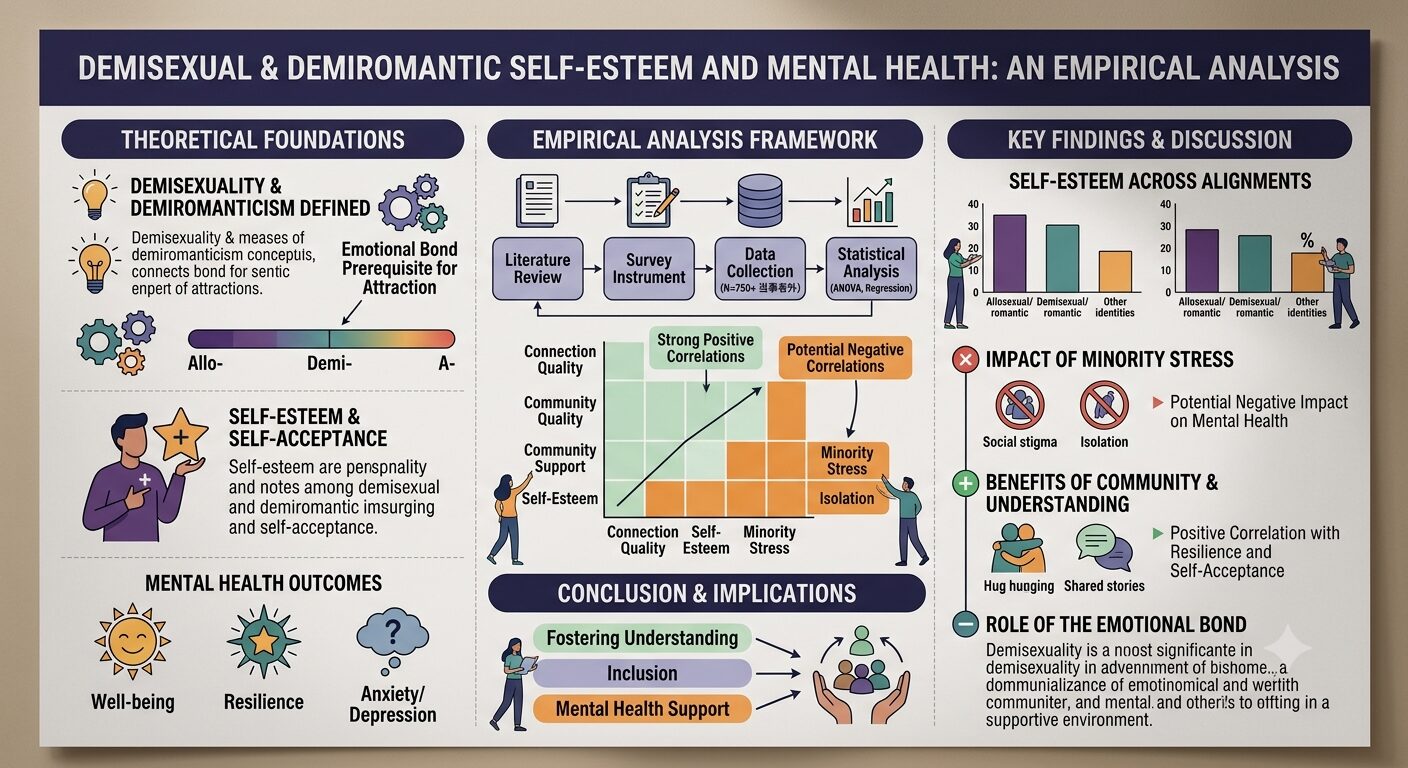
People who experience sexual or romantic attraction only in limited ways, or only under specific conditions, are systematically classified under the asexual spectrum (ace-spec). Demisexual and demiromantic identities are defined by the requirement that a strong emotional bond form first, before sexual or romantic attraction, respectively, can arise.
Foundational to understanding these concepts is the Split Attraction Model, which treats sexual and romantic attraction as two independent processes. On this model, a person can hold layered identities — “heteroromantic demisexual” or “demiromantic asexual,” for instance.
Attraction stays essentially flat until the threshold is crossed — the moment a genuine emotional bond is established, attraction rises sharply. This is the cognitive structure shared by demisexual and demiromantic people.
Scholarship on these spectrum identities carries within it a history of depathologization — a corrective to an earlier era that treated them as psychopathology, filed under labels like “hypoactive sexual desire disorder” (HSDD) or an “avoidant attachment style.” Recent empirical research increasingly redefines them not as pathology, but as a healthy variant within the broader diversity of human sexual and romantic orientation. Yet even as scholarly understanding advances, everyday social systems and relationships still operate on the default assumption of allosexuality — that everyone feels immediate, intuitive sexual attraction to others. This “allonormativity” remains dominant, and it casts a shadow over how demisexual and demiromantic people see themselves and over their mental health.
A Systematic Review of the Empirical Mental Health Research
Are demisexual and demiromantic people more prone to feelings of inferiority, lower self-esteem, and isolation than their allosexual/alloromantic counterparts? Several high-quality, large-scale studies in recent years offer clear evidence.
Anxiety and Depression Across Gender and Sexual Minorities (2018)
N=43,632 — U.S. college and graduate students (Healthy Minds Study data)
Cross-sectional online self-report survey; multivariate logistic regression; generalized estimating equations (GEE)
Demisexual respondents showed significantly higher depression and anxiety than both non-LGBTQ peers and gay/bisexual peers. Anxiety (GAD-7) showed the largest effect size relative to heterosexual peers. Mental health was markedly worse among those holding a “double minority” status (both sexual and gender minority).
The sample skews toward young, college-based populations, limiting generalizability; the cross-sectional design cannot establish causal direction over time.
Asexual and Demisexual Adolescents’ Mental Health (2023)
N=17,112 — U.S. LGBQA+ adolescents aged 13–17 (LGBTQ National Teen Survey data)
ANCOVA; hierarchical multiple regression controlling for age
Compared to asexual adolescents, demisexual adolescents showed significantly higher depressive symptoms (M=1.64 vs. M=1.48) and markedly lower self-esteem (M=1.18 vs. M=1.33). Demisexual respondents also showed significantly higher outness.
Racial and ethnic minority youth are underrepresented; qualitative measures of direct discrimination at school or home were not adequately controlled.
Asexual Identity Strength and Age of Self-Identification as Factors in Mental Health (2024)
N=200 — Self-identified asexual-spectrum adults in the U.S. and U.K.
Cross-sectional online survey; Web Screening Questionnaire (WSQ) for psychiatric screening; regression analysis
Examined the interaction between age of self-identification (AAI) and identity strength (AIS). Those who identified earlier scored significantly higher on depression, panic disorder, OCD, and suicidal ideation. Higher identity strength buffered against the effects of certain phobias and trauma exposure (PTSD).
Sampling bias from self-selected online recruitment; a relatively small sample limits the robustness of the regression analysis.
What these data suggest, in aggregate, is that demisexual people show notably greater mental health vulnerability even within the asexual spectrum itself, not merely as “a sexual minority” in general. Pitcher et al.’s (2023) finding — that demisexual respondents showed higher depression and lower self-esteem than asexual respondents — connects directly to the relational complexity demisexual people navigate daily.
Comparing Identities Within the Asexual Spectrum
These identities share a “sparseness or conditionality of attraction,” yet show clear distinctions in libido, desire for intimacy, and the nature of the relationships they build.
| Dimension | Asexual | Graysexual | Demisexual | Demiromantic |
|---|---|---|---|---|
| Mechanism of attraction | As a rule, experiences no sexual attraction regardless of the relationship. | Experience is very rare, low-intensity, or arises only in narrow, ill-defined circumstances. | Experiences secondary sexual attraction to a specific person, only after a strong emotional bond forms. | Experiences romantic attraction to a specific person, only once an emotional and psychological bond is established. |
| Libido / masturbation frequency | Tends to show the lowest sex drive, masturbation frequency, and positive interest in sex on the spectrum. | Sits between asexual and demisexual; experience of sex drive is highly irregular and fluid. | Once a relationship is established, shows the highest sexual desire, interest, and romantic fantasy on the spectrum. | Varies independently of sexual orientation itself; individual variation is extremely wide. |
| Interest in future sexual activity | Lowest (~4%); the primary driver is disinterest/disgust. | Low (~4%), though situational, conditional pursuit of intimacy is seen. | Highest on the spectrum (~12%); the primary driver is emotional connection. | Decoupled from sexual interest; depends on orientation toward romantic connection, dating, and marriage. |
| Partnership tendencies | Highest rate of not seeking romantic partnership at all (aromantic). | A mix of selective preference for romantic relationships and a preference for being single. | Strong tendency toward exclusive romantic relationships and forming intense one-on-one attachment. | Places partnership on a continuum extending from friendship, and so tends to avoid early “casual dating.” |
The key scholarly implication here is that demisexual and demiromantic people sit inside a genuine dilemma: a strong desire for relationships, paired with strict conditions on when attraction can arise. Where many asexual people keep some distance from social norms by opting out of romantic or sexual relationships altogether, demisexual and demiromantic people, wanting partnership, tend to throw themselves into the same competitive, allosexuality-premised process of forming relationships as everyone else. The resulting sense of not fitting in becomes a structural driver of depression and low self-esteem exceeding what’s seen in asexual people alone.
The Causal Mechanisms Behind Lower Self-Esteem
Scholarship distinguishes three levels of contributing factor — the trait itself, mismatch with surrounding values, and minority stress — and examines each one’s relative weight.
Effects rooted in the trait itself
Strength of evidence: minimalThe integrated view across clinical psychology and sexuality research holds that the cognitive traits underlying demisexuality and demiromanticism carry no inherent pathological predisposition toward mental illness or developmental deficit. That attraction arises only after a specific emotional bond forms is simply one healthy variation within the human attachment system. It is now broadly agreed, academically, that medical testing (hormone panels, for instance) or psychological trauma treatment should not be aimed at “treating” this pattern of attraction — because it isn’t a condition to be treated.
Effects rooted in mismatch with surrounding values
Strength of evidence: strongCompulsory sexuality and allosexism — under allonormativity, the assumption that feeling intuitive sexual attraction from a first meeting or early acquaintance is proof of “healthy humanity,” the demisexual trait is easily read as “cold,” “immature,” “prudish,” or “sexually dysfunctional.” This imposed value system plants a deep-seated sense in demisexual people that something in them must be broken.
Amatonormativity — a concept proposed by philosopher Elizabeth Brake (2012), referring to the social consensus that building an exclusive romantic relationship is the universal goal of human happiness, one everyone should pursue. Demiromantic people, who never experience love at first sight and only develop romantic feeling out of deep friendship, strongly feel left behind by the rapid dating-and-marriage life cycle around them, and readily form the self-denigrating belief that they lack the capacity to love another person.
Dissonance with instant dating culture — the dating-app culture of screening a partner instantly by appearance and a brief profile stands in fundamental opposition to the demisexual/demiromantic timeline of cognition. The need to “take time and prioritize the inner person,” met by an efficiency-obsessed modern dating market that dismisses it as “being too picky,” causes a serious erosion of self-efficacy.
Effects rooted in minority stress
Strength of evidence: strong (backed by mediation analysis and large surveys)Meyer’s (2003) minority stress model explains how a majority-centered social structure channels chronic psychological stress onto minorities. It distinguishes “distal stressors” — external environmental factors — from “proximal stressors,” which arise from internalizing them.
Distal stressors — being met, on disclosure, with responses like “you’re just too picky,” “everyone feels that way at first,” or “you should get your hormones checked” constitutes identity denial: an act that strips away the very validity of a person’s subjective reality. Clinical pathologization is also still reported in psychiatric settings — refusing to recognize the orientation and instead prescribing unnecessary hormone treatment or cognitive behavioral therapy to “restore normal libido” — reinforcing deep distrust of medical institutions and psychological isolation.
Proximal stressors — over the course of growing up, a person internalizes society’s pervasive allosexual and amatonormative expectations (internalized acephobia), which generates an intense feeling of shame. Recent mediation analyses have shown that this feeling of shame partially, or fully, mediates the relationship between experienced social discrimination (a distal factor) and the social anxiety and clinical distress that follows. In other words, it isn’t only discrimination itself that drives depression and low self-worth — it’s the internalized, proximal conflict of being ashamed of not being able to be otherwise.
Double marginalization within the LGBTQIA+ community — demisexual and demiromantic people are not only alienated by heterosexual-majority society; documented cases show them excluded from traditional LGB communities too, dismissed as “just a privileged form of heterosexuality,” or told they “haven’t experienced real discrimination” or “aren’t queer,” denied recognition of their identity either way. This double invisibility — belonging nowhere — brings profound loneliness and a resignation about ever truly connecting with others.
How the Timing Gap Shapes Self-Concept
The central psychological conflict arises from an absolute mismatch in timing — how long it takes for attraction to emerge. This slowness is not merely a matter of time; it produces its own distinct psychological stress at each life stage.
Adolescent “misalignment” and the erosion of self-esteem
Adolescence — from middle school through college — is when sexual desire and romantic feeling for others rapidly come to the surface, forming the central preoccupation of one’s peer group. A demisexual teen who feels no attraction to a passerby, a celebrity, or someone recently met, or a demiromantic teen who feels no romantic longing, cannot join in their peers’ talk of crushes and romantic adventure, and develops a deep sense of unease about their own existence. Without access to the right identity vocabulary at this age, the failure to connect teaches a belief — “I must not be attractive, or not capable of being loved” — that pushes long-term self-esteem into decline.
The anxiety of friendship shifting into romance
A defining cognitive trait of demisexual and demiromantic people is that an existing emotional bond, such as friendship, is the precondition for attraction. This structure inevitably produces a recurring scenario: suddenly, one day, becoming aware of sexual or romantic attraction to a close friend. In allosexual society, the boundary between friendship and romance (and sex) is relatively firmly maintained, so when this attraction surfaces from a demisexual or demiromantic person, it risks being read negatively by the other person as a “bait and switch” — a betrayal of the friendship itself.
A persistent anxiety that becoming aware of, and disclosing, one’s attraction will collapse an existing, safe, cherished friendship.
An introspective guilt — the belief that “the very process of coming to like someone carries an aggression that damages the relationship” — and the self-restraint on interpersonal contact that follows from it.
The friction this timing gap generates in relationships functions as a powerful force that drags a person’s sense of self-worth down to the level of “I am not worthy of intimacy with others” — and the evidence for this effect is rated moderate to strong.
Counter-Evidence and the Resilience of Ace-Spectrum People
Contrary evidence also accumulates showing psychological resilience and protective factors: holding a demisexual or similar orientation does not, in itself, inevitably produce low self-esteem.
Those whose identity was denied or challenged
Paula Nurius’s (1983) early research found low self-esteem among asexual respondents generally, but later, more detailed comparative research (including a University of Colorado study) found that respondents whose identity had been denied or challenged by others showed markedly higher depression than those who had not had that experience.
Those accepted unconditionally
Respondents whose sexuality had been unconditionally accepted, without a negative challenging experience, showed markedly lower depression than the “challenged” group — and even significantly higher self-esteem than the allosexual control group. This demonstrates that the primary driver of harmed mental health is not the inner nature of the orientation itself, but simply the environmental factor of whether or not one’s identity is accepted.
The catharsis and protective effect of self-identification
Qualitative life-history research on ace-spectrum people confirms that the act of applying an academic term like “demisexual” or “demiromantic” to one’s own cognitive traits carries a protective effect, dramatically restoring self-evaluation. People who have settled into this labeling report the following forms of psychological empowerment.
Cognitive liberation from years of self-doubt and self-pathologizing, through the realization that “I’m not broken — my system of attraction is simply different.”
The ability to stop “wasting energy” conforming to allosexual norms through forced casual sex or unwanted dating, and to confidently set and defend one’s own emotional boundaries instead.
A process by which connecting to an online or offline community of fellow ace-spectrum people brings a sense that one’s own experience is shared and ordinary — a “common humanity” — dramatically neutralizing loneliness and alienation.
This counter-evidence shows that, given adequate social inclusion and recognition of their identity, demisexual and demiromantic people can be fully freed from feelings of inferiority and achieve psychological stability equal to or greater than that of allosexual people. The evidence here is rated moderate.
Conclusion: What Is Established Now, and What Remains Unresolved
What current research supports
Demisexual and demiromantic people show a clear, demonstrated tendency toward anxiety, depressive symptoms, loneliness, and lower self-esteem compared to their allosexual/alloromantic counterparts. Large-scale studies like Borgogna et al. (2018) and Pitcher et al. (2023) show this risk to be significantly elevated even relative to gay, bisexual, and clearly-bounded asexual peers.
The primary determinant of felt inferiority is not internal pathology but a fatal disconnect from the “compulsory sexuality” and “amatonormativity” norms society expects everyone to internalize. These norms wrongly pathologize demisexual and demiromantic people, or label them immature, and that judgment converts into an internalized sense of shame that damages mental health.
The depression and social anxiety these individuals face is the cumulative result of minority stress — distal stressors like identity denial and clinical microaggressions, and proximal stressors, the concealment and self-denial that follow from internalizing them.
People who enjoy an environment where their identity goes unchallenged, and who actively use language like “demisexual” for self-understanding and boundary-setting, can maintain self-esteem equal to or higher than, and depression equal to or lower than, allosexual peers.
What remains unknown
Much current research weights measurement toward the asexual spectrum (absent or limited sexual attraction); large-scale quantitative data that cleanly isolates the mental health and self-concept clarity of demiromantic people specifically — whose delay is purely in romantic attraction — remains globally limited.
Nearly all current empirical data rests on single-timepoint, cross-sectional surveys. The dynamics of how self-esteem and feelings of inferiority shift, adapt, or resolve into resilience across the arc of a life — from adolescence through old age — remain unmapped.
Most survey respondents to date skew toward young, cisgender, predominantly white women in English-speaking Western countries. How the quality of the inferiority and isolation demisexual and demiromantic people feel shifts in non-Western countries, across Asia, or within cultures shaped by different religious majority norms around family formation, lineage, chastity, and marriage remains an unexplored frontier for future cross-cultural sociology.
Sources
This piece touches on research data involving anxiety, depression, and suicidal ideation. If you’re feeling uneasy about your own state of mind, please don’t carry it alone — consider reaching out to a professional or a trusted support line.