NEUROSCIENCE OF SOCIAL DRINKING
The Anatomy of Alcohol-Mediated Communication: Psychosocial Vulnerability, Neurobiology, and Clinical Intervention
The feeling that you “can’t talk without a drink” is not a matter of preference. It’s a complex psychobiological phenomenon woven from personality, attachment style, and the brain’s own neurotransmitters.
- The Psychological Profile Behind “I Can’t Talk Without a Drink”
- The Neurobiology Behind Alcohol’s Facilitation of Conversation
- The Craving for Emotional Connection and Alcohol-Driven Social Approach
The Psychological Profile Behind “I Can’t Talk Without a Drink”
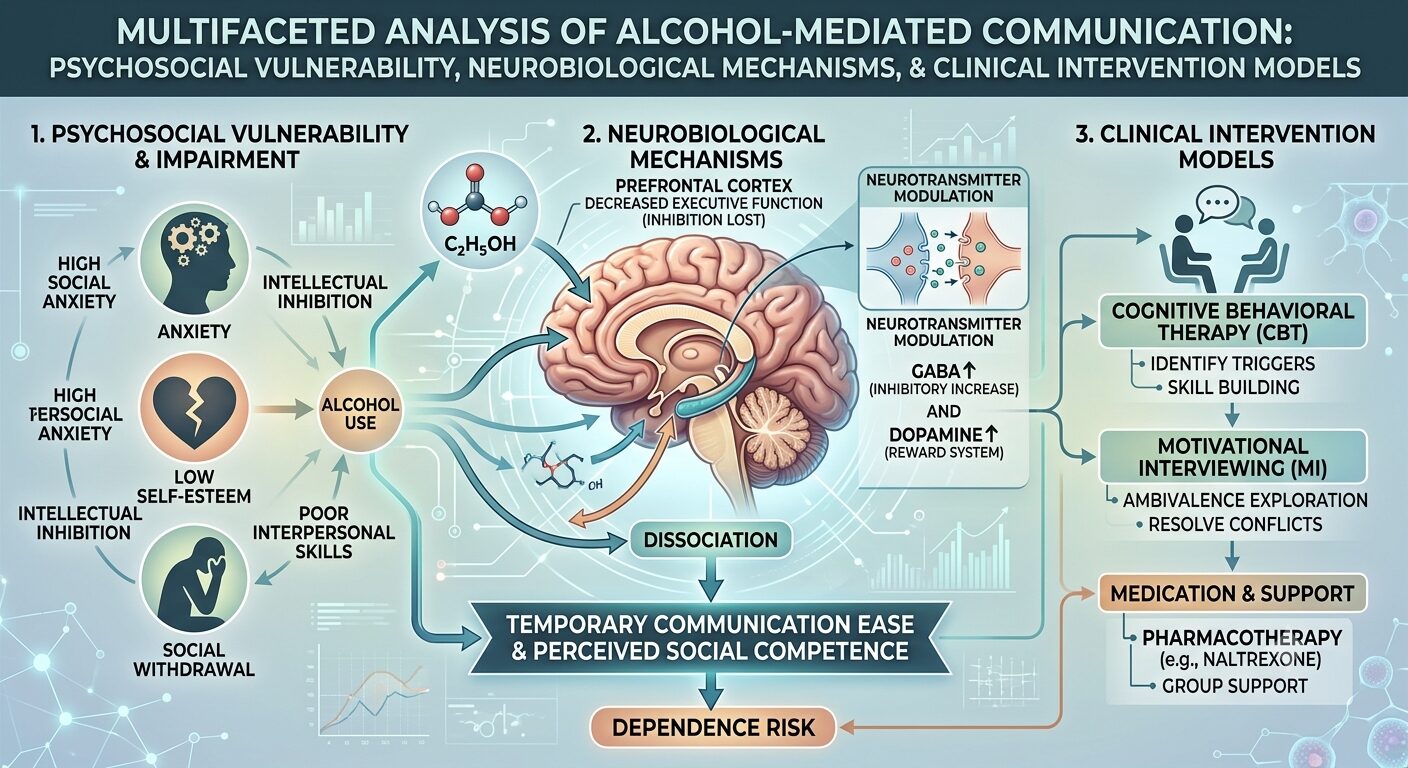
The feeling that one cannot sustain self-disclosure or interpersonal interaction without alcohol’s help is the product of a complex interplay between personality structure, anxiety tendencies, and attachment styles formed in early development.
Viewed through the Big Five personality model, people prone to relying on alcohol-mediated communication are generally characterized by a combination of high neuroticism (emotional instability) and low extraversion. Highly neurotic individuals are hypersensitive to others’ evaluation, and prone to high anxiety, depression, and low self-esteem in social settings — a profile that strongly drives “coping motives,” drinking to ease social stress. Highly extraverted individuals, by contrast, drink from “enhancement motives,” seeking amplified positive emotion and elation, increasing their intake in pursuit of successful social experiences. Meta-analyses further show that individuals low in conscientiousness and agreeableness — the other two Big Five traits — have weaker self-control and are more prone to alcohol-related problem behavior and use disorder (AUD). Those high in openness to experience are known to drink from a mix of social, coping, and enhancement motives, seeking out social or sensory stimulation.
Social anxiety is the direct driver of this dependent style of communication. Women with low social self-esteem (SSE) show high tension and suppressed self-disclosure while sober, but under alcohol their social anxiety drops dramatically and spontaneous self-disclosure rises significantly. In people with naturally high SSE, by contrast, the presence or absence of alcohol has almost no observable effect on social behavior or anxiety level. Alcohol’s effect as a “social lubricant” emerges specifically in populations with low self-esteem and interpersonal anxiety.
| Trait / attachment style | Core vulnerability | Primary drinking motive | Effect on communication |
|---|---|---|---|
| High neuroticism | Emotional instability, excess anxiety, high sensitivity to criticism | Coping — easing psychological distress | Suppresses sober self-disclosure; only relaxes enough to engage while drinking |
| Low conscientiousness | High impulsivity, weak self-control | Enhancement — sensation-seeking, immediate pleasure | Behavioral brakes fail; frequent interpersonal mishaps while drinking |
| Anxious attachment | Strong fear of abandonment, craving for excessive closeness | Coping / expectation of intimacy enhancement | Rapidly approaches a specific person, forming boundary-less emotional fusion under alcohol |
| Avoidant attachment | Deep discomfort with intimacy, ostentatious self-sufficiency | Coping — suppressing the stress of emotional closeness | Avoids direct dialogue during conflict, using alcohol as a “defensive shield” |
| High Sensory Processing Sensitivity (HSP) | Deep processing of environmental stimuli, prone to overstimulation | Coping — blocking excess stimulation | Uses alcohol as a “mute button” to avoid social exhaustion |
Adult relational patterns rooted in attachment theory are also closely tied to drinking behavior. Anxious attachment, through the attachment system’s “hyperactivation,” predisposes a person to relationship-specific coping drinking; avoidant attachment, through the system’s “deactivation,” compensates for intense internal stress with alcohol while still avoiding direct intimacy. “Fearful-avoidant” attachment — holding a negative working model of both self and others — carries, mediated by social isolation, the highest risk of progression toward alcohol dependence. For someone high in SPS, alcohol functions as a temporary “mute button” lowering sensory sensitivity, but the SPS brain also reacts with heightened sensitivity to the physical and emotional withdrawal symptoms that follow drinking, making it especially prone to forming a vicious cycle of dependence.
The Neurobiology Behind Alcohol’s Facilitation of Conversation
Behind alcohol’s action as a “social lubricant” lies a multi-stage pharmacological cascade acting on specific anatomical regions and neurotransmitter systems in the brain.
Ethanol entering the brain rapidly suppresses the prefrontal cortex (PFC) — the seat of higher cognition, self-monitoring, decision-making, and the top-down inhibition of emotion. The PFC, and particularly the orbitofrontal cortex (OFC), normally evaluates the social risk of a behavior and applies the “brakes” to anything inappropriate. Alcohol selectively dampens neuronal activity in this region, paralyzing this top-down control mechanism. This releases what psychology calls “punished behavior” — indiscreet remarks or excessive self-disclosure ordinarily suppressed by social norms and self-censorship — and the barrier to conversing with others disappears.
What directly drives this neural decline is a change in binding strength at the GABA receptor, the brain’s principal inhibitory neurotransmitter. Ethanol acts as an allosteric modulator, potentiating GABAA receptor function and inducing neuronal hyperpolarization. This acute strengthening of GABA activity temporarily boosts functional connectivity across the brain’s resting-state network (RSN) — raising coherence in alpha, beta, and theta bands and overall network density — shifting the brain into a kind of synchronized, relaxed state. At the same time, the excitatory glutamate receptors (chiefly NMDA) are inhibited, slowing overall information processing and blocking the alert signals tied to social stress. Alcohol also activates the mesolimbic dopamine pathway projecting from the ventral tegmental area (VTA) to the nucleus accumbens (NAc), triggering a rapid dopamine release. This stimulation of the reward system produces euphoria, and socializing itself comes to be perceived as an extremely high-value, appealing activity.
| Level | Region / substance | Acute pharmacological action | Manifest effect |
|---|---|---|---|
| Higher cognition | Prefrontal cortex / OFC | Paralysis of self-monitoring and behavioral brakes | Bold speech heedless of social risk |
| Neurotransmitter systems | GABAA / glutamate receptors | GABA potentiation, glutamate blockade | Eased anticipatory anxiety, more fluent speech |
| Reward circuitry | Nucleus accumbens / mesocortical dopamine | Increased dopamine release | Elation, heightened reward sensitivity to conversation |
| Cognitive narrowing | Alcohol myopia theory | Working-memory overload | Extreme focus on the immediate interaction only |
This cognitive shift is precisely described by alcohol myopia theory. Because alcohol rapidly consumes the brain’s limited working-memory capacity, a drinker can only allocate cognitive resources to the most physically immediate, salient cue in front of them. As a result, the brain resources needed to register distant, complex information — or the anxiety-provoking possibility of tomorrow’s consequences — run dry. This myopic narrowing of attention eliminates anxiety and produces a temporary inflation of self-esteem and irrational social confidence. The popular belief that “drunk words are sober thoughts” is, scientifically, an incomplete account. In the sense that the prefrontal brakes come off and ordinarily unspoken “suppressed feelings, complaints, and secrets” get vented unfiltered, some temporary leakage of emotion does occur. But because alcohol disrupts the limbic system (the emotional hub) indiscriminately, it also exaggerates perceived emotion and can produce distorted perception of reality or outright confabulation. What’s said while intoxicated is likely less a consistent, sober belief than a mixture of exaggerated, transient emotion, regression in emotional control, and the “cognitive noise” produced by myopic attention.
The Craving for Emotional Connection and Alcohol-Driven Social Approach
The dramatic narrowing of interpersonal distance under alcohol, in someone carrying a strong affiliative need or loneliness, is explained by the activation of the attachment system and the dynamics of cognitive narrowing.
Someone with chronic loneliness or a strong need for validation — especially anxious attachment — keeps their guard constantly raised while sober against the interpersonal risk of “maybe I’ll be rejected” or “maybe I’ll be abandoned.” This tension chronically paralyzes their communicative ability. But once alcohol myopia takes hold through drinking, self-monitoring is temporarily disabled, and the emotional isolation and self-defense barricade that had firmly protected the self comes down. Alcohol quiets the fear and self-consciousness born of vigilance against interpersonal rejection, and reallocates the cognitive energy previously spent on defense toward forming bonds and social connection. In this moment, the suppressed, primal desire to connect is laid bare, and self-disclosure, sudden physical proximity, and emotional identification reach levels impossible while sober.
Initial defenses collapse
Deactivation of interpersonal vigilance signals (amygdala activity) and release of the PFC brake soften social defenses and open the door to unguarded social engagement.
Attention narrows locally
Alcohol myopia’s dominance of the “here and now” excludes distant others from view, producing a fixated enthusiasm for the person seated nearby.
Attachment anxiety activates
Anxious attachment’s hyperactivation strategy is disinhibited, producing a total loss of boundaries, excessive physical contact, and demands for premature intimacy.
Dependence fixates on one target
Amplified emotion and a subjective overestimation of “common ground” lead to blind faith that a particular person is “the one who truly understands me” — a compulsive, transient emotional fusion.
This alcohol-fueled emotional approach carries a serious vulnerability: it easily tips into a “pathological, sudden, excessive dependence” on one particular person. Under alcohol myopia, the intoxicated brain, ignoring the full context of the situation, wildly overvalues whoever is physically nearest as “the one true person who understands me” or “my savior.” Because the limbic disruption also adds a layer of temporary euphoria and sentimental elation, it’s easy to mistake a shallow, momentary connection for “fated emotional bonding.” A person with anxious attachment, in this disinhibited state, tends to explode with the “clinging need” they normally suppress — persistently calling a target, intruding uninvited into private space, or hurling one-sided declarations of love or resentment, all boundary violations. When the person whose distance was so rapidly closed then tries to reestablish appropriate distance once sober, the drinker experiences this as “unbearable rejection” and suffers a further psychological blow. This is one root of the “emotional vicious cycle” — reaching for alcohol again to soothe the two-stage damage of relational breakdown and amplified loneliness.
Triggers of Drinking-Related Trouble and the Psychiatric Boundary of Pathology
Behind the way attempts at alcohol-fueled socializing often escalate into interpersonal aggression, violence, or social collapse lies a breakdown of biological, psychological, and moral neural control.
People who reveal “bad drunk” behavior — interpersonal conflict, violence — with every drink are characterized by a persistent lack of impulse control and fragile emotional regulation. Reduced serotonergic function in particular links directly to impulsivity, excess aggression, and emotional instability. Someone with serotonergic dysfunction who also experienced early-life abuse, psychological trauma, or social isolation finds it especially difficult to rein in an emotional outburst once drinking releases the PFC’s control signal over the amygdala. A sharp spike in blood alcohol concentration (BAC) from binge drinking also throws the brain into acute disinhibition, severely impairing emotional regulation.
The Five Moral Foundations Under Alcohol — Two Brakes Selectively Loosen
Professor Mariola Paruzel-Czachura’s experimental moral psychology research (2023) demonstrated that even a single drink specifically loosens part of our moral braking system. Measuring willingness to violate each of the five moral foundations — care, fairness, authority, loyalty, and purity — the study found that alcohol significantly lowered resistance to violation on only two: “care” (harm avoidance) and “purity” (visceral, ethical disgust toward impure acts). “Fairness,” “authority,” and “loyalty” remained stable and unaffected by drinking.
collapses
stable
stable
stable
collapses
In other words, alcohol specifically lowers the ethical brakes against “physically harming another person” (domestic violence, assault) and “indulging in impure pleasure” (sexual transgression), which is why physical trouble arises so dramatically often in drinking settings. Further, research by Kumar and colleagues (2024) found that alcohol specifically impairs facial emotion recognition of others’ anger, while abnormally heightening the subjective sense of “empathy” — of relating well to someone. In this state, a drinker fails to register a warning signal (a look of disgust or anger meaning “don’t come any closer”) while subjectively misreading the moment as “we are completely, deeply connected” — a dangerous cognitive blind spot that leads to violating another person’s boundaries and triggering unexpected conflict or assault.
| Diagnostic category | Clinical features | Primary evaluation axis | Intervention |
|---|---|---|---|
| Simple “bad drunk” behavior | Acute maladaptive behavior from high impulsivity, low self-regard | No chronic dependence, but repeated one-off relational breakdowns | Psychosocial guidance, moderation programs |
| Alcohol Use Disorder (AUD) | Chronic, structural change in the reward system and PFC control circuits | Loss of drinking control, social/occupational dysfunction, tolerance and withdrawal | Specialized psychiatric treatment (anti-craving medication, psychosocial programs) |
| Comorbid Social Anxiety Disorder (SAD) | Uses drinking as the sole “social safety behavior” | Meets phobic avoidance criteria; drinking maintains SAD and drives AUD onset | Integrated approach (e.g., MET-CBT) |
Whether a “person who causes trouble while drinking” has crossed into pathological territory is judged not by the frequency of social missteps, but by DSM-5 and similar criteria centered on “compulsivity around continued use” — the collapse of biological and psychological autonomy. Where dysfunction is found across loss of drinking control, continued use despite recognized breakdown in relationships or roles, repeated drinking in physically hazardous situations, and the emergence of tolerance and withdrawal signals (hand tremor, abnormal sweating, and in severe cases hallucination or delirium involving life-threatening autonomic instability), this is judged to be a chronic, pathological Alcohol Use Disorder that willpower alone cannot treat, requiring urgent clinical intervention.
A Multi-Angle Differential of “I Can’t Show My True Self Without a Drink”
The cognitive distortion that “the person I am while drinking is my true self, and sober is a false mask” is differentiated, in clinical psychology and psychiatry, not as a single mechanism but as a defensive reaction rooted in one of several distinct psychological contexts.
A substitute for emotional regulation
Here, a person’s capacity to autonomously regulate their own emotions, self-esteem, and interpersonal conflict has chronically declined. Alcohol functions as a “placebo for self-healing” — a substitute emotional-regulation process that temporarily eases anxiety, simulates self-esteem, and forcibly, numbingly expands interpersonal boundaries. Governed by the dysfunctional belief that “only by drinking can I become someone worth connecting with,” the person compulsively needs alcohol’s pharmacological action as a psychological crutch.
Structural change through neuroadaptation
At this stage, psychological dependence has evolved beyond mere belief into neuroadaptation — structural change at the level of the brain’s receptors. Years of exposure to high-concentration ethanol chronically degenerates prefrontal neurons and downregulates mesolimbic dopamine receptors, until the sober brain enters a state of anhedonia — a physiological state of starvation in which no positive joy, security, or satisfaction can be drawn from dialogue or social interaction without alcohol’s stimulus. The complaint of “not being able to show my true self” at this stage goes beyond psychological defense; it is the anguished expression of biological craving and emotional breakdown, reflecting the neurochemical fact that the brain’s reward system simply will not fire without alcohol.
Drinking as a “safety behavior”
A person with SAD fears others’ negative evaluation, or failure in a social setting, as an excessive, catastrophic threat. Alcohol consumed in social settings functions as a powerful extinction-blocking signal that temporarily gets them through this fear, but it simultaneously and decisively blocks the brain’s own “extinction learning” — the process of learning that a situation is actually safe. As long as someone depends on drinking as a safety behavior, they can never undergo the cognitive restructuring that comes from the self-efficacy of “I managed to communicate with others just fine, sober.” As a result, the belief that one’s sober self is “powerless and an object of shame” strengthens day by day, sustaining a vicious cycle that worsens social anxiety further.
Recent Research Trends and the State of the Evidence
Peer-reviewed papers and large-scale reviews since 2020, across addiction science, psychiatry, and neuroscience, are revising previously inaccurate assumptions about alcohol’s social effects and individual variation, using objective empirical data.
Empathy and social cognition — a deficit in cognitive empathy, but preserved affective empathy
Creswell and colleagues’ recent meta-analyses (2022, 2024) found that people with AUD show a marked deficit, relative to healthy controls, in “cognitive empathy” — inferring another’s inner perspective, akin to theory of mind — while their “affective empathy,” resonating with another’s distress, remains relatively preserved. Importantly, even in non-clinical samples of young adults, those with innately lower cognitive empathy skills experience the strongest subjective jump in “felt empathy with others” when drinking socially — a powerful positive reinforcer that becomes a strong risk factor for future harmful drinking and use disorder.
The constancy of morality and personality under alcohol
A series of preregistered, double-blind studies by Paruzel-Czachura and colleagues (2021, 2023) firmly rejected the long-held belief that “getting drunk fundamentally changes who you are,” or that alcohol shifts people toward “drunk utilitarian” ethical reasoning. Their data showed that even subjects given relatively high doses of alcohol showed no change in their internal moral concepts (judgments on ethical dilemmas), and that their self-assessments of their own morality, aggressiveness, and intelligence remained remarkably constant. What changes is not personality itself, but an increase in disinhibited “extraversion” (social facilitation) and the temporary release of the two brakes discussed above — “harm” (care) and “physical disgust” (purity).
A direct link between sensory processing difficulty and alcohol use
A study by van den Boogert and colleagues (2023), examining people with autism spectrum disorder or sensory hypersensitivity comorbid with psychiatric conditions, found that differences in sensory processing patterns correlate significantly with alcohol consumption. Specifically, people with a “low registration” tendency — under-registering stimuli — tend to drink more overall to compensate for monotony; non-harmful drinkers with “sensory sensitivity” to environmental stimuli use alcohol as a self-treatment to dull the senses and achieve social fit; and hazardous drinkers showing “sensory seeking” pursue alcohol’s immediate dopamine reward through extreme heavy drinking — three distinct dependence pathways rooted in distinct temperament profiles.
Where scientific consensus has been reached
Alcohol’s social facilitation effect heightens subjective feelings of solidarity and empathy while markedly degrading the objective ability to recognize hostility (anger) — and this mismatch is a primary breeding ground for interpersonal trouble.
Alcohol’s disinhibiting effect does not remake personality into something new; it merely selectively releases existing, previously suppressed potential behavior, while core self-identity remains remarkably stable even while intoxicated.
Points still unresolved
Whether subscales of sensory processing sensitivity in the non-clinical general population causally determine progression toward coping-motivated alcohol dependence is still under active investigation via longitudinal developmental tracking and large cohort studies; no conclusion has been reached.
Exactly how much abstinence is needed for a recovering brain to plastically repair the anhedonia stemming from dopamine receptor downregulation remains without a fully established, quantitative timeline.
Clinical and Real-World Applications: A Model for Intervention
A multidimensional path out of “I can’t talk without a drink,” toward stable emotional connection and a reclaimed sense of social self-efficacy while sober.
What the individual can actively do
At the core of a person’s own approach is autonomous cognitive restructuring paired with the gradual construction of an alternative reward-acquisition system. One first identifies “hot thoughts” — beliefs like “sober me is worthless” or “I have no skill for livening up a conversation” — and tests their validity against real-life evidence, such as experiences of successfully handling things, or receiving a kind response, without alcohol. In addition, introducing the concept of Substance-Free Activity Sessions (SFAS) into daily life is extremely effective: structurally planning and scheduling goal-directed, enjoyable, emotionally activating non-substance activities — regular light aerobic exercise, painting or playing an instrument, ecotherapy in a natural setting, or a club built around shared intellectual interests. This is a behavioral-economic intervention that recalibrates dopamine and opioid reward receptor function, dulled by alcohol, using natural stimuli, raising sensitivity to delayed reward so the brain can reproduce “the sustained, quiet happiness that time without drinking brings.” Mimicking Approach Bias Modification (ApBM), consciously distancing oneself from alcohol-related images and objects (bottles, bar signage) while physically drawing non-alcoholic substitutes (sparkling water, herbal tea, novelty sodas) closer at hand is also a highly practical way to retrain the brain’s conditioned-reflex circuitry.
How family and others should respond
Those around a person must strictly avoid hurling intense emotional condemnation (“you’re weak-willed,” “you’re lazy”) at their drinking problem. Such negative feedback only heightens the person’s internal stress, self-loathing, and social anxiety, supplying fuel that drives them further into escapist, coping-motivated drinking. Supporters should follow the principles of motivational interviewing (MI), aiming to be an empathetic, non-confrontational listener who lets the person articulate, in their own words, the discrepancy in their life — between “the temporary sociability alcohol provides” and “the intense sense of dysfunction, broken trust, and physical exhaustion the next morning.” The most rigorously followed principle should be avoiding enabling — those around the person must not clean up after the social mistakes (broken workplace relationships, unpaid debts, damage control for something said in a fit of emotion) made while drunk. It’s necessary to maintain a consistent, defensive boundary: letting the person face the direct consequences of drunk communication on their own, while reserving warm, affirming reassurance only for the calm, healthy conversations and commitments made while sober.
Concrete methods to build sober communication ability
Externally-directed attention shift training — deliberately shifting the excess attention paid to internal information (“how am I coming across?”) toward external, objective facts like a partner’s lip movement or vocal inflection, physically crowding out and eliminating, within working memory, the very space in which self-consciousness arises.
Assertive communication and systematic social skills training (SST) — calmly declaring one’s own weakness in advance (assertive self-presentation) dramatically lowers anxiety. Starting with low-difficulty role-play (a light greeting to a convenience-store clerk, five seconds of small talk with a coworker) and repeating graduated exposure, then objectively evaluating the results with a therapist or trusted other, accumulates in the brain the “prediction error” that nothing catastrophic happened even after a misstep — the safest, most durable path to making sober self-defense unnecessary for the rest of one’s life.
This piece is intended to organize psychological and neuroscientific findings on drinking behavior. If you or someone in your family has concerns about drinking, please don’t carry it alone — consider reaching out to a medical professional or a support line.