On Broken Things and the
Turning Points of a Life
Crossing religion, mythology, psychology, anthropology, divination, and science to ask why we find meaning in the moment something breaks.
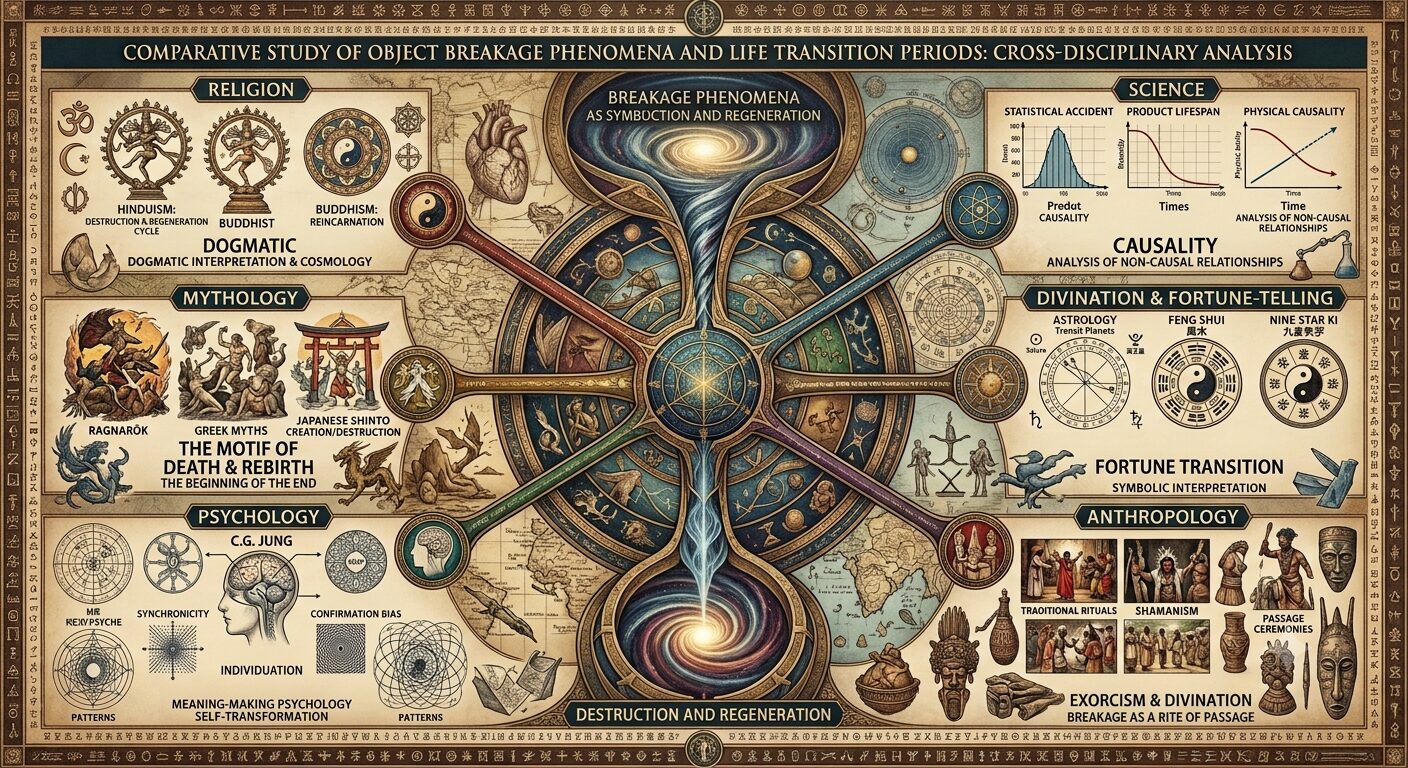
A bowl chips. A clock stops. Appliances fail one after another. In that moment, many people quietly ask themselves whether this is mere coincidence, or some kind of sign. This essay begins with that ordinary question and moves across ten fields — Hindu theology, Western astrology, Jungian psychology, world mythology, Japanese folk belief, feng shui and the nine-star astrology of East Asia, Buddhist and Taoist thought, cognitive psychology, cultural anthropology, and natural science — to trace how each tradition has understood the phenomenon of breakage.
The conclusion, stated in advance: every field agrees on the physical fact that things break. Where they diverge is in where they locate the cause — a god, a planet, the unconscious, qi, cognition, physical law, or vibration. That divergence is the path this essay attempts to walk.
Hindu Theology of Destruction and Rebirth
Shiva and the cycle of the Trimurti
In Hindu theology, the workings of the cosmos are understood as a cycle of three indispensable functions: creation (sṛṣṭi), preservation (sthiti), and dissolution or destruction (saṃhāra). These are governed by the three faces of the highest god, the Trimurti — Brahma the creator, Vishnu the preserver, and Shiva the destroyer. In the West’s dualistic frame, “destruction” is easily equated with evil or finality. But in Hindu theology, the destruction that belongs to Shiva is not mere annihilation or terror — it is the cosmic act of purification that clears away ignorance (avidyā), illusion (māyā), and structures whose time has passed, so that new life and higher states of being can emerge. Texts such as the Shvetashvatara Upanishad and the Shiva Purana describe Shiva as the dynamic expression of ultimate reality, embodying the cosmic necessity that new creation cannot begin until the old form has been dissolved.
Nataraja: the cosmology of the dancing Shiva
The most condensed expression of this theology is the image of Nataraja, the Lord of the Dance — perfected as bronze sculpture under the Chola dynasty of South India. Nataraja performs the blissful dance of the cosmos, the ananda tandava. The small drum (damaru) in the upper right hand marks the beginning of creation; the flame (agni) in the upper left hand marks the inevitability of destruction; the dwarf Apasmara, crushed beneath the right foot, represents ignorance overcome, opening the way to spiritual liberation (moksha).
| Element | Theological symbol | Cosmic function |
|---|---|---|
| Drum, upper right hand | The primal vibration — Om | The beginning of creation |
| Flame, upper left hand | Purifying fire, the power to dissolve | The destruction and end of the world |
| The dwarf underfoot | Ignorance and forgetting, overcome | The path to liberation |
| The ring of fire | The wheel of time and matter | The endless cosmic cycle |
Testing the claim that broken objects are messages from Shiva
Nowhere in classical scripture or ritual practice is it taught that a broken appliance or household object is a personal message sent by Shiva. Ancient Indian omen literature, the Shakuna Shastra, does classify certain broken objects as nimitta — omens of fortune governed by the law of karma acting through the environment — but this is fundamentally different from the claim that a supreme god breaks a person’s belongings to communicate with them. The popular idea that “appliances break in a row because Shiva’s energy is destroying your old self to push you forward” is best understood as a modern adaptation: New Age and self-help discourse borrowing the theological concept of cyclical destruction and reapplying it, loosely, to everyday domestic life.
Shiva’s “destruction” is a cosmological force whose condition is renewal and the defeat of ignorance — not the banishment of evil or an ending in itself. Classical Indian omenology does contain a system for reading unexpected material change as an environmental sign.
Whether ancient nimitta texts treated the breaking of household vessels purely as ill omen, or as a transitional event that ritual could reverse — a question that varies across regional source traditions.
Western Astrology and the Trans-Saturnians
Saturn, Uranus, Pluto: symbols of reconstruction
In Western astrology, the planets most associated with the collapse and transformation of a person’s life structure are Saturn, marking the classical limit, and the trans-Saturnian planets — Uranus, Neptune, and Pluto — discovered from the eighteenth century onward. Saturn governs social structure, discipline, and the boundaries of the real; the trans-Saturnians symbolize forces beyond the individual ego, tied to the collective unconscious and to transformation that cannot be avoided.
| Planet | Symbolic role | Mechanism of destruction and rebuilding |
|---|---|---|
| Saturn | Limits, structure, trial | Makes visible the limits of a hardened structure; pressure forces gradual rebuilding |
| Uranus | Awakening, sudden upheaval, freedom | Shatters existing frameworks through unforeseen shocks, delivering freedom |
| Pluto | Radical dissolution, death and rebirth | Thoroughly dismantles what the old structure no longer needs, forcing rebirth from the root |
Reading material breakage during a transit
When Uranus or Pluto forms a strong aspect with a person’s natal planets or angles, astrologers treat it as a marked turning point in life. Psychological astrologers read Uranian transits — associated with electric shock and unexpected separation — as likely to surface physically as electrical or device failure, while Pluto’s transits, governing “the irreversible death of the old regime,” are read as correlating with the failure of long-used furniture or fixtures that must be replaced at the root. In this framework, physical breakage is understood as a synchronistic phenomenon: inner energetic transformation that cannot be fully processed on the level of body or mind, and is instead projected outward onto the material environment.
Differences among schools of thought
Traditional (Hellenistic) astrology treats a discordant placement of the outer planets simply as loss of property — an objective misfortune. Modern psychological astrologers such as Howard Sasportas and Liz Greene, drawing on Jung’s concept of projection, read the same event as an inner psychological shift made visible in the physical world. Evolutionary astrology, associated with Jeffrey Wolf Green, goes further still: material destruction is read affirmatively, as the soul’s necessary shedding of old attachments in order to be pushed toward the next stage of its evolution.
Since the discovery of the outer planets, the closed worldview bounded by Saturn has given way to a systematized concept of “transformation through destruction.” Modern psychological and evolutionary astrology treat material breakage as an external correspondence to psychological and spiritual change.
Whether any statistical correlation exists between outer-planet transits and the actual frequency of material trouble — an open, largely unresolved question within astrology itself.
Jung and the Correspondence of Psyche and Matter
Synchronicity, an acausal connecting principle
Carl Gustav Jung defined synchronicity as “an acausal connecting principle” — a phenomenon in which a subjective psychological state and an objective external event occur together, without causal relation, unified by shared meaning. Jung developed the theory in part through his collaboration with the physicist Wolfgang Pauli, proposing that psyche and matter are grounded in a single, undivided reality he called the unus mundus.
Archetypes and the process of individuation
Jung’s “individuation” describes the lifelong psychological process by which the ego comes into harmony with the deeper archetype of the Self, moving toward integrated self-realization. When an existing structure of consciousness reaches an impasse, powerful archetypes — most notably that of death and rebirth — activate in the unconscious. This psychic energy, Jung’s followers argue, can resonate with the outer material world, surfacing as the breakage of a cherished object or the stopping of a clock.
Jung’s own writing versus later interpretation
Jung’s most cited example is the “golden scarab”: a patient resistant to rational analysis described a dream in which she was given a piece of scarab jewelry, and at that moment a real gold-green scarab beetle struck the consulting-room window, breaking through her resistance and opening a genuine psychological shift. Yet Jung himself warned explicitly against treating synchronicity as a spiritual communication channel available on demand — what he called inflation of the ego. For Jung, synchronicity was a limit placed on the ego’s sense of omnipotence, never a tool for affirming the self the way much contemporary spirituality treats it.
Jung observed and theorized, clinically, that psyche and matter can correspond acausally during periods of psychological limit or transformation — a correspondence rooted in the activation of unconscious archetypes.
What mechanism, if any, could account for acausal correspondence at the boundary between physics and psychology remains theoretically unresolved.
Destruction and Rebirth in World Mythology
Across unrelated mythic traditions, a strikingly common structure emerges: creation is always preceded by large-scale destruction. In Hindu myth, Shiva’s dance of destruction dissolves the old world to open the next age. Buddhist cosmology describes the three calamities that end an aeon before a new one begins. In Shinto myth, Izanami’s death and the ordeal of the underworld precede Izanagi’s purification and the birth of the three noble children. In Norse myth, Ragnarök ends the world in the final battle of gods and monsters, yet a new, green world rises again from the sea. In Greek myth, Dionysus is torn apart by the Titans, and the phoenix rises from its own ashes. In Egyptian myth, Osiris is killed and cut into fourteen pieces by his brother Set, then reassembled by Isis to be reborn as ruler of the underworld.
Destruction as the universal precondition of creation
As mythologists Joseph Campbell and Mircea Eliade both observed, sacred re-creation cannot occur without the complete dissolution of the existing form. These recurring structures suggest that the human unconscious holds a shared psychological pattern: that growth into a higher state can only be reached through the irreversible breaking of the old.
Across independently developed mythic traditions worldwide, destruction is consistently portrayed not as tragedy alone, but as the necessary precondition for renewed order and higher creation.
Whether this shared structure results from historical diffusion between cultures, or from a structural universality rooted in the collective unconscious — a debate that remains open between diffusionist and structuralist readings.
Object-Breaking in Japanese Folk Belief
In Japanese folk religion, a broken object was never simply a physical accident — it was read carefully as a shirase, an occult or spiritual sign.
| Event | Folk interpretation |
|---|---|
| A rice bowl breaks | Both a release of misfortune, and — just before a celebration — an ill omen |
| A clock stops | The end of the household head’s lifespan, or the close of a family’s cycle of fortune |
| Prayer beads snap | The beads have taken on misfortune in the owner’s place |
| Something falls from the household altar | A warning from the household or ancestral spirits of trouble at home |
| A mirror breaks | A feared sign of a divided soul, personal crisis, or family rupture |
| Appliances fail one after another | A modern reading: the rapid turnover of a household’s qi, a shift in family fortune |
Substitution, purification, and divine warning
Japanese folklore classifies these readings into three main mechanisms. First, substitution: an object absorbs and takes on, in the owner’s place, a misfortune that would otherwise have befallen them. Second, purification: pollution or impurity that has built up inside a person is released and discharged through the breaking of an object. Third, warning: a wordless spirit or ancestor uses the breaking of an object to signal that something within the family requires attention. In parts of the Tōhoku and San’in regions, broken vessels were traditionally left at crossroads to carry misfortune away from the household; in urban folk belief today, a broken object is more often reframed positively, as a sign that a new connection is about to arrive.
In Japanese folk belief, an object is understood as a vessel that holds a form of spirit, and its breaking is thought to interact closely with a person’s fortune and state of purity.
Whether the contemporary urban belief that “appliances breaking in a row signals a shift in fortune” is a genuine continuation of the older concept of pollution, or a modern urban legend in its own right.
Qi, Feng Shui, and Broken Objects
In classical feng shui, any object that has lost its function, or that has broken into sharp fragments, is treated as a source of “killing qi” or stagnant negative energy. Leaving a broken appliance or chipped dish in the home disrupts the natural circulation of qi, generating stagnation that is believed to chronically affect a household’s health, wealth, and relationships. Breakage itself is read as a physical signal that the object’s old qi has run its course and reached saturation, and discarding it is treated as necessary to clear space for fresh, vital qi to enter.
Classical schools of feng shui — such as Flying Star — generally treat household breakage as inauspicious and requiring active remedy. Contemporary, more Westernized feng shui often reframes the same event more positively: breakage as the visible sign of an object’s frequency failing to keep pace with a person’s rising energy, and therefore as a promising omen just ahead of a change in fortune.
Classical feng shui treats a broken object as a source of stagnant or killing qi requiring swift removal; contemporary feng shui discourse increasingly reframes the same event as a positive sign of metabolic renewal in a household’s energy.
Which reading holds greater historical legitimacy — the classical remedial approach, or the contemporary reframing of breakage as good fortune — remains debated within the history of the discipline.
Nine-Star Astrology and Shifting Fortune
In the East Asian system of nine-star astrology (kyūsei kigaku), the year’s greatest turning point falls near the start of spring, when the annual chart’s underlying qi shifts most sharply. As a person’s ruling star moves between houses, a temporary friction is thought to arise between their inner qi and the qi of their surroundings — friction that can surface as the unexpected failure of household appliances or furniture.
| Direction | Element | Associated breakage and meaning |
|---|---|---|
| East | Wood, thunder, electricity | Electronics, audio and communication devices — an omen of rapid change ahead |
| South | Fire, beauty, dispersal | Mirrors, lighting, jewelry — shifts in separation or reputation |
| West | Metal, harvest | Metal goods, tableware — fluctuation in wealth |
| North | Water, secrecy | Plumbing and water fixtures — concerns of health or relationships |
Within nine-star astrology, material breakage is understood as friction arising between the shifting phase of a person’s own qi and the qi of a given direction in their space.
Practitioners disagree on how to determine the direction associated with a given breakage — specifically, whether calculations should be based on magnetic north or true north.
Impermanence in Buddhism and Taoism
Buddhism’s foundational teaching of impermanence, anicca, holds that everything composed is in flux and cannot remain the same for even an instant. From this view, an object breaking is not mysterious at all — it is simply impermanence made visible. Suffering arises when a person mistakes their possessions, or their own condition, for something permanent, and clings to that illusion. The experience of something breaking becomes an occasion for teaching: an invitation to release attachment to impermanent matter and awaken to emptiness.
In Taoist and yin-yang thought, Laozi’s principle that “things reverse once they reach their extreme” holds that any form, pushed to its limit, inevitably turns into its opposite. The arc from completion, through use, to eventual breakage is simply the natural unfolding of the Tao — not something to be rejected as misfortune, but accepted as the inevitable return of all things to the great cycle of nature.
In East Asian thought, material destruction is not an anomaly but the natural expression of cosmic law — an occasion for releasing attachment and moving toward spiritual freedom.
How the doctrinal concept of impermanence historically came to accommodate the folk-level expectation that “breakage means a fresh start” remains a matter of interpretive debate.
How the Mind Generates Meaning
Teleological thinking and apophenia
Human cognition evolved to find pattern and intention in a disordered environment. The bias toward seeing meaningful connections between unrelated events is known as apophenia. Faced with the question “why did my appliances all break at once?”, the mind rejects the idea of mere coincidence and actively generates a teleological meaning instead: that this is a sign meant to announce a turning point in life.
Confirmation bias and the study of life events
Confirmation bias plays a strong role in linking a string of breakages to a life transition. Breakages that occur during a genuine turning point are remembered vividly, while identical breakages during uneventful periods are quickly forgotten and dismissed as simple wear. The clustering illusion compounds this: random events that happen to bunch together are misread as a meaningful, connected chain. William Bridges’ transition theory describes a life turning point as moving through three stages — an ending, a neutral zone, and a new beginning — and it is precisely in the uncertain neutral zone that people tend to use an external, material breakage as a symbolic marker of separation from their old self, easing the psychological work of adapting to change.
Through confirmation bias, apophenia, and teleological thinking, people actively assign the meaning of “a turning point” to essentially random mechanical failures. There is also a genuine behavioral correlation: periods of stress and life change tend to reduce attentiveness, making accidental breakage somewhat more likely.
Whether this meaning-generating process is simply a cognitive distortion, or whether it also serves an adaptive psychological function in helping people cope with crisis, remains an open question.
Rites of Passage in Anthropology
In the framework of rites of passage developed by Arnold van Gennep and later Victor Turner, a shift in social status moves through three stages: separation, liminality, and reincorporation. Across many societies, the separation and liminal stages are marked by the deliberate, ritual destruction of objects — the discarding of clothing, the smashing of household vessels. Breaking plates at a wedding, or shattering a deceased person’s favorite bowl at a funeral, are both boundary-marking rites: they irreversibly break the old structure and send the spirit into its next state.
In animist worldviews, tools and everyday objects are treated as bearers of their own vital spirit, and their breaking is understood as the death of the object. In shamanic tradition, the death of a tool is thought to release the spirit that had been contained within it, returning it to the spiritual realm.
Across anthropological history, the ritual destruction of objects functions as a nearly universal symbolic mechanism for irreversibly confirming a shift in social or spiritual status, and for reintegrating the community around it.
Whether the contemporary, unconscious sense that “breakage marks a turning point” is a genuine cultural survival of these older collective rites remains empirically unresolved.
The Scientific Account of Simultaneous Failure
In reliability engineering, a product’s failure rate over time traces what is known as the bathtub curve: an early period of manufacturing-defect failures, a long stretch of low, random failures, and finally a rising period of wear-out failure as components age. People commonly buy furniture and appliances together during a major life transition — moving in together, marrying, starting a new job — and as a direct consequence, those items tend to enter their wear-out phase together, years or even a decade or more later. This is simply physical lifespan arriving on schedule, nothing supernatural. Shared environmental stress — power surges, sharp swings in humidity or temperature — further raises the odds that several devices fail within the same short window.
In probability theory, the Poisson process and the law of truly large numbers both demonstrate that even genuinely random events will, some of the time, cluster into short bursts purely by chance. Humans are prone to seeing meaningful pattern in these clusters — the clustering illusion. Given the dozens or hundreds of electrical and household items in an average home, the odds that three or more break within a few months of each other fall well within ordinary statistical variation.
The clustered failure of appliances is fully explained by shared purchase dates reaching wear-out simultaneously, and by environmental stress. Random clustering is a statistically inevitable feature of chance itself.
Whether strong emotional or psychological stress could physically influence sensitive electronics through minute bioelectric signals remains a fringe question at the boundary of physics and biology — one the scientific mainstream regards as unsupported.
Contemporary Spirituality’s Framework
Contemporary spiritual discourse reaches for its own vocabulary of vibration and frequency: as a person’s personal frequency rises, possessions carrying an older, lower frequency can no longer stay in sync, and break under the mismatch. The breakage is then read as a message to let go — a sign that it is time to release an old paradigm one has outgrown.
| Axis | Traditional religion | Contemporary spirituality |
|---|---|---|
| Worldview | Submission to cosmic order — dharma, the Tao, divine will | Adjusting one’s own frequency toward self-actualization |
| Meaning of breakage | Cosmic cycle, the truth of impermanence, release of pollution | Proof of rising frequency, a positive sign from the universe |
| Treatment of the self | Transcending or dissolving the ego | Affirming and maximizing the ego’s potential |
Traditional religion treated destruction with a kind of solemnity — as awe before a sacred order, as purification, as a trial meant to break the ego’s attachments. Contemporary spiritual discourse, by contrast, tends to positively reframe the same unwelcome experience as proof that “you’ve leveled up,” turning it into a tool that reinforces the ego’s own need for validation.
Contemporary spirituality draws symbols and vocabulary from traditional religion and East Asian thought and adapts them into a form of individualist, self-actualization-oriented popular culture.
Whether this discourse represents a decline in religious literacy, or a genuine, functioning form of existential therapy for a society in which traditional religion no longer serves that role, remains a live sociological question.
A Cross-Disciplinary Comparison
Across every field examined here, five recurring themes emerge: destruction as the precondition of creation; the cycle of death and rebirth; forced detachment from what came before; the material as a visible marker of an invisible threshold; and the eventual reintegration of the self. Each field agrees on the same physical fact — that things break — while grounding it in an entirely different epistemology.
| Field | Root cause | Recommended response |
|---|---|---|
| Hindu theology | The cosmic cycle, the sacred dance | Contemplation, devotion |
| Western astrology | Transits of the trans-Saturnian planets | Accepting the configuration, releasing the old structure |
| Jungian psychology | Archetypal activation resonating with matter | Analysis of dreams and the unconscious |
| Japanese folk belief | Accumulated misfortune, or divine warning | Gratitude, ritual purification, prayer |
| Feng shui / nine-star astrology | Stagnant qi, directional discord | Disposal, cleaning, rearranging the space |
| Cognitive psychology | Apophenia, confirmation bias | Recognizing one’s own cognitive bias |
| Cultural anthropology | The liminal threshold, spirit release | Ritual disposal, re-marking boundaries |
| Natural science and engineering | Age-related wear, environmental stress | Repair, replacement, preventive maintenance |
| Contemporary spirituality | Rising personal frequency, mismatch | Positive reframing |
Every human society and every field of study shares the same underlying structure of destruction followed by renewal — while assigning its cause to entirely different sources.
Why humans seem unable to resist projecting their own inner state onto external destruction remains open at the level of neuroscience and evolutionary anthropology.
Closing Synthesis
Why does the same idea — that a broken object signals a turning point, a coming rebirth — keep surfacing, with real persuasive force, across every era, culture, and system of knowledge? The answer traces back to an unavoidable condition of being human: mortality, and a life lived amid constant, uncertain change. If destruction meant only nothingness, the human mind could not bear it. So humanity has spun, again and again, the same powerful story: that destruction is the sacred prelude to new creation. Standing before a cracked phone screen or a shattered plate, a person unknowingly re-enacts the great mythic pattern of the whole species — and in doing so, finds the strength to move past the fear of change.
In closing
What research actually supports — the cognitive mechanisms of apophenia, confirmation bias, and teleological thinking as active meaning-generators; the way a life transition externalizes an internal shift in identity through metaphor; and a genuine behavioral correlation between rising stress and an increase in accidental breakage.
What religion and myth offer symbolically — the theological claim, echoed from Shiva to Ragnarök to Osiris, that no new world can be created without the dissolution of the old one; and the Buddhist and Taoist insistence that impermanence forces the release of attachment.
As physical fact, this is nothing more than statistical coincidence and overlapping product lifespans. And yet, on the level of the humanities and the psyche, it continues to function — across the whole of human history — as an extraordinarily sophisticated, universal instrument for making sense of uncertain change, for moving through loss, and for being reborn as someone new.