& INK
An Anthropology of
What We Carve Into Skin
Flowers, feathers, dragons, serpents, sacred script, skulls — what has humanity been etching into its own skin, and why? A cross-disciplinary look through anthropology, psychology, and sociology.
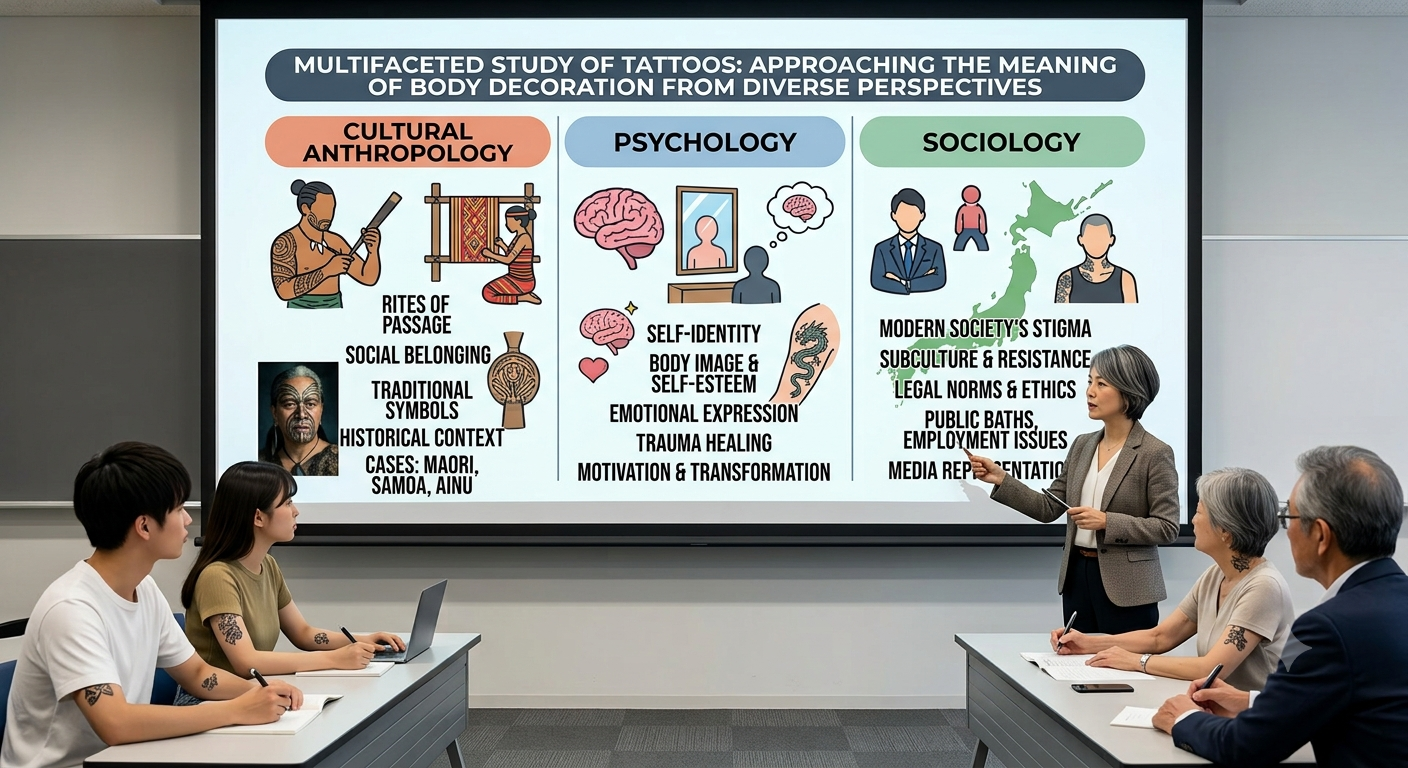
Carving marks and images into the body is a cultural practice found, in one form or another, across nearly every human society, in every era. Treating the body not simply as a biological object but as a social, spiritual, and psychological canvas is a practice that stretches from prehistoric ritual to contemporary urban self-expression, changing shape constantly along the way. This essay draws on cultural anthropology, religious studies, psychology, and sociology to look at how the symbols people carve into their own skin shape identity, self-perception, and social standing.
Body Modification Around the World
The practice of marking the body has always developed in close relationship with a society’s cultural context, religious worldview, and social structure. Its historical purposes range widely — proof of belonging to a group, protection by a sacred power, or a formal marker within a rite of passage.
| Region / Culture | Form | Method | Primary meaning |
|---|---|---|---|
| Thailand (SE Asia) | Sak Yant | Permanent, hand-tapped with a metal rod | A talisman blending Buddhism, Hinduism, and animism — protection, fortune, invulnerability |
| Middle East / South Asia | Henna (Mehndi) | Temporary, plant-based dye | Invoking good fortune (baraka) at weddings and celebrations; warding off harm |
| Egypt (Coptic) | Coptic cross | Permanent, small dotted tattoo, needle-applied | Inner wrist marker of Christian identity; a lasting profession of faith |
| Japan (Edo period onward) | Wabori (irezumi) | Permanent, hand-poked pigment | A protective talisman and aesthetic (iki) for tradesmen; also historically a mark of criminal punishment |
Sak Yant: a sacred rite passed through pain
Thailand’s traditional Sak Yant tattoo is not mere decoration — it is a sacred rite performed by a Buddhist monk or a lay master known as an ajarn, chanting mantras throughout the process. Geometric patterns such as the Hah Taew (five sacred lines) or the Gao Yord (nine spires), or mythic guardian figures such as Hanuman, are believed to shield the wearer from physical and spiritual danger and to draw good fortune. Accepting the physical pain of the process is itself treated as a transformative experience that reshapes the recipient’s state of mind.
The Coptic cross and henna: permanence against the temporary
Coptic Christians in Egypt have maintained, for over fifteen hundred years, the tradition of tattooing a small cross on the inside of the wrist. Within a majority culture, it is an irreversible mark of religious identity — a full declaration of belonging to the community and a near-martyr’s loyalty to the faith. Henna, by contrast, draws its meaning precisely from being temporary: a symbol of a transitional state in life, used at turning points to invite good fortune and ward off misfortune.
The Two Faces of Tattooing in Japan
Japan’s history of marking the body is a genuinely complicated one, where reverence and rejection have run side by side. Motifs found on Jōmon-era clay figures hint at an ancient tradition of body marking, but by the Edo period, body decoration had clearly split into two opposing tracks. The shogunate introduced irezumi-kei — tattooing the arms or forehead of criminals as a public mark of punishment, exiling them symbolically from society. Among ordinary townspeople, meanwhile, tattooing flourished as a form of chosen, self-directed aesthetic.
Manual laborers in particular — roof workers, palanquin bearers, and the town firefighters known as hikeshi — had dragons and deities tattooed across their backs, both to display their courage at the scene of a fire and as a prayer for protection against fire and water. For a firefighter, a dragon tattoo functioned as a practical and spiritual shield: dragons summon water, and water defeats fire. After the Meiji Restoration, though, the new government banned tattooing outright, eager to project a “civilized” image to Western powers. Tattooing was officially branded uncivilized and illegal — and its later association with yakuza intimidation cemented a uniquely deep social stigma in Japan that persists today.
Spiritual Readings of the Symbol
Any discussion of body decoration rests on an esoteric, spiritual view of the body as a vessel for soul or energy rather than mere biological matter. In traditional spiritualist and animist thought, the skin is understood as the boundary between the outer world and the inner self. Carving a sacred figure or mantra into that boundary is believed to raise a kind of ward against outside spiritual intrusion, and to strengthen one’s inner vitality.
Practitioners of spiritual traditions tend to split into two camps. The affirmative view treats a tattoo as a form of grounding — a way of fixing intention in the body — where a symbol applied under proper ritual is thought to act as a catalyst binding higher consciousness to the physical form. The skeptical view holds that physically wounding the skin to deposit pigment disrupts the flow of the etheric body or the meridians, and that the intense emotion of the procedure itself becomes fixed in the pigment, potentially drawing in lower, unwanted vibrations. Scientifically speaking, there is no direct evidence that an external symbol changes any objective spiritual energy field. Cognitive psychology, however, does offer a workable mechanism: repeatedly and visually encountering a meaningful symbol on one’s own body can measurably shift behavior and emotional regulation over time.
A cognitive priming effect from carrying a chosen motif on the body, and a self-fulfilling-prophecy mechanism that can genuinely shift behavior over time.
The claim that a tattoo physically alters an objective spiritual energy field or the body’s meridians has never been scientifically demonstrated.
What Each Motif Carries
The specific motif a person chooses tends to project a particular set of psychological and symbolic qualities onto how they see themselves.
| Motif | Symbolic meaning |
|---|---|
| Dragon | Command over weather and water; overwhelming authority. Draws out the resilience needed to face down fear |
| Snake | Rebirth through shedding skin; release and eternal life. Often chosen as a wish to move past old trauma |
| Deities / sacred script | An attempt to carry a buddha’s virtue or divine protection directly on the skin — spiritual growth, discipline, right conduct |
| Skull | Memento mori made visible — an acknowledgment of life’s impermanence that sharpens the resolve to live fully now |
| Flower | An affirmation of fleeting beauty and vitality — blooming and falling, the brief brilliance of a single life |
| Feather | Lightness of soul, freedom from constraint — departure, or mourning for someone lost |
Identity and Behavioral Change
Psychology explains how carrying a chosen symbol shifts a person’s thoughts and behavior through concepts like enclothed cognition and symbolic self-completion theory. A tattoo differs from clothing in one crucial way: it doesn’t come off. It fuses with the anatomical skin itself. Feeling stronger after getting a dragon tattoo isn’t simply a subjective impression — it reflects a genuine behavioral shift tied to a reworked sense of body image.
Clinical psychology has paid particular attention to the role physical pain plays in affect regulation during the tattooing process. For someone carrying psychological distress, the procedure can convert an unmanageable emotional pain into a controllable, bearable physical one. The endorphins and dopamine released during that process of accepting pain contribute to a felt sense of reintegration between mind and body — a recovery of mastery and control over one’s own body.
| Measure | Short-term (weeks) | Long-term |
|---|---|---|
| Body satisfaction / self-esteem | Significant increase | Effect fades or settles to baseline |
| Body-related social anxiety | Decreases (a felt sense of authenticity) | Can rise again in some, especially women, as stigma resurfaces |
| Identity reinforcement | Stronger sense of uniqueness | Either a stabilized self-concept, or over-reliance on appearance |
How Contemporary Japan Responds
In Japan, where a tattoo sits on the body has an outsized effect on a person’s social standing and daily life. A tattoo fully covered by clothing — on the back or chest, say — carries limited social cost, and traditional wabori developed in part around this very aesthetic of concealment. A tattoo on the neck, face, hands, or forearms, by contrast, creates real friction in relationships and career options. The deepest root of this aversion traces back to the latter half of the twentieth century, when organized crime groups used tattoos as an internal marker, prompting a long campaign of exclusion by police and local authorities. In recent years, as inbound tourism has grown, Japan’s tourism agency has begun urging hot-spring resorts and hotels toward more flexible policies.
| Approach | What it looks like | Effect and limits |
|---|---|---|
| Cover stickers / tape | Palm-sized tattoos may be covered with a dedicated patch to allow entry | Simple to apply, but useless for larger pieces |
| Private baths | Guests are directed to a family bath or an in-room open-air bath | Avoids contact with other guests entirely, but requires dedicated facilities |
| Off-peak hours | Bathing is scheduled for early morning or late-night low-traffic windows | Requires flexible operations and the guest’s own agreement |
The Cost of an Irreversible Mark
Removing a tattoo once it’s been carved into the skin is technically, financially, and physically demanding — and that difficulty is precisely what gives the original act of tattooing its irreversible weight.
| Method | Sessions / duration | Approx. cost | Physical risk |
|---|---|---|---|
| Laser (e.g. picosecond) | 5–10+ sessions, spaced 6–12 weeks apart | Roughly $1,500–$3,500+ for a palm-sized piece | Hyperpigmentation, scarring, difficulty clearing multi-color ink |
| Surgical excision | 1 or more sessions (staged for larger areas) | Several hundred to several thousand dollars, by size and site | Hypertrophic scarring, skin tightness, a permanent surgical scar |
Tattoo removal is generally classified as a cosmetic procedure, meaning it is paid entirely out of pocket — and even after the process, full restoration of the skin is rarely achieved; some trace almost always remains.
The Tattooist’s Trade and the 2020 Ruling
Japan’s traditional tattoo artists descend, in craft lineage, from the ukiyo-e printmakers and woodblock carvers of an earlier era. Knowledge passed down through apprenticeship — how to draw a design, how to bundle needles, how to mix ink, how to hand-poke — carries that same long history forward. Today’s tattoo studio owners and artists come from far more varied backgrounds: fine-art schools, graphic design, street culture. Their tendency to be read as outsiders or as vaguely disreputable owes more to an artistic temperament — treating each piece as a permanent, one-off work of art — and an independent, studio-owning entrepreneurial streak than to anything genuinely antisocial; the two should not be conflated.
The single largest turning point for Japan’s tattoo industry came with a Supreme Court ruling in September 2020. A tattoo artist, prosecuted for practicing medicine without a license under Japan’s Medical Practitioners Act simply for tattooing clients, had his conviction overturned on appeal by the Osaka High Court, which held that tattooing is not a medical act — a decision the Supreme Court then upheld. The court’s reasoning described tattooing as a social custom with genuine artistic significance, requiring a body of knowledge and skill fundamentally different from medicine, and one that could not reasonably be treated as the exclusive domain of licensed physicians. The ruling averted what had been a real risk that the profession itself would be rendered illegal in Japan. Since then, industry associations and individual studios have pushed to strengthen self-regulation — sterilizing equipment, refusing to tattoo minors, and severing all ties to organized crime — in order to build public trust from a position that had long occupied a legal gray zone.
Closing Thoughts
Carving a permanent symbol into the body sits at the intersection of a person’s inner world and their outer social environment, and it exerts real force on both sides of that line, positive and negative alike. Designing one’s own body by one’s own will fosters a genuine sense of agency — that the true owner of this body is oneself — and can serve as a real path out of psychological trauma or social suppression. At the same time, that same permanence carries a risk: as values and life circumstances shift, a once-meaningful mark can become a source of real regret, and in a society where social conformity and stigma still run deep, it can mean facing ongoing, concrete limits.
In closing
What gets carved into skin is, at its core, both a demand for inner self-expression and a tool for dialogue with other people and with society. It is more than decoration — it is an attempt to fix one’s own existence, visibly, into the world. The permanence of that mark carries a real social cost, and it also offers real function as a form of self-mastery and psychological protection. Understanding both sides is asked of anyone who chooses to modify their body — and of the society that receives them.