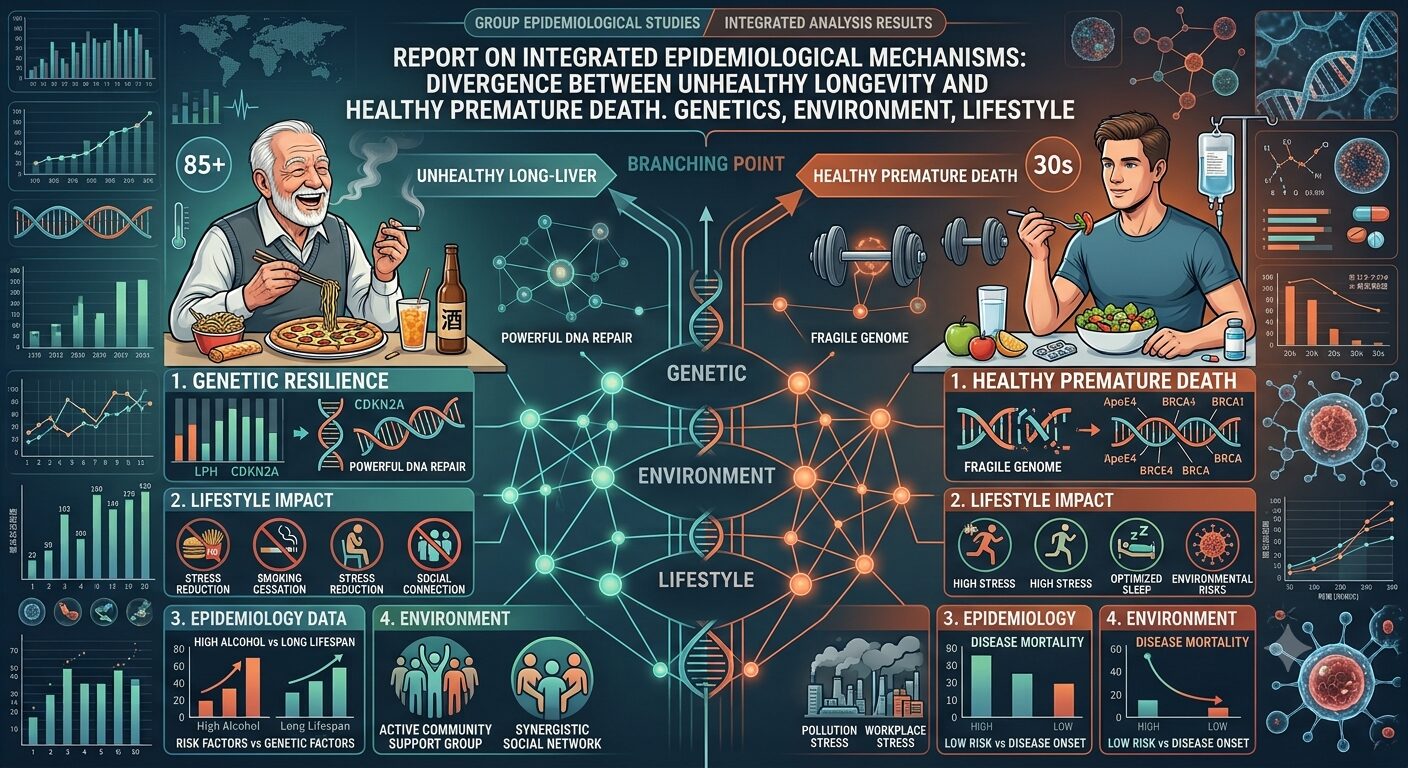
The Fork in the Road Between the Reckless Long-Lived and the Healthy Short-LivedAn Integrative Epidemiological Mechanism of Genetics, Environment, and Lifestyle
Some people live recklessly and never fall ill; others live with scrupulous discipline and are struck down by serious disease while still young. Behind this epidemiological paradox lies a complex interplay of genomic stability, metabolic buffering capacity, the wear of psychoneuroimmunological stress, and probabilistic molecular events. Drawing on recent genomic analyses, large-scale cohort studies, and gut microbiome metagenomics, this report quantitatively examines the contribution of each factor.
In medicine and public health, the existence of people who “live a reckless life yet reach old age without ever falling ill,” and people who “live with rigorous health discipline yet are struck down by serious disease while still young,” has long been debated as an epidemiological paradox.
Behind a phenomenon that seems to render a person’s own disciplined effort toward health irrelevant lies a complex interaction of genomic stability, metabolic buffering capacity, the wear of psychoneuroimmunological stress, and probabilistic molecular-biological events. Drawing on recent findings from genomic analysis, large-scale cohort studies, and gut microbiome metagenomics, this report comprehensively examines the scientific basis for resolving this paradox, and quantitatively evaluates the contribution of each factor.
- The Heritability of Intrinsic Lifespan, and the Science of Metabolic & Protective Variants
- The Risk of Ultra-Processed Foods (UPF), and the Molecular Background of “Metabolically Healthy Obesity”
- Stress and Allostatic Load: How Psychological Damage Becomes Physical
- Sleep Quality and Duration, and Exercise Habits: The Epidemiology of Autonomic Repair and Cardiopulmonary Protection
- The Gut Environment: A Centenarian-Specific Microbiome and Secondary Bile Acid Metabolism
- Social Connection: The Physical Lethality of Loneliness, and the Neurophysiology of “Ikigai”
- Statistical Pitfalls and Probability: Examining the Reality of Survivor Bias and Medical “Luck”
- A Case-by-Case Examination of Health Effects from Disrupted Rhythms and Special Circumstances
- How Should We Situate the Idea That “Those Who Live with a Calling Are Protected by Heaven”?
The Heritability of Intrinsic Lifespan, and the Science of Metabolic & Protective Variants
Innate genomic stability determines tolerance for a reckless lifestyle
A Modern Reassessment of the Heritability of Intrinsic Lifespan
The genetic contribution to human lifespan was conventionally estimated at around 20–30%, and some skeptical pedigree analyses that strictly accounted for assortative mating (the correlation in lifespan between spouses) put that contribution below 10%, or even as low as around 6%. But a mathematical modeling analysis of twin cohorts published in 2026 offers a new perspective that overturns this conventional wisdom.
Earlier studies had analyzed lifespan without excluding “extrinsic mortality” — death from accidents or acute infection — and as a result had severely underestimated the genetic influence on “intrinsic lifespan,” the lifespan determined by biological aging and endogenous disease. Once the noise of extrinsic mortality was mathematically corrected for, the heritability (h²) of human intrinsic lifespan was shown to reach over 50%. This confirms that genetic factors exert far more powerful control over an individual’s potential maximum lifespan than previously assumed.
DOI: 10.1126/science.adz1187
Once extrinsic mortality (accidents, infections) is excluded, the heritability of lifespan roughly doubles, from the conventional 20–25% to over 50% (about 55%).
“Genomic Stability” and Protective Genes in Centenarians
Genome sequencing of centenarians and supercentenarians has revealed that they not only “lack disease-risk genes” but are also born with “protective variants” and a “highly developed capacity for genomic repair” that offset harmful mutations. Studies such as the Longevity Genes Project, which tracks centenarians of Ashkenazi Jewish descent, have identified a high frequency of favorable single-nucleotide polymorphisms (SNPs) that suppress inflammation and metabolism — including functional variants in the cholesteryl ester transfer protein (CETP) gene (which induce high HDL cholesterol) and attenuating variants in the insulin-like growth factor 1 (IGF-1) signaling pathway.
Furthermore, a genomic study using whole-exome sequencing (published 2024) found that centenarians and their direct descendants carry a significantly lower cumulative burden — 11 to 22% less — of rare loss-of-function (LOF) mutations that destroy protein function, compared with control groups. In particular, the scarcity of harmful mutations in specific genes such as RGP1, PCNX2, and ANO9 appears to function as a robust buffer against the onset of disease across multiple organ systems.
Compared with the general population, centenarians carry a significantly lower burden of rare loss-of-function (LOF) mutations across the genome — 11–22% lower.
The Causal Relationship Between Alcohol-Metabolism Gene Variants and Cancer Risk
Nothing illustrates more vividly the health damage that results when a reckless habit (such as drinking) collides with genetic predisposition than the alcohol-metabolism gene variants specific to East Asian populations. Variants in alcohol dehydrogenase 1B (ADH1B: rs1229984), which breaks down alcohol into the intermediate metabolite acetaldehyde, and in aldehyde dehydrogenase 2 (ALDH2: rs671), which breaks down the highly toxic acetaldehyde into harmless acetic acid, decisively shape the causal relationship between drinking and cancer.
The inactive aldehyde dehydrogenase allele (ALDH2*2), carried by roughly 30–49% of East Asians, leads to a lethal buildup of acetaldehyde in the body after drinking. According to Japanese case-control studies and genomic cohort analyses, individuals carrying the inactive ALDH2 Glu/Lys variant who routinely drink and smoke face up to roughly a 190-fold increase in the risk of esophageal squamous cell carcinoma (ESCC), compared with non-drinking, non-smoking individuals with the normal active form. A pooled analysis from the JPHC (Japan Public Health Center-based) cohort study has further demonstrated that current drinkers carrying this inactive allele also face a significantly elevated risk of bladder cancer, due to chronic exposure to acetaldehyde excreted in the urine.
DOI: 10.1093/carcin/bgw033
When carriers of the inactive ALDH2*2 variant drink and smoke, their risk of esophageal squamous cell carcinoma rises synergistically by up to roughly 190-fold.
In other words, even though “drinking every day” is the same reckless habit in both cases, an individual carrying the normally active ALDH2 Glu/Glu variant — who can process acetaldehyde quickly — can avoid direct genotoxicity and live a long life, while an individual carrying the inactive variant who continues the same habit faces a high probability of inducing cancer.
The Risk of Ultra-Processed Foods (UPF), and the Molecular Background of “Metabolically Healthy Obesity”
The fat-storage mechanism behind people who eat junk food constantly yet never fall ill
The Dose-Response Causal Relationship Between Ultra-Processed Food Intake and All-Cause Mortality
The chronic consumption of “ultra-processed foods” (UPF) — typified by junk food and packaged snacks — is the most representative form of recklessness in the modern diet. A comprehensive umbrella review published in The BMJ in 2024, along with the latest dose-response meta-analyses, clearly demonstrates that UPF consumption is an independent factor that shortens healthy lifespan.
A meta-analysis of 18 prospective cohort studies covering roughly 1.14 million participants found that all-cause mortality was significantly higher — by about 15–21% — in the group with the highest UPF intake compared with the lowest. For every 10% increase in the proportion of UPF in the diet, all-cause mortality risk rises linearly by 10%.
By cause of death, cardiovascular disease (CVD)-related mortality risk was reported to rise by 50%, heart-disease-related mortality by 40–66%, and the risk of anxiety and common mental disorders by 48–53%. The mechanism by which UPF damages vascular endothelium and drives carcinogenesis and cardiovascular disease lies in acute metabolic stress from excess saturated fat, sodium, and added simple sugars (such as high-fructose corn syrup), compounded by the breakdown of intestinal barrier function caused by emulsifiers and artificial sweeteners — and the resulting chronic, systemic, low-grade inflammation known as “metaflammation.”
The Paradox of “Eating Junk Food Constantly, Yet Healthy”
At the same time, there exist people who happily eat junk food and remain obese, yet show no clinical signs of diabetes or cardiovascular disease. This is clinically defined as Metabolically Healthy Obesity (MHO). Three physiological and genetic mechanisms have been identified as governing MHO.
- The ability to avoid ectopic fat accumulation: Individuals with MHO are better able to store excess lipid intake preferentially in safe subcutaneous fat tissue, rather than depositing it in organs such as the liver, heart, and skeletal muscle (ectopic fat). This allows them to avoid the onset of insulin resistance and non-alcoholic fatty liver disease (MASLD).
- A low-inflammation state in adipose tissue: Macrophage infiltration is suppressed in the adipose tissue of those with MHO, and the secretion of adiponectin — a beneficial adipokine that maintains insulin sensitivity — remains normal.
- The involvement of genetic variants: A genome-wide association study (GWAS) of roughly 50,000 participants in Korea has revealed that SNPs at specific gene loci involved in lipid metabolism — LPL (lipoprotein lipase), APOA5, and CETP — function as a protective wall that prevents lipid-profile deterioration under conditions of overnutrition.
Stress and Allostatic Load: How Psychological Damage Becomes Physical
Chronic stress raises the risk of autoimmune disease in a near-linear fashion
The Mechanism of Allostatic Load (Biological Wear)
The process by which psychological stress, far from remaining a mere subjective discomfort, physically wears down body tissue and shortens lifespan is explained by the model of “Allostatic Load” (AL). When the body is exposed to stress, it mobilizes the hypothalamic-pituitary-adrenal (HPA) axis and the sympathetic nervous system to achieve “adaptation” (allostasis). But when this adaptive response is repeated persistently and excessively, the feedback mechanisms governing cortisol and catecholamines break down. The resulting physiological wear that accumulates across multiple organ systems is Allostatic Load.
AL is quantified as a “multisystem index” that integrates elevated systolic and diastolic blood pressure, reduced heart rate variability (HRV), elevated HbA1c, dyslipidemia, and elevated trace inflammatory markers such as CRP and IL-6.
How Chronic Stress Triggers Autoimmunity and Worsens Survival Outcomes
A large prospective study (published 2024) of 186,310 participants registered in the UK Biobank demonstrated that elevated allostatic load significantly raises both the incidence of autoimmune and immune-mediated inflammatory diseases (IMIDs) and the all-cause mortality that follows as their prognosis. Compared with the lowest AL quartile, the group in the highest quartile — those with the greatest stress and wear — showed significantly elevated risk for the following autoimmune diseases.
How Far Can Low Stress Offset a Reckless Lifestyle?
To what extent does having very little psychological stress — or possessing a high degree of optimism and resilience — mitigate the harmful effects of a reckless lifestyle? In theory, an individual under little stress is less prone to sympathetic overactivation and excess cortisol secretion, which keeps the thresholds of the autonomic nervous and immune systems from dropping too readily, preserves the relaxation capacity of the vascular endothelium, and makes it easier to avoid acute cardiovascular failure arising from psychological stress. Mindfulness and psychological fulfillment (eudaimonia) have been shown to establish a physiological pathway that lowers the inflammatory cytokine IL-6.
But psychological calm cannot fully offset the direct “physical and chemical insult” inflicted by reckless habits such as smoking or a poor diet. This is because allostatic load accumulates not only from psychological stress but “directly and unavoidably” from heavy drinking, smoking, physical inactivity, ultra-processed foods, and irregular sleep in their own right.
Sleep Quality and Duration, and Exercise Habits: The Epidemiology of Autonomic Repair and Cardiopulmonary Protection
The number of “six healthy habits” practiced can shift disease-free life expectancy by roughly a decade
The Truth Behind the “U-Shaped Curve” of Sleep Duration and Mortality Risk: Distinguishing Correlation from Causation
The relationship between sleep duration and both all-cause mortality and cardiovascular disease (CVD) risk is widely known to trace a “U-shaped” (or “J-shaped”) curve, with the optimal sleep duration sitting at the bottom. Across multiple meta-analyses (pooling cohorts of over 1.38 million people), using “7–8 hours” as the reference point for the general adult population, relative mortality risk rises at both ends of the spectrum: short sleep duration (under 6 hours) and long sleep duration (9 hours or more).
- Short sleep (under 6 hours: risk ratio 1.12): Directly induces sympathetic hyperactivation, overnutrition associated with reduced leptin, and lowered insulin sensitivity, leading to obesity and CVD-related death.
- Long sleep (9 hours or more: risk ratio 1.30): At first glance, excessive sleep appears to harm the body, but lurking here is powerful statistical confounding — “reverse causation” and “unmeasured physical frailty.”
Large-scale wearable heart-rate data (overnight physiological tracking across roughly 230,000 people) similarly shows that the cardiopulmonary system recovers most efficiently — with resting heart rate at its lowest and nighttime heart rate variability at its peak — when sleep duration falls between 7 and 9 hours, confirming the existence of a biologically optimal recovery window.
The Life-Extending Effect of Exercise (Walking), and the Physiology of Cardiorespiratory Fitness (CRF)
The most powerful acquired means of offsetting the harm caused by a reckless lifestyle is a habit of regular exercise, chiefly walking. According to a prospective study that followed 27,738 people for 13 years, including Japan’s Ohsaki Cohort, those who walk for an hour or more per day show a significantly extended life expectancy at age 40 — by 1.38 years for men and 1.16 years for women — compared with those who walk less than an hour, along with substantially reduced lifetime healthcare costs.
Furthermore, an analysis of the large-scale Japanese JACC Study cohort (following 27,582 people) has confirmed a clear, linear extension of life expectancy according to the number of the following “six healthy habits” practiced.
- Not smoking (or having quit in the past)
- Drinking in moderation (less than the equivalent of one go of sake per day, or abstaining)
- Walking or exercising for an hour or more per day
- Sleeping an appropriate amount (6.5–7.4 hours per day)
- Eating green and yellow vegetables on nearly every day
- Maintaining an appropriate body mass index (BMI 18.5–24.9)
DOI: 10.2188/jea.je20100017
Those who practiced all six of these healthy habits at age 40 lived, on average, 10.3 years longer (men) and 8.3 years longer (women) than those practicing 0–2 of them.
A habit of exercise improves cardiorespiratory fitness (CRF), suppressing systemic chronic inflammation (IL-6, CRP), dramatically improving vascular endothelial function, maintaining heart rate variability, and increasing mitochondrial density. It has been confirmed to substantially offset genetic cardiovascular disease risk (polygenic risk score, PRS) by lowering the incidence of hypertension and cancers such as breast and colorectal cancer.
The Gut Environment: A Centenarian-Specific Microbiome and Secondary Bile Acid Metabolism
An “antibiotic-like” bile acid, and the ability to eliminate multidrug-resistant pathogens, found only in centenarians
A Centenarian-Specific Metagenome, and “isoalloLCA,” a Molecule That Eliminates Multidrug-Resistant Bacteria
As high-throughput analysis of the gut microbiome has advanced in recent years, it has become clear that long-lived individuals build — whether innately or through lifestyle — a “gut symbiotic system that prevents illness even amid reckless living.” A discovery published in Nature (2021) by a research group at Keio University and RIKEN identified, in the gut flora of centenarians (average age 107), a distinctive secondary bile acid metabolic pathway with extremely potent antibacterial and immunomodulatory activity.
Compared with younger adults (average age 31) and older adults (average age 86), the guts of centenarians harbor a markedly high proportion of distinctive gram-negative bacteria, including the family Odoribacteraceae and the species Parabacteroides merdae.
Through the coordinated action of specific enzymes carried by these bacterial groups — 5α-reductase (5AR) and 3β-hydroxysteroid dehydrogenase (3β-HSDH) — primary bile acids are converted at high concentration into a previously unidentified secondary bile acid: isoallolithocholic acid (isoalloLCA).
This isoalloLCA specifically suppresses the growth, at an extremely low minimum inhibitory concentration (MIC), of gram-positive, highly multidrug-resistant pathobionts that run rampant after hospital-acquired infection or age-related disruption of the gut flora — organisms such as Clostridioides difficile and vancomycin-resistant Enterococcus faecium (VRE). Furthermore, isoalloLCA activates the nuclear receptor NR4A1, forming a permissive chromatin structure at the promoter region of the transcription factor Foxp3, and thereby strongly promotes the differentiation of regulatory T cells (Tregs) — the central agents of anti-inflammatory control. Through this mechanism, it fundamentally quells the age-related runaway inflammation known as “inflammaging.”
Identifying the Centenarian Virome, and Its Metabolism-Extending Function
A study published in Nature Microbiology in 2023 performed a metagenomic analysis of the gut virome of centenarians — the ecosystem of bacteriophages that primarily infect bacteria — and identified an extraordinarily diverse and previously undescribed set of viral genera living in symbiosis within centenarians’ guts. The centenarian virome is centered on bacteriophages that parasitize the genus Clostridium, and these viruses were found to supply their bacterial hosts with auxiliary metabolic genes (AMGs) that enhance the “conversion of sulfate to sulfide” and “methionine and taurine metabolism.”
Social Connection: The Physical Lethality of Loneliness, and the Neurophysiology of “Ikigai”
The lethality of social isolation rivals that of smoking 15 cigarettes a day
The Mortality Impact of Loneliness and Social Isolation: Equivalent to 15 Cigarettes a Day
The strength with which psychological factors and social isolation harm physical health is one of the most firmly established risks in public health. A cumulative analysis by Julianne Holt-Lunstad and colleagues (published 2010, 2015), covering over 3.4 million people across 148 prospective studies and related meta-analyses, demonstrated that people with strong social connections have a significantly higher probability of survival during the follow-up period — 50% higher (odds ratio 1.50) — than those who are isolated.
Conversely, the hazard ratios by which social isolation and loneliness shorten lifespan are strikingly high, as shown below.
The Epidemiology of “Ikigai,” a Concept Originating in Japan
By contrast, Japan’s leading community-based cohort studies have shown that a positive psychological state — “ikigai,” or a sense of purpose in living — acts as a powerful protective barrier for sustaining life. In the Ohsaki Cohort Study, which followed 43,391 people in Miyagi Prefecture for seven years, those who reported at baseline that they had “no ikigai” were found to have an all-cause mortality hazard 1.5 times higher (multivariable-adjusted HR 1.5; 95% CI 1.3–1.7) than those who reported having one.
By cause of death, the increase in risk was striking for “death from cardiovascular disease (CVD)” (HR 1.6) and “external causes of death such as accidents and suicide” (HR 1.9), but the direct effect on cancer mortality was limited (HR 1.3, not statistically significant).
That said, the greatest confounder in research on psychological factors is the contamination of “reverse causation” — the possibility that people fail to feel a sense of ikigai precisely because they already harbor a latent illness. When more detailed baseline physical data are used, and statistical correction models that rigorously exclude the bias of the first few years after disease onset are applied, the pure mortality risk (hazard ratio) attributable to lacking ikigai attenuates to roughly 1.20. Even so, this does not shake the underlying fact that a subjective sense of purpose and robust social capital play a powerful role in buffering the whole-body allostatic load generated by chronic stress.
Statistical Pitfalls and Probability: Examining the Reality of Survivor Bias and Medical “Luck”
The reckless super-centenarian is no more than a single fighter plane that made it back from the battlefield
Defining “Survivor Bias,” and the Distortion of Perception It Produces
The phenomenon, so conspicuous in our midst, of people who “live recklessly — smoking, heavy drinking, a constant diet of ultra-processed food, working through the night — yet stay vigorous and disease-free into their hundreds” is fully explained, in public-health terms, by the statistical blind spot known as survivor bias.
Survivor bias is the distortion of perception that arises when only the “extremely rare survivors” (the outcome) who passed through a particular “selection process” (the high mortality of reckless living in youth and middle age) are observed, while the “silent majority” (the underlying population) — those who fell away along the way from the same recklessness, dying of heart attacks, strokes, early-onset cancer, and the like — become entirely invisible.
Quantifying Medical “Bad Luck”: The Universality of the Somatic Mutation Rate
The innovative figures that put this “luck” in molecular-biological and mathematical-oncological terms came from Cristian Tomasetti and Bert Vogelstein, who published the “Bad Luck” theory of cancer origin in Science (2015, 2017). They analyzed the correlation between lifetime cancer risk (log R) across various organ tissues in the human body, and the number of normal somatic stem cell divisions (log D) required to maintain that tissue’s health.
Correlation coefficient r = 0.804 (p < 5.15 × 10⁻⁸). Roughly 65% (about two-thirds) of the variation in cancer risk across tissues is determined not by heredity or specific environmental carcinogens, but by “random copying errors in the DNA sequence” — errors that inevitably occur, at a certain probability, whenever a stem cell replicates its own DNA.
No matter how perfectly a person maintains a healthy lifestyle, it is physically impossible to bring the rate of copying errors during cell division — fluctuations rooted in thermodynamics, and the occasional failure of repair systems — down to exactly zero. As a result, no one can fully escape the risk that oncogenic mutations will, by sheer bad luck, co-occur (a “multi-hit” event) at a certain rate.
Accordingly, the phenomenon of heavy smokers living long lives without developing lung cancer owes far less to their having “good genes” than to the fact that, across decades of DNA replication in their somatic stem cells, the errors that accumulated happened, by chance, never to trigger a mutation in a tumor suppressor gene such as TP53 — a matter, in large part, of pure probabilistic “good luck.”
A Case-by-Case Examination of Health Effects from Disrupted Rhythms and Special Circumstances
The realities for shift workers, daily drinkers, and junk-food lovers, each in turn
Long-Term Disease Incidence Among Shift Workers and Night-Shift Employees
The irregular shift work — particularly night work — unavoidable in today’s service industries and healthcare settings physically reverses or desynchronizes the circadian clock, destroying the body’s epigenetic regulatory functions. The long-term disease risk that results has been precisely quantified by the latest dose-response cohorts, including the UK Biobank, as follows.
- Cardiovascular disease (CVD) risk: Shift work that includes night shifts significantly raises the incidence of cardiovascular disease by 13% (RR 1.13) and CVD mortality risk by 27% (RR 1.27). For every five cumulative years of night-shift work, incidence risk rises by a further 7% and CVD mortality risk by a further 4%, in a stepwise dose-response pattern.
- Metabolic liver disease (MASLD): Night-shift workers show a 29% higher odds of non-alcoholic fatty liver disease. Exposure to artificial light at night (ALAN) suppresses melatonin secretion, disrupting the circadian dynamics of lipid metabolism and the gut microbiota, which directly induces abnormal lipid metabolism in the liver.
- Carcinogenesis and lung cancer risk: A Cox proportional hazards analysis (10.6-year follow-up) of 278,650 people in the UK Biobank found that night-shift work is associated with a significant rise in lung cancer risk, with the combined exposure group of “night shift plus smoking” showing by far the worst incidence rate.
The Epidemiological Reality Behind “People Who Drink Every Day and Still Live a Long Life”
People who drink every day and still reach their hundreds combine the rapid acetaldehyde-clearing capacity described earlier (the ALDH2 Glu/Glu variant) with an extremely robust resilience that has survived “population selection.” It has been rigorously shown that alcohol’s hazard for all-cause mortality offers no protective health effect even at low intake (one to two drinks per day) and rises linearly instead (much of the apparent J-shaped curve is an artifact of “sick quitter” bias).
Also, among men, those who maintain a regular habit of taking several “liver holidays” per week have been shown, in Japan’s JPHC cohort study, to substantially reduce their risk of all-cause mortality, cancer mortality, and cerebrovascular disease mortality — suggesting that this kind of voluntary partial mitigation (securing a temporary window for endogenous repair) may be part of what makes long life possible.
The Epidemiological Reality Behind “People Who Eat Junk Food Constantly and Stay Healthy”
People who maintain good health (showing no hyperglycemia or dyslipidemia) despite a constant diet of junk food have a highly developed capacity, described earlier, for safely storing lipids in subcutaneous fat tissue while avoiding ectopic fat accumulation. They carry distinctive, highly active alleles of genes such as LPL that allow them to consume large quantities of fat and simple sugars without developing insulin resistance (exhaustion of pancreatic β-cells), and they can rapidly process triglycerides in the blood.
Furthermore, their gut may harbor beneficial symbiotic bacteria — such as Akkermansia muciniphila, which protects the intestinal mucosal barrier even while processing a high-carbohydrate, high-fat diet, and butyrate-producing bacteria — that, fortunately, are not wiped out by certain high-fiber sources (such as the small amount of prebiotics consumed in between junk-food meals), allowing them to retain a degree of species evenness. That said, this too tends to break down over the long term as insulin sensitivity naturally declines with age (the transition from MHO to MUO), and a period in which maintaining health suddenly becomes far more difficult eventually arrives with aging.
How Should We Situate the Idea That “Those Who Live with a Calling Are Protected by Heaven”?
A reckoning that holds both the spiritual worldview and the scientific evidence in view
Across spirituality, religion, and philosophy alike, a shared idea has long appeared in many traditions: that “those who live with a calling are protected by heaven,” or that “life is preserved until one’s heavenly mission is fulfilled.” This, however, is one worldview among matters of faith — it is not a fact that has been scientifically verified. Scientific research, meanwhile, has shown that having a sense of “purpose in life” may be associated with health. Studies have found that people with a stronger sense of life purpose tend, on average, to have lower mortality, and a lower risk of depression and cognitive decline.
This does not, however, prove that “heaven is protecting them.” Rather, it is thought to be explained by factors such as the following.
- Having a purpose in life makes it easier to cope with stress
- It makes healthy behaviors easier to sustain
- It tends to increase one’s connections with other people
- It makes it easier to recover from adversity (greater resilience)
The Spiritual View
The idea that “those who contribute to society are protected by their heavenly calling” exists within religious and philosophical traditions. This is a worldview belonging to a system of faith, and it plays a role in sustaining a person’s will to live and their sense of meaning.
The Scientific View
Multiple studies have shown that “a sense of purpose or calling in life may be associated with health and longevity,” but this cannot be proven to result from any supernatural force. At present, the scientific understanding is that this association is explained by mediating factors — stress coping, behavioral habits, social connection, and resilience.
Rather than reducing this theme to a simple choice between belief and disbelief, it becomes a genuinely interesting field when approached through the question of what effect living with a sense of calling has on a person’s mind and body — a question where spirituality and the fields of psychology and epidemiology overlap.
In the End, What Determines Health and Lifespan Most?
Genetic ceiling × lifestyle habits × probabilistic luck — a product of three terms
Drawing on the findings of medicine, epidemiology, psychology, and public health, the structure of the core factors that ultimately determine an individual’s healthy lifespan and total lifespan is fully captured by the following integrated proportions and their synergistic interaction. An individual’s lifespan and health status is determined by the product of three terms: the fated “genetic constraint,” the acquired “lifestyle behavior,” and the unavoidable “thermodynamic and quantum-level luck.”
genetic ceiling
social capital
(somatic mutation)
An International Cohort Comparison: The Absolute Power of Acquired Healthy Habits
However strong the genetic constraint may be (heritability reaching as high as 55% in the latest model from Shenhar and colleagues), the net gain in healthy lifespan delivered by the “five major low-risk lifestyle habits” that an individual can control autonomously — not smoking, moderate drinking, regular walking, adequate sleep, and a high-quality diet — has been proven as an immovable scientific fact by follow-up studies covering hundreds of thousands of people in both Japan and the United States.
| Cohort | Key Study | Difference Attributable to the Five Major Habits |
|---|---|---|
| United States Nurses’ Health Study / HPFS |
Y. Li et al., BMJ (2020) DOI: 10.1136/bmj.m1650 |
Those who practiced “all five” healthy habits at age 50 had a total life expectancy that was longer by 14.0 years (women) and 12.2 years (men) than those practicing “zero” of them. Disease-free healthy lifespan was also longer, by a net 10.7 years (women) and 7.6 years (men). |
| Japan JACC Study |
A. Tamakoshi et al., Journal of Epidemiology (2010) DOI: 10.2188/jea.je20100017 |
Those practicing “5–6 of the six” healthy habits at age 40 had a life expectancy longer by 10.3 years (men) and 8.3 years (women) than the reckless group practicing 0–2 of them. |
This extraordinary “gap of roughly a decade in disease-free life expectancy” demonstrates, as clearly as any finding can, the public-health significance of an individual choosing a healthy way of living.
Genes, Probability, and Habit — What Is Actually Left in Our Hands
The person who lives recklessly and never falls ill is, genetically speaking, either someone whose intrinsic lifespan was designed from the start to be exceptionally long and who carries a protective genomic stability against certain harmful substances, or someone who, by sheer chance, escaped a direct hit from a probabilistic somatic mutation — in either case, a singular case of good fortune under survivor bias.
The person who falls ill despite living a healthy life, on the other hand, either inherited a strong innate genetic vulnerability (a heavy burden of LOF mutations, difficulty regulating their lipid profile, and so on), drew a probabilistic copying error during stem cell division (bad luck), or is someone whose biological clock and autonomic nervous system quietly and prematurely completed their systemic wear through the physical allostatic load of social isolation or chronic stress — in either case, someone who breached the protective wall.