OPEN COUNTERThe Bar Study of Boundaries & Emotional Labor
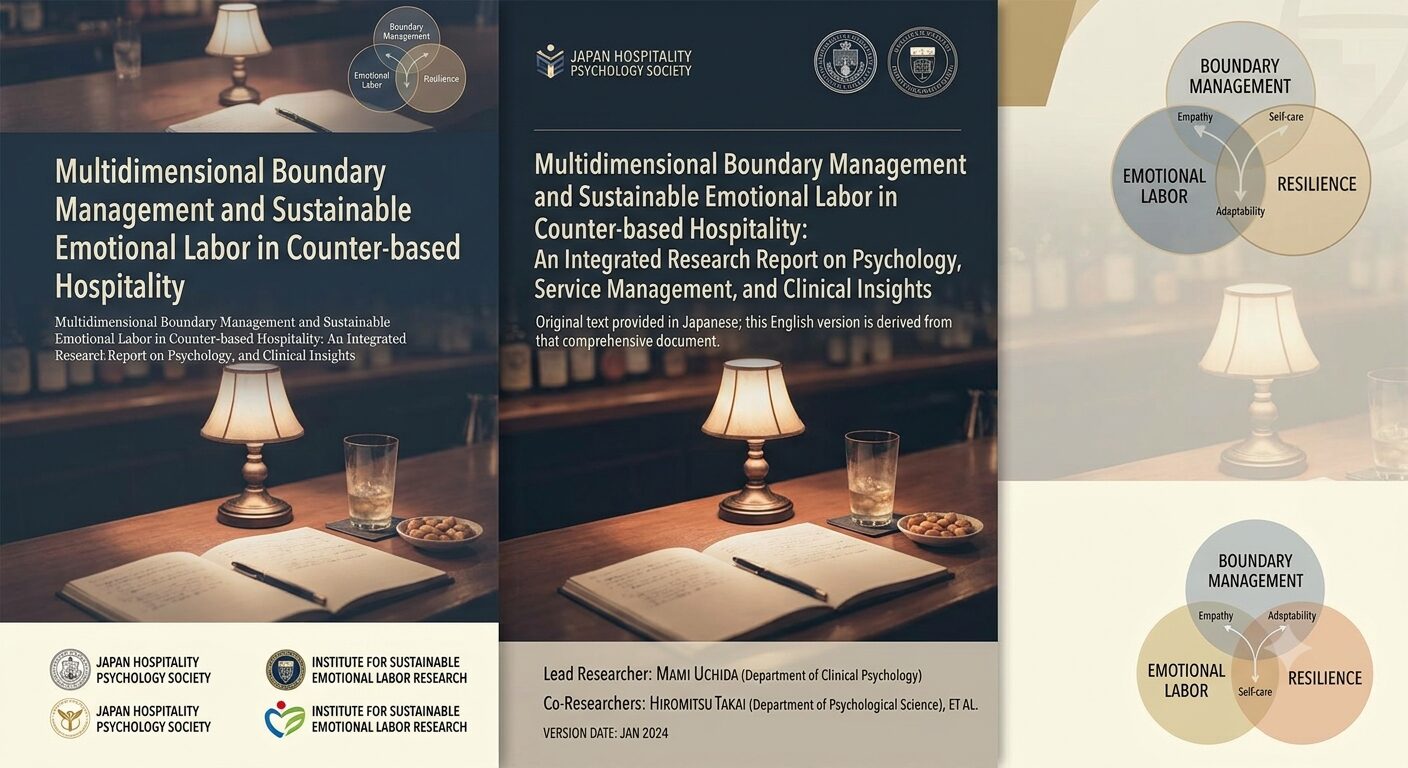
A multi-dimensional analysis of the interpersonal values held by an individual aspiring to enter counter-service hospitality — examined through the lenses of clinical psychology, emotional labor theory, and service management. Why do “maintaining appropriate distance,” “tolerance for others’ imperfections,” and “a whole-system win-win orientation” become the greatest assets in counter-service work? This report integrates academic frameworks with practical knowledge for sustainable bar design.
The interpersonal values expressed by an individual aspiring to enter counter-service hospitality — bars, snack bars, and similar establishments — are evaluated, from the perspectives of contemporary clinical psychology, emotional labor theory, and service management, as possessing exceptionally high adaptability and long-term sustainability.
The consultant’s expressed approach to human relationships stands apart from mere altruism or self-sacrificing hospitality (the so-called “selfless devotion” ethos), and meets the foundational requirements of professional boundary management — the ability to maintain one’s mental health while building healthy relationships with others. This report analyzes the consultant’s cognitive schema — which encompasses “valuing appropriate interpersonal distance,” “tolerance for others’ immaturity and a belief in the possibility of relationship improvement,” “a whole-system win-win orientation,” “balancing self-protection with understanding others,” and “a pragmatic acceptance of others’ venting and gossip” — from both academic theory and the practical dimensions of service design.
- Structural Analysis of Empathy and Professional Interpersonal Distance
- The Dynamics of “The Middle Way,” “Self-Axis,” and Psychological Boundaries
- Mental Resilience Techniques and Emotional Labor Strategy for Surviving Complaints & Gossip
- Multi-Dimensional Assessment of the “Everyone Wins” Orientation: Structuring Strengths and Risks
- “No Deal” Decisions and the Art of Assertive Refusal
Structural Analysis of Empathy and Professional Interpersonal Distance
The psychological distance across a counter is a more delicate craft than the angle at which you pour a drink
The Psychological Distinction Between Active Listening and Emotional Contagion
One of the most critical skills in counter-service hospitality is the design of “psychological distance” formed between the host and the guest. This is not simply about becoming close — it demands a sophisticated, professionally-grounded dynamic control.
Clinical psychologist Carl Rogers’ concept of “Empathic Understanding” in client-centered therapy describes a cognitive process of feeling the client’s inner world “as if it were your own” — while simultaneously maintaining the strict boundary of “yet never losing the ‘as if’ quality.” By contrast, everyday “sympathy” (emotional contagion) dissolves that self-other boundary: one experiences the other’s pain or anger as if it were one’s own world, physically absorbing it into oneself.
In his later years, Rogers reconceptualized empathic understanding not as a fixed state but as “a moment-to-moment sensitivity present in the here and now” — an ongoing process. Rather than whether understanding is perfectly achieved, it is the very attitude of seeking to understand that is seen to carry therapeutic value.
When emotional contagion becomes habitual, the host begins to receive the gossip and complaints that guests pour out across the counter as if they were personal matters — leading to serious Empathy Fatigue. Psychologically trained “active listening,” by contrast, infers and understands the guest’s perspective and the context of their suffering at a cognitive level, without excessively depleting the host’s own emotional energy. Consciously distinguishing between active listening and emotional contagion plays an extraordinarily important role in sustaining long-term mental health.
Designing Dynamic Psychological Distance with Guests
The master of counter-service begins with new guests from a “cool and neutral baseline distance.” At this stage, they avoid intruding too quickly — instead easing the guest’s tension through small gestures like presenting the glass, brief eye contact while taking orders, and introducing seasonal menu items, while maintaining control of the interaction while giving the guest a sense of being the protagonist. Then, as visits accumulate and the guest’s personality and trust have been established, the host strategically closes the “emotional distance” — drawing a little closer.
In actual bar operations, a bartender who has run a solo shop for years develops a unique stance: “get a laugh out of them quickly, then step away just as fast.” This approach of “being present without being intrusive” is a survival strategy for preventing any one relationship from becoming excessively sticky, and for maintaining the fluidity and harmony of the counter space as a whole.
The Dynamics of “The Middle Way,” “Self-Axis,” and Psychological Boundaries
A boundary is not a wall — it is an adjustable filter
Boundaries as “Adjustable Filters,” Not “Walls”
The consultant’s desire to “protect their own heart while also understanding others” is closely linked to the establishment of self-other boundaries. In psychology, boundaries are defined not as a rigid physical “wall” for rejecting others, but as an “adjustable filter” that protects one’s energy, focus, and recovery, while sustaining a healthy, respect-based relationship with the other person.
When boundaries become extremely thin (self-other boundary erosion), one begins to feel responsible for others’ bad moods, or takes on personal problems that others should resolve for themselves. Conversely, when boundaries become completely rigid and too thick, the emotional connection with guests is severed, leading to a cold, mechanical service style. Professional hosts develop the ability to stretch, compress, and adjust these boundaries according to the situation and the nature of each guest — as a form of communication skill.
| Boundary State | Psychological Traits & Cognitive Approach | Concrete Impact in Counter-Service |
|---|---|---|
| Too Thin (Blurred / Eroded) |
Conflates others’ emotions with one’s own. Perceives others’ bad moods as one’s own fault and over-accommodates. | Over-identifies with guests’ complaints and gossip, leading to exhaustion. Unable to assert refusal against unreasonable demands. |
| Flexibly Adjustable (Professional) |
Maintains self-other separation while exercising cognitive empathy (active listening). Balances self-protection with understanding others. | Listens sincerely to guests’ concerns without being emotionally drawn in. Maintains the “get a laugh, then step away” distance. |
| Too Thick (Blocked / Rejecting) |
Thoroughly rejects others’ intrusion and completely cuts off from the outside world. Fixated solely on controlling one’s own sphere. | Guests perceive coldness or an overly transactional manner, reducing repeat visits. The spontaneous conversations unique to counter spaces never emerge. |
Building a “Self-Axis” and “The Calm Gatekeeper Mode”
To avoid being swept around by others’ bad moods or demands, a clear “self-axis” is essential. A self-axis means grounding one’s sense of self-worth in one’s own values and standards of judgment — a mental posture that does not over-depend on external evaluations such as guests’ praise or criticism. When one’s boundaries are about to be eroded, setting up a “calm gatekeeper mode” internally and making a systemic judgment — “further intrusion will not be accepted” — makes it easier to offer a firm “No” without guilt. This felt sense of self-other separation is the defensive shield that prevents excessive compliance and appeasement.
Mental Resilience Techniques and Emotional Labor Strategy for Surviving Complaints & Gossip
For customers, a bar is also a place to expel the waste of everyday life
Bars and snack bars frequently function as “emotional detox facilities” where guests come to decompress from daily stress. To maintain genuine mental health while being exposed to “complaints and gossip” on a daily basis, hosts must internalize a strategic approach to emotional labor.
The Fatigue Correlation Between Surface Acting and Deep Acting
Research on emotional labor shows that “surface acting” — maintaining a smile on the outside while feeling nothing on the inside — creates a gap between inner and expressed emotions (emotional dissonance), and is a fast track to burnout. By contrast, “deep acting” — inferring a guest’s background and context and arriving at genuine, internally felt empathy through cognitive reappraisal (“it makes perfect sense that this person would need to vent”) — has been found to produce significantly lower psychological stress. Because surface acting, when it accumulates, numbs one’s own emotions and leads to emotional exhaustion, actively choosing and learning deep acting is what sustains long-term work.
Surface Acting — saying “Welcome” with just your face. A smile with nothing behind it chips away at you more with every hour that passes.
Deep Acting — only when you’ve imagined “they must have had a hard day today” does the smile actually arrive. Same expression, but a completely different quality of exhaustion.
The Practice of “Flavor-Shifting” and Metacognition
Rather than silently enduring negative topics, the host must actively deploy the communication skill of “flavor-shifting” conversations. When a guest begins a negative narrative, the host first signals alignment — “That really must have been difficult” — but the moment the conversation risks stagnating or looping, they step in with a drink suggestion, a shift to a hobby topic, or a reframing through humor, cutting the rhythm of the counter’s atmosphere and redirecting it.
In addition, by metacognitively observing one’s own emotions — watching from one step back and tracking how much emotional energy is being consumed right now — it becomes possible to take corrective action before stress accumulates to excess.
Overcoming the Defensive Response to Complaints and Negative Feedback
In hospitality, what matters even more than the first impression is the last impression — specifically how one responds to complaints or negative evaluations. When a guest presents a direct complaint, a “defensive response” — citing expertise to make excuses or argue back — may momentarily protect one’s pride, but the guest will never return. In internationally acclaimed bars, the established practice when receiving a complaint is to apologize immediately without making excuses, and to swiftly offer an alternative drink. This “non-defensive, supple response” can only be sustained by the establishment of a solid self-axis that separates emotion from action and puts constructive resolution first.
Multi-Dimensional Assessment of the “Everyone Wins” Orientation: Structuring Strengths and Risks
The kindness that seeks harmony can also become a blade
The consultant’s orientation toward “wanting everyone to be satisfied in a relationship — win-win — rather than making anyone the villain” is grounded in a highly principled paradigm that views human relationships not as competition but as a field for cooperation. However, in the service industry, where an extraordinarily diverse and sometimes unpredictable range of guests intermingle, this value system carries a dual nature: it can become a powerful “strength,” but if mismanaged, it becomes a potentially fatal “risk.”
Strength: Community Mediation
In bars and snack bars, an attitude that neither favors specific guests nor excludes others gives new visitors a strong sense of safety. When the host “quietly calibrates the space,” natural conversation can arise between strangers who happen to be sitting there — forming an informal public sphere (a nocturnal commons) freed from home and workplace.
The Hidden Trap: Sliding into Lose-Win
Over-attachment to finding “a solution everyone accepts” causes coordination failure when a guest confronts the host with clearly Win-Lose demands. Swallowing what you want to say, smiling vaguely to smooth things over — this attitude permanently establishes a “Lose-Win” state in which you offer yourself as a doormat.
When regulars increase in number, problems can arise: they start creating “their own rules,” demanding excessive off-menu customizations, or directing jealousy at other guests. If the host, in an attempt to offer a win-win to everyone, responds indecisively and delays intervention, operational regulations break down and the establishment risks losing other valuable guests entirely.
“No Deal” Decisions and the Art of Assertive Refusal
For relationships in which win-win is judged impossible, or for guests who significantly damage other guests’ comfort or the bar’s concept, a third paradigm must be applied — not simply giving in to the other party, but invoking “Win-Win or No Deal (if we cannot reach a mutually satisfactory arrangement, we agree not to do business).” When a mutually desirable situation cannot be created, the host must be able to make the call — without guilt — to decline service. In such moments, “assertion” — a communication technique of honoring both oneself and the other person — becomes critically important.
| Paradigm | Psychological Stance & Mindset | Outcomes & Risks in Counter-Service |
|---|---|---|
| Win-Win (Ideal Cooperation) |
Both I and the guest win. Collaboratively seek an outcome that satisfies both parties. | Mutually beneficial trust is built, maximizing Customer Lifetime Value (LTV). |
| Lose-Win (The Self-Sacrifice Trap) |
If it means satisfying the other person, I’m willing to endure and be used as a stepping stone. | The guest’s excessive sense of entitlement escalates, and the host burns out. |
| Win-Lose (Coercion / Authority) |
Push through only the store’s interests and rules, discarding guest satisfaction. | Guests feel “unwanted,” and repeat visit rates drop catastrophically. |
| No Deal (Agreed Non-Transaction) |
When Win-Win is impossible for both parties, agree not to do business (e.g., banning the guest). | Functions as a last line of defense for protecting the store’s concept and its other quality guests. |
Analysis of Innate Traits vs. Post-Developmental Potential
Sensitivity cannot be changed — but learning where to draw the line can
Correctly distinguishing “which traits are innate (nature) and which can be acquired through training and experience (nurture)” is enormously beneficial for career design and the development of self-efficacy in the consultant’s effort to bring their values to counter-service work.
The Mechanisms of Genetic Sensitivity and EQ Development
In general, hypersensitivity in interpersonal relationships, high empathy, and the ability to detect subtle emotional changes in others (traits associated with HSP: Highly Sensitive Person) are said to be strongly rooted in the characteristics of the brain’s amygdala and genetic factors (approximately 50%). For this reason, when one innately possesses high empathic capacity as a congenital trait, intentionally rewriting it into “a completely insensitive, unfeeling state” is extremely difficult. However, “Emotional Intelligence (EQ)” — the skill for managing relationships with others — has been empirically demonstrated to be a skill that can be substantially improved and developed through training and intentional practice even in adulthood, in stark contrast to innate IQ.
| Trait Category | Specific Psychological & Behavioral Components | Nature / Nurture | Post-Developmental Approach |
|---|---|---|---|
| Sensory & Emotional Sensitivity | The acute ability to detect emotions from others’ tone of voice, facial expressions, and subtle shifts in the room’s atmosphere. | Strongly innate (~50% is genetic temperament) |
Rather than eliminating sensitivity, learn cognitive adjustment (metacognition) — observing the incoming stimulus from an objective distance. |
| Emotional Intelligence (EQ) | Controlling one’s own emotions, social consideration for others, and the strategic use of empathy. | Fully improvable through nurture | Reflective journaling on emotions, verbal labeling of feelings, one-on-one feedback with others. |
| Boundaries | The skill of maintaining clear self-other distinctions and not taking on responsibility for others’ emotional states. | Acquired through learned behavior (can break free from childhood patterns) |
Establishing a “calm gatekeeper mode” in the mind. Trusting the body’s discomfort signals and practicing internal self-questioning. |
| Assertiveness Skills | Communicating “No” and store rules without erasing yourself — and without attacking the other person. | Dependent on post-developmental training | Using “I-messages.” Eliminating unnecessary apologies and over-explaining; practicing tolerance for the other person’s silence. |
| Emotional Labor Acting Adjustment | Strategically switching between surface acting and deep acting (cognitive reappraisal) according to the situation. | Professional skill acquired through experience and education | Cognitive profiling of guests’ negative behaviors. Deliberately keeping the emotional gap to roughly “20% above actual.” |
The Acquisition Path for Post-Developmental Skills
Specifically, the psychological skill of drawing appropriate self-other boundaries is influenced by the family environment in childhood, but can be fully re-learned in adulthood through cognitive-behavioral training and repeated assertiveness role-play. Similarly, the practice of “deep acting” in emotional labor accelerates rapidly in proficiency as one builds up a cognitive database (profiling) — an understanding of the hidden backgrounds and inner motivations that tend to underlie particular guest behavior patterns. Consequently, the consultant’s concern about “mental exhaustion from listening to complaints” — an innate response — moves into a fully manageable domain once the acquired defensive skill of “self-other separation (boundary setting)” is implemented.
Sustainable Store Environment Design (Third Place Theory) and Guest Control
The space itself can become armor that protects the host’s emotional state
The consultant’s vision — “wanting to create a space where guests can have fun, not just vent” — is an extremely sound approach from the perspectives of service management and environmental engineering. This is because the limitations of emotional labor that depend on the host’s personal traits and endurance can be dramatically reduced by “the psychological control functions inherent in the store environment itself.”
The “Ma” (Interval) in Third Place Theory
Research on snack bars focusing on the unique structure of Japanese counter hospitality as a “nocturnal public sphere” notes that whereas Western third places (pubs, cafés, etc.) presuppose spontaneous conversation among patrons, in Japanese society — where resistance to engaging with strangers is relatively high — it is indispensable to community formation that the space’s proprietor (the Mama or Master) serves as a “subtle calibrator of interval (a human mediator).” The host’s existence as a neutral “physical and psychological mediator of distance” across the counter draws out flat, casual conversation between guests, and spatially prevents any individual from monopolizing the space with complaints and bringing the atmosphere to a standstill.
Engineering “Reasons to Return”: Space as a Defense System
Scattering “multi-layered meaningful symbols (hooks)” throughout the store — beyond food and drink — not only diversifies guests’ motivations to return, but functions as a physical and cognitive “defense system” protecting the host’s emotional labor.
- Monthly rotating amuse-bouche and seasonal cocktails: Specific creative offerings that stimulate the senses (taste, sight) forcibly shift guests’ attention from the “cognitive loop of daily life (workplace anger, domestic complaints)” to “pleasure in this moment, right now.”
- Dynamic control of temperature and lighting: A store’s lighting and physical temperature directly govern guests’ behavior and psychological state. When a couple with a significant age gap arrives, dimming to a tone that makes expressions less visible; brightening the space naturally before closing time to let guests sense the passage of time and nudge them toward leaving — these subtle environmental adjustments are powerful control tools that preemptively avoid unnecessary guest friction and the exhaustion of guests who overstay.
- Cognitive harmony through music and visuals: Rather than Japanese J-Pop, whose lyrics enter the ear directly, playing emotionally evocative foreign-language tracks — jazz, bossa nova, soul — at a moderate volume that masks others’ loud conversations protects the overall privacy of the space and physically suppresses the acoustic spread of complaints.
- Board games and books (stimulating intellectual curiosity): By mediating through shared tools like games or books, the face-to-face communication between guests and host shifts from “one-on-one emotional dependence” to “neutral dialogue mediated through a common language.”
- Guest profiling and calibrating distance: The habit of meticulously recording guests’ names, faces, preferred drink profiles, and past conversation topics is the foundation for offering individually customized value. Because the host holds this data, when a specific guest appears about to cross a line, they can calmly execute a strategic distancing — securing appropriate personal space with precision.
Habits and Defenses Cultivated by Long-Running Hospitality Professionals
Kindness also has an aspect of resolute strength
The Yin-Yang Dynamic of Self-Compassion
Kristin Neff and colleagues, founders of Mindful Self-Compassion (MSC), argue that self-compassion has two poles — yin and yang. The approach of gently nurturing oneself, accepting one’s imperfections as they are, and healing wounded inner emotions is called “Yin Compassion.” By contrast, the resolute strength of bravely standing up to protect oneself from danger or pain — speaking up, drawing clear boundaries, and delivering a firm “No” when necessary — is defined as “Fierce Self-Compassion” (Yang Compassion).
Yin Compassion
Gently nurturing oneself, accepting one’s imperfections as they are, and healing wounded inner emotions. At the end of a shift, honoring the effort you gave today.
Yang Compassion (Fierce)
The strength to assert a firm “No further” against guests who violate boundaries and threaten one’s dignity or the harmony of the space. The ultimate act of compassion.
The element most commonly missing from burnout prevention in service-sector emotional labor is precisely this “Yang Self-Compassion.” Like the ferocious energy a mother bear shows when protecting her cubs from a threat, asserting a resolute stance toward customer harassment and boundary-violating guests who threaten one’s dignity or the harmony of the space is the ultimate act of compassion — one that protects one’s inner life and enables sustained long-term performance. Drawing a line grounded in one’s true values connects directly to self-appreciation (a legitimate recognition of one’s own worth).
Lifestyle Self-Management and Designing a Life Rhythm
To sustain emotional labor that extends into the late hours over a long period, self-management that appropriately regulates the body’s autonomic nervous system is an essential prerequisite. Beyond sleep, diet, and adequate hydration, “managing the psychological and physical relationship with alcohol during and after work” is critically important. Many professionals rigorously maintain control by avoiding excessive alcohol consumption alongside guests during service, and by making use of non-alcoholic “dummy drinks.” Post-shift cooldown stretching and routine habits physically anchor a sustainable work-life balance by settling the stimulated nervous system.
The Consultant’s Values Are the “Greatest Asset” in Counter-Service Hospitality
Based on the academic and practical analysis in this report, the interpersonal values the consultant has expressed — “appropriate distance,” “tolerance for imperfection,” “a win-win orientation,” and “balancing self-protection with understanding others” — are concluded to constitute “the greatest asset (strength)” in counter-service hospitality: one that covers innate vulnerabilities while simultaneously achieving sustainability and exceptional trust-building.
The remarkably flexible view of humanity expressed as “people have imperfect sides, and relationships can improve with time and understanding” becomes both the foundation for practicing “deep acting (cognitive reappraisal)” — which reduces the burden of emotional labor — and the basis for acquiring repeat guests that maximize Customer Lifetime Value. Furthermore, the realistic acceptance embedded in “people do vent and gossip a little behind closed doors” functions as a psychological cushion preventing the risk of becoming disillusioned with guests due to excessive moral idealism.
However, to prevent these values from falling into the trap of “self-sacrifice (Lose-Win),” the following behavioral design model is recommended as a guiding framework.
Turning Assertive Refusal (Yang Compassion) into a Skill ── Anticipate the special situations where the ideal of “everyone is satisfied” cannot function, and pre-install a “calm gatekeeper” in the mind. For unreasonable demands, avoid excessive apology; instead, present only the facts and one’s own boundary briefly through “I-messages,” and smoothly process Win-Win-impossible situations as “No Deal.”
Automatic Masking of Emotional Labor Through Environment Design ── So that guests’ reasons for visiting are not concentrated entirely on “emotional detoxing,” intentionally place “multi-layered symbols” throughout the space — rotating amuse-bouche, cocktails, acoustics, board games, and more. Meticulously control acoustics, lighting, and layout to elevate the emotional dumping ground into a “refined, mindful experience space.”
Self-Protection Through Thorough “Empathic Understanding (Active Listening)” ── Rather than emotionally merging with guests’ words, maintain “cognitive empathy” from one step back, and recognize the counter as “a stage with boundaries.” This establishes a stance in which the host “doesn’t sink with the guest” — reducing energy expenditure at the source.
- Shunsuke Yamada, “A Study on the Meaning of Empathic Understanding — Based on Changes in Carl Rogers’ Conceptualization,” Journal of Developmental Clinical Research
- chocolat.work/column/service/460
- igroup-bar.jp/column/detail/20260402190002
- cookbiz.jp/soken/career/interview_220615
- yogajournal.jp/31330
- onaji.me/entry/2022/01/20/01
- tcbt-counseling.com/?p=50
- mindfultherapy.jp/column/nurseselfcompassion
- hibito.co.jp/coaching/emotional-intelligence-sales
- nomura.co.jp/wealthstyle/article/0021
- jmam.co.jp/hrm/column/0267-eq.html
- naciel.jp/restaurant-industry/howto_jouren
- media.yayoi-kk.co.jp/23473
- kokotomo.com/column/assertion-guide
- hachiq.jp/blog/column/detail/20260118000017
- garage-working.com/archives/2697