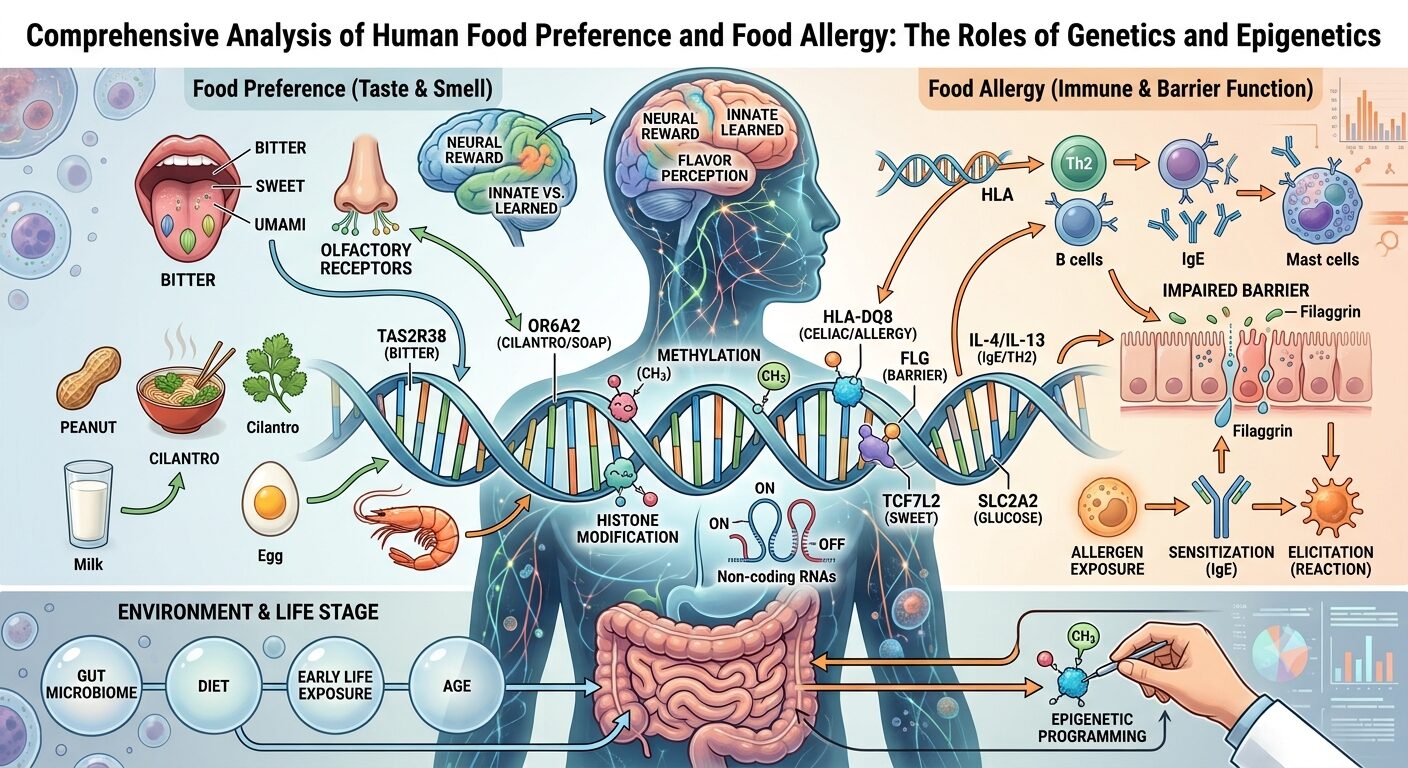
FOOD PREFERENCE/FOOD ALLERGY· GENOME & EPIGENOME
Genetic and Epigenetic Determinants of Human Food Preference and Food Allergy
Neither “picky eating” nor a food allergy is a matter of willfulness or constitution in some vague sense. Both trace back to a blueprint written in DNA, and to epigenetics — the way environment rewrites how genes are expressed. This piece follows that dual thread from taste receptors down to the gut microbiome, as far as current research allows.
Five Things to Know First
Eating is essential to being human, and it carries two faces: “liking and disliking,” which feels like part of who we are, and “food allergy,” which can be life-threatening. Both are scientifically explicable phenomena.
30–70% of taste preference is genetic
Individual differences in taste and smell receptors heavily shape how we feel about vegetables and herbs.
Cilantro aversion is gene OR6A2
A variant in an aldehyde-sensitive olfactory receptor makes the herb smell like soap or stink bugs.
Bitterness depends on being a “supertaster”
The TAS2R38 gene variant determines how intensely you register bitterness in broccoli and the like.
Allergy is the immune system misfiring
Peanut allergy heritability exceeds 80%. The immune system mistakes a harmless protein for a threat.
“Constitution” and “specific food” run on different genes
The skin-barrier gene FLG and the immune “antenna” gene HLA play entirely different roles.
The first 1,000 days, and the gut microbiome
Gut conditions from pregnancy through age two flip genetic switches that shape prevention.
The Heritability of Food Preference — Twin and Genomic Studies
Food preference, along with wariness of unfamiliar foods (food neophobia) and picky-eating tendencies, is a multifactorial trait shaped by many gene loci interacting with environment. Structural equation modeling on twin cohorts finds genetic contribution shifting across developmental stages, reaching as high as 78%.
Notably, the weight of genetic determination shifts structurally with age. Longitudinal analysis from British birth cohorts (TEDS) and others shows that in early childhood (ages 3–4), “home environment” (shared environment) is the dominant factor explaining individual variation in food preference — over 40% for vegetables — but by late adolescence and young adulthood, the influence of shared environment converges statistically to zero, and the remaining variance is explained solely by genetic predisposition and by “non-shared environment” — an individual’s own friendships and dining habits. A child’s pickiness can shift temporarily through the home environment, but by adulthood, autonomous food choice reflects only innate genetic sensitivity and one’s own unique experience.
Food Fussiness (FF) and Food Neophobia (FN) show an extremely high phenotypic correlation (r=0.72) and a high genetic correlation (rg=0.73) as well, suggesting they essentially share a common genetic etiology. Because food neophobia connects neurobiologically to highly heritable temperamental domains — anxiety and avoidance toward novel stimuli, such as shyness or emotionality — it shows a consistently higher heritability (h²=0.58–0.78) than FF.
Chemosensory Receptor Genes — The Blueprint of Flavor
The process of sensing what we eat begins at the periphery, governed by taste and olfactory receptors. Variation in these receptor genes fundamentally shapes the resolution — and the emotional valence — of the flavor each of us experiences.
OR6A2
11p15.4 · olfactory receptorEncodes a G-protein-coupled receptor that detects, with high sensitivity, the aldehyde compounds (chiefly trans-2-decenal) that make up cilantro’s aroma. These aldehydes are molecularly near-identical to compounds found in commercial soaps and detergents, and in the defensive secretions of certain stink bugs.
TAS2R38
7q35 · bitter receptorDetects PTC and PROP, and the glucosinolates responsible for the bitterness of cruciferous vegetables like broccoli and kale. Three amino-acid substitutions across exon 10 define two principal haplotypes.
Cilantro Aversion — Variation Across Ancestral Populations
The frequency of the rs72921001 allele near OR6A2, and actual aversion rates, reflect not just genetic sensitivity but a strong overlay of food-culture exposure.
Sweetness, Umami, and Other Senses
Sweetness (detecting energy sources) and umami (detecting amino acids and protein) are chiefly handled by heterodimers from the TAS1R gene family (TAS1R1, TAS1R2, TAS1R3). Functional variants in the genes encoding the sweet receptor (TAS1R2/TAS1R3) and umami receptor (TAS1R1/TAS1R3) directly shape individual thresholds, influencing behaviors like excess sugar intake and preference for savory seasonings. Systematic reviews further link a serotonin receptor gene (5-HT2A) polymorphism to preference for high-protein food, and a lipid receptor (CD36) variant to sensitivity and preference for dietary fat.
The Genetic Basis of Food Allergy — Twin Cohort Studies
Food allergy is an inappropriate immune response to a specific food (allergen) — a multifactorial immune disorder rooted in genetic predisposition. Comparing concordance rates between monozygotic twins (MZ, sharing 100% of genome) and dizygotic twins (DZ, sharing 50% on average) lets researchers mathematically separate shared environment from pure genetic contribution.
| Metric | Value | Note |
|---|---|---|
| Peanut allergy concordance (MZ) | 64.3% | From Sicherer et al.’s landmark twin study. |
| Peanut allergy concordance (DZ) | 6.8% | The gap from MZ underlies the high heritability estimate. |
| Peanut allergy heritability | 81.6–87.0% | Over 80% of the variance is explained by DNA sequence variation. |
| Allergen-specific IgE sensitization (general cohorts) | 15–35% | A latent allergic state preceding clinical symptoms. |
| Peanut sensitization (Chinese twin data) | 51% | Moderate-to-high heritability measured. |
| Shellfish sensitization (Chinese twin data) | 54% | Same source. |
| Familial risk elevation (parent/sibling history) | ~7× | Relative risk compared to the general population. |
“Atopic Constitution” vs. “Specific Food” — Where Genetics Draws the Line
A systemic “atopic constitution” — a body prone to allergic reaction generally — and an allergy to one specific food (egg, shrimp, mackerel, peanut, and so on) rest on essentially different gene loci and biological pathways.
Epidermal Barrier Failure — the FLG (Filaggrin) Gene
Located at 1q21.3, the FLG gene encodes filaggrin, the source protein for the skin’s natural moisturizing factor. Common loss-of-function variants (R501X, 2282del4, and others) collapse the barrier’s hydrophilic structure, raising transepidermal water loss. This lets food allergens penetrate an immature epidermis, where they are captured by local dendritic cells and drive systemic Th2-skewed sensitization — the starting point of the “dual allergen exposure hypothesis.” Carriers of FLG loss-of-function variants show a 2.9-fold average increase in food allergy risk independent of eczema severity, and a dramatically elevated risk of allergy persisting at age 18 (OR=4.25).
Th2 Signal Amplification — IL4, IL13, STAT6
Single-nucleotide polymorphisms in the cytokine gene cluster at 5q31.1 — IL4, IL13, their receptor IL4R, and the downstream transcription factor STAT6 — strongly polarize naive T cells toward the allergy-promoting Th2 phenotype. This constitutively drives class-switching to IgE across B cells system-wide, regardless of antigen type, raising total IgE levels.
Rare but Severe Single-Gene Disorders
DOCK8 deficiency, caused by loss-of-function mutations, releases the brake on Tfh13 cells (a specialized helper T cell that overproduces IL-13) while simultaneously impairing regulatory T cell (Treg) function, producing extreme systemic hyper-IgE and life-threatening, multiple, severe food allergies. More recently, heterozygous de novo missense mutations in STAT6’s DNA-binding domain have been identified as a novel autosomal-dominant primary atopic disorder (STAT6 gain-of-function), causing treatment-resistant severe atopic dermatitis, eosinophilic esophagitis, and multiple food allergies together.
The Immune System’s Recognition Antenna — HLA Class II Genes
Antigen specificity — an allergy confined to one particular food — is determined not by “constitution” genes but by the precise three-dimensional inheritance of HLA class II molecules (HLA-DR, -DQ, -DP) at 6p21.3. Food protein taken up by antigen-presenting cells is broken into peptide fragments (epitopes) and lodged in the HLA molecule’s “antigen-binding groove” for display on the cell surface. Because that groove’s shape varies markedly by allele, whether a given food peptide can bind with high affinity becomes the fork in the road that decides whether the immune system treats that food as an enemy.
| Food | Major allergen | Susceptibility haplotype | Effect size |
|---|---|---|---|
| Shrimp (shellfish) | Tropomyosin | HLA-DRB1*04:05–DQB1*04:01 | OR=1.99 |
| Mackerel (fish) | Parvalbumin | DRB1*15:01 / 15:02 cluster | — |
| Peach (fruit) | Lipid transfer protein | HLA-DRB1*09:01–DQB1*03:03 | OR=1.68 |
| Peanut (European ancestry) | Ara h family proteins | HLA-DQA1*01:02 | OR≈2.03 |
| Peanut (African-American) | Same | HLA-DRB1*13:02 | aOR=1.94 |
| Egg & milk | Egg-white protein, casein | Specific HLA-DQB1 variant regions | Usually outgrown before school age |
Immunological Mechanisms Behind Adult-Onset Food Allergy
Unlike childhood egg and milk allergies, which usually resolve naturally with growth, “adult-onset food allergy” — first appearing at 18 or later — rarely resolves on its own, and carries a distinct clinical profile prone to severe systemic reactions like anaphylaxis.
Cross-Reaction with Inhaled Antigens (Class 2 Food Allergy)
Up to 80% of adult-onset allergy is not sensitized through direct oral ingestion of food (Class 1) but through prior sensitization to an inhaled antigen via the respiratory mucosa, with symptoms later triggered when antibodies “misidentify” a structurally similar food antigen — so-called Class 2 food allergy.
Pollen-Food Allergy Syndrome (PFAS, or oral allergy syndrome) is classic in birch pollen sufferers. Adults sensitized by repeated spring inhalation of the pollen antigen Bet v 1 react, on eating apple, peach, pear, raw carrot, and similar produce containing the structurally near-identical plant defense protein PR-10, with local degranulation in the oral mucosa — intense itching and laryngeal swelling. Cooking, which denatures PR-10, avoids the reaction; eating the food raw does not.
In mite-shellfish syndrome, tropomyosin — the house dust mite’s major muscle-protein antigen and an evolutionarily well-conserved insoluble structural protein — cross-reacts intensely with the tropomyosin of shellfish, mollusks, and even insects increasingly explored as sustainable protein. Specific IgE built up from chronic mite inhalation can trigger explosive anaphylaxis (hives, airway obstruction, hypotension) on eating shellfish.
Improper Transdermal Sensitization via Cosmetics and Topical Products
The oral route through the digestive mucosa naturally tends to induce “oral tolerance.” But when food protein repeatedly enters through wounds, eczema, or an imperfect skin barrier, alarmins like TSLP and IL-33, secreted by local keratinocytes, stimulate dendritic cells and establish allergic sensitization transdermally instead. A notable case in Japan — a facial soap containing hydrolyzed wheat protein (Glupearl 19) — fits this pattern exactly: repeated exposure through the eyes, nasal mucosa, and micro-breaks in facial skin caused many adults to develop new wheat-specific transdermal sensitization, later triggering wheat-dependent exercise-induced anaphylaxis (WDEIA).
Immunosenescence and Declining Mucosal Barrier Function
The adaptive immune system changes dynamically with age. From adulthood onward, the gut’s physical and chemical barriers gradually weaken, raising the risk that undigested food protein enters the body. Regulatory T cells (Tregs) also decline in function and grow more heterogeneous in number, causing previously established food tolerance to break down — and allergy to emerge for the first time in adulthood.
Gut Microbiota and Epigenetic Immune Regulation
The sharp rise in allergy prevalence in modern society has occurred over a timescale far too short for the human genome sequence itself to have changed. Explaining this “missing link” requires epigenetics — the environment switching gene expression on and off without altering the DNA sequence — and its principal engine, the gut microbiome.
TSDR Methylation Dynamics at the FOXP3 Gene
Regulatory T cells (Tregs), which actively suppress allergy and maintain oral tolerance, are governed by the master transcription factor FOXP3. The cytosine methylation rate at FOXP3’s enhancer region — the Treg-specific demethylated region (TSDR) — decides whether a Treg lives or dies as such. Only when the TSDR is fully demethylated can FOXP3 sustain stable, long-term expression. In children with milk or peanut allergy, or in those with a strong atopic predisposition, this TSDR is heavily hypermethylated, epigenetically silencing FOXP3. Over the course of oral immunotherapy (OIT) and similar treatments that build allergy tolerance, demethylation of this TSDR region is observed — direct evidence that Treg functional recovery and epigenetic reprogramming go hand in hand.
Hypomethylation of Th2 Cytokine Gene Regions
In allergic patients’ peripheral blood mononuclear cells, the IL4 and IL13 promoter regions are markedly hypomethylated compared to healthy controls, and kept in an “open,” acetylated-histone-enriched, active state. This means even trace allergen exposure can trigger explosive Th2 cytokine transcription and sustained IgE production.
Short-Chain Fatty Acids (Butyrate) and Dysbiosis
The diversity and dominant taxa established in the gut microbiome during the “first 1,000 days” — from pregnancy through age two — function as an epigenetic “training window” that shapes future allergy risk. Infants who go on to develop allergy consistently show a marked drop in microbiota diversity, along with the following compositional distortion (dysbiosis).
| Change | Taxa |
|---|---|
| Markedly reduced vs. healthy children | Bifidobacterium, Faecalibacterium, Clostridia (clusters IV & XIVa) |
| Overrepresented | Enterobacteriaceae, Escherichia-Shigella, Enterococcus |
Clostridia and Bifidobacterium species ferment breast-milk oligosaccharides and dietary fiber into high concentrations of short-chain fatty acids — butyrate, propionate, and acetate. Butyrate in particular functions directly, and with remarkable potency and specificity, as a histone deacetylase (HDAC) inhibitor. When taken up by naive T cells, butyrate blocks HDAC activity, maintaining an active acetylation mark on histones around the FOXP3 locus while strongly driving active demethylation of the TSDR. The result is an exponential increase in the differentiation of functional Tregs that powerfully shut down local intestinal allergic inflammation. Cesarean delivery, formula feeding, early overuse of antibiotics, and an excessively sanitized modern environment — no older siblings, no contact with household pets — all devastate the early colonization of these butyrate-producing bacteria, directly disabling the epigenetic tolerance program.
A Catalogue of Key Allergy and Taste Genes
The principal genes governing allergy onset and sensory reception, as identified across large-scale genomic studies (WGS, GWAS, and single-gene primary atopic disorder research).
| Gene | Locus | Function | Associated phenotype | Effect size |
|---|---|---|---|---|
| FLG | 1q21.3 | Skin-barrier scaffold; source of natural moisturizing factor | LOF variants raise TEWL, atopic dermatitis, food allergy | ×2.9 / OR=4.25 |
| HLA-II (DRB1, etc.) | 6p21.3 | Presents food peptides to CD4+ T cells | Antigen-specific allergy to particular foods | OR=1.68–2.03 |
| MALT1 | 18q21.32 | Mediates NF-κB pathway activation | Powerful modifier gene for peanut allergy | OR=10.99 |
| IL4 / IL13 | 5q31.1 | Master Th2 cytokines driving allergic inflammation | General atopic predisposition, raised total IgE | Prone to environmental hypomethylation |
| STAT6 | 12q13.3 | Nuclear transcription downstream of IL4/IL13 signaling | GOF mutations cause autosomal-dominant PAD | Severe atopic dermatitis, EoE, multiple food allergies |
| OR6A2 | 11p15.4 | Aldehyde-selective olfactory receptor | Cilantro’s “soapy / stink-bug” perception | Under 10% of variance |
| TAS2R38 | 7q35 | Detects glucosinolates and PTC/PROP bitterness | Determines supertaster vs. non-taster status | PAV type predicts strong vegetable dislike |
Against Genetic Determinism — The Plasticity of Taste
The claim that “taste is fixed entirely by genetics and can never change” is clearly contradicted by modern neuroscience, cognitive psychology, and developmental medicine. A receptor’s baseline sensitivity is only the starting line — the brain’s ultimate value judgment of a flavor, “delicious” or “disgusting,” remains highly plastic throughout life.
Reprogramming the Amygdala
Sourness signaling unripe or spoiled fruit, bitterness signaling toxic alkaloids — these associations arrive as innate danger signals, and even newborns show instinctive rejection reflexes to bitter substances. Yet brain imaging and animal-model research have shown that these innate aversions can be fully reversed through “conditioning” overwritten in the amygdala, the brain’s emotional hub. Repeated experience of safely consuming a substance — without harm — autonomously rewrites an innate aversive signal into an “acquired taste,” now safe and even prized. That adults come to passionately love the bitterness of beer or coffee, the funk of blue cheese, or cilantro’s aldehyde note, is a direct benefit of this experience-dependent plasticity centered on the amygdala.
Physically Neutralizing Aldehydes Through Cooking Chemistry
Cilantro’s soap-like aroma compounds are heat-labile and unstable; when the cell wall is physically ruptured, the plant’s own self-degrading enzymes act rapidly, converting these aldehydes into odorless or mild aromatic compounds. Blending the leaves into a fine paste — as with a pesto — or thoroughly cooking or drying the herb chemically destroys the aldehyde molecules that would otherwise drive OR6A2, eliminating the unpleasant flavor before it reaches the palate. Even a genetically hypersensitive person can then incorporate the ingredient into everyday cooking without discomfort.
The Natural Decline of Taste and Smell with Age
From one’s thirties onward, human chemosensation dulls due to declining cell-renewal capacity, gradually falling receptor protein expression, and delayed neural transmission. This decline works to soften the sharply tuned “hypersensitive rejection of faint bitterness or unpleasant odor” typical of childhood and adolescence. That the leafy greens, pungent spices, or distinctively flavored seafood a person once disliked as a child become “no longer bothersome, even delicious” in middle age and beyond is a direct physiological consequence of that declining receptor sensitivity.
Where the Established Knowledge Ends and the Frontier Begins
The convergence of genomics, epigenetics, and systems immunology is rapidly revealing the full picture, but translating it into clinical practice requires drawing a firm line between what is now solidly established and what remains an unresolved frontier.
Established, well-evidenced findings
Lack and colleagues’ model — that improper food entry through a broken epidermis (as in eczema) drives sensitization, while early oral exposure drives tolerance — has been fully validated by multiple large-scale clinical trials (LEAP, EAT, and others). Early skin care and trace oral food exposure from around 4–6 months significantly reduce allergy incidence, and this is now standardized in global medical guidelines.
That peanut allergy heritability exceeds 80%, and that specificity for particular foods is physically and biochemically determined by the three-dimensional binding-groove structure of HLA class II genes, are both firmly established.
Aldehyde perception via OR6A2, and bitterness threshold shifts via TAS2R38 haplotypes, have been demonstrated with robust reproducibility.
Still unresolved, or at the hypothesis stage
Why, given identical allergen-specific IgE sensitization levels on a blood test, one person shows only mild skin symptoms while another develops systemic, potentially fatal anaphylaxis — the precise genomic variants that individually determine severity remain largely unmapped. Active research explores hypotheses involving the MALT1 locus, STAT6 hyperamplification cascades, and peripheral sensory neuron reactivity.
The cell-signaling “logic” — that gut bacteria drive FOXP3 demethylation via butyrate and induce Tregs — is powerfully demonstrated. But randomized controlled trials of commercial prebiotics or probiotics given as therapy or prevention show a mix of positive and null results, and international guidelines have yet to reach a consistent recommendation.
Precisely screening — from whole-genome sequence alone — that “this child will develop egg allergy” with clinical certainty remains impossible today.