Behavior in Public Space: Toward a Fuller Understanding
A look at atypical behavior in shared public spaces, and at how both the general public and the people affected can be understood — through medicine, psychology, social policy, and ethics.
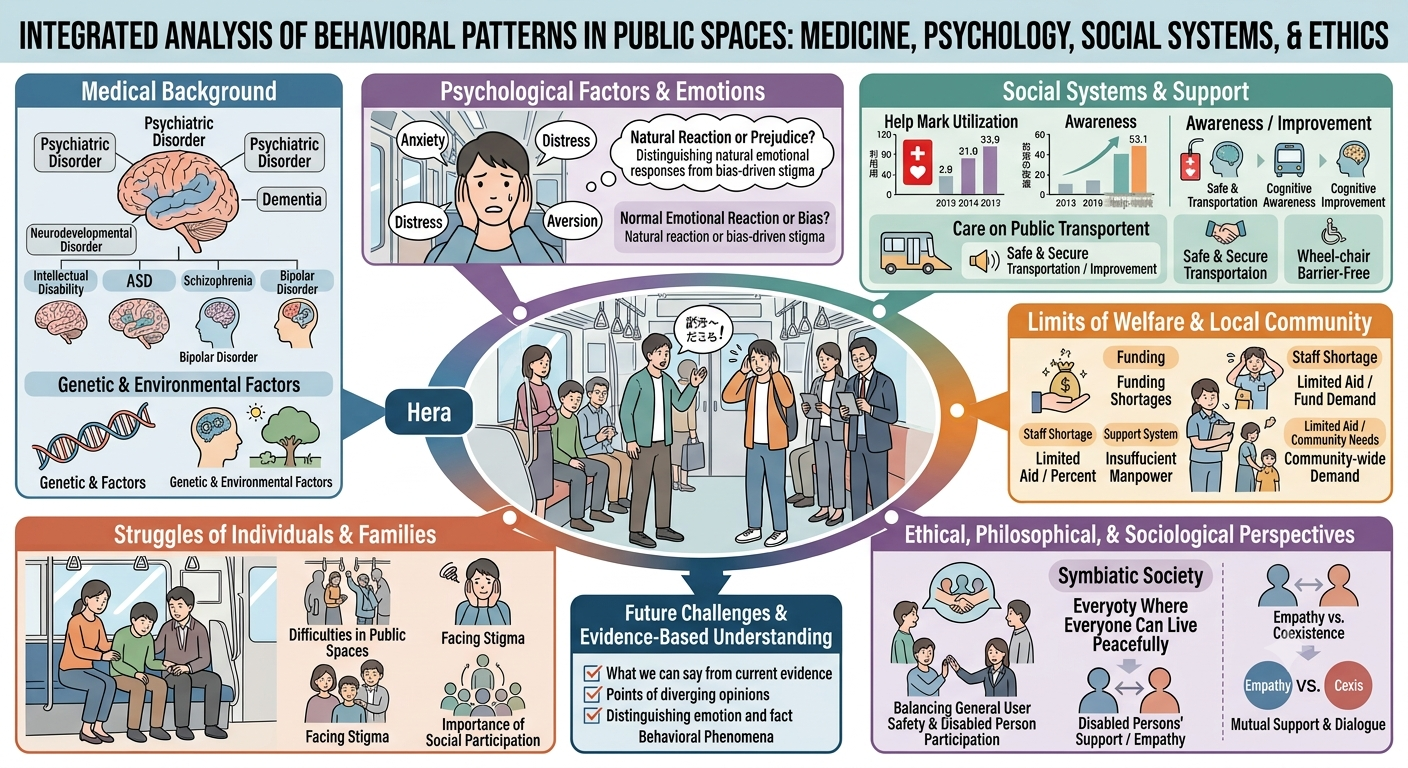
Public transit and city streets are places where strangers of every background, health status, and physical or mental condition share the same space and time. When someone suddenly cries out, talks to themselves, or moves in a way that breaks from expectation, it is entirely natural for other people nearby to feel confused, anxious, or inclined to keep their distance. At the same time, behavior like this is very often rooted in a real medical condition — a mental illness, a developmental disability, an acquired brain injury — and for the person involved, and their family, it is frequently an involuntary symptom or an attempt at self-regulation rather than a choice. This report looks at the medical background of these behaviors, the interplay of genetics and environment in developmental disability, the spread of visibility tools like Japan’s Help Mark, the balance transit operators strike between accommodation and safety, the ongoing debate over the limits of the welfare system, the psychology behind the general public’s reactions, the difficulties faced by affected individuals and their families, and the ethical questions raised by the goal of a public space everyone can use without fear.
The Medical Background of Atypical Public Behavior
Behavior that draws confused looks in public — loud outbursts, talking to oneself, rocking or repetitive movement — is almost never a single diagnosis or a deliberate breach of manners. It arises from a wide range of distinct anatomical, physiological, and psychological mechanisms.
| Condition | Behavior seen in public | Underlying mechanism |
|---|---|---|
| Intellectual disability | Difficulty regulating volume, loud vocalizing, hand-flapping and other repetitive movement | Self-expression and self-stimulation where verbalizing emotion or discomfort is difficult |
| Autism spectrum disorder | Echolalia (talking to oneself), rocking, vocalizing during a panic response | A defense against sensory overload; an attempt to restore internal equilibrium |
| Schizophrenia | Responding to someone who isn’t there, wary or defensive vocalizing | A direct response to auditory hallucination, or defense rooted in persecutory delusion |
| Bipolar disorder (manic episode) | Loud, continuous speech; over-familiar approaches to strangers | Flight of ideas combined with reduced impulse control and social inhibition |
| Dementia | Loud distress when disoriented, out-of-context remarks or behavior | Anxiety from a collapsing sense of place, loss of frontal-lobe inhibition |
| Tourette syndrome | Sudden vocal outbursts, coprolalia (involuntary offensive words) | Involuntary vocalization driven by a premonitory urge, worse in quiet settings |
| Non-pathological causes | Momentary muttering, rough or abrupt vocal behavior | Acute stress, intoxication, exhaustion, dissociative states |
Tourette syndrome in particular tends to worsen in exactly the settings where quiet is expected — a movie theater, a library, public transit — because the premonitory urge intensifies under that pressure, making an involuntary outburst more likely, not less. Suppressing symptoms for a stretch of time in public costs an enormous amount of psychological and physical energy, and once that effort reaches its limit, tics often return with a sharp rebound.
Genes and Environment in Developmental Disability
Current genetics and pediatric neuroscience treat the causes of intellectual disability, autism, and ADHD not as a single factor but as a polygenic threshold model — a complex interaction between genetic predisposition and environment. Autism’s heritability is estimated at roughly 70–80%, but that doesn’t mean a single “autism gene” is passed down; it reflects the cumulative effect of hundreds of small genetic variants scattered across the genome, together shaping how the brain’s developmental networks form. In cases with no family history at all, de novo mutations arising during the formation of sperm or egg cells are often the primary driver — and recent research links these new mutations to paternal age.
| Factor | What it involves | Contribution to risk |
|---|---|---|
| Genetic factors | Cumulative effect of many small variants (SNPs); copy-number variation | High heritability (70–80% for autism). Not a single-gene disorder |
| De novo mutation | New mutations arising during sperm or egg formation; linked to paternal age | The leading cause in cases with no family history |
| Environmental / perinatal factors | In-utero infection, perinatal hypoxia, low birth weight, certain medications | Interacts with genetic predisposition (gene x environment); alters gene expression epigenetically |
| What remains unknown | Epigenetic regulation of gene expression | The search for “missing heritability”; limits on predicting individual behavioral traits |
Intellectual and developmental disability arise from a genuine interaction of complex genetic predisposition, de novo mutation, and perinatal environmental factors — the science does not support attributing them simply to parenting or to genetics alone.
The Help Mark and the Push for Visibility
Tokyo introduced the Help Mark in 2012 as a way for people with disabilities or conditions not visible from the outside to signal that to those around them. Adopted as a Japanese Industrial Standard in 2017, it has since spread to all 47 prefectures, with more than 800,000 marks distributed nationwide. Overall awareness now stands at roughly 47%, though a clear gap remains by region and by age.
| Measure | Figure | Context |
|---|---|---|
| Awareness by region | Greater Tokyo: 55% / Elsewhere: 38% | Reflects greater exposure to in-transit awareness campaigns in major metro areas |
| Awareness by age | Ages 18–29: over 75% / Age 70+: roughly 30% | Younger groups learn largely through digital and social media; older groups are underserved |
| Actual vs. intended use | Currently use: 22% / Would like to use: 49% | Unclear how to obtain one, and self-consciousness about others’ reactions, hold usage back |
Among people who could use the mark but don’t, the most common barriers — beyond simply not knowing how to obtain one — are self-consciousness about how others might react, and a sense that low public awareness would make it pointless anyway.
Balancing Accommodation and Safety in Transit
Transit operators carry two legal duties at once: a duty of care to keep every passenger safe, and — under Japan’s Act for Eliminating Discrimination against Persons with Disabilities — a duty to provide reasonable accommodation. Since the law’s amended version took effect in April 2024, that accommodation duty has shifted, even for private operators, from a best-effort obligation to a binding legal one.
Reading the situation on the ground
Immediately treating a passenger who is speaking loudly or talking to themselves as a “dangerous person” and removing them from the vehicle can itself amount to unlawful discriminatory treatment. On the other hand, if a passenger becomes physically violent toward others, or tampers with an emergency stop button, or otherwise physically obstructs operation, the safety of everyone on board takes precedence, and calling security or police becomes appropriate. For a passenger experiencing sensory overload or a panic response, current best practice favors guiding them to a quieter space, and communicating through writing or simple, brief questions rather than raised voices or physical restraint.
The Limits of the Welfare System
OECD data shows that roughly a third of the world’s total psychiatric hospital beds are located in Japan, reflecting a long history of relying on extended institutional stays for people with mental illness. The government has pushed a policy of shifting care into the community, but the support infrastructure has not kept pace — only 54% of facilities currently offer any community transition support, with the remaining 44% unable to due to a lack of know-how or, more often, a severe staffing shortage.
On the financial side, providing round-the-clock, intensive support to every person who needs it is simply not sustainable within current public budgets. On staffing, chronically low wages and difficult working conditions in the care sector make it extremely hard to recruit and retain the specialized personal-support workers needed for people with significant behavioral needs. There is also a real risk that pushing community transition faster than community infrastructure can support it leaves people without adequate care, isolated on the street, in a cycle that tends to make behavioral symptoms more visible rather than less. And as primary caregivers age — Japan’s so-called “8050 problem,” where aging parents in their 80s are still caring for a dependent child in their 50s — and single-person households become more common, families alone are reaching the physical and emotional limit of what they can manage.
The Psychology of the Bystander’s Reaction
The anxiety, discomfort, or urge to keep one’s distance that arises when someone encounters a sudden outburst or unfamiliar behavior in public is best understood as an adaptive defense mechanism that humans evolved for survival — not, on its own, evidence of prejudice or discrimination. In an enclosed space where physical distance from strangers is minimal, an unpredictable loud sound triggers the amygdala’s detection of a “prediction error,” raising the alarm for a potential physical threat (predictive coding). Evolutionary psychology’s behavioral immune system theory holds that humans evolved to unconsciously notice anything that departs from the norm and to respond with an instinctive aversion, as a way of avoiding possible harm.
| Stage | What it looks like | Relationship to prejudice |
|---|---|---|
| Primary response (automatic, physiological) | A startle, physical tension, moving away, watching closely | A natural act of self-protection — not a basis for moral criticism |
| Secondary cognition (judgment) | Overgeneralizing “disability equals danger,” condemning a whole group | This is where prejudice and stigma actually form — a logical leap toward discrimination |
| Tertiary behavior (institutional exclusion) | Campaigns to bar entry, bad-faith reports, online harassment | Unjust discrimination — a violation of both law and ethics |
The initial, automatic reaction — a normal act of self-protection — is not itself something to feel guilty about. Prejudice and stigma take shape specifically in the next step: when that unexamined discomfort is rationalized into a sweeping judgment about an entire group.
What Affected Individuals and Families Face
Behind the anxiety felt by bystanders, the person exhibiting the behavior — and their family — are often navigating real hardship of their own. Someone with Tourette syndrome, forced to suppress a tic in a quiet train car, endures intense psychological strain that is itself physically painful; suppressing symptoms for too long frequently produces a sharp rebound of tics once they get home. People who experience coprolalia — involuntarily saying something hurtful with no intent behind it — often carry deep guilt and shame that leads them to restrict how often they leave the house at all.
Family members who accompany someone through public space live in a near-constant state of heightened vigilance, sometimes facing cold stares or direct criticism — comments like “you should have raised them better” or “don’t bring them out in public.” Over time, this kind of repeated experience can plant an internalized sense of guilt — a feeling that the family is somehow “bothering” everyone else — accelerating both isolation and emotional exhaustion for the whole family.
Toward a Public Space Everyone Can Use
How to balance the general public’s sense of security against the right of people with disabilities to move freely and participate in public life is a genuine question of modern social philosophy. Applying John Rawls’ “veil of ignorance” — imagining a hypothetical state in which no one knows whether they will be born able-bodied or with a severe disability — a rational chooser would select the social model that guarantees freedom of movement for the most vulnerable. The sociologist Iris Marion Young defined the essence of urban space as “unassimilated togetherness,” arguing that living alongside people whose senses, bodies, and ways of speaking differ from one’s own is not a compromise of public life — it is the very substance of it.
A central shift within disability studies has been the move from a medical model of disability to a social model. Under the social model, it isn’t the sudden outburst or the unusual behavior that constitutes the “problem” — it’s the rigidity of a public space unable to absorb it. The security the general public is entitled to means freedom from actual physical harm; it does not extend to an unlimited right to be free of any subjective discomfort whatsoever.
Conclusion: A Practical Way Forward
The medical and psychological evidence is clear: outbursts, self-talk, and repetitive behavior seen in public are not failures of manners or deliberate provocation — they trace back to well-documented anatomical and physiological mechanisms. What remains genuinely unresolved is where to draw certain lines: how far to expand publicly funded support against constrained budgets, what threshold of behavior should justify institutional intervention, and how to manage the mismatch between the pace of deinstitutionalization and the pace at which community care infrastructure can actually grow.
A practical way to separate feeling from fact
When an instinctive feeling of surprise or unease arises, there’s no need to immediately judge that reaction as discriminatory — moving to a physically safer spot is a healthy act of self-protection in its own right. From there, it helps to separate one’s own subjective discomfort from the objective question of whether the other person is actually attempting physical harm; an involuntary vocal tic or an instance of echolalia is very often, medically speaking, free of any intent to harm, even when it’s genuinely uncomfortable to witness. It’s worth actively resisting the leap from that discomfort to a broader judgment about an entire group of people. And if real harm is occurring, the better response is not to confront the person directly, but to calmly hand the situation to someone with the authority to intervene — station staff, security, or the relevant authorities.
Public space was never meant to guarantee perfect quiet or perfect predictability — it is, by definition, a place where a great many different people, under very different conditions, share the same ground. Building a sustainable, genuinely shared society means neither denying the instinctive, protective feelings of the general public nor losing sight of the medical facts and ethical obligations that call for greater tolerance.
In closing
Atypical behavior in public space is neither simply a “breach of manners” nor simply “prejudice on the part of bystanders.” It emerges where medical fact, gaps in social infrastructure, and ordinary human psychology all intersect. Taking seriously the experience of the person affected, their family, and the bystander alike — without dismissing any of them — is the real first step toward a society where everyone can move through public space without fear.