REGISTRY
Marriage, Household, and Lineage in Japan: A History of the “Ie” System
A history of two distinct concepts — marriage and the household — drawn through legal history, anthropology, psychology, and family sociology.
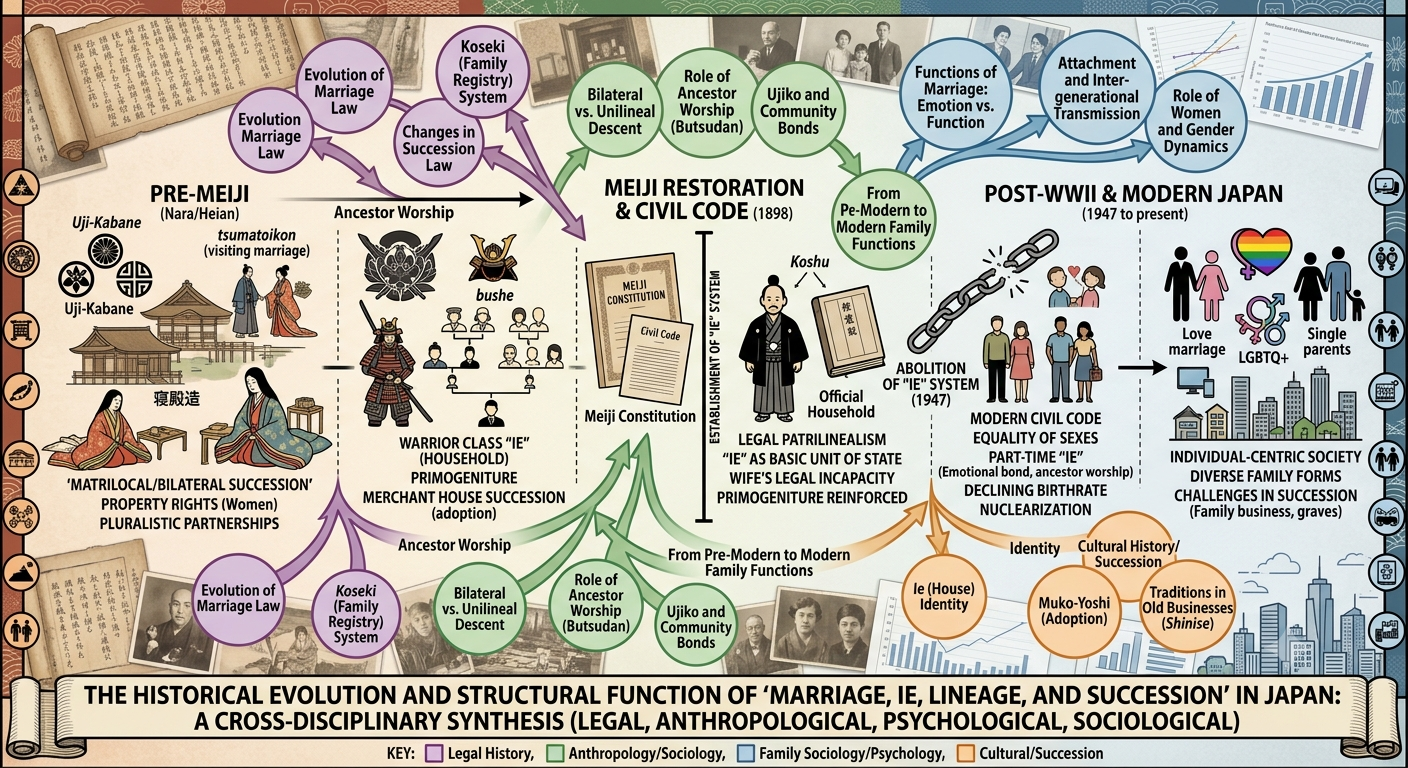
Understanding how family structure and the concept of marriage developed in Japan requires, first, drawing a sharp line between two very different things: the personal, intimate bond between two people, and the legal institution of marriage as defined by the state. The common belief that “Japan’s marriage system began with the Meiji Restoration” conflates these two — and it’s only partially true. What the Meiji government actually did was not invent marriage; it took the diverse regional and status-based marriage customs that already existed and standardized them under a single, centralized modern legal code.
Marriage vs. the Legal Institution: Testing the Meiji Myth
Human bonds can be broken into layers: sexual and romantic partnership; the shared work of reproduction and child-rearing; marriage recognized socially by a community; marriage sanctified religiously; marriage as a legal status conferred by the state; and marriage recorded in an official family registry. “Marriage itself” and “marriage as a state-defined legal institution” need to be kept conceptually distinct. Long before the Meiji era, Japanese society already had extensive marriage and kinship regulation — under the ritsuryō legal codes, under samurai house law governing succession and marriage, and through community-recognized wedding customs among commoners.
| Period | Marriage and kinship practice | Legal / administrative character |
|---|---|---|
| Pre-Meiji (antiquity–Edo) | Visiting marriage, uxorilocal and virilocal marriage; succession tied to status | Layered regulation under ritsuryō law, samurai house codes, and local custom |
| Early Meiji (1870s onward) | 1871 Family Registration Act; 1872 Jinshin Register; separate surnames for spouses | Building a national governance base through universal family registration |
| Meiji Civil Code (1898) | Legal establishment of the ie system; sole inheritance by the eldest son | Full legal codification of a state-sponsored patriarchal model |
Marriage in the Jōmon Period and Antiquity
Jōmon-period kinship structure has to be reconstructed entirely from archaeology and population genetics, since no written record survives. Strontium isotope analysis of ancient skeletal remains suggests a strong likelihood of exogamy — groups deliberately exchanging marriage partners with neighboring communities to avoid inbreeding. The popular claim that “Jōmon people were sexually and romantically unrestrained, with no marriage norms at all” doesn’t hold up; no hunter-gatherer society studied by anthropologists has ever lacked kinship regulation entirely.
As the Yamato court consolidated power through the Kofun period, politically and genealogically defined clans known as uji took shape. Among the elite of the Nara period, the dominant form was tsumadoikon — visiting marriage, where the husband traveled to the wife’s residence. Children were typically raised within the mother’s kin group, giving the system a strongly matrilineal cast — though not a purely matrilineal one, since paternal lineage still mattered; the overall structure was bilineal. Women often continued to live in their natal household after marriage, and daughters held independent inheritance rights to land and property.
The now-familiar model — a married couple sharing one household, sharing one surname, raising children as a fixed nuclear unit — is not an ancient, universal Japanese tradition. It is a specific historical construct, crystallized at a particular (and quite recent) moment.
From Heian Court Society to the Samurai Household
In Heian court society, visiting and uxorilocal marriage remained dominant — a husband would move into his wife’s family home, with her relatives providing the political and financial backing that underwrote, for instance, the Fujiwara clan’s regency politics. Neither the belief that “premodern Japan enforced strict monogamy” nor its opposite, “anyone could sleep with anyone,” holds up to scrutiny; marriage was governed by rigid, status-bound constraints shaped by political calculation.
Once the samurai class took control of society in the medieval period, marriage and inheritance structures changed irreversibly. In the early Kamakura period, women still held some inheritance rights to land, under a system of partible inheritance. But as the Mongol invasions and generational land fragmentation drove families toward poverty, that system gave way, forcibly, to sole inheritance by the eldest son. Marriage shifted in step, moving away from visiting and uxorilocal patterns toward yomeirikon — the wife entering the husband’s household — and women’s economic independence declined sharply as a result.
Family Structure Under Edo-Era Class Divisions
Family structure, marriage, and sexual norms in Edo-period Japan operated on entirely different tracks depending on class — samurai, farmer, or townsperson.
| Class | Primary purpose of marriage | Inheritance | Divorce, remarriage, sexual norms |
|---|---|---|---|
| Samurai | Preserving house name and status; required a lord’s approval | Sole inheritance by eldest son; concubines tolerated | Divorce and remarriage tightly controlled; wife bound to strict fidelity, adultery punished |
| Farmers / townspeople | Continuity of the family trade and labor supply; community-sanctioned | Eldest-son preference, but flexible; adopted sons-in-law common | High divorce and remarriage rates (“dual-income” marriages); pragmatic sexual order |
Among samurai, adultery could carry the death penalty under legal codes such as the Kujikata Osadamegaki. Commoner society, by sharp contrast, ran on remarkably high divorce and remarriage rates — a genuine “nation of divorce and remarriage.” A 1730 record notes flatly that “remarriage is common in society,” and Tosa domain went so far as to legally cap remarriage after seven divorces — evidence that several rounds of divorce and remarriage were simply ordinary. This society ran on meimei-kasegi, where husband and wife each worked independently; women were indispensable productive labor, not merely domestic help.
The claim that “Edo-era Japan was sexually permissive by today’s standards” needs to separate two different things: sexual culture, and the freedom of the family system itself. Practices like mixed bathing or nighttime courtship visits reflect tolerance toward sexual behavior — but breaking community order through an unsanctioned affair still brought harsh sanction, including social ostracism. Sexual permissiveness and marital regulation operated on entirely separate planes.
The Ie: The Household as a Corporate Body
In Japanese history, the ie was never simply a household in the ordinary sense — it functioned as a near-permanent corporate body, meant to persist across past, present, and future generations. It bound together the family name, headship, land and property, the family trade, and ancestor worship into a single, indivisible unit. Within that structure, “preserving and advancing the ie” and “the happiness and free will of its individual members” routinely came into direct conflict — an individual was treated as merely a temporary custodian of a baton being carried from the past into the future.
Eldest-Son Primacy and the Mukoyōshi System
There is no biological instinct, and no ethnic predisposition, behind the entrenched idea that “the eldest son inherits the household.” It’s a socioeconomic adaptation, tied directly to keeping land and assets from being divided. Splitting farmland across heirs generation after generation shrinks each parcel below the point of viability, making tax obligations impossible to meet — so the shogunate and domains actively enforced sole inheritance by the eldest son as policy. Younger sons were treated as a kind of household insurance, expected to be adopted into another family or to leave for the cities as laborers.
The mukoyōshi system evolved specifically to correct for this. An ordinary muko simply marries into the family from outside. A mukoyōshi goes further: he is formally adopted by his wife’s father, gaining the legal status of a son before marrying the daughter — and with it, full inheritance rights equal to a biological eldest son. Elsewhere in East Asia, where clans placed enormous weight on shared surname and patrilineal descent, adopting someone outside the bloodline to continue the family line was generally taboo. Japan’s ie system, by contrast, was strikingly flexible: it prioritized the survival of the household as an institution over bloodline itself. This mechanism — still visible today in old merchant houses, traditional performing arts, and family-run companies — functioned as a genuinely rational way to avoid the risk of handing a business to an unsuited biological heir.
The Meiji Civil Code and the Creation of the Ie System
The 1871 Family Registration Act and the 1872 Jinshin Register severed people from local community identity and organized them, instead, around the household head, as instruments of state governance. An 1876 decree, drawing on samurai custom, actually established separate surnames for husband and wife — “the wife shall bear her natal family’s surname” — meaning marriage did not, at that stage, change a woman’s legal name at all.
It was the 1898 Meiji Civil Code — specifically Article 746, “the household head and family members shall bear the surname of their household” — that redefined the surname not as a marker of individual or bloodline identity, but as the name of a legal institution: the ie. Because a wife entered “her husband’s household” upon marriage and took that household’s name, shared surnames became the automatic legal consequence. The household head held consent power over members’ marriages and residences, and the entirety of the household’s property and status passed, as a rule, to the eldest son alone. The image many now think of as ancient tradition — a husband acting as family head, a couple sharing one surname, the eldest son inheriting the household — is not thousands of years old at all. It is a modern institutional product, created by the Meiji Civil Code and then instilled nationwide through state education.
Monogamy, Jealousy, and Ownership: An Evolutionary View
Cross-cultural anthropological data shows that societies legally or customarily permitting polygyny actually make up the majority worldwide — strict, exclusive monogamy is, if anything, the minority arrangement. Even in societies that permit polygyny, though, most ordinary people end up living in practice as monogamous couples, simply because of the economic cost involved.
Possessiveness and jealousy toward a partner were not created by any particular legal system. They trace back to evolved psychological mechanisms tied to reproductive strategy and parental investment. Male jealousy centers on securing paternity certainty — confidence that one’s genes are actually the ones being passed on. Female jealousy centers on guarding against a partner’s resources — food, protection, financial support — being diverted elsewhere. Legal monogamy and formal punishment for infidelity function, in large part, as social reinforcement mechanisms built on top of these underlying emotions.
The History of “Marriage Equals Love”
The idea that marriage is something two people in love enter into on the strength of emotional connection — the love marriage — is, historically speaking, a very recent invention, one that only took hold with modernity. For most of history, marriage functioned as a structural contract serving several overlapping social and economic purposes at once: securing economic survival and labor, transferring property and status to the next generation, forging political alliances between families, and reproducing the next generation of workers. In Japan, the idea that marriage equals love spread through the Romantic literary movement of the Meiji era, was reinforced by Article 24 of the postwar constitution — which requires marriage to rest solely on the mutual consent of both parties — and became statistically dominant sometime in the 1960s and 70s, the exact period when love marriages first overtook arranged marriages (miai) in frequency.
Deconstructing “Lineage”: Daughters-Only Households
The single concept of “lineage” actually breaks apart into distinct elements: biological descent, legal surname, social house name, family trade or profession, property and assets, and ancestral rites. Here is what happens to each, in practice, in a household with only daughters and no sons.
| Scenario | Biological descent | Legal surname | House name / trade | Structural outcome |
|---|---|---|---|---|
| A. Daughter marries out | Continues (through her line) | Ends (takes husband’s name) | Ends or fades | Bloodline continues, but the surname and house name end (the household is extinguished) |
| B. A mukoyōshi is adopted in | Continues (through her line) | Continues (in the wife’s name) | Continues | Bloodline, surname, house name, trade, and ancestral rites all pass on intact |
| C. Husband takes wife’s surname | Continues (through her line) | Continues (in the wife’s name) | Can continue | Legal surname and house name pass on even without formal adoption |
What this table makes clear is that bloodline passes naturally through a daughter regardless of anyone’s choice, while preserving the surname or the house name and trade requires a deliberate legal or social act. “A bloodline ending” and “a family name ending” are two entirely separate events.
Hereditary Succession in Contemporary Japan
Hereditary patterns are still visible today among doctors, lawyers, politicians, practitioners of traditional performing arts, and family-run businesses — but it’s worth separating legal succession from the inheritance of social and cultural capital. A professional license can never legally be inherited outright; what actually gets passed down is a parent’s financial capital (medical school tuition is substantial), environmental capital (an upbringing suited to the work), and social capital (an existing practice, clinic, or client base). Politicians inherit what’s known in Japanese as the “three bans” — jiban (a support base), kanban (name recognition), and kaban (funding). In kabuki and similar traditional arts, a stage name carries far more than a name — it embodies a trust relationship with loyal patrons, contracts with production houses, and rights to perform particular repertoire, all bundled into a single cultural and economic asset. Training within the family from early childhood has also proven, historically, to be the most efficient way to instill that embodied skill.
A Critical Look at “Family Curse” Narratives
Some folk genealogical readings claim things like “a grandparent’s divorce or infidelity surfaces as trouble for the grandson who becomes eldest son” or “the eldest son always carries the heaviest debt from a family’s past wrongs.” These claims can be examined critically through psychology, family sociology, and epigenetics.
| The claim | What the evidence actually shows |
|---|---|
| A grandparent’s infidelity or divorce lowers a grandchild’s fortune | Intergenerational transmission of attachment — a documented mechanism where a degraded early caregiving environment produces real relational difficulty later |
| Trouble and misfortune concentrate on the eldest son | Family systems theory: excessive role expectation and pressure tied to “being the eldest,” producing what’s known as an identified patient |
| The same family problems repeat across generations | Intergenerational trauma and epigenetics — though the science is clear this is not permanent; adult intervention and a changed environment can reverse it |
The “family curse” narrative, on this evidence, is best understood as folk reasoning: a way of substituting a simple, premodern idea — ancestral wrath — for what is actually a complex psychological and social-structural problem. And when abuse, coercive control, or other harmful patterns genuinely do repeat across generations, deliberately breaking that cycle in a given generation carries higher ethical weight than preserving the family name — because it protects the dignity and wellbeing of the people actually living now.
Conclusion: Answers to the Core Questions
Marriage was never a single concept. It’s a multifunctional social institution encompassing biological reproduction, shared economic life, the transfer of social status and property, and emotional attachment. Since modernity, its dominant function has shifted toward being a partnership grounded in personal feeling and individual choice.
The ie was never simply a cluster of blood relatives — it was a social and economic corporate body, created to defend and manage property, land, trade, and status across generations under harsh material conditions.
Not biological instinct or ethnicity — a structural adaptation formed in medieval and early-modern samurai and farming society to prevent land and business from fragmenting into ruin through divided inheritance, later maximized nationwide through the Meiji Civil Code.
Before Meiji, family and marriage practice varied widely and shifted fluidly by class and region. After Meiji, the family registry system and the Civil Code imposed a single, legally uniform patriarchal ie model — household-head authority, sole inheritance by the eldest son, shared surnames. The ie system was abolished under the postwar Civil Code.
Not quite. Possessiveness toward a partner is rooted in evolved psychology — securing paternity certainty, guarding against resource loss — and legal monogamy functions as a social mechanism built to stabilize those underlying emotions and property arrangements, not as their sole cause.
It breaks into several independent strands: passing on bloodline, passing on the surname and house name, passing on property and trade, and carrying forward ritual and cultural tradition.
The ie was a human-made structure, built to meet the demands of a particular social system — not an untouchable universal truth. Read against Article 24 of Japan’s constitution and contemporary ethics, the wellbeing, rights, and dignity of the people actually living should take priority over the abstraction of “preserving the lineage.”
In closing
Neither the ie nor the rule that “the eldest son inherits” was some timeless Japanese truth. Both were thoroughly artificial systems, built by people to adapt to the land laws, tax structures, and status hierarchies of a particular era. Passing on bloodline, and passing on a surname or a trade, were always separate matters — the flexibility of the mukoyōshi system proves as much. Tracing this history is, in the end, a way of naming exactly what kind of pressure “you must preserve the family line” really is — and of choosing, deliberately, where the dignity of the people actually alive today ought to sit.