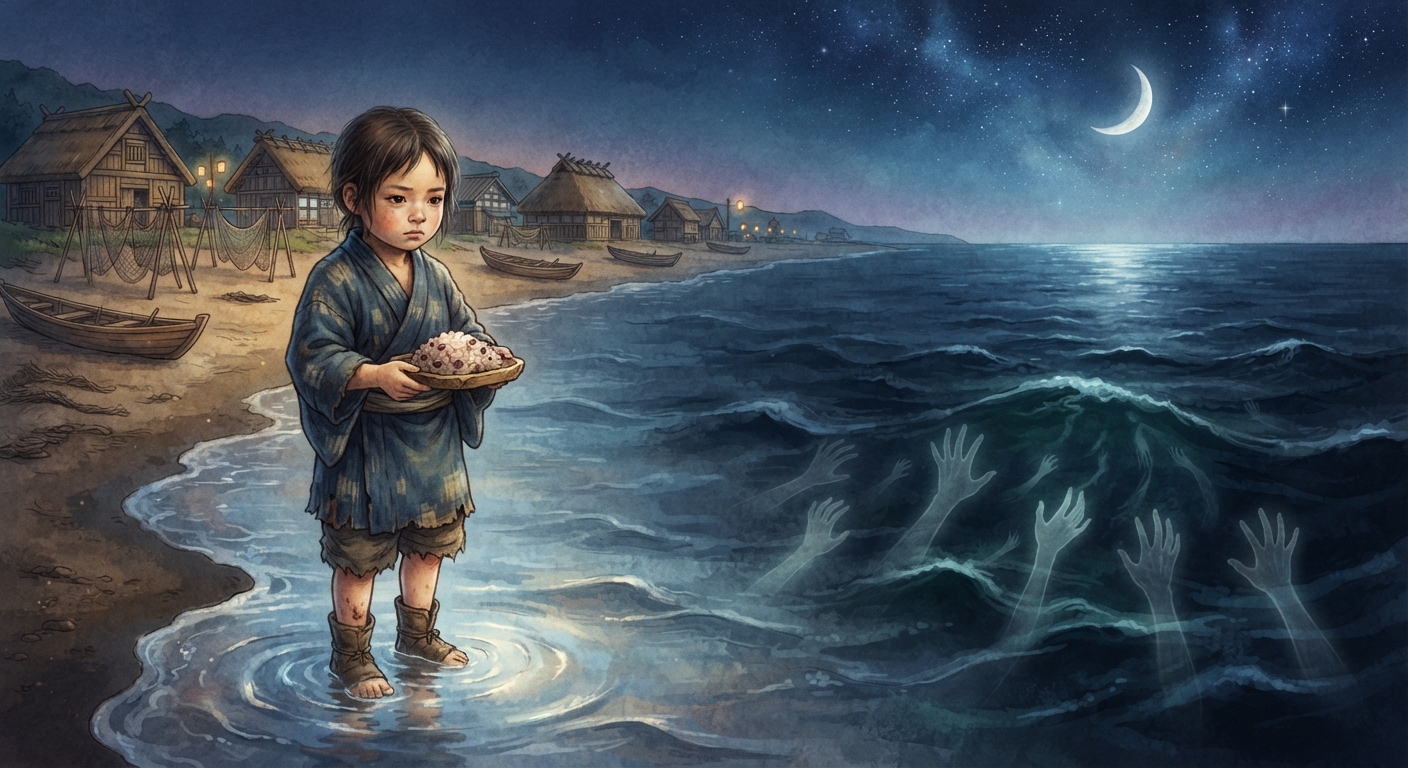
Obon and the Water’s Edge: A Hokkaido Field Investigation
Did people in Hokkaido really believe that entering the water during Obon meant a spirit would pull you under by the ankle? Here is what an online investigation can establish as fact, inference, or genuinely unknown — sorted the way water separates by clarity.
This investigation is based on an online survey of publicly available web sources, government materials, news reporting, and academic information. For many points, the primary text of municipal histories and local folklore compendiums (print-only or non-digitized materials) could not be directly consulted. Given that limitation, each section below explicitly separates “what could be confirmed as fact,” “inference drawn from that,” and “what remains unconfirmed.”
Conclusion, Stated Up Front
There is no broad evidence that the legend “entering the water during Obon means a spirit will pull you under” existed as a traditional folk belief across Hokkaido. What the investigation was able to confirm comes down to three points.
- Materials published by the Hokkaido Regional Agricultural Administration Office (a division of Japan’s Ministry of Agriculture, Forestry and Fisheries) confirm that a custom called “Nanokabi” (also “Nanuka Bon” or “seventh-day Bon”), observed on July 7th — or August 7th in areas that keep Obon a month later — did in fact exist, at least historically: children would bathe in the sea near their village, following the saying “enter the sea seven times, eat sticky rice seven times.” This is not a prohibition on entering water during Obon — it is, if anything, the opposite: a custom of entering water at the very start of Obon.
- As for the legend that entering the sea during Obon (particularly after Obon has passed) causes a spirit to pull you under, exactly one case could be confirmed: a personal blog post by someone from the Shakotan area (Shiribeshi Subprefecture), recalling a grandmother’s warning that “the gates of hell open during Obon and the dead will pull you under by the leg.” This is a personal testimony, not an academic source, and cannot be treated as a primary document establishing a specific region or era.
- Hokkaido’s beaches are, for structural reasons, mostly closed by mid-to-late August anyway (owing to slow-warming water and a short summer). This means the norm “don’t go in the water after Obon” may not function, as it does in mainland Japan, as a cultural taboo imposed during a period when swimming was still physically possible — it may instead simply coincide with the period when swimming season was ending regardless.
Confirming a stronger conclusion — that the legend definitely did or did not exist — would require direct examination of municipal histories and local folklore archives.
Obon and Water Nationwide: An Overview
2-1 The “don’t enter the water during Obon” legend
This type of legend appears widely across lifestyle websites, columns published by funeral service companies, personal blogs, and Yahoo! News Expert articles, generally presented as a nationwide belief. The forbidden day is usually described as sometime during Obon, especially “the last day of Obon” or “just after Obon”; the forbidden act is swimming in the sea or a river; and the entity said to pull you under varies by article — “a spirit,” “the dead,” “unclaimed spirits with no living relatives,” “buddhas,” “something that has emerged from hell,” “a sea monk (umibōzu).”
Nearly all of these articles are general-audience columns from funeral industry sites or lifestyle media, not academic folklore research. The word “nationwide” is frequently used without citing region-specific sources, and it is impossible to determine, from these articles alone, whether this represents a single tradition with one common origin, or whether similar stories arose independently in different regions.
2-2 An academically supported adjacent concept: Nanuka Bon / Nanokabi
According to an academic source (an entry by Sen’ichi Tanaka in the encyclopedia Sekai Daihyakka Jiten, confirmed via Kotobank), “Nanuka Bon” (also Nanokabi) treats July 7th (Tanabata) as part of Obon, and is observed nationwide as a day of preparation for welcoming ancestral spirits. The source states explicitly that “Nanuka Bon is frequently associated with traditions of ritual purification through water.”
What is academically supported is not “don’t enter water during Obon,” but rather “purify the body with water at the start of Obon” — a purification-type (misogi) custom. These two practices — avoiding water, versus entering water to be purified — likely belong to two different phases of the season, and are probably not a simple contradiction (see Section 9).
What Could Be Confirmed in Hokkaido
3-1 An official source: the Hokkaido Regional Agricultural Administration Office
“The 7th marks the start of Obon; households clean graves in preparation for welcoming ancestral spirits. This day is called Nanokabi, and tradition held that one should ‘enter the sea seven times and eat sticky rice seven times’ — children would bathe at the shore near their village, snacking on okowa (sticky red-bean rice) throughout the day.” (Summarized and quoted from “Events and Food, July to August,” Hokkaido Regional Agricultural Administration Office.) This is a reasonably solid primary government source, confirming that a custom of children bathing in the sea genuinely existed as recorded tradition in Hokkaido. Source: maff.go.jp/hokkaido
The document does not specify which region of Hokkaido (southern, central, or eastern) this description is drawn from, and its use of past-tense reported speech (“tradition held that,” “they would spend the day”) leaves the era unspecified as well. Contextually, it likely describes a custom practiced more broadly sometime between the prewar period and the mid-Showa era, retrospectively — but this remains an inference, not confirmed fact.
3-2 A personal account from Shakotan (Shiribeshi Subprefecture)
A blog post by someone who grew up in “a small fishing village in Shakotan, Hokkaido” recalls being told, as a child, by their grandmother: “During Obon the gates of hell open, and the dead will pull you under by the leg, so don’t go to the sea.” This is a concrete testimony showing that a legend matching the “pulled under during Obon” pattern was genuinely told as a family tradition somewhere in Hokkaido (at least in the Shiribeshi/Shakotan area) — but it is a personal memoir, not academic research, and this single case cannot be generalized into “an established Hokkaido-wide folk belief.” Source: fromnorth.net (personal blog)
3-3 Regional variation in timing
Some areas of southern Hokkaido, including Hakodate, observe Obon in July, closer to the lunar calendar, while most of the rest of the region observes it a month later, around August 13–16 (source: hokkaido-gatewaytours.com). This timing difference could plausibly affect when any water-avoidance taboo was thought to apply, but no source directly confirming that connection could be found.
No primary source at the level of a municipal history or local folklore archive could be reached, within this investigation’s online search, regarding the “don’t enter the water during Obon” tradition in Hokkaido specifically. This is not proof that such a tradition doesn’t exist — only that an online search alone could not confirm it.
Nanokabi and Sea Bathing
Nanuka Bon (Nanokabi, or Nanukabon, depending on region) treats July 7th (Tanabata) as the day preparations for Obon begin, involving grave-cleaning and setting up an altar to welcome spirits. It is generally called “Nanukabi” in the Tohoku and Chugoku regions, and “Nanukabon” in the Kinki region and elsewhere.
Several folklore explainer sites cite formulaic sayings of the type: “bow to your parents seven times, bathe in the sea seven times”; “eat rice seven times, bathe in the sea seven times”; “eat hōtō noodles seven times and swim seven times, and you won’t fall ill.” The Hokkaido agricultural office’s phrase — “enter the sea seven times, eat okowa seven times” — closely matches this nationwide pattern, suggesting the Hokkaido tradition is likely a regional variant of Nanuka Bon customs carried in from Tohoku or Hokuriku (see Section 6).
The Kotobank entry on Nanuka Bon states plainly that “Nanuka Bon is frequently associated with traditions of ritual purification through water.” Tanabata-related festivals such as the Aomori Nebuta and Akita Kantō are said to share the same underlying idea — washing away impurity and drowsiness with water. The bathing custom within Hokkaido’s Nanokabi likely carried, historically, a genuinely religious and ceremonial meaning — purifying body and mind before welcoming ancestral spirits — rather than functioning simply as summer recreation.
Nanuka Bon / Nanukabi is not a custom unique to Hokkaido — it is observed nationwide, particularly in the Tohoku and Chugoku regions. Under the old lunar calendar, Tanabata and Obon proper (around the 15th) were separated by barely a week, positioning Tanabata as a functional “entrance” to Obon.
Who, or What, Pulls You Under?
Sorting through the nationwide articles found in this investigation, the entity said to pull people underwater varies considerably.
| Entity | Example sources |
|---|---|
| A spirit / an unliberated soul | Chiisana Osoushiki column, senkojisanso.com, etc. |
| Something emerged from hell (demons, hell’s cauldron opening) | senkojisanso.com, bousai-base.com, etc. |
| Unclaimed spirits / ancestral spirits | generalmerchandises.com, etc. |
| Umibōzu (a sea monk yōkai) | generalmerchandises.com |
None of these are primary academic sources — all are at the level of lifestyle media or personal blogs. No primary source explicitly naming kappa as the entity that pulls people under during Obon could be found in this investigation (kappa are generally associated with river hazards, but no direct reference in this specific Obon context turned up).
The single concrete testimony found for Hokkaido (Shakotan) describes “the gates of hell opening, and the dead pulling you under.” This matches one of the nationwide patterns; no distinctly Hokkaido-specific entity (a local yōkai, or an Ainu-derived water spirit, for example) turned up. This single testimony is not sufficient grounds to conclude that Hokkaido had its own developed system of “entities that pull you under.”
Relation to Hokkaido’s Settlement History
Public records from the Historical Village of Hokkaido (a public interest foundation) show that, among households that migrated to Hokkaido between 1882 and 1935, the largest number came from Aomori Prefecture (roughly 68,900 households), followed by Akita (roughly 64,000) and Niigata (roughly 61,600) — with settlers from the Tohoku and Hokuriku regions together accounting for more than 67% of the total. Source: kaitaku.or.jp
Nanuka Bon / Nanukabi is precisely the kind of custom that was especially deeply rooted in Tohoku and Hokuriku. It is a reasonable inference, then, that the Nanokabi tradition confirmed in Hokkaido was carried over by settlers from those regions as part of their home Obon customs. Records show that Hokkaido settlers formed villages organized by hometown, and even kept their regional Obon dance songs and festivals separate — settlers from Yamaguchi performed the Chōshū Ondo, while those from Tottori performed the Inaba Odori, in separate observances.
No source directly tracing the specific transmission path of Hokkaido’s Nanokabi — which prefecture, which village, when, or through whom — could be found in this investigation. And regarding the “don’t enter the water” taboo specifically, no primary source confirming a similar tradition in Tohoku or Hokuriku could be located either, so whether this taboo was carried over from mainland Japan, or arose independently in Hokkaido after settlement, cannot currently be determined.
Relation to Ainu Culture
Ainu culture holds a rich body of kamuy (spirit/deity) beliefs concerning water and rivers. Kamuikotan, on the middle reaches of the Ishikari River, is a treacherous stretch of rapids and boulders that Ainu communities attributed to a “nitne kamuy” (malevolent spirit), and safety rituals are still performed there today (source: Agency for Cultural Affairs, Japan Heritage portal). In the Hidaka region, a tradition (oyna, an ancient narrative) describes a river flood as a battle between a giant amemasu fish and Ainu-rak-kur, a culture hero — analyzed as reflecting genuine memory of a major historical natural disaster (source: research report by Tetsuyuki Minami, Graduate School of Agriculture, Hokkaido University).
Obon is a custom rooted in Buddhism and Wajin (ethnic Japanese) folk religion, and does not originally exist within traditional Ainu belief systems. Within the range of sources examined in this investigation, no primary source shows a direct contact or fusion between the Wajin custom of Obon and Ainu kamuy beliefs about water and rivers. The conclusion “Hokkaido’s water-related taboos originate in Ainu culture” cannot be supported. It is possible to note that both traditions independently held a similar worldview — that water’s edge is dangerous and governed by forces beyond human control — but that observation is not evidence of cultural contact; it is simply a parallel.
Natural Conditions and Drowning Statistics
8-1 The structurally short swimming season
Hokkaido’s beaches, owing to slow-warming water and a short summer, generally open in late June to mid-July and close (umi-jime) between mid- and late August (source: Hokkaido Government Sports Promotion Division, among others). Almost nowhere in Hokkaido stays open for swimming into September the way parts of mainland Japan do.
On the mainland, the warning “don’t go in the water after Obon” carries real weight because the water often remains physically swimmable well after Obon passes. In Hokkaido, by contrast, Obon (roughly August 13–16) already falls right around the tail end of the swimming season. A cultural taboo against swimming after Obon may simply never have needed the same force in Hokkaido, since the beaches themselves were already, structurally, closing for the season regardless.
8-2 Testing this against drowning statistics
At the national level, National Police Agency statistics reportedly show 241 drowning deaths or disappearances during the summer months (July–August) of 2025, roughly 30% of the annual total. This confirms that drownings rise during summer generally — it does not directly demonstrate a statistical spike specific to Obon itself. No primary statistical source specific to Hokkaido drowning incidents around the Obon period could be located in this investigation. One specific incident is on record, however: in August 2025, an extratropical cyclone that had formed from a typhoon caused multiple simultaneous incidents of swimmers being swept out at several beaches in Ishikari City.
8-3 Could folklore have functioned as practical safety knowledge?
Multiple articles consistently suggest that genuine deterioration in sea conditions around Obon — rip currents, the rough “doyō-nami” swells, jellyfish blooms — may have been passed down, in folk memory, in the form of the “pulled under by a spirit” legend. These, however, remain popular folk interpretations, and no primary source verifying this interpretation itself could be found in this investigation.
Why “Enter” and “Don’t Enter” Can Both Be True
This is the single most important point in this whole investigation. The short answer: introducing a timeline resolves the apparent contradiction entirely.
| Timing | Phase | Meaning of water |
|---|---|---|
| Tanabata / Nanuka Bon (July 7, or August 7 a month later) | Obon’s “entrance” — preparing to welcome ancestral spirits | Bathing and purification, cleansing body and mind (water as an ally in purification) |
| Obon proper (roughly the 13th–16th) | The period spirits are believed to be present | Avoided as recreation inappropriate to a time meant for honoring ancestors |
| Obon’s close (okuri-bon, around the 16th) | Sending spirits back | The “pulled under by a spirit” warning is emphasized most strongly here |
“Entering the water” belongs to Obon’s entrance; “don’t enter the water” belongs to Obon’s middle and end. Both practices concern the same water, but appear to answer to two different phases of one continuous ritual sequence. No primary academic source explicitly stating this integrated reading could be located, however — this is presented as an inference drawn from multiple confirmed facts, not as an established scholarly conclusion.
For Hokkaido specifically, only the “entrance” portion of this structure — the Nanokabi bathing custom — could be confirmed. No source of comparable reliability beyond the single Shakotan testimony could be found for the “middle-to-end” portion. Whether this nationwide structure genuinely existed intact in Hokkaido therefore remains, accurately speaking, insufficiently confirmed at this time.
Final Conclusion — Sorting Fact, Interpretation, and the Unconfirmed
- A record confirming that, on Nanokabi (Nanuka Bon), children in Hokkaido bathed in the sea seven times, at least at some point in the past, is documented in materials from the Hokkaido Regional Agricultural Administration Office.
- Nanuka Bon / Nanukabi is not unique to Hokkaido — it is observed nationwide, especially in Tohoku and Chugoku, and its association with ritual purification through water is academically supported.
- More than 67% of Hokkaido’s settlers came from Tohoku and Hokuriku, and records confirm settlers carried customs from their hometowns — including Obon dances and festivals — with them.
- Hokkaido’s beaches are structurally prone to closing in mid-to-late August, which largely coincides with the end of the Obon season.
- Ainu culture holds its own distinct reverence for water and rivers (kamuy belief), but no evidence confirms this fused directly with the Wajin custom of Obon.
- One personal testimony, from someone raised in Shakotan (Shiribeshi Subprefecture), confirms a family tradition of being warned that “the gates of hell open during Obon and the dead pull you under.”
- Hokkaido’s Nanokabi was likely carried over by settlers from Tohoku and Hokuriku.
- Purifying oneself with water at Obon’s start, and avoiding water at Obon’s end, likely represent two non-contradictory phases of a single continuous ritual sequence.
- Because Hokkaido’s swimming season structurally ends around Obon anyway, a cultural taboo against swimming “after Obon” may never have needed to stand out as sharply as it does on the mainland.
- The “pulled under by a spirit” legend may be a folk restatement of genuine seasonal hazards — rip currents, rough swells — a claim repeated across several popular explainer articles, though no primary source verifies it directly.
- Which regions of Hokkaido told this legend, from what era, and how widely, could not be pinned down within the scope of this online investigation.
- Whether this taboo was carried over from the mainland (particularly Tohoku or Hokuriku) or arose independently in Hokkaido after settlement cannot currently be determined.
- Whether any distinctly Hokkaido-specific entity, beyond spirits or buddhas generally, was imagined as “the thing that pulls you under” could not be confirmed.
- When this legend first appears in the documentary or local-history record in Hokkaido — Meiji, Taishō, or Shōwa era — could not be established in this investigation.
A more definitive investigation would require direct access to the Hokkaido Prefectural Library’s local history holdings, materials held by the Hokkaido Museum and regional folklore museums, specialized works such as Shin Hokkaidō-shi and the Hokkaido Folklore Survey Report, and the folklore chapters of individual municipal histories. None of these could be reached in full text through this round of online research, and they are flagged here as a clear direction for future investigation.
- Hokkaido Regional Agricultural Administration Office, “Events and Food, July to August” maff.go.jp/hokkaido
- Kotobank, “Nanuka Bon” (entry by Sen’ichi Tanaka) kotobank.jp
- bonodori.net, “The World of Bon Odori,” 5. The Start of Obon bonodori.net
- worldfolksong.com, “Nanuka Bon and Its Relation to Tanabata” worldfolksong.com
- linderabell.com, “Nanuka Bon” linderabell.com
- Historical Village of Hokkaido, “Hokkaido’s Settlement and Immigrants” kaitaku.or.jp
- heigun.jp, “Hokkaido Immigrants” heigun.jp
- Agency for Cultural Affairs, Japan Heritage Portal, “The Kamikawa Ainu, Living With Kamuy” japan-heritage.bunka.go.jp
- Hokkaido Development Bureau, Tokachi River materials, Ch. 3, “Tokachi’s Ainu Culture and the River” hkd.mlit.go.jp (PDF)
- Tetsuyuki Minami, Graduate School of Agriculture, Hokkaido University, “Verifying Large-Scale Disasters Recorded in Ainu Oral Tradition” hkk.or.jp (PDF)
- Hokkaido Government, Environmental and Lifestyle Department, Sports Promotion Division, “On the Opening of Beaches” pref.hokkaido.lg.jp
- fromnorth.net, “Does the Obon Sea Really Pull You Under? A 40-Year Surfer’s Perspective” (personal blog) fromnorth.net
- hokkaido-gatewaytours.com, “Hokkaido’s Obon Customs Vary Slightly by Region in Timing and Practice” hokkaido-gatewaytours.com
- National Diet Library Research Navi, “Selected Folklore Materials, Vol. 32 (Obon Customs 5: Yamagata and Niigata Prefectures)” rnavi.ndl.go.jp
- Various Yahoo! News Expert articles (drowning statistics and Hokkaido incident reports)