Consciousness & Cosmogenesis
The Universe and Humanity:
Tracing the Spiral of Conscious Evolution
From matter to life, from life to thought — is the universe still evolving toward an ever-higher vantage point? At the crossroads of theology, developmental psychology, neuroscience, and anthropology, this piece examines that vast question.
SCROLL — descend the spiral
The hypothesis that the universe and humanity are evolving toward greater harmony and an ever-higher vantage point has recurred, in various guises, throughout the history of ideas. This piece examines that hypothesis systematically, drawing on theology, cosmology, developmental psychology, neuroscience, and anthropology.
Chapter One
- A Lineage of Kindred Ideas
- Beyond Good and Evil — A View from Comparative Religion
- A Vantage Point in the Brain — The Neuroscience of Metacognition and Self-Transcendence
- Does It Evolve, or Doesn’t It? — A Clash of Theories
- Does the Universe Have a Purpose? — Perspectives from Modern Physics and Biology
- Three Layers of the Hypothesis — The Boundary Between Science, Philosophy, and Faith
A Lineage of Kindred Ideas
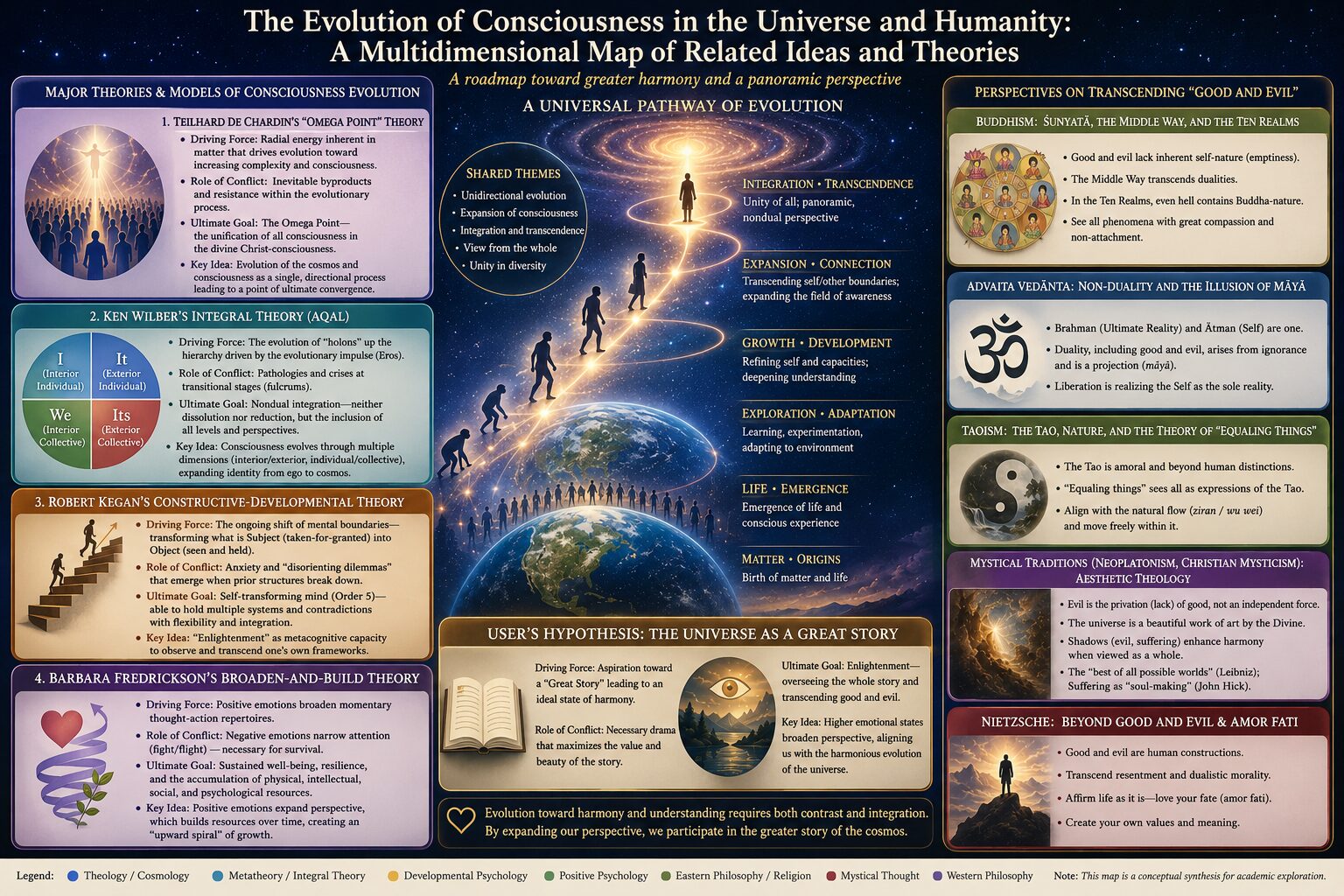
Four systematic approaches that treat the universe not as a mere collection of matter, but as a dynamic, teleological process — cosmogenesis.
Omega Point Theory
Pierre Teilhard de Chardin
The universe passes through four stages — pre-life, life, thought, and super-life — converging on the “Omega Point,” an ultimate convergence beyond time and space. Teilhard proposed a “law of complexity-consciousness”: the more complex matter becomes, the more its interior consciousness deepens.
Integral Theory (AQAL)
Ken Wilber
Describes the hierarchical development of “holons” — wholes that are simultaneously parts. Wilber rigorously distinguishes stable developmental stages (“growth”) from temporary peak experiences (“awakening”), warning against conflating the two in what he calls the “pre/trans fallacy.”
Constructive-Developmental Theory
Robert Kegan
Growth is the process of converting what one is fused with and cannot see objectively (subject) into something one can step back from, observe, and manage (object). At its highest stage, the “self-transforming mind,” one can even objectify the ideology one stands on.
Broaden-and-Build Theory
Barbara Fredrickson
Positive emotions such as joy and awe momentarily “broaden” one’s repertoire of thought and action, and the accumulated experience “builds” durable resources — generating an upward spiral of growth.
| Theory | Driving force | Role of conflict/chaos | End state |
|---|---|---|---|
| Omega Point Theory | Radial energy inherent in matter | An inevitable byproduct of evolution | Consciousness united in the love of Christ |
| Integral Theory | The developmental impulse of holons ascending toward the whole | Pathology arising during transitions between stages | Non-dual consciousness integrating subject and object |
| Constructive-Developmental Theory | Continuous conversion from subject to object | Disorientation as cognitive structures dismantle | Self-transforming mind that integrates multiple value systems |
| Broaden-and-Build Theory | Attentional broadening driven by positive emotion | Emotions that narrow attention for survival | Sustained resilience and an upward spiral of growth |
Chapter Two
Beyond Good and Evil — A View from Comparative Religion
Rather than denying conflict, the concept of “transcendence” — surveying conflict from a higher vantage point that encompasses it — has been refined with different logics across traditions.
Buddhism — Emptiness and the Middle Way
Nagarjuna, Dogen, Tiantai
Good and evil are relational appearances without fixed substance (emptiness). The doctrine of the “mutual possession of the ten worlds,” which holds that Buddhahood is present even within the hell realm, teaches a standpoint that lets go of the discriminating mind bound to judgments of good and evil, surveying the whole of dependent origination through great compassion.
Advaita Vedanta
Non-dualism
Brahman and Atman are non-dually identical (Brahman-Atman unity), and the duality of good and evil is merely an illusion (maya) born of fundamental ignorance. One who attains liberation calmly beholds the entire phenomenal world as their own activity.
Daoism — The Equality of All Things
Zhuangzi, Laozi
The Dao is indifferent to human concerns. Zhuangzi relativized human-centered moral standards and taught “free and easy wandering” — a playful state of surrendering to the universe’s cycles without imposing one’s will.
Aesthetic Theodicy
Augustine, Leibniz
Evil is not an independent force but the “privation of good.” Viewing the universe as a single beautiful painting, its dark shadows become indispensable elements that complete the overall harmony.
Amor Fati
Friedrich Nietzsche
Facing the harsh reality of an eternally repeating universe (eternal recurrence), Nietzsche proposed loving the world exactly as it is, pain and chaos included. In contrast to Buddhist stillness, this is a form of transcendence that joyfully embraces struggle and becoming.
| Tradition | Substantiality of good/evil | Character of transcendence | Signature concept |
|---|---|---|---|
| Buddhism | An illusion arising through interdependence | Static, contemplative | Mutual possession of the ten worlds, non-discriminating wisdom |
| Advaita | An illusion created by ignorance | Static, absolute non-dualism | Brahman-Atman unity, moksha |
| Daoism | A boundary drawn by human-centered ego | Dynamic, fluid | Equality of all things, wu wei |
| Mystical thought | Evil as the absence of good | Static, ordered harmony | Aesthetic theodicy, cultivation of the soul |
| Nietzsche | A socially fabricated slave morality | Dynamic, life-affirming | Amor fati, will to power |
Chapter Three
A Vantage Point in the Brain — The Neuroscience of Metacognition and Self-Transcendence
The mechanisms behind the higher state of consciousness in which one observes the self and the world as a whole from a step back are gradually being uncovered by neuroscience.
This large-scale brain network, known as the “default mode network” (DMN), is the infrastructure of the “narrative self,” comprising the medial prefrontal cortex (self-referential thought), the posterior cingulate cortex and precuneus (integration of autobiographical memory), and the angular gyrus (maintaining the boundary between self and other). Lesion-mapping studies of brain-injury patients have found that those with damage to this posterior midline region show a significant increase in self-transcendence scores after their injury. The posterior hub of the DMN normally functions as a boundary suppressing self-transcendent states of consciousness; when its function declines, the sense of connection to nature, to others, or to a transcendent universe is thought to be released.
Mindfulness meditation deactivates the DMN, while non-directive practices such as Transcendental Meditation bring about a high degree of coherence across the whole brain while maintaining the DMN. Psychedelics such as psilocybin and LSD, acting through serotonin receptors, dramatically dismantle DMN synchrony and trigger global communication between brain regions that are normally segregated. Subjectively this is experienced as an “ego dissolution,” and it has been applied, for instance, to ease terminally ill cancer patients’ fear of death.
Chapter Four
Does It Evolve, or Doesn’t It? — A Clash of Theories
Around the narrative that “human consciousness has progressed, through history, toward greater abstraction and empathic perspective,” a positivist approach and a critical approach that dismantles it are sharply opposed.
Theories supporting progress in consciousness
Steven Pinker
Across several millennia of human history, death rates from physical violence such as war and torture have declined exponentially. Pinker attributes this to the rise of the state and the spread of Enlightenment thought, which expanded humanity’s circles of empathy.
Spiral Dynamics / Ken Wilber
As social infrastructure and technology advance, society’s average level of consciousness traces a trajectory of co-evolution — from survival, through magic and myth, to rational, pluralistic, and integral stages.
Theories rejecting linear progress
David Graeber / David Wengrow
Early humans exercised a sophisticated political intelligence, consciously moving between centralized authority and anarchy according to the season. Human history, they argue, is not a story of progress but one in which basic social freedoms — to migrate, to disobey, to redesign one’s institutions — were stripped away as people became locked into rigid systems.
Claude Lévi-Strauss
The kinship systems and mythologies of “primitive” societies are variations on structures every bit as complex and symmetrical as modern analysis. Human intelligence is not a vertical ascent but a repeated, horizontal maintenance of diversity within a limited set of combinations.
| Axis | Proponents | Critics |
|---|---|---|
| View of history | Vertical, stage-based development | Horizontal variation on diversity |
| History of violence | Declining through the refinement of reason | Freedom suppressed by violent infrastructure |
| Mechanism of change | Co-evolution of technology and inner structure | Local environmental adaptation and contingent power |
Chapter Five
Does the Universe Have a Purpose? — Perspectives from Modern Physics and Biology
Teleology — the view that the universe itself has direction or intention — was once banished by modern science, but is being reassessed from different mechanistic angles.
Anthropic Principle
Regarding the fact that the universe’s physical constants are finely tuned to permit life, the weak anthropic principle explains this as a selection effect, the strong anthropic principle as the universe’s purpose, and the participatory anthropic principle as reality being fixed through the act of observation.
Teleonomy
Jacques Monod argued that the seemingly purposeful behavior of living things is not drawn by any future goal, but is the retrospective result of natural selection acting on chance replication errors. He denied any transcendent direction in the universe or in evolution.
Dissipative Structures
Ilya Prigogine showed that in open systems far from thermodynamic equilibrium, spontaneous order can emerge once amplified fluctuations cross a critical threshold. The universe possesses a latent capacity for repeated, local self-organization.
Chapter Six
Three Layers of the Hypothesis — The Boundary Between Science, Philosophy, and Faith
Unpacking the hypothesis that “the universe is evolving toward a utopia” reveals three layers of differing certainty. The closer to the ground, the stronger the empirical support; the higher one climbs, the closer one comes to faith.
Heightened emotion broadens one’s vantage point
The phenomenon whereby positive emotions like joy and awe genuinely broaden one’s repertoire of attention and thought is substantiated by Fredrickson’s broaden-and-build theory and by neuroscience research on DMN decoupling.
Basis: broaden-and-build theory, DMN deactivation studies
Enlightenment beyond good and evil, and aesthetic theodicy
The standpoint that transcends and surveys conflict, or the notion that chaos is staged for the sake of the whole’s beauty, are logically coherent, sophisticated cognitive models — but they are not falsifiable claims of objective truth.
Basis: mutual possession of the ten worlds, the equalizing of things, aesthetic theodicy
The universe is evolving toward a utopia
Objective teleology — the claim that the universe has a predetermined destination — is rejected by modern evolutionary biology and physics, and cannot be scientifically grounded.
Basis: Omega Point theory, the strong anthropic principle
Chapter Seven
The Sharpest Critiques, and Rebuttals
Two powerful critiques leveled against this hypothesis, together with rebuttals that can be built in response.
Critique 1 — Teleological bias and apophenia
The human brain has evolved a “teleological bias” as a default cognitive function, one that over-detects intention and pattern in disordered phenomena. The notion that the universe is weaving a beautiful story is, on this view, merely a product of “apophenia” — finding false causation in random events.
Rebuttal
It’s true the brain has a teleological bias, but it’s equally true that the universe, through the self-organization of dissipative structures, has actually produced a sophisticated metacognitive apparatus — the brain — capable of weaving stories. One could position humanity’s own teleological tendency as part of the very engine the universe’s self-organization employs.
Critique 2 — The moral barrenness of aesthetic theodicy
The narrative that darkness is necessary to set off the beauty of the whole conveniently aestheticizes senseless evils — such as the suffering of innocent children — that carry no aesthetic value whatsoever, and it can neutralize concrete action to eradicate evil.
Rebuttal
If one abandons the image of a detached author viewing the universe from a safe seat, and instead adopts a process theology in which a universal consciousness suffers alongside humanity on the same plane, continually weaving pain into a higher harmony, then the very act of fighting to eradicate evil becomes participation in the universe’s own healing process.
Chapter Eight
A Roadmap for Further Inquiry
Eight guiding stars to follow, in order of priority, for those who wish to explore this theme more deeply.
priority 01
Ken Wilber
A Brief History of Everything
Essential reading for understanding conscious evolution in its fullest dimensionality, while avoiding the conflation of growth and awakening.
priority 02
Pierre Teilhard de Chardin
The Phenomenon of Man
A classic depicting how the evolution of matter converges toward the integration of spirit.
priority 03
Jacques Monod
Chance and Necessity
Biology’s coldest and most rigorous rebuttal, dismantling the teleological view of the universe.
priority 04
Ilya Prigogine
Order Out of Chaos
A systems theory laying out the physical and chemical foundations of spontaneous order.
priority 05
Barbara Fredrickson
Papers on broaden-and-build theory
Experimental research demonstrating that heightened emotion broadens cognition and perspective.
priority 06
Robert Kegan
Writings on subject-object relations
Traces the panoramic vantage point scientifically as a stage of cognitive structural reorganization.
priority 07
Neuroimaging research groups
Recent studies on the DMN and lesion networks
Cutting-edge research establishing the causal relationship between self-transcendence and the DMN.
priority 08
David Graeber / Lévi-Strauss
The Dawn of Everything, The Savage Mind
Dismantle the progressivist view of history with facts from archaeology and anthropology.
Final Chapter
The Most Reasonable Conclusion for Now, and Unresolved Questions
The capacity for panoramic metacognition — by which individuals and groups objectify the frameworks that bind them, and hold contradiction while caring for others and their environment — is indeed well established. A linear, cosmic-scale purpose cannot be proven as science, but non-equilibrium thermodynamics has shown that matter carries within it a latent capacity to spontaneously generate order. The universe holds no absolute blueprint, but it is equipped with a sophisticated infrastructure for repeated, local self-organization. And the vantage point that regards human history as one beautiful story, while a philosophical and aesthetic choice beyond the reach of strict science, can function as an immensely useful pragmatic framework — one that brings real psychological resilience and deep compassion into the world.
Can deep experiences of self-transcendence coexist with the harsh demands of survival competition and socioeconomic life?
Does the advance of artificial intelligence and information integration complete a noosphere that encompasses the Earth — or does it lock us into a freedom-denying stasis?
Can the aesthetic redemption of senseless evil truly offset the physiological pain of its victims?
Does cumulative cultural evolution continue to free humanity from its biological constraints, or will it eventually plateau?