A Structural Analysis — Genealogy of a Modern Spiritual Myth
Twin Ray/Twin Flame
A story of a soul split between light and darkness, rebuilt as a myth of a single “flame.” We trace its historical origins, its divergent reception in Japan and the West, and the psychological and social dynamics underneath it.
Origins & Definitions
From Western Occultism to a Native Japanese Narrative
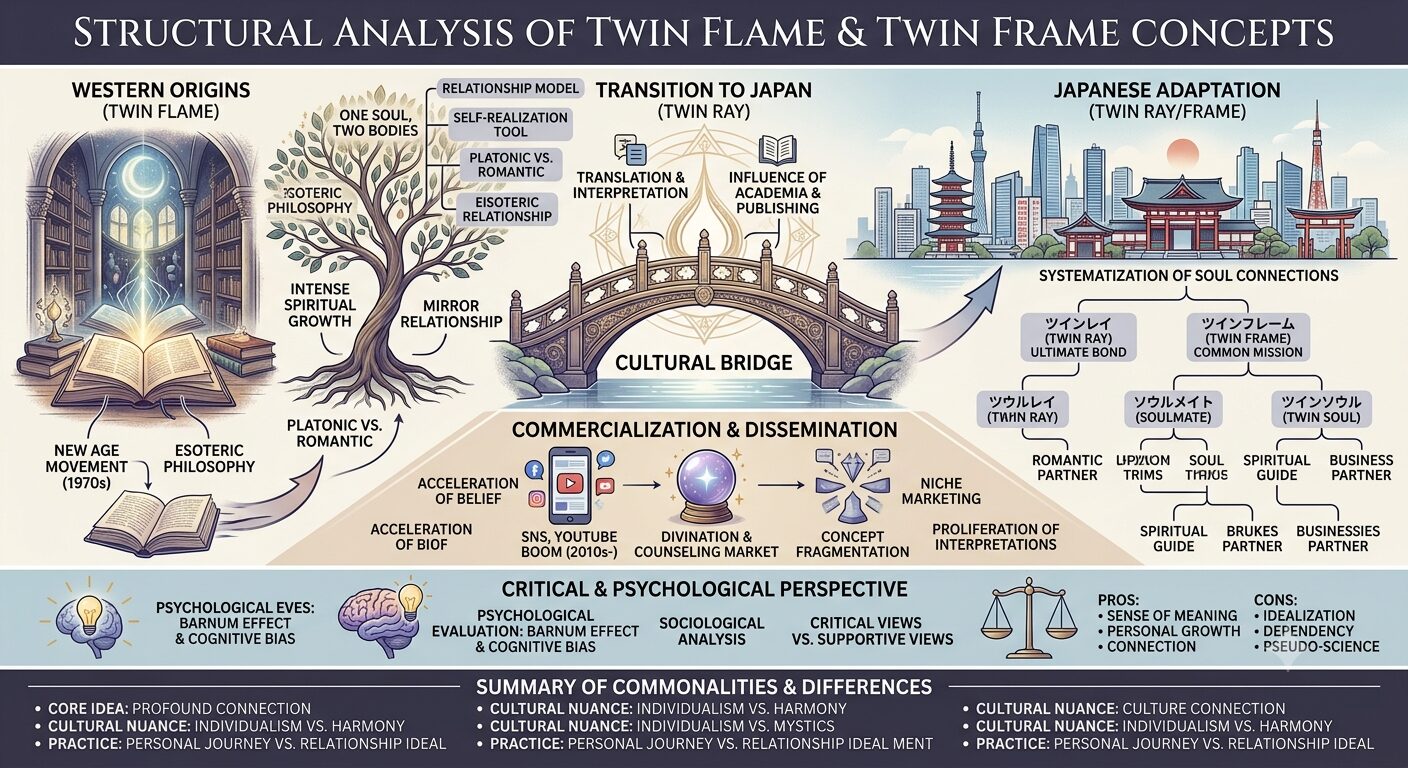
“Twin Ray” and “Twin Flame” present themselves as unchanging cosmic truths, yet in reality they are a relatively recent “modern myth,” woven together from nineteenth-century Western occultism, the New Age movement of the late twentieth century, and Japan’s own contemporary fortune-telling culture.
The Making of
“Twin Flame” in the West
Its intellectual soil traces back to Plato’s Symposium, where an originally androgynous, spherical human is torn in two by the gods and spends its life searching for its other half.
In 1886, British novelist Marie Corelli’s A Romance of Two Worlds anticipated the “twin soul” motif. Later, Helena Blavatsky’s Theosophy systematized a framework of cosmic duality overcome and reincarnating souls, laying the groundwork for modern spirituality.
It was the American spiritual teacher Elizabeth Clare Prophet who fixed the term “Twin Flame” and its doctrine in its current form. In her 1999 book, she fused Hindu and Buddhist reincarnation with Christian evangelical salvation narratives, presenting the Twin Flame as “the ultimate partner, created by God at the same instant in the earliest stage of the soul’s evolution, essential for ascension.”
How “Twin Ray”
Was Introduced in Japan
The term widely circulated in Japan today is not a direct translation of the English “Twin Flame.” Its direct origin traces to a message received in January 1999 by Lisa J. Smith, a channeler in Michigan, USA, allegedly from the cosmic being “Sananda.”
Smith organized male-female relationships into a “Seven-Step Earth Pyramid,” placing “Twin Ray” — the singular, cosmic other half — at the top, with “Twin Flames” one tier below.
In translating and absorbing this hierarchy, Japan’s market fixed the top tier, “Twin Ray,” as “the one soul that was originally a single soul split in two.” Meanwhile “Flame” became phonetically conflated with “Frame,” and — combined with its lower position in the hierarchy — was independently reconstructed as “a group of collaborators who share the same aspiration or energetic structure.”
An International Comparison
Divergent Interpretations, Cultural Reinvention
The same vocabulary functions very differently abroad and in Japan. In the West it is framed as a tool for gruelling self-transformation; in Japan, as a story of destined romance. The two have, in effect, become separate concepts.
Abroad — the Mirror Soul of Awakening
Emphasis falls on the “ultimate mirror soul” that catalyzes a shift in consciousness. The relationship’s essence is not the pursuit of romantic happiness, but a destructive, trial-laden process in which one’s deepest fears, traumas, and wounds are forced into view through the mirror of the other person.
This journey involves a spiritual crisis known as the “Dark Night of the Soul.” Its aim is to release attachment to the other and arrive at an expanded state of consciousness — “unconditional love.” An outcome where the partner never incarnates in physical form, or where the two never unite in this lifetime, is treated as entirely within the range of expected outcomes.
Japan — the Destined Red Thread
The gruelling tool for self-transformation seen in the West has been domesticated into a narrative of “the ultimate romantic love.” It is used as a framework to resolve or justify worldly relationship troubles — romance, affairs, divorce, remarriage — among others.
A temporary breakup or period of silence is reframed as a “silent period” necessary for the soul’s growth, with “reunion and marriage (union) in this life,” once that period is overcome, set as the final goal — a tendency that is exceptionally strong. The meticulous stratification of relationship stages is another distinguishing feature.
A Structural Analysis of the Concept
“Polar (Yin-Yang)” vs. “Harmonic (Resonant)” Types
These relationship models can be sorted into two underlying energetic vectors.
Polar / Yin-YangMost visible in Twin Ray
A single particle of light is said to have split into masculine and feminine poles in order to experience the duality of the three-dimensional world. Like the poles of a magnet, the two are pulled together with intense, instantaneous force — and repel each other just as violently. Because the other embodies “the missing part of oneself,” the shadow self is projected onto them fiercely, and the relationship becomes one of love-hate and ordeal. Ultimately, rather than chasing an external partner, the goal is to achieve “an inner balance between one’s own masculine and feminine energies” and become whole alone.
Harmonic / ResonantMost visible in Twin Flame & similar
Rather than a complement of opposing poles, this rests on “complete resonance at the same frequency.” From the moment of meeting, both parties share a sense of coming home and a match in values, with very little conflict. This relationship is organized not within the closed sphere of romance, but to advance a shared social mission — joint business, environmental activism, creative work, enlightenment activities — where the essence is maximizing collective performance rather than individual introspection.
The Hierarchy of Relationships, as proposed by Lisa J. Smith
- 01Twin RayOne only · one male-female pair
The ultimate divine partner, integrating yin-yang polarity. Idealized to the highest degree as the “destined lover / spouse” of this life.
- 02Twin FlameUp to seven · any gender
Pure devotion and a connection of the heart. A partner for shared work and social mission beyond romance.
- 03Twin SoulTwelve · any gender
A rival who sharpens you at a near-identical frequency, or a deep acquaintance who walks with you through life’s turning points.
- 04Twin MateAt least one hundred forty-four
Romance is stripped away; a collective of like-minded servants connected for a planetary or galactic mission.
- 05Divine ExpressionMultiple
A temporary presence that provokes intense conflict when life strays off course, awakening one to a hidden truth.
- 06Soul MateMultiple
A relationship promised before this life for a specific lesson. Appears at the optimal moment to grant crucial self-understanding.
- 07Divine ComplementMultiple
A mirror that accurately reflects your current vibrational state. Departs from your life swiftly once the lesson is complete.
The Business Behind the Boom, and
the Risk of Mind Control
Behind this extremely abstract spiritual discourse forming a massive consumer market — and at times, cult-like groups — lies a structural problem: the advance of information technology combined with the exploitation of psychological vulnerability in an increasingly atomized society. Japan’s Twin Ray boom exploded from the late 2010s onward, driven by explainer videos on streaming platforms, social-media recommendation algorithms, and the rapid spread of phone and chat fortune-telling apps.
Real-World Moral Conflict
An affair, a partner who’s gone silent, domestic violence, harassment, lingering attachment, unrequited love — deep pain, in other words.
Spiritual Bypassing
The dishonesty of the situation is sanctified and redefined as “a gruelling trial meant to polish the soul.”
A Permanent Billing Structure
“Don’t give up on him — raise your vibration instead,” the client is told, driving repeat purchases of readings and seminars.
When a client confronts a reality like an affair or a sudden silence, the ordinary advice is a rational resolution — divorce, letting go, ending contact. A reading instead sanctifies it as “cosmic destiny” or “a program to unite the soul.” Because the period when the relationship has completely broken down is affirmed as a “silent period,” the client abandons the healthy decision to move on, and — attachment intact — keeps repeat-purchasing costly readings and seminars for years, building an exploitative structure.
The unnaturally fine-grained division into seven relationship tiers serves no purpose but “eliminating falsifiability.” Even if a client is permanently rejected by their “true Twin Ray,” as long as substitute categories like “Divine Expression” remain available, the reading can easily be rewritten: “that person wasn’t the real Twin Ray — they appeared only to lead you to your true one.” The client is thereby led to re-enter the consumption cycle in search of a new “true” match.
A Case Study in Cult Formation — Twin Flames Universe
The most extreme case where commercialization escalated into collective mind control is “Twin Flames Universe” (TFU), organized by Jeff and Shaleia Ayan in the United States. The group gathered young people burdened by loneliness and relational trauma online and promised the fulfillment of absolute love; its harmful reality has since been detailed in a documentary series.
- Financial exploitation — Compelling members into costly courses and uncompensated labor (content production, recruiting).
- Encouraged stalking — Even after a member’s assigned “Twin Flame” obtained a restraining order, members were told the other was simply “running from fear,” and were compelled to keep pursuing them as a “sacred practice.”
- Identity manipulation — Leaders unilaterally assigned male-female polarity to pairs, forcing changes to pronouns, clothing, names, and physical or sexual presentation.
- Forced self-blame — Members were repeatedly made to perform a “mirror exercise,” treating any criticism from others as a “sin within themselves,” stripping away independent, critical thought.
Cult researchers describe the group as “a sophisticated self-help cult disguised in the modern packaging of self-improvement and wellness, selling salvation for the soul.”
Academic & Critical Scrutiny
A Psychosocial Reassessment
Viewed through clinical psychology, psychiatry, and sociology, most of the dynamics behind the narrative of a “destined relationship” are explainable not as mystery, but as well-documented psychological phenomena.
Limerence
Psychologist Dorothy Tennov’s concept of “limerence” describes compulsive, intrusive thoughts about a particular person and emotional swings driven by uncertainty about their feelings. It is a form of dependency arising from low self-esteem or anxious attachment — yet by reinterpreting this unhealthy state of overexcitement as “resonance of souls from a past life,” the person forfeits the chance to address or treat their romantic dependency.
Attachment-Style Interaction
The chase between “runner” and “chaser” is identical to the pathological interaction between “anxious” and “avoidant” attachment styles. As intimacy deepens, the avoidant partner pulls away in fear of rejection, while the anxious partner — driven by fear of abandonment — intensifies pursuit; the more they are pursued, the further the avoidant partner retreats. This deadlock gets wrapped in the beautiful growth story of “a silent period before union,” prolonging a relationship that should instead be ended with clear boundaries.
The Barnum Effect & Confirmation Bias
The “Barnum effect” — where a vague description that applies to nearly anyone is mistaken for a special personal truth — combines with “confirmation bias,” in which only information matching the hypothesis “we are connected” is selectively remembered, to underlie experiences like repeating numbers or synchronicities.
Resolving Cognitive Dissonance
To ease the mental distress of confronting a harsh reality — an affair, a rejection — reframing it as “this suffering is a sacred barrier the universe placed here to unite our souls” lets the person mentally recast a humiliating position as “a sacred journey,” preserving their self-esteem.
The Spiritual Narrative
A soul-splitting “silent period”
The trial of runner and chaser
Intense synchronicity with the one true partner
Discomfort resolved through the mirror exercise
The Psychological Reality
Rejection, a complete breakup, cut-off contact
A codependent cycle of avoidant and anxious attachment
Confirmation bias, apophenia, limerence
Self-blaming thought, cognitive manipulation, eroded self-worth
Even so, the assessment doesn’t run in only one direction. Where a person releases attachment to an external other and channels that passion into introspection and psychological independence — or where the narrative gives meaning to a genuinely irreversible loss, such as bereavement — it can bolster psychological resilience. At the same time, it always risks acting as a “psychological anesthetic,” blinding a person to the objective fact that a partner is already married or abusive, and blocking practical solutions like filing for divorce or seeking therapy.
Summary of Similarities & Differences
Shared Ground
A single cosmic origin — both share the metaphysical premise that, before incarnation, the two were a single particle of light, or a single soul blueprint.
An uncanny initial pull — the instant they meet, both parties feel an inexplicable sense of coming home and a premonition of destiny.
A demand for self-transformation — rather than a placid romance, the relationship involves an ordeal that purifies one’s deepest wounds and ego, elevating consciousness.
Where They Differ
| Twin Ray | Twin Flame | |
|---|---|---|
| Origin | 1999 channeling by Lisa J. Smith | Theosophy, systematized by Prophet (1999) |
| Number & scope | One only, typically a male-female pair | Up to seven, any gender |
| Dynamic | Yin-yang repulsion and magnetism; conflict as ordeal | Frequency resonance; familiarity and cooperation |
| Goal, this life | Often framed as romantic/marital “union,” though some interpretations aim instead at inner union (one’s own yin-yang balance) — the goal varies by person | A steadfast comradeship for a shared social mission |
The story of a soul torn between light and darkness, and the flame that keeps that story perpetually burning, both come down to something profoundly human — how we make meaning of loneliness and uncertainty.