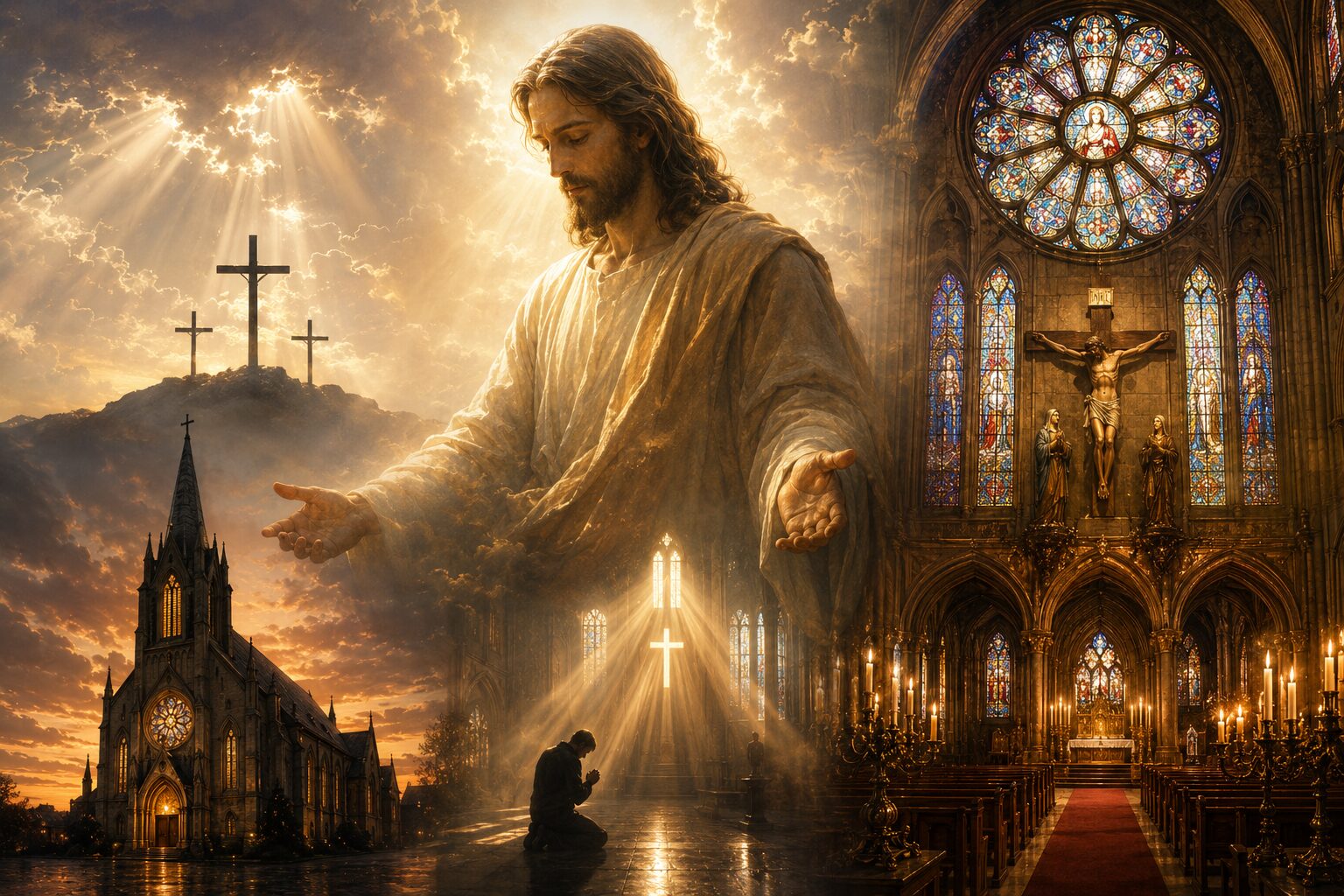
Faith · History · Truth
Believing “God Loves People”
in an Age That Demands Truth
Exploring Christianity, Scripture, the Church & Faith Together
“What is the difference between Christians and Catholics?”
A single question like this can open into something much larger — a conversation about what faith means, what truth is, and ultimately, how we are to live.
We live in an age surrounded by information unlike any before. Open the internet and you can encounter research, history, and perspectives from every corner of the world. Yet precisely because there is so much, many people find themselves wondering: What is actually true?
Religion is no exception. “The Bible was edited by human hands.” “The Church has made grave mistakes throughout history.” “Isn’t religion just a tool for control?” These are not fringe views — they appear regularly, and they deserve to be taken seriously.
And yet, across those same centuries, countless people have found in faith something that lifted them from despair, gave them reason to live, and sustained them through suffering that would otherwise have broken them entirely.
Scripture itself contains the instruction: “Test everything; hold fast to what is good.” Questioning and continuing to think are not opposites of faith. The very posture of seeking truth is honored within it.
This article is not a call to conversion, nor a defense of any single denomination. It is written for Christians, for the curious, and for those who have been hurt by religion. The only goal is this: to think carefully together, before deciding what to believe.
Christians & Catholics —
What Most People Misunderstand
When people hear the word “Christian,” they often picture a specific denomination or style of church. But the word itself simply refers to anyone who follows Jesus Christ. By that definition, Catholics are Christians — and so are Protestants. The labels describe branches of the same tree, not separate trees entirely.
Think of it like Buddhism: one broad tradition that contains many distinct schools. Christianity similarly encompasses a wide family of traditions that have developed over two thousand years of history. The three major streams are Catholic, Orthodox, and Protestant.
Catholic
Holds Scripture and Church tradition — passed down from the apostles — as twin authorities. Recognizes the Pope as the universal leader. Worship, sacrament, and the weight of nearly two millennia of history are central to Catholic life.
Protestant
Emerged from the 16th-century Reformation. Its core conviction: Scripture alone is the final authority for faith. Protestant traditions vary widely in worship style and theology, but share this biblical emphasis.
What They Share
The differences are real. But beneath them runs a common foundation that unites the vast majority of Christian traditions:
- God loves human beings
- Humanity is broken and in need of grace
- Salvation is made possible through Jesus Christ
- Love is the defining mark of a life well lived
More than doctrinal labels, what matters is what a faith actually produces. Does it cultivate kindness, humility, and the willingness to admit failure? Does it move people toward love rather than fear? These questions cut deeper than denominational identity.
What the Bible Actually Says —
Mary, Prayer, Salvation & God
Whatever one thinks of churches and traditions, the central text of Christianity is the Bible. Setting aside denominational interpretation for a moment, what does Scripture itself actually say?
The Bible’s Central Theme
The Bible is not a single book by a single author. It is a library — a collection of texts written across many centuries in multiple languages, spanning poetry, history, prophecy, letters, and narrative. Yet running through all of it is one dominant theme: the relationship between God and human beings.
It does not depict an idealized humanity. Failure, betrayal, doubt, and moral collapse appear throughout. What Scripture offers is not the story of perfect people — it is the story of broken people who encounter God in the midst of their brokenness.
What Does “Salvation” Mean?
One of Christianity’s most central concepts is salvation. The Bible describes human beings as estranged from God — a condition called “sin.” This does not mean simply breaking rules. It means:
- Living as though one is the center of everything
- Causing harm to others
- Drifting away from love
Scripture is honest: no one achieves wholeness by their own effort alone. That is why grace is needed. And genuine faith, Scripture insists, is always visible in how a person lives — in acts of care, forgiveness, and solidarity with the vulnerable.
The God Portrayed in Scripture
At the heart of the Bible stands this claim: God is love. But this is not a soft or sentimental statement. It describes a love that sees human failure clearly — and refuses to abandon. A love that keeps the door open. That makes second chances possible.
Perhaps that is why the Bible has endured. Its pages are full of people who stumbled, wandered, fled — and found their way back. People recognize themselves in those stories.
Can Doubt and Belief Coexist? —
The Meaning of “God Loves People”
Ours is an era when believing anything firmly has become difficult. We are exposed to so many perspectives, so many conflicting accounts of the same events, that conviction itself can feel like naivety. Many people ask: Even if some of what I believed turns out to be wrong — is there still a reason to believe at all?
Belief Is Not the Absence of Thinking
The word “faith” can sound like blind acceptance — a suspension of critical thought. But the Bible itself does not portray faith that way. Scripture is full of people who wrestle with God, who ask “Why?” in the middle of suffering, who struggle to understand what they once thought they knew.
Doubt, in this frame, is not the enemy of faith. It may be one of its most honest expressions. The biblical instruction to “test everything and hold fast to what is good” assumes that testing — real, rigorous examination — is part of the journey.
What Jesus Said About Truth
Jesus declared: “The truth will set you free.” He was not offering comfortable reassurance. He was pointing to something more demanding: that genuine freedom comes not from believing whatever makes us feel safe, but from encountering what is actually real. In the Christian understanding, hope and truth are not in competition. Real hope must be built on something true.
Separating Human Institutions from Faith Itself
One of the most common sources of confusion is conflating “believing in God” with “believing that religious organizations are always right.” These are different claims. A doctor’s errors do not disprove medicine. A corrupt official does not invalidate governance. Likewise, the failures of religious institutions — which are real and often serious — are not the same thing as the failure of faith itself.
Faith is not a fixed possession. It moves, deepens, and sometimes falters across a lifetime. People who once believed nothing have, through suffering or encounter, come to faith. People who were raised in faith have, through disillusionment or doubt, stepped away. Both trajectories are human.
The Church Is Not Perfect —
Separating God from Human Institutions
It is a reasonable question: if God is perfectly good, why has so much harm been done in his name? The honest answer requires a distinction that Christianity itself insists upon — between a perfect God and the very imperfect human beings who follow him.
A Perfect God, Imperfect People
Christian theology maintains that God is perfect. Human beings are not. That gap matters enormously. A person with sincere faith can still be wrong. Well-intentioned actions can cause real harm. History inside the Church — as within every human institution — contains both remarkable goodness and serious failure.
Scripture’s Characters Are Not Perfect Either
This is one of the striking features of the Bible: its heroes are not heroic in the way we might expect. Peter, one of Jesus’s closest disciples, swore he would never abandon him — then denied him three times under pressure. Yet Peter went on to become a foundational figure in the early Church. The story did not end with the failure.
What the Bible communicates is not “become perfect from the start.” It is something more honest and more demanding: even people who have failed can change.
Judging by the Fruit
Jesus himself offered a simple diagnostic: “You will know them by their fruits.” The name a group carries matters less than what that group actually produces. Does this faith make people kinder, more humble, more willing to admit they are wrong? Does it protect the vulnerable?
- Does it cultivate genuine care for others?
- Does it create space to acknowledge mistakes?
- Does it stand with those who are weak?
- Or does it produce fear, contempt, and control?
Critiquing a religious institution is a different act from questioning God. Both deserve serious thought — but they are not the same question.
Religion vs. Cults —
Faith That Frees, Faith That Controls
The word “religion” carries very different weight for different people. For some it means community, meaning, and a lifeline in the dark. For others it means broken family relationships, the suppression of honest questions, and years lived under guilt and fear. The same word — radically different experiences.
Healthy Communities
Questions are welcomed. Doubt is treated as honest, not treasonous. No single leader is treated as infallible. People are free to leave — and their choice is respected, not punished.
Controlling Groups
“We alone have the truth” — the world is divided into the enlightened and the lost. Questioning is defined as sin. Loyalty is enforced through fear: “Leave us and face the consequences.”
Love and Control Look Similar From the Outside
Manipulation rarely announces itself. It often arrives wrapped in concern: “I’m doing this for you.” “I just want to protect you.” But genuine love has a distinctive quality: it does not take over another person’s mind. It does not strip away their freedom to think, choose, or walk away.
Healthy faith, across traditions, has been understood as something that expands a person — toward greater maturity, deeper compassion, and a freer relationship with truth. Any ideology — religious or not — that moves people toward isolation, fear, and diminished personhood deserves serious scrutiny.
Christians Fail Too —
Scripture’s Portrait of Human Weakness
“If you’re a Christian, why do you still do wrong things?” It’s a fair question. The assumption behind it — that sincere faith should produce moral perfection — is understandable. But it is not what Scripture actually claims.
Faith and Perfection Are Not the Same
Christianity does not teach that becoming a believer erases human weakness. Anger, envy, fear, self-centeredness — these remain. The Christian life, as Scripture describes it, is less a state of arrival than a process of gradual transformation in relationship with God.
Paul: The Persecutor Who Became a Preacher
Paul — who wrote many of the New Testament’s letters — was not always a Christian. He actively persecuted the early church. He believed, with sincere conviction, that he was doing what was right. Then something happened that reversed everything. He became perhaps the most important figure in the spread of early Christianity. His story has been read for two thousand years as a sign that profound change is possible.
The Bible’s Core Message
God does not abandon people who have failed. The weak. The wandering. The ones who made choices they now regret. If Scripture were only for the already-perfect, most of its characters would have been disqualified before the story began. The message is not “be perfect.” It is: there is a way back.
What matters is not whether a person has ever failed. What matters is what happens after the failure — whether they are willing to acknowledge it, and how they choose to live from that point forward.
Can the Bible Be Trusted? —
History, Science & Faith
“Can a book written thousands of years ago actually be reliable?” This question is worth taking seriously. It deserves more than a defensive dismissal or an uncritical acceptance — it deserves careful examination.
Does Science Contradict the Bible?
Science asks: how does this work? It investigates mechanisms — the structure of the cosmos, the process of biological change, the behavior of matter. Religion, at its best, asks different questions: Why does anything exist? What does it mean to be human? How should we live? These are not competing questions — they are different kinds of inquiry, and conflating them creates confusion in both directions.
“Not yet verified” is not the same as “didn’t happen.” Historical research works within the limits of surviving evidence. Absence of proof is not proof of absence. And the deepest questions about meaning, love, and purpose are not the kind science was designed to answer.
What Does It Mean to Trust the Bible?
That depends on what kind of reading is brought to it. Treating it as a science textbook creates problems it was never designed to solve. Reading it only as a historical document misses its depth. Many people have found its enduring value in a third mode: as a record of how human beings across millennia have encountered the question of God — and what they found.
If something is true, it should be able to withstand scrutiny. If our understanding is incomplete — as it always is — we should remain students. The Bible has been read, challenged, translated, debated, and returned to for thousands of years. Something in it keeps drawing people back.
Faith as Invitation, Not Imposition —
Freedom and Love
One word more than any other makes people cautious about religion: pressure. The sense that belief is being forced, that doubt is unwelcome, that leaving is not really an option. These fears are not irrational — they reflect real experiences that real people have had.
Sharing and Imposing Are Different Acts
There is nothing wrong with a person sharing what matters to them. People do it all the time — with books they love, ideas that changed them, experiences that shaped their view of life. Faith, for many, is simply the deepest version of that impulse.
The line is crossed when sharing becomes pressure. “This is what I believe” is an offering. “You must believe this too” is a demand. The first allows conversation. The second forecloses it. Christianity has historically understood human beings as endowed with free will — which implies that coerced faith is a contradiction in terms.
For Those Hurt by Religion
Some people reading this will have been harmed by religious environments — coerced into belief, silenced when they had doubts, or cut off from family and community when they tried to leave. No single phrase can address that. What those experiences deserve, first, is honest acknowledgment and respect. Faith was never meant to be used as a weapon. When it has been, that is a failure — of people, of institutions, of the gap between what is professed and what is practiced.
Genuine Faith Respects the Other Person
The portrait of Jesus in the Gospels is striking on this point. He invited. He did not compel. People walked away from him, and he let them go. He asked his own disciples, when the crowds left: “Do you also wish to go away?” That is not the posture of someone who demands agreement. It is the posture of someone who believes the truth is capable of speaking for itself.
Walking Toward Truth Without Losing Hope
We have moved through a great deal of ground — Christianity and its branches, the Bible, the Church, faith and its counterfeits, the relationship between doubt and belief. The question underneath all of it remains the one we began with: If some of what we have been taught turns out to be wrong, or shaped by human hands, can we still live by the conviction that God loves us?
Human beings make mistakes. The Church, as a human institution, makes mistakes. But the failures of human beings do not erase everything human beings have ever valued. Love. Hope. Forgiveness. Compassion. Justice. These have persisted across every age and every culture, regardless of whether they were held under a religious banner or not. They point to something.
What the phrase “God loves people” means — and whether it can be believed — is something each person must work out for themselves. For some it is a bedrock truth. For others it remains an open question. For others still it is something they cannot accept. None of these responses is simple, and none deserves to be dismissed.
Faith is not the suspension of thought.
It is not the end of questions.
It is not the abandonment of the search for truth.
It may be the willingness to keep choosing
what is good and true and life-giving —
even in the middle of uncertainty.
To seek truth without letting go of hope.
To keep thinking, keep asking,
and still walk forward.
Somewhere in that journey
may be what human beings
have always been looking for.