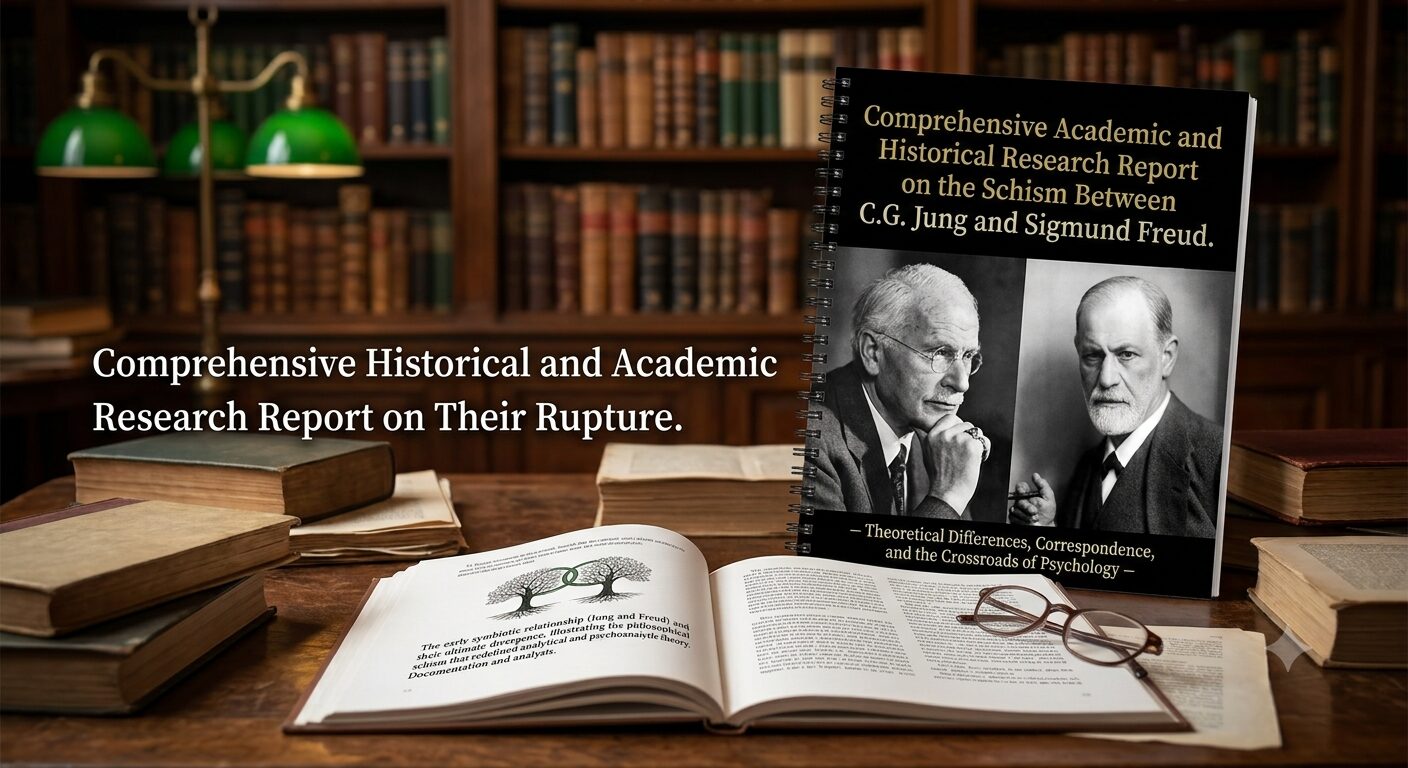
FREUD, S. — 1856–1939/JUNG, C.G. — 1875–1961· 1906–1914
The Rupture Between Carl Gustav Jung and Sigmund Freud
A Scholarly and Historical Synthesis
Reconstructed from correspondence, clinical records, and later testimony, this account traces eight years from honeymoon to breakdown. No theoretical disagreement alone explains it — this was a split driven by tangled personal distrust and organizational politics, the largest fracture the psychoanalytic movement ever suffered.
The Historical Arc — From Honeymoon to Rupture (1906–1914)
The trajectory from Freud and Jung’s first encounter to their final break is the most dramatic episode in the early psychoanalytic movement’s history — one that decided its fate.
The word-association book, and a first letter
Jung sent Freud a book detailing his own word-association experiments, opening a serious scholarly exchange. That October, Jung wrote to Freud for the first time seeking advice on treating a Russian student, Sabina Spielrein; Freud replied that “treatment is brought about by love.”
The Vienna visit and thirteen hours of talk
Jung visited Freud’s home at Berggasse 19 for the first time, and the two talked for thirteen unbroken hours. During this stay, Freud’s sister-in-law Minna Bernays is said to have confided an affair with Freud to Jung — an episode some read as the seed of Jung’s distrust in Freud’s “absolute moral authority.” By August 1908, Freud himself was voicing concern, in a letter to Karl Abraham, that Jung might harbor latent antisemitic feeling.
The American voyage — two fainting spells and a reversal of authority
Invited to Clark University’s anniversary celebration, Freud, Jung, and Ferenczi shared a seven-week sea voyage. Their attempt to analyze each other’s dreams each morning collapsed when Freud refused self-disclosure, saying he “could not risk his authority.” Over dinner in Bremen, Jung spoke eagerly of preserved “peat-bog corpses,” which Freud read as an unconscious death-wish toward himself and fainted for the first time. After arrival, at the Palisades cliffs near the Hudson, Freud lost control of his bladder from distress — Jung caught him and walked him back to the hotel, a striking reversal of physical and psychic authority.
Founding the IPA, and the first theoretical break
Freud founded the International Psychoanalytical Association and installed Jung as its first president, provoking sharp political friction with the Vienna old guard. In 1911, Jung immersed himself in writing Transformations and Symbols of the Libido, beginning to dismantle Freud’s doctrinaire theory of sexual libido at its root.
The “Kreuzlingen gesture,” and a second fainting spell
In May, Freud stayed near Zurich at Kreuzlingen without visiting Jung — an omission Jung took as deliberate slight, the “Kreuzlingen gesture.” That summer, at Jones’s proposal, a secret committee was formed. At the November Munich conference, immediately after a reconciling walk, Freud fainted a second time during a dinner debate over Akhenaten’s religious reforms. Freud later confessed to Jones that homoerotic transference toward Jung had played a part.
Mutual analysis, and the parting
Between December 1912 and January 1913, the two traded letters attacking each other’s neuroses directly — a “mutual analysis” of sorts — until Freud declared the personal relationship over on January 3, 1913. After the Fourth International Psychoanalytical Congress that September, all direct contact ceased; Jung resigned the IPA presidency and his membership in 1914.
Choosing a Successor — Strategic and Geopolitical Background
Freud’s attachment to Jung, nineteen years his junior — calling him “crown prince” and even “the Joshua who will lead our movement into the promised land” — rested on calculated organizational strategy.
Escaping Jewish sectarianism
The early Vienna Psychoanalytic Society was almost entirely Jewish physicians, and in the antisemitic climate of the era, psychoanalysis risked being dismissed as a “Jewish science of sexual obsession.” Freud judged that scholarly universality required a leader of Aryan, specifically Swiss Protestant, lineage with standing in European academia. Jung taking the movement’s helm would grant psychoanalysis international legitimacy and shield it from sectarian prejudice.
The academic authority of Zurich psychiatry
Most of the Vienna group were private clinicians with thin ties to universities. Jung’s Burghölzli hospital, by contrast, led by Eugen Bleuler, stood among the world’s foremost centers of clinical psychiatry, and had begun applying psychoanalytic method to “dementia praecox” (later schizophrenia) — cases once thought unanalyzable. For Freud, making Jung his successor meant folding Burghölzli’s unmatched academic weight into the psychoanalytic movement itself.
Psychoanalysis and Analytical Psychology — Six Points of Divergence
At the core of their conflict lay a split over the very energy that drives the psyche, and its structure. Psychoanalysis rests on causal, biological reductionism; analytical psychology aims at teleological, symbolic wholeness.
| Domain | Freud (Psychoanalysis) | Jung (Analytical Psychology) |
|---|---|---|
| Structure of the unconscious | Centered on the personal unconscious — a storehouse of repressed infantile wishes, traumatic memory, and biological drive, essentially pathological in character. | Beneath the personal unconscious lies a “collective unconscious,” an inherited substrate shared by all humanity and a wellspring of creativity and wisdom. |
| Libido | Essentially sexual drive. All cultural and spiritual activity is a secondary product of this erotic energy “sublimated” socially. | Desexualized, general “psychic energy” — a non-material force that transforms into eros, power, spirituality, or self-realization depending on circumstance. |
| Function of dreams | A dream is “the disguised fulfillment of a repressed unconscious wish.” Free association dismantles its manifest content down to latent, largely Oedipal, thought. | Dreams perform an autonomous “compensatory function,” correcting conscious bias. They are teleological messages about future possibility, read through amplification rather than free association. |
| Religion | “Humanity’s universal obsessional neurosis” — a projection of infantile dependence on a father-figure, and a compensatory illusion for instinctual repression. | Religious experience (the numinous) is a healthy, instinctual function arising from contact with archetypes, essential to restoring psychic wholeness (individuation). |
| Myth and symbol | Derivatives of pathological symptoms — biological instincts like incestuous wish and Oedipal conflict, disguised to evade social censorship. | Expressions of “archetypes” imprinted in the collective unconscious — healing images common to humanity across time, bridging conscious and unconscious. |
| Aim of treatment | Resolve neurotic conflict determined by early family relations and psychosexual stages (oral, anal, phallic), strengthening the ego’s command. | Prioritize lifelong development — especially “individuation” in life’s second half — integrating the shadow and anima/animus to establish the self. |
Behind the Theoretical Conflict — Personal, Organizational, Political
What sealed the rupture was never argument alone — it was driven by fierce political power struggles and a chain of deeply personal grievances.
The shadow left by the Minna Bernays affair
The suspected affair between Freud and his sister-in-law Minna planted a serious ethical doubt in Jung’s mind. Jung saw through the hypocrisy: Freud preached the duty of “thorough self-analysis” while rigorously concealing an inconvenient truth of his own, absolutizing himself behind dogma. Jung’s refusal of mutual dream analysis aboard ship in 1909 was itself a contest over this hidden “shadow,” and became, for Jung, grounds to declare Freud’s scientific objectivity fatally compromised.
Latent and overt antisemitism
Entrusting psychoanalysis to the Swiss group was strategic necessity for Freud, but it carried a constant fear that “Jewish analysis” would be absorbed into an “Aryan psychiatry” and diluted. In 1912 Freud wrote to Otto Rank that Jung had “trouble reconciling Jews and antisemites on the ground of psychoanalysis” — evidence of how easily ethnic and cultural difference curdled scholarly disagreement into political enmity. When Jung later argued, in 1933, that “the Aryan unconscious has a higher potential than the Jewish,” it confirmed in hindsight that Freud’s earlier suspicion had not been mere paranoia.
The “Secret Committee” and Viennese resistance
After Adler’s departure in 1911, Ernest Jones proposed a secret committee to defend Freud exclusively. This inner circle — Freud, Jones, Ferenczi, Rank, Sachs, and Abraham — relentlessly monitored Jung’s scholarly “deviations” and worked to politically remove him from the movement’s leadership. For Jung, the committee’s very existence was proof that psychoanalysis had degraded from objective science into an exclusionary “religious sect.”
Sabina Spielrein — A Contested Historical Legacy
Wrongly marginalized for decades, Spielrein has only recently had her pioneering work reassessed. The role her relationship with Jung played in the rupture remains fiercely disputed among historians reading the same primary sources.
Boundary violation as the decisive cause
This reading holds that a physical, ethically compromising relationship existed between Jung and Spielrein, and that its concealment destroyed Freud’s trust in him. In 1909, to prevent the affair coming to light, Jung falsely told Freud that a former patient was “fabricating a scandal out of revenge,” attempting to crush her using Freud’s authority. It was only when Spielrein wrote to Freud directly, exposing Jung’s fabrication, that Freud saw through to Jung’s deception. “From the moment I received her first letter, my estimate of Jung changed considerably,” Freud confessed in a 1913 letter — a rupture of personal trust said to have pushed the theoretical conflict past any hope of repair.
A collaborative, non-erotic bond
This reading finds no decisive evidence of a sexual relationship, and casts Spielrein instead as a mediator who enriched the intellectual dialogue between the two men. Her formal hospitalization ended in 1905; afterward she became an outstanding student and research collaborator at the University of Zurich, working with Jung on equal footing. In 1911, under his supervision, she defended the first doctoral thesis by a woman applying psychoanalytic method to schizophrenia. The 1909 scandal, on this account, was a brief panic sparked by Jung’s misreading rumors about an unrelated woman — and casting Spielrein as the rupture’s direct cause is an over-dramatization that took hold through gossip-driven histories (and later film and theater) after the 1980s; the real break should be explained by broader theoretical and organizational forces.
Spielrein’s own theoretical originality
Whichever reading one takes, it is beyond dispute that she gave both men decisive ideas of their own. Her 1912 paper “Destruction as the Cause of Becoming” argued that the reproductive instinct carries within it an essential self-destructiveness — an insight that spurred Jung’s formulation of the anima. Freud, drawing on much the same idea, proposed the “death instinct” in Beyond the Pleasure Principle (1920), acknowledging her, if inadequately, in a footnote.
Reading the Correspondence
Some 360 letters passed between them from 1906 to 1914, laying bare — almost as documentary evidence — a psychological collapse sliding from intellectual excitement into distrust and hatred.
“My dear Jung, promise me never to abandon the sexual theory of the libido. That is the most essential fortress we possess. Against every scientific resistance and popular backlash, we must hold this dogma as a bulwark.”
“Dear Dr. Jung, welcome back from America. I can no longer greet you with the same warm affection as at Nuremberg — you have quite thoroughly broken me of that habit. That you keep raising Kreuzlingen and using it as ammunition is difficult to understand, and deeply insulting.”
“Your treatment of your pupils as though they were your patients — reducing every one of their actions to your own erotic complexes — is plainly baseless. None of us analysts need be ashamed of carrying a bit of neurosis ourselves. But a man who behaves abnormally while insisting to everyone that he is ‘normal and has insight’ offers the surest proof that his insight into his own illness is exactly what he lacks.”
“Your letter proves that continuing our personal relationship is entirely impossible. Corresponding with a man who is himself neurotic, and who maintains his psychic balance by attacking others, is a waste of time. I therefore propose that we abandon our personal relations altogether.”
“I gladly comply with your wish to abandon our personal relations. I am not the sort of man who forces his friendship on others.”
A Psychodynamic Reading via the 22 Levels of Emotion
Borrowing the Abraham-Hicks “Emotional Guidance Scale” — running from the highest state of joy, love, and appreciation down to the lowest, fear and powerlessness — this section tracks the psychological and physical dynamics between the two men from 1907 to 1913. Each bar marks a position from 1 (joy) to 22 (fear/powerlessness).
1907 — First meeting, honeymoon begins
Thirteen hours of talk in Vienna. Minna’s confession.
Level 1 — an overwhelming sense of omnipotence and certainty at having found psychoanalysis’s ideal heir.
Levels 1–2 — blind reverence (transference) for the pioneer Freud, and intellectual excitement at putting the theory into practice.
1909 — The American voyage and the first faint
Shipboard dream analysis, conflict at Bremen, the accident at the Palisades.
Level 14 sliding to 22 — confronted with Jung’s fixation on the dead, a physical collapse born of a fear of death.
Level 10 sliding to 13 — a sharpening distrust of his mentor’s character after Freud refuses self-analysis.
1911 — Writing Transformations of the Libido
Spielrein earns her degree; Jung begins his own mythological research.
Level 14 to 15 — mounting anxiety that the Zurich school is dragging psychoanalysis toward the occult.
Between levels 2 and 11 — exhilarated by the discovery of archetypes, yet nearly crushed by conflict with his own father-complex.
1912 — Kreuzlingen, and a second faint
Misunderstandings accumulate; the Munich fainting spell; the Secret Committee is formed.
Level 17 sliding to 22 — castration anxiety and homoerotic transference collapse him into unconsciousness again.
Level 12 to 15 — pride wounded, Jung denounces Freud without mercy as an “unscientific tyrant.”
1913 — Letters end, the official break
“Abandoning personal relations”; the parting at the Fourth International Congress.
Level 19 sliding to 15 — condemning Jung in writing as “a neurotic lacking self-insight,” and cutting him loose without mercy.
Level 22 — the collapse of a great father-figure. Jung loses his bearings and falls into a profound dark period from 1913 to 1918.
Modern Scholarship — “Betrayal” versus “Independence”
In current scholarly consensus, the rupture is no longer told through the single narrative of “an immature disciple’s betrayal.”
Sonu Shamdasani
Jung and the Making of Modern Psychology, 2003
A thorough critique of the old “Freudocentric legend.” Shamdasani demonstrates that Jung built his own “complex theory” on foundations laid by the Swiss-French school of experimental psychology — Janet, Flournoy, Wundt — recasting the rupture not as betrayal but as two distinct intellectual currents autonomously returning to their own trajectories after a period of political alliance.
Peter Gay
Freud: A Life for Our Time, 1988
Gay reads Freud’s dogmatism as a necessary shield defending psychoanalysis’s scientific objectivity against a reversion to unscientific “occultism and mysticism.” Jung’s devotion to the “collective unconscious,” in this view, embodied exactly the “religious, infantile regression” psychoanalysis most needed to guard against — lending historical legitimacy to Freud’s excommunication of him.
A betrayal of psychoanalysis
This view holds firm among those who see psychoanalysis as a rigorous, reductive science of instinct. Freud read Jung’s desexualization of libido and embrace of religion as a “cowardly compromise” catering to conventional morality. In turning away from the biological reality of the pleasure principle for a more comfortable spiritual world, Jung betrayed psychoanalysis’s most essential discovery — a reading with a real internal consistency.
The independence of a new psychology
This view is strongly supported wherever the treatment’s goal is framed as the human search for meaning. Jung recognized the limits of Freud’s sexual monism, which could not clinically account for the hallucinations and delusions of severe psychosis like schizophrenia. By positing a collective unconscious and reading dreams and symptoms teleologically, as efforts toward self-realization, Jung introduced a transcendent dimension into psychology — a great and independent leap.
The Intellectual Legacy in Modern Psychology and Psychiatry
The rupture’s greatest ripple effect was to split later dynamic psychiatry into two complementary currents, broadening our understanding of the human mind.
Freud’s legacy
Oedipal theory and infantile determinism were refined by Klein, Winnicott, and Bowlby into attachment theory and object relations — a paradigm that remains the bedrock of dynamic psychotherapy today.
Repression, defense mechanisms, and unconscious process are increasingly fused with fMRI and other neuroimaging research as “neuropsychoanalysis,” gaining biological grounding.
Jung’s legacy
“Individuation” and “self-realization” became foundational for Rogers, Maslow, and Grof’s humanistic psychology — shaping a modern counseling stance that treats the person as an organism striving toward growth, not a bundle of pathology.
Introversion/extraversion and Jung’s function types became the theoretical root of the MBTI, and image-based therapies — sandplay, active imagination — could not exist without his theory of archetypes.
Summary of Scholarly Findings
What current research holds as established
The Kreuzlingen episode, the Minna affair, Swiss-versus-Vienna ethnic and political dynamics, the Secret Committee’s maneuvering, homoerotic transference — personal, physical, and political factors interlocked like a net.
Jung was never a disciple built from nothing — before they met, his word-association experiments at Burghölzli had already earned him international standing, and he held his own clinical approach from the start.
Sexual energy (Freud) versus a broader, desexualized psychic life-energy (Jung) — this disagreement was the essential fault line that shook early psychoanalytic dogma.
What remains contested
Carotenuto and Kerr’s claim that “the exposure of Jung’s deception made the rupture irreversible” still stands against Lothane and Launer’s, that “treatment had ended by 1905 and was not a direct trigger.”
How much his 1930s statements trace back, consciously or as organizational rivalry, to the period of intellectual struggle with Freud around 1908.
How Freud repressed and somatized his own castration anxiety and homoerotic transference toward Jung behind the two fainting spells.
Common misreadings
Jung was never a one-way recipient — by lending Burghölzli’s authority and empirical rigor, he was the figure most responsible for lifting the fledgling movement into a worldwide academic force, an equal ally rather than a subordinate.
Jung never denied Freud’s “personal unconscious” — he accepted it as the psyche’s surface layer, then proposed a two-tier model adding a still deeper “collective unconscious.”
She was no mere casualty caught between two geniuses — she overcame a boundary crisis to earn her medical doctorate, became one of the first female psychoanalysts, and gave both Freud’s death instinct and Jung’s anima direct, powerful seeds of their own.