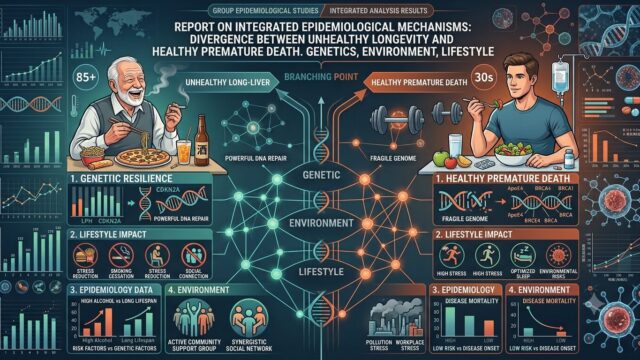
The Tipping Point Between Unhealthy Centenarians and Healthy Short-Lived Individuals: A Report on the Integrated Epidemiological Mechanisms of Genetics, Environment, and Lifestyle
Some people live recklessly and never fall ill; others live with scrupulous discipline and are struck down by serious disease while still young. Behind this epidemiological paradox lies a complex interplay of genomic stability, metabolic buffering capacity, the wear of psychoneuroimmunological stress, and probabilistic molecular events. Drawing on recent genomic analyses, large-scale cohort studies, and gut microbiome metagenomics, this report quantitatively examines the contribution of each factor.
 意識の深層
意識の深層